


The integration of Artificial Intelligence into enterprise operations represents a transformative pivot, placing organizational leaders and their workforces in an intricate, often delicate, balancing act. This profound shift, arguably unparalleled in its potential scope since the advent of the internet, is particularly evident in the highly variegated efforts surrounding AI adoption. Even those with a superficial understanding of the technology acknowledge the prevailing dichotomy: opinions span from fervent advocacy for AI’s revolutionary potential to a spectrum of deep-seated skepticism and aversion, with a pervasive undercurrent of ambivalence sprinkled throughout organizational ranks. This complex emotional and intellectual landscape underscores a critical challenge for leadership: how to forge a cohesive vision for AI adoption that resonates across all employee demographics, harnessing collective energy rather than fragmenting it.
The contemporary workplace is a microcosm of this broader societal debate. A candid survey of employees within any given organization would likely yield a divergent array of responses regarding AI. While some might immediately invoke dystopian imagery from popular culture, referencing cautionary tales like The Terminator or lamenting the potential loss of truth "like tears in rain," others are eager to embrace the promise of "super intelligence" to tackle humanity’s grand challenges, from curing intractable diseases to mitigating climate change, envisioning a future of unprecedented human liberation. Still others, perhaps overwhelmed or disengaged, might prefer to discuss more mundane topics, highlighting the sheer breadth of perspectives leaders must contend with.
For organizations still bearing the scars of previous, less-than-seamless technological revolutions, the specter of FOMO—the fear of missing out—looms large, driving an imperative for rapid adaptation. The perceived risk of not embracing AI could be existentially detrimental in a hyper-competitive global market. However, this urgency can inadvertently lead to a situation where AI-enablement becomes an end in itself, rather than a means to a strategically defined outcome. In such scenarios, fundamental questions often go unasked or unanswered: Is this specific AI tool truly necessary? What are the intangible costs of automating this particular workflow? Should an AI agent genuinely be entrusted with a company credit card? Without a clear, unifying narrative to bridge these wildly divergent perspectives, achieving AI adoption at scale remains an elusive goal, demanding an era-defining communication strategy.
The Imperative of Human-Centric Leadership in an AI Era
In this environment of technological flux and diverse human sentiment, Fortune 50 companies and global brands consistently demonstrate that core communication skills remain the bedrock for sparking and sustaining significant organizational change. Leaders must possess the nuanced ability to acknowledge existing difficulties, constructively challenge pushback, and meticulously build momentum behind their strategic vision. This demands a powerful trifecta of time-tested storytelling structures, compelling design principles, and sophisticated presentation strategies designed to foster a shared sense of investment in a common outcome.
Crucially, these deeply human qualities—empathy, inspiration, persuasion—cannot be automated. While AI excels at processing data, generating content, and optimizing algorithms, it cannot authentically stand on a stage, capture the collective imagination with a resonant story, or move a reluctant audience to committed action. Reliance solely on "prompt engineering" or superficial "vibe-coding" falls significantly short in the complex, human-centric quest for transformational change.
However, the outlook is far from bleak. Established methodologies for change communication, such as Duarte’s Illuminate™ framework, offer a proven pathway for guiding organizations from entrenched operational norms toward a "new bliss" of transformation. In the age of AI, the foundational elements of compelling communication—well-structured, three-act narratives, symbolic ceremonies, powerful speeches, and crisp, clear visuals—remain indispensable ingredients for inspiring lasting, meaningful change. This journey, like most grand visions, begins with a dream, but critically, it first necessitates a clear-eyed acknowledgment of current realities.

Unpacking Employee Sentiments on AI: Why Understanding Matters
Discussions surrounding AI within organizations are often fragmented, reflecting a kaleidoscopic array of hopes and fears among executives, managers, frontline teams, and even external consumers. While broad polls of the electorate, major university studies, and corporate-backed surveys offer valuable macro-level insights into AI understanding, leaders must drill down to comprehend how their own workers genuinely feel about AI. This granular understanding is paramount for calibrating the most effective approach to communicating an organizational AI vision.
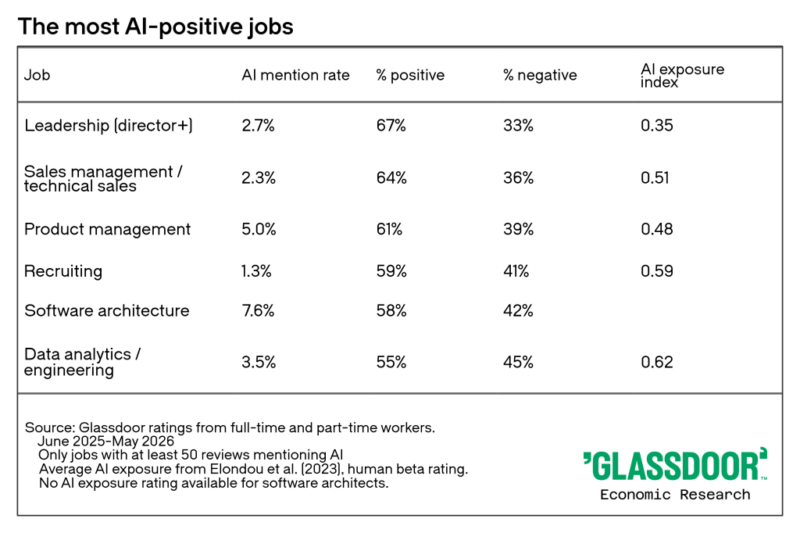
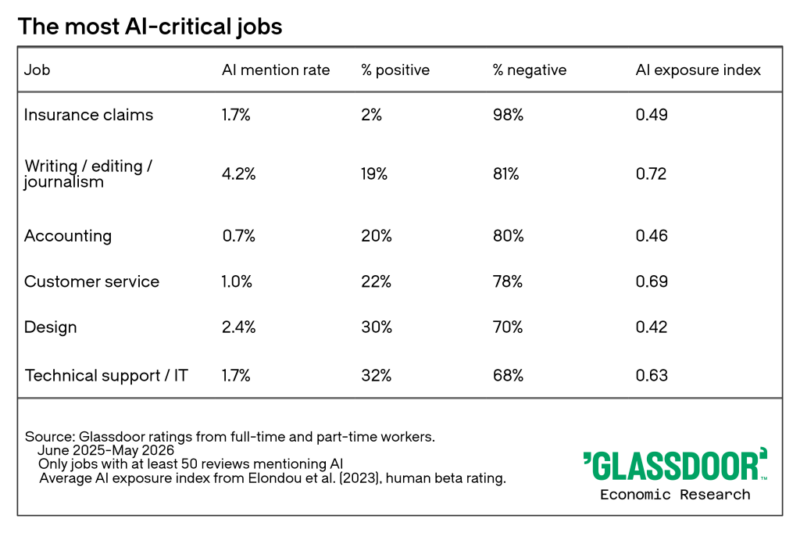
A revealing August 2026 study by Glassdoor, analyzing employer reviews by workers, unveiled a diverse range of opinions across various roles, demographics, and industries. The study highlighted significant trends both in favor of and against AI usage. On the favorable side, roles associated with strategic oversight, sales, and product development exhibited higher enthusiasm:
- Leadership (Director+): 67% positive mentions
- Sales Management / Technical Sales: 64% positive mentions
- Product Management: 61% positive mentions
- Recruiting: 59% positive mentions
- Software Architecture: 58% positive mentions
- Data Analytics / Engineering: 55% positive mentions
Conversely, roles heavily reliant on precise language, meticulous numerical accuracy, or intricate interpersonal relationships tended to express more critical sentiments, struggling to articulate AI’s value or perceiving it as a threat:
- Insurance Claims: 98% negative mentions
- Writing / Editing / Journalism: 81% negative mentions
- Accounting: 80% negative mentions
- Customer Service: 78% negative mentions
- Design: 70% negative mentions
- Technical Support / IT: 68% negative mentions
This data clearly illustrates a significant perceptual chasm between leadership and key cross-sections of the workforce regarding AI. However, the problem extends beyond mere perception. A parallel study from the University of Konstanz underscores how employers are inadvertently exacerbating this misalignment through their approach to tool prescription and implementation. Dr. Florian Kunze, head of the study and professor of organizational behavior at the University of Konstanz, noted, "In many organizations, the major AI revolution has not unfolded as a planned transformation process so far. Instead, many employees are experimenting with AI, while employers are still lagging behind when it comes to establishing clear policies, providing training and implementing secure AI solutions."
In their haste to navigate the novel problems and opportunities presented by AI, many leaders overlook the crucial step of defining success. A recent Gallup poll further corroborated this gap, revealing that "only 25% of workers say their company has communicated a clear plan for AI integration." This statistic is startling, indicating that the vast majority of businesses are offering inadequate guidance, issuing confusing mandates, or providing no support whatsoever for their AI initiatives. Such unfocused usage can lead to tangible negative consequences, including skills atrophy, the proliferation of sloppy or off-brand assets, and economically unsustainable "runaway token spend" on generative AI models.
In their earnest rush toward progress, leaders often unintentionally send mixed messages or fail to address the legitimate concerns of AI-averse or AI-agnostic workers. Without a communication strategy that scales effectively, any AI strategy will struggle to achieve comprehensive buy-in. Leaders must proactively anticipate potential pushback, genuinely consider feedback, and transparently articulate their thinking to present a coherent, achievable path forward. If the vision for AI is perceived as incomplete, incoherent, or inauthentic to the organization’s core values, progress inevitably stalls, roadmaps deviate, and top talent can become disillusioned, potentially seeking opportunities elsewhere.
Fortunately, there is a more effective approach. Committing to a proven change communication strategy can provide an AI initiative with the necessary support to take root and deliver measurable return on investment (ROI). Duarte’s Illuminate™ methodology offers a trusted blueprint for change communication, capable of motivating teams to move boldly and confidently into the AI era. With dedication, grit, and grace, this proven five-part process can serve as a comprehensive pathway to success for an organization’s AI adoption journey. And with that, let us return to the genesis of all great transformations: the dream.
Stage 1: Making AI Adoption a Winnable Dream
The initial stage of Duarte’s Illuminate™ framework, the "Dream" stage, focuses on transforming a moment of inspiration into a powerful catalyst for change. Trailblazing leaders, or "torchbearers," illuminate a plausible future, inviting their organizations, industries, and even humanity at large to envision it with them. To spark genuine change, leaders in this stage expertly contrast what is with what could be, aiming to elicit recognition and a deep craving for a new bliss. This "new bliss" might manifest as a more efficient way of working, an innovative new product, or a fundamentally improved mindset toward a revolutionary idea like AI. These strategic juxtapositions are designed to build constructive tension and persuade audience members to enthusiastically support the articulated vision.
The Dream stage often incorporates impactful vision speeches or other forms of persuasive communication to clearly establish the stakes and rally teams around the transformative possibilities. However, crafting content that genuinely moves audiences forward requires an intimate understanding of their existing hopes and fears concerning AI. Leaders should meticulously test the waters around their vision before making any official pronouncements, engaging in adaptive listening to discern not only what their teams are thinking but, more importantly, what they are feeling.
According to Glassdoor’s analysis, resistance to AI often crystallizes into eight primary concerns, ranging from fears of job displacement (accounting for 20% of negative replies) to anxieties about AI distracting from core business objectives (13%) and concerns about companies using AI in alienating ways, such as workplace surveillance or as a substitute for human executive communication (10%). Given the prevalence of these reactions, leaders need an AI adoption vision that transcends a simple, imperative directive to "just use it."
Consider this illustrative framework for communicating the AI dream:
- What Is: Teams are burdened by the repetitive grind of manually tracking data updates, laboring through content brainstorming, and conducting exhaustive buyer research in an increasingly saturated and decaying information environment. While AI has its inherent drawbacks, competitors who proactively embrace and clearly define AI adoption are achieving greater velocity and reach with AI-enabled workflows.
- What Could Be: With meticulously developed AI Standard Operating Procedures (SOPs), robust IT-supported integration, and continuous "temperature checks" throughout the implementation process, teams can systematically eliminate extraneous steps from ingrained processes, significantly boost systems maintenance efficiency, and consistently deliver high-quality results that not only keep pace but potentially outstrip the competition.
- The New Bliss: Empowered by AI, teams can now dedicate themselves to further refining their core workflows, enjoying more flexible schedules that allow for the cultivation of deeper customer connections, proactive engagement with additional accounts, and the exploration of novel creative projects, all facilitated by newly available bandwidth.
For optimal results during the Dream stage, leaders must approach the process with clear-eyed reflection, considering: the current state of operations, the perceived pain points, the aspirational future, and the tangible benefits of the "new bliss." With the right framing and a compelling justification underpinning this vision, it is then time to take the decisive "Leap" toward change.
Stage 2: Leaping into AI Adoption
Organizations enter the "Leap" stage when torchbearers successfully galvanize their teams to commit to action. At this juncture, leadership’s AI message begins to resonate and amplify across various teams, characterized by action-oriented words and phrases that denote burgeoning consensus. Concrete AI processes are progressively rolled out, and all-hands meetings and regular syncs transform into vital touchpoints within this unfolding adventure. During this critical stage, maintaining a steady, confident pace and actively celebrating incremental progress are absolutely essential to keep FUD (fear, uncertainty, and doubt) firmly in check.
Leaders can reinforce this burgeoning sense of wonder and commitment through speeches that provide deeper context to the overarching vision or serve as timely reminders of what is truly at stake. Given that comprehensive AI adoption necessitates buy-in and active participation from every level of the organization, it is highly beneficial to structure the AI strategy more as an "incubator" for innovation rather than a rigidly top-down solution. In this period of discovery and experimentation, workers should feel empowered to share their individual AI approaches, contributing actively to the company’s collective evolution. Crafting the right story from the outset can effectively lock in this crucial commitment.
Duarte’s own internal journey exemplified this approach, featuring a summer "vibe-coding" experiment that deliberately prioritized dedicated time for exploration and learning. Weekly "AI Office Hours" were established to nurture curiosity, providing a safe and collaborative space for employees to share knowledge, pool strategies for optimizing "token spend," and collectively work towards producing clearer, more effective outputs. Teams naturally united to collaboratively maintain a shared prompt library, update brand guidelines to incorporate AI-generated content, and rigorously test guardrails for ethical and effective usage. With AI positioned as a collaborative "thought-partner," teams were actively encouraged to brainstorm, bounce ideas, and pressure-test solutions throughout their daily workflows.
While giving a company’s tech stack an AI makeover might not possess the immediate glamour of launching a groundbreaking new product or unveiling a state-of-the-art headquarters, with the right support and sustained commitment, organizations can strategically position themselves to proactively harness emerging tools and remain exceptionally nimble in fast-moving environments. This foresight inherently means bracing for both known and unforeseen challenges that lie ahead.
Stage 3: Navigating the AI Frontier: Knowing When to Fight and When to Adapt
During any significant quest toward change, it is virtually inevitable that complications will arise. With AI, the myriad of potential problems is particularly pronounced: inadequate prompts yielding unusable output, persistent accuracy issues and "hallucinations," "AI-Optimized" workflows that paradoxically consume more time than traditional methods, or the relentless march of news stories, both laudatory and cautionary, surrounding AI adoption. Rather than attempting to gloss over hardships or suppress dissent, leaders championing AI adoption should view resistance or exasperation as invaluable opportunities to check in with their teams and thoughtfully modify their change plan.
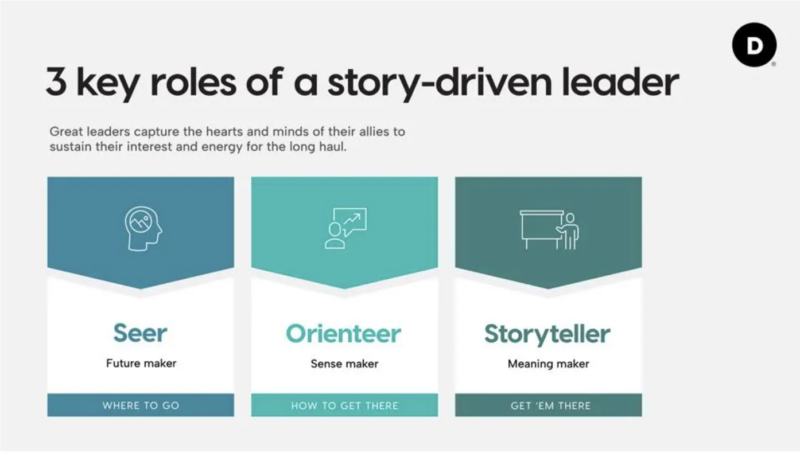
In a September 2026 C200 column for Forbes, Duarte CEO Nancy Duarte reflected on her experience announcing a bold AI vision at Duarte’s company kickoff. In the intervening months, a combination of "eureka moments" and "patches of rough air" coalesced into a refined vision for change in her mind. To successfully launch and implement a new vision, leaders must embody three critical personas that are essential for sparking and sustaining change within their organizations: the Seer, the Orienteer, and the Storyteller.
- The Seer: The visionary who foresees the future and articulates the ultimate destination. When the path ahead becomes ambiguous, the Seer brings the overarching goal back into sharp focus.
- The Orienteer: The strategic guide who understands the terrain, identifies pathways, and navigates obstacles. If an implementation pathway stalls, the Orienteer charts a new, viable course.
- The Storyteller: The meaning-maker who frames experiences, celebrates successes, and contextualizes struggles, ensuring the journey remains compelling. When competitors appear to leapfrog an organization’s AI outputs, the Storyteller helps make meaning of the struggle, reinforcing purpose and resilience.
Every challenge encountered will demand that leaders revisit one or more of these personas. Viewing change through the lens of each persona helps weave a continuous, coherent thread through the entire transformation process. It helps to contextualize hurdles, punctuating skirmishes with acknowledgments of victories and lessons learned. In the "Fight" stage, leaders must constantly reevaluate whether the most prudent path through a rough patch is unwavering perseverance or a strategic pivot. This is where regular, open communication with teams (such as dedicated AI Office Hours) or inspiring "battle speeches" at key turning points become critical for maintaining morale and alignment.
Unacknowledged problems, persistent progress delays, and a lack of clear guidance are natural breeding grounds for FUD. Keeping the correct narrative afloat and consistently reinforced is vital for helping teams stay on track for the long haul. For if the "fights" prove bruising, the subsequent "climb" demands even greater fortitude.

Stage 4: Proving the Climb is Worth the View
Initiatives, no matter how promising, can lose steam. Deadlines come and go. Seemingly surefire fixes prove insufficient. The "messy middle" of transformation can sabotage even the most meticulously laid plans and overwhelm organizations of all sizes. When teams begin to question their capacity to continue, leaders know they have unequivocally entered the "Climb" stage. This stage often runs concurrently with the "Fight" stage, continuously testing leaders’ ability to pull the right strategic lever at the opportune moment. The Climb stage specifically contrasts the seemingly endless, arduous plodding between sites of conflict with the imperative to recognize and celebrate tangible progress. It is arguably the most trying stage for both teams and leaders: an uphill battle often devoid of the immediate adrenaline rush of conflict.
Where the possibilities of AI can feel infinite, human capacity is not. Employees experience exhaustion, burnout, and discouragement. During the Climb stage, existing workloads clash with new AI obstacles, AI-generated results might prove lackluster, and newly implemented workflows can inadvertently create unforeseen problems. Adoption slows, teams regress into old habits, and competitors may appear to be charging full speed ahead. At this point, even leaders might begin to harbor doubts: Will we ever truly achieve AI adoption?
Balancing the right approach requires a holistic understanding of the prevailing situation. Maintaining open lines of communication through regular one-on-one meetings with team leaders, anonymous surveys, and live Q&A sessions can help gather essential context and accurately gauge the scope of any problems. While "Fight" messaging aims to ready teams for battle, the "Climb" is fundamentally about drawing strength from past accomplishments to refuel ongoing change efforts. As a guiding principle: "Keep reminding people how far they’ve come and why the destination is still worth reaching."
Each "temperature check" presents a vital opportunity to revitalize the core message, acknowledge and reward diligent workers who are staying the course, and gain crucial insights into what might be undermining the vision. It’s a chance to help stragglers realize they are not alone, to underscore that genuine transformation does not occur overnight, and to demonstrate that the significant investment of time, energy, and resources is indeed yielding tangible payoffs.
As leaders, if defending decisions for change becomes increasingly difficult, there is a risk of succumbing to the sunk cost fallacy. This is a bitter pill to swallow. This highlights why having a 360-degree understanding of the organization’s pulse is paramount to success in widespread change efforts. Such comprehensive insight makes it far easier to accurately diagnose problems, to discern when it is prudent to abandon a particular change effort, and crucially, to recognize when it is finally beginning to pay off.
Stage 5: Arriving at AI Adoption—And Beyond
At long last, the intricate balance between dreaming, delegating, and doing achieves perfect harmony. Leaders have successfully envisioned and articulated a compelling future, and the workforce has mobilized effectively to bring it to fruition. After all the leaping, fighting, and climbing, the organizational "new bliss" transitions from aspiration to reality. Teams are demonstrably AI-optimized, workflows exhibit enhanced agency, and outputs are consistently humming along at a greater clip. While some dissenters and critics may always harbor private grumbles, the unifying message has prevailed. Mission accomplished, right?
Yes, and no. Unlike taking a singular product to market or migrating to a new CRM system, being "AI-enabled" signifies an ongoing, dynamic commitment to staying current with relentless innovations and evolving best practices. Just as cybersecurity demands regular re-education and updated procedures, AI requires a continuous commitment to learning and adaptation. New models and capabilities are constantly emerging, while potential vulnerabilities and exploits perpetually keep organizations on their toes.
This continuous evolution should not, however, dampen feelings of accomplishment. Retooling how teams engage with their work, adopting new Standard Operating Procedures (SOPs), defining and then achieving success are all profound causes for celebration. While some organizations may be "party-averse," teams genuinely need time to reflect on and process the journey they have undertaken. Scheduling an open mic session or a fireside chat where individuals can share their experiences contributes significantly to the "mythmaking" that enriches workplace culture and fosters a sense of shared history.
After the symbolic s’mores (or perhaps something stronger) at the closing ceremony, it is time to settle into and sustain the change. Workers can continue to refine their AI agility, and leaders can turn their attention to pulling the next transformative initiative from the clouds, knowing they have a proven framework to guide them.
Duarte: Your Partner in Change Communication
Organizations once enjoyed longer runways for reinvention. Today, industry evolution can unfold almost overnight. This environment of accelerated uncertainty demands prompter, more agile action. Geopolitical friction, supply chain disruptions, and relentless technological disruption are now integral components of daily operational life. Companies must remain nimble, endlessly recalibrating to each new normal. With every team member often pulled in different directions, true team alignment requires a message meticulously crafted, expertly delivered, and robustly supported to withstand the headwinds of constant flux.
Whether an organization is adopting a proactive posture toward an emerging opportunity like AI or strategically repositioning to batten down the hatches, committing to a proven framework for change communication can significantly ease the transition and enhance the likelihood of success.
If change is causing your organization to feel adrift, reaching out to Duarte can provide clarity and direction. Their strategists, designers, speaker coaches, and training facilitators stand ready to imbue change initiatives with clarity, composure, and conviction. By rallying teams with a story they are compelled to tell, leaders can effectively put the future into perspective and navigate the complexities of AI adoption with confidence and shared purpose.
