


Emotions, far from being mere internal sensations, are powerful drivers of behavior, influencing our actions in ways both automatic and deliberate. Understanding the subtle distinctions between these emotional outputs – how they arise and their ultimate impact – is crucial for navigating interpersonal dynamics, fostering personal well-being, and cultivating more constructive interactions. This exploration delves into the science behind emotional actions, differentiating between intrinsic and intentional behaviors, and analyzing their constructive versus destructive potential, drawing insights from leading research in the field.
The Emotional Episode Timeline: Action as a Critical Stage
The journey of an emotion, often termed an "emotional episode," involves a series of interconnected stages. Following the initial trigger and the subjective experience of an emotion, the subsequent stage is action. This is where internal feelings manifest outwardly or inwardly, shaping our immediate reality and influencing future outcomes. Researchers like Dr. Paul Ekman and his colleagues have meticulously mapped these stages, emphasizing that the action phase is not monolithic. It can be spontaneous, a direct, unconsidered outgrowth of the emotional state, or it can be a considered, purposeful choice.
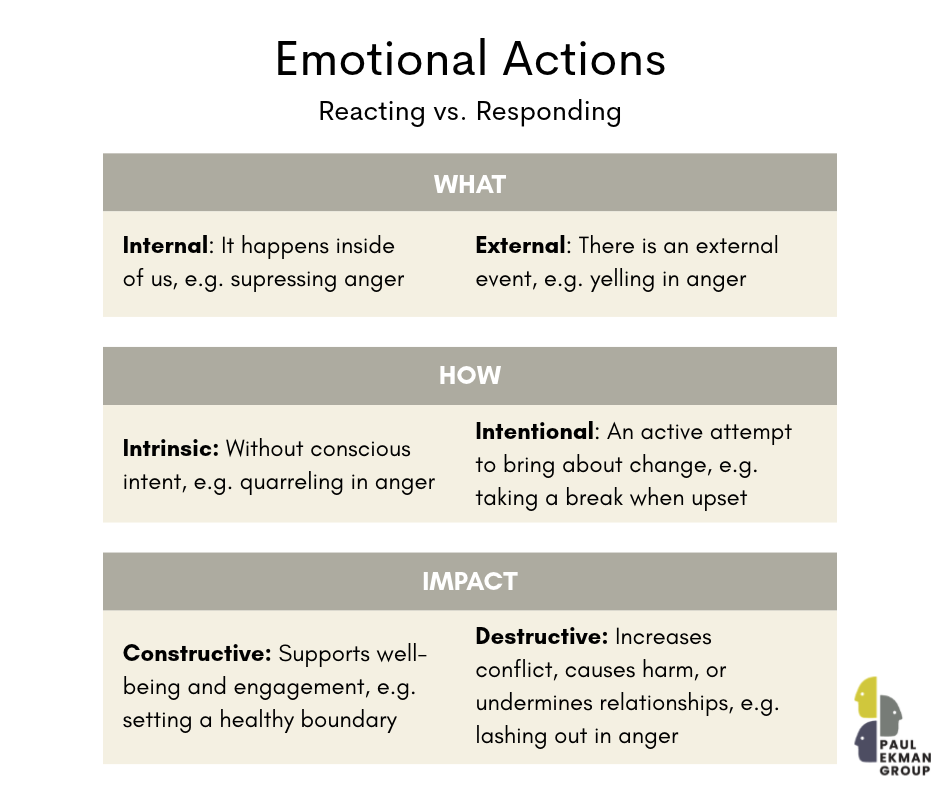
The distinction between an automatic reaction and a deliberate response hinges on consciousness and intent. An automatic reaction is often described as "intrinsic," meaning it arises without conscious deliberation. This might be a flinch, a sudden outburst, or an immediate withdrawal. In contrast, an "intentional" action involves a conscious decision to act, often with a specific goal in mind. For instance, a person experiencing fear might instinctively flee a perceived threat (intrinsic action), or they might consciously decide to confront the situation after assessing the risks (intentional action).
Intrinsic vs. Intentional Actions: The Spectrum of Our Responses
The genesis of an emotional action lies in whether it is intrinsically driven or intentionally chosen. Intrinsic actions are akin to reflexes, immediate and often unbidden responses to an emotional state. These can manifest externally, such as yelling in anger, or internally, like the urge to ruminate on a past grievance. The intensity and nature of the emotion often dictate the immediacy and power of these intrinsic responses. For example, a surge of surprise might lead to a startled jump, a purely intrinsic reaction.
Intentional actions, on the other hand, involve a layer of cognitive processing. They are deliberate attempts to influence a situation, manage an emotional state, or achieve a particular outcome. This conscious choice allows for a degree of control and strategic application of behavior. For example, after experiencing a significant disappointment, an individual might intentionally seek out social support to process their feelings, rather than passively succumbing to sadness. The same behavior, such as withdrawing from a conversation, can be either intrinsic or intentional. If it stems from an overwhelming sense of fear or sadness, it’s an intrinsic reaction. However, if an individual deliberately steps away from an argument to cool down and gather their thoughts before re-engaging, it is an intentional response. This crucial difference underscores the agency we possess in managing our emotional lives, even when the initial emotional wave is overwhelming.
Constructive vs. Destructive Emotional Actions: Evaluating Impact
Beyond the origin of an action (intrinsic or intentional), a critical dimension for analysis is its impact: is it constructive or destructive? This framework, explored in programs like "Cultivating Emotional Balance" (CEB), shifts the focus from the cause to the consequence of our emotional behaviors.
Constructive actions are those that promote well-being, foster understanding, and facilitate effective engagement with the world. These actions tend to build bridges, resolve conflicts, and enhance personal and relational resilience. Examples include expressing one’s needs clearly and respectfully, seeking to understand another’s perspective, or taking steps to regulate intense emotions in a healthy manner.
Destructive actions, conversely, tend to escalate conflict, inflict harm, or undermine relationships. These behaviors can exacerbate negative emotional states, create distance between individuals, and hinder problem-solving. Examples include lashing out aggressively, engaging in passive-aggressive tactics, or resorting to avoidance that prevents necessary resolution.
It is vital to recognize that these two dimensions – intrinsic/intentional and constructive/destructive – operate independently. An action can be intrinsic yet constructive, such as an automatic impulse to comfort a distressed friend. Conversely, an intentional action can be destructive, for instance, deliberately withholding crucial information to manipulate a situation. The complexity arises when an intrinsically driven behavior leads to destructive outcomes, or when a well-intentioned action is executed poorly, resulting in unintended negative consequences.
Data and Research Insights
Research from organizations like the Atlas of Emotions, a project co-developed by Drs. Paul and Eve Ekman, provides a comprehensive framework for understanding the vast landscape of human emotions and their associated action tendencies. The Atlas categorizes emotions and maps out potential responses, highlighting the diverse behavioral repertoires linked to each emotional state. For instance, anger can manifest as a destructive urge to lash out, but also as a constructive drive to set boundaries and address injustice. Fear can lead to destructive avoidance of necessary challenges, or constructive caution and preparation in the face of danger.
Studies in emotional intelligence and regulation consistently show a correlation between an individual’s ability to differentiate between their emotional reactions and their intentional responses, and their overall psychological well-being and success in interpersonal relationships. For example, a meta-analysis of studies on emotional regulation published in the Journal of Personality and Social Psychology found that individuals who could effectively reappraise their emotions (an intentional process) reported lower levels of stress and depression compared to those who primarily relied on suppression or rumination.

The Implications of Understanding Emotional Action
The ability to distinguish between reacting and responding offers profound implications for personal development and societal interaction. It empowers individuals to:
- Increase Self-Awareness: By recognizing the automatic nature of some reactions, individuals can begin to identify their emotional triggers and habitual response patterns. This awareness is the first step towards change.
- Cultivate Emotional Regulation: Understanding the choice involved in intentional actions allows for the development of strategies to manage emotions effectively. This might involve mindfulness practices, cognitive reframing, or seeking support.
- Improve Interpersonal Relationships: When individuals can consciously choose their responses, they are better equipped to engage in constructive dialogue, resolve conflicts empathetically, and build stronger, more trusting relationships.
- Enhance Decision-Making: By moving beyond immediate emotional impulses, individuals can engage in more rational and considered decision-making, leading to better outcomes in both personal and professional spheres.
The goal, as emphasized by researchers in the field, is not to eliminate emotions or reactions altogether, but rather to develop the capacity for mindful awareness. This allows for a more deliberate and skillful navigation of emotional experiences, leading to actions that are more aligned with one’s values and long-term well-being, as well as the well-being of those around them.
Moving Forward: Cultivating a More Responsive Approach
The journey from reactive behavior to responsive action is an ongoing process. Resources such as the interactive Atlas of Emotions and training programs like Cultivating Emotional Balance (CEB) offer structured pathways to enhance emotional literacy and develop more constructive response patterns. These initiatives provide tools and frameworks for individuals to understand their emotional landscapes, recognize ingrained habits, and practice making more informed and beneficial choices.
The development of an Atlas of Emotions book by Dr. Eve Ekman further promises to expand public understanding of these foundational concepts, offering deeper insights and practical applications for navigating the complexities of human emotion. By embracing the science of emotion and committing to self-awareness and intentional practice, individuals can foster greater emotional resilience, strengthen their relationships, and contribute to a more understanding and harmonious society. The power to move from automatic reaction to thoughtful response lies within our capacity to understand and consciously shape our emotional actions.
