

Freeman, a global leader in designing and delivering immersive brand experiences at live events, has solidified its position not only through unparalleled execution but also by serving as a beacon of strategic insight within the dynamic events industry. Their commitment extends beyond creating memorable moments for clients; it involves a meticulous, data-driven approach to understanding market shifts and consumer behaviors, articulated through their acclaimed quarterly Trends Reports. This analytical rigor, particularly crucial in navigating the transition from pre-pandemic norms to a complex post-COVID landscape, underpins their ability to help companies adapt to evolving expectations. At the heart of this success lies a profound appreciation for strategic data storytelling, a discipline they have refined in close collaboration with Duarte, a renowned firm specializing in transforming complex information into compelling narratives.
The live events sector, a colossal industry estimated to reach over $1.5 trillion globally by 2028, according to recent market analyses, has long grappled with the challenge of quantifying impact and optimizing engagement. Historically, decision-making often relied on anecdotal evidence, seasoned intuition, or a general "gut feeling." While experience remains invaluable, the accelerating pace of technological advancement and the unprecedented disruption of the COVID-19 pandemic underscored the critical need for objective, data-backed strategies. This paradigm shift necessitated a new approach to presenting insights – one that moves beyond mere data dissemination to actionable storytelling.
The Evolution of Data-Driven Insights in the Events Industry
For decades, the live events industry operated on a foundation of established practices, where success was often measured by attendance numbers, sponsor satisfaction, and qualitative feedback. While these metrics offered a snapshot, they frequently lacked the granular detail required for truly strategic optimization. The advent of digital tools for registration, lead capture, and post-event surveys began to introduce more quantitative data, but the challenge remained in synthesizing this information into clear, persuasive narratives that could inform future planning and demonstrate tangible return on investment (ROI).
The global pandemic of 2020 served as an undeniable catalyst, forcing the industry to innovate at an unprecedented pace. With in-person gatherings halted, virtual and hybrid events surged, generating vast amounts of digital interaction data. This period highlighted both the potential and the pitfalls of data. While organizations collected more data than ever, many struggled to extract meaningful insights and communicate them effectively to stakeholders. It became clear that raw data, no matter how abundant, was insufficient without a compelling story to contextualize it, explain its significance, and prescribe clear actions.
Freeman, with its deep roots in the industry, recognized this imperative early on. Their quarterly Trends Reports evolved from simple data summaries into sophisticated narratives that illuminate critical shifts in attendee expectations, technological advancements, and operational best practices. These reports are meticulously crafted through rigorous data collection, in-depth interviews with industry leaders and attendees, and on-the-ground observations. They aim to provide actionable intelligence, helping event organizers and exhibiting companies maximize their impact and navigate an increasingly complex environment.
The Strategic Partnership: Freeman and Duarte
Recognizing that the art of strategic data storytelling requires specialized expertise, Freeman sought a thought partner that could elevate their analytical findings into truly impactful communications. They found this synergy with Duarte, a firm widely credited with putting data storytelling on the map through its pioneering work in presentation design and communication strategy. Duarte’s philosophy centers on transforming data observations into effective decisions through actionable storytelling, a methodology that perfectly aligned with Freeman’s objectives.
Over several years, Duarte has collaborated closely with Freeman to produce their quarterly Trends Reports, fostering a shared methodology grounded in the belief that data is most powerful when it tells a story. This partnership exemplifies how external expertise can enhance internal capabilities, ensuring that complex data not only informs but also inspires and compels action. The collaboration has been instrumental in shaping Freeman’s communication culture, embedding data storytelling as a fundamental driver of strategic alignment from the executive suite down to operational teams.
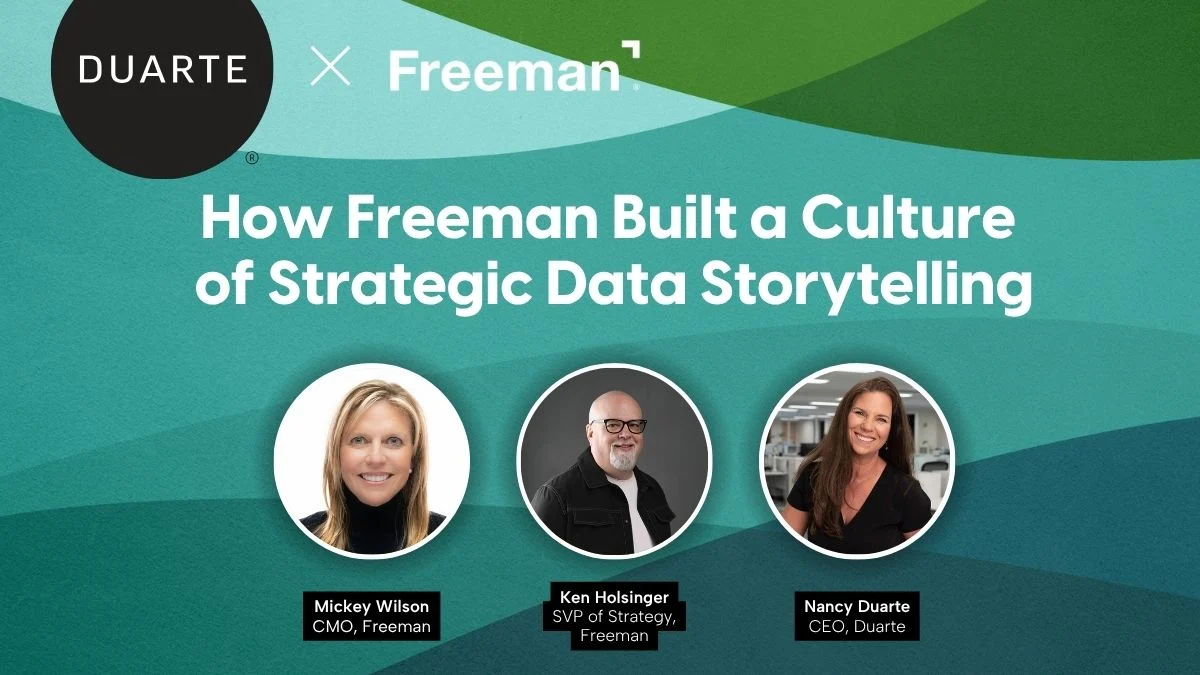
This collaborative approach was prominently showcased during a recent webinar featuring Freeman’s CMO, Mickey Wilson, and SVP of Strategy, Ken Holsinger. During the session, Wilson emphasized how data storytelling transforms subjective conversations into objective ones, fostering a shared understanding and building momentum for strategic initiatives. Holsinger further elaborated on the critical need for event experiences to transcend static information delivery, advocating for dynamic, human-centric engagement rooted in data-driven insights.
Why Strategic Storytelling is Indispensable for Data-Driven Organizations
In today’s hyper-competitive landscape, organizations across all sectors are awash in data. From customer analytics to operational efficiencies, every facet of a company’s health and performance is trackable. The challenge is no longer merely collecting data but rather making sense of it and translating those insights into strategic decisions. This is precisely where data storytelling becomes indispensable.
Before the widespread adoption of advanced analytics, leaders often relied on experience, intuition, and anecdotal evidence. While these factors still play a role, the sheer volume and granularity of available data now demand a more measured and objective approach. Data storytelling bridges the gap between raw numbers and human comprehension, making complex information accessible, relevant, and compelling. It provides the context, urgency, and direction necessary for stakeholders to grasp opportunities, mitigate risks, and make informed choices.
For Freeman, whose audience includes event organizers, exhibitors, and companies looking to make a significant in-person impact, getting the message right is paramount. Their recent Trends Report, for instance, highlighted the urgent need for companies to harness the full potential of their event presence, moving beyond traditional sales pitches to deliver real-time expertise and novel, human-first experiences. These groundbreaking insights, gleaned from extensive research into attendee preferences, could easily be lost in a sea of statistics without the right narrative framework. As Ken Holsinger articulates, the goal is to animate data, bringing it to life for quick comprehension and decisive action.
Addressing the Pitfalls of Ineffective Communication
Holsinger’s observation, "If your booth is just a physical version of your website, you’re doing it wrong," encapsulates a broader truth about ineffective business communication. This principle extends far beyond trade show exhibits to presentations, emails, blog posts, and social media content that often deliver static facts devoid of context, empathy, or a clear "so what?"
Such "free-floating figures," disconnected from a compelling narrative, leave audiences feeling detached and uninvested. Whether rattling off product features, service metrics, or market share percentages, the failure to weave these data points into a relatable story diminishes their impact. Today’s audiences, whether they are stepping into a physical booth, attending a webinar, or reviewing a strategic deck, demand relevance and resonance.
This isn’t merely a matter of opinion; it’s a hard-won lesson derived from rigorous data analysis. Freeman’s 2025 Commercial Trends Report, for example, revealed a striking disconnect: 84% of attendees want to talk to a subject matter expert, yet less than half of exhibitors prioritize making such experts readily available. This gap isn’t just a logistical oversight; it’s fundamentally a storytelling problem. When a brand’s message fails to make the audience feel seen, understood, and engaged, disengagement inevitably follows. For brands to truly succeed at events, they must think beyond their browser and craft experiences that prioritize human connection and expert interaction, strategically informed by data.
Crafting a Strategic Narrative: Two Formats, One Story
Effective data dissemination hinges on understanding audience consumption habits. Some individuals prefer to absorb information via a live presentation, guided by a speaker who walks them through the narrative. Others prefer to read at their own pace, perhaps skimming for key takeaways initially and returning for a deeper dive later. Recognizing these varied preferences, one of Freeman’s most intelligent data storytelling practices, refined with Duarte, is the development of two distinct versions of their Trends Reports to ensure maximum resonance:
- The "Live" Presentation Deck: Designed for a speaker-led environment, this format is highly visual, uses concise bullet points, and leverages the speaker’s ability to elaborate on the data and engage the audience interactively. It prioritizes impact and immediate understanding.
- The "Read-Ahead" Document/Report: This version is more detailed, with comprehensive explanations, supporting charts, and in-depth analysis. It allows for self-paced consumption and serves as a valuable reference document for stakeholders who need to delve into the nuances of the data.
From a data storytelling perspective, broadcasting a message across multiple frequencies ensures that the target audience is reached, regardless of their preferred communication method. As Nancy Duarte has often explained, both formats, despite their structural differences, employ the same underlying narrative framework. They consistently lead with empathy, articulate the stakes involved, and guide the audience toward clear, actionable steps. This consistent narrative structure, applied across various mediums, ensures that the core message remains coherent and impactful, reinforcing understanding and driving desired outcomes.
Cultivating a Strategic Storytelling Culture
Building and maintaining a robust data storytelling culture within an organization is an ongoing journey, akin to mastering any complex skill. It’s not a one-time initiative but a continuous process that demands consistent engagement, re-education, and reinforcement to keep skills and best practices at the forefront.
Mickey Wilson, Freeman’s CMO, underscored this during the webinar, stating, "We take it away from being a subjective conversation to an objective one… and keep educating to build momentum." This commitment to consistency fosters trust, not only with external clients and partners but also across internal teams. By establishing a shared language for interpreting data, understanding its significance, and determining appropriate actions, Freeman’s departments operate with greater alignment and efficiency. Once this foundation is laid and the expectation for applying data storytelling principles is set across the organization, these practices naturally take root and proliferate.
The benefits of such a culture are manifold. Internal teams become more adept at communicating insights to each other, reducing misinterpretations and accelerating decision-making. External communications become more persuasive, leading to stronger client relationships and improved business outcomes. Moreover, a culture that values objective, data-backed narratives empowers employees at all levels to contribute to strategic discussions, fostering a more informed and engaged workforce. Industry analysts suggest that companies with a strong data literacy and storytelling culture report up to a 25% higher rate of successful strategic initiatives.
Duarte’s Role in Empowering Organizations
Duarte stands as a critical partner for organizations like Freeman, helping them embed strategic storytelling as a foundational communication standard. Through their specialized training workshops, such as DataStory®, and their high-stakes communication consulting services, Duarte equips teams with the essential skills to:
- Uncover the Story in Data: Moving beyond mere visualization to identify the underlying narrative, patterns, and implications within complex datasets.
- Structure Data for Impact: Applying classical storytelling structures to data presentations, ensuring clarity, relevance, and persuasive power.
- Design Compelling Visuals: Creating graphics and charts that not only display data accurately but also enhance its narrative and emotional resonance.
- Deliver with Confidence: Coaching individuals and teams on how to present data stories in a clear, engaging, and authoritative manner, whether in a boardroom or at a major industry conference.
By expertly marrying thoughtful data analysis with time-honored narrative structures, Duarte empowers teams, customers, buyers, and sellers to collectively understand the profound impact of emerging trends and make informed decisions. This approach transforms data from a mere collection of facts into a powerful tool for driving change, fostering understanding, and achieving strategic objectives.
For organizations seeking to awaken their team’s data storytelling potential or to significantly upskill their current efforts, contacting Duarte offers access to groundbreaking training workshops designed to achieve these very outcomes. Alternatively, for those wishing to delve deeper into the practical application of strategic data storytelling within the events industry, the full Freeman webinar is available for viewing, offering invaluable insights directly from the industry leaders who are reshaping how a trillion-dollar industry communicates its future.
