


The traditional understanding of effective listening, often distilled into maxims like Epictetus’s "We have two ears and one mouth so that we can listen twice as much as we speak," or Richard Branson’s assertion that "Nobody learned anything by hearing themselves speak," has long emphasized silence, attention, and non-interruption. These foundational principles, ingrained from early education, advocate for paying attention, maintaining eye contact, and refraining from speaking as the hallmarks of a good listener. While these practices form the bedrock of respectful interaction, modern organizational psychology and communication theory increasingly suggest that they represent merely the baseline, not the zenith, of effective workplace listening. The rise of "active listening," a widely adopted strategy focusing on attention and paraphrasing, marked a significant step forward, yet even this approach may fall short in addressing the multifaceted demands of contemporary professional environments.
A growing consensus among communication experts indicates that true listening efficacy transcends mere attentiveness. It necessitates a dynamic, goal-oriented approach that aligns the listener’s response with the speaker’s underlying needs and objectives. This realization has given rise to the concept of Adaptive Listening™, a sophisticated framework designed to equip individuals and teams with the skills to navigate complex communication landscapes by asking a pivotal question: "What does the person speaking need from me?" This fundamental shift from a self-centric "What’s in it for me?" perspective to an empathic, speaker-centric inquiry marks a critical evolution in communication strategy, promising profound benefits for individual career trajectories and organizational health alike.
The Evolution of Listening Theory: From Passive Reception to Strategic Engagement
Historically, listening was often viewed as a passive activity – the quiet reception of information. Early philosophical insights, while valuing silence and reflection, did not explicitly detail the active processing required for complex human interaction. As societies became more organized and workplaces more structured, the need for improved communication became evident. The mid-20th century saw the emergence of "active listening" techniques, heavily influenced by Carl Rogers’ client-centered therapy. This model introduced concepts like reflective listening, paraphrasing, and clarification, aimed at demonstrating understanding and empathy. It became a cornerstone of interpersonal skills training, widely adopted in business, counseling, and education.
However, the rapid pace of technological advancement, globalization, and the increasing complexity of organizational structures have exposed the limitations of even active listening. While excellent for building rapport and ensuring message reception, active listening often assumes a singular goal: mutual understanding. In reality, workplace interactions are rarely so monolithic. A colleague might be seeking emotional solace, a manager might require strategic input, a client might need factual updates, or a team member might be looking for practical assistance. A one-size-fits-all approach to listening, even an active one, can lead to misaligned responses, unmet needs, and ultimately, communication breakdowns that impact productivity, morale, and decision-making.
Data from numerous industry reports underscore the cost of ineffective communication. Studies by organizations like the Project Management Institute and the Society for Human Resource Management consistently highlight that poor communication is a leading cause of project failure, employee disengagement, and conflict. Conversely, companies with highly effective communication practices have been shown to outperform their peers in terms of employee retention, customer satisfaction, and financial performance. These findings provide a compelling impetus for moving beyond basic attention to a more nuanced, adaptive approach to listening.

Adaptive Listening: A Paradigm Shift for Workplace Communication
Adaptive Listening™ distinguishes itself by emphasizing the listener’s responsibility to discern and meet the speaker’s specific communication goal. This approach transforms listening from a receptive act into a strategic intervention. It recognizes that every conversation, particularly in a professional context, carries an implicit or explicit objective from the speaker’s perspective. The listener’s role, therefore, is not just to hear, but to diagnose the speaker’s need and tailor their response accordingly.
The foundational principle of Adaptive Listening™ is encapsulated in the question: "What does the person speaking need from me?" This inquiry forces a shift in mental models, prompting listeners to move beyond their own agenda or interpretation and to genuinely consider the speaker’s intent. This deliberate, empathic engagement leads to more impactful interactions, fostering trust, reducing ambiguity, and accelerating progress. Organizational psychologists and communication strategists advocating for this model point to its ability to enhance collaboration, improve decision-making accuracy, and cultivate a more supportive and efficient work culture.
The S.A.I.D. Framework: Four Pillars of Adaptive Engagement
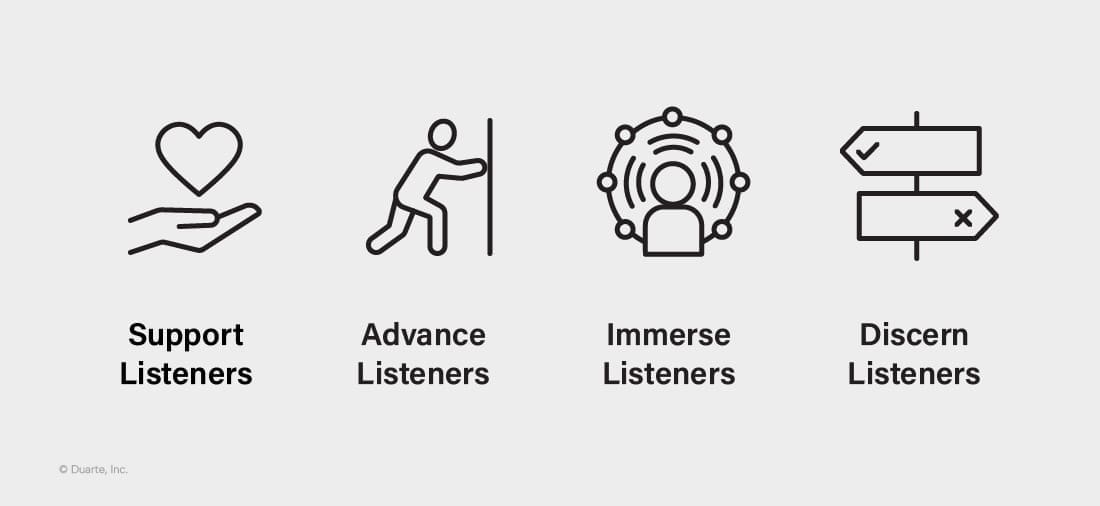
Adaptive Listening™ categorizes speaker needs into four distinct goals, forming the memorable acronym S.A.I.D.™: Support, Advance, Immerse, and Discern. Each goal dictates a specific listening strategy and corresponding response, ensuring that the listener’s contribution is precisely what the speaker requires.
1. Support Listening™ Skills: Fostering Connection and Empathy
Support Listening is activated when a speaker seeks emotional acknowledgment, validation, or celebration. This often arises during challenging times, such as project setbacks, personal difficulties impacting work, or moments of significant achievement. The speaker’s primary need is not for solutions or advice, but for a human connection and an affirmation of their feelings.
- Context and Cues: Phrases like "I’m having a horrible day," "I just received incredible news," or "I’m really struggling with this situation" are clear indicators. Non-verbal cues, such as tone of voice, body language, and facial expressions, are equally vital in discerning a need for support.
- Adaptive Response: The listener’s role is to act as a confidant or a cheerleader. This involves active mirroring of emotions, expressing empathy ("That sounds incredibly frustrating," "I can imagine how exciting that must be!"), and offering comfort or congratulations without judgment or immediate problem-solving. The goal is to create a safe space for emotional expression and build interpersonal rapport.
- Implications: In the workplace, effective Support Listening cultivates psychological safety, strengthens team bonds, reduces stress, and boosts morale. Employees who feel heard and supported are more likely to be engaged, resilient, and loyal.
2. Advance Listening™ Skills: Driving Progress and Efficiency
When a speaker expresses overwhelm, time constraints, or a need to move a project forward, they are signaling a need for Advance Listening. Here, the listener’s objective is to facilitate progress by unburdening the speaker or helping to identify the next steps.
- Context and Cues: Statements such as "I don’t think I’ll have time to finish all of this," "I’m stuck on how to proceed," or "We need to get this project moving" are indicative. The speaker is looking for tangible assistance or strategic input to overcome an obstacle.
- Adaptive Response: The listener shifts into a proactive problem-solving mode. This might involve offering to take on tasks, delegating responsibilities, brainstorming solutions, or connecting the speaker with necessary resources. The focus is on actionable steps that contribute directly to the speaker’s goals and the project’s momentum.
- Implications: Advance Listening directly impacts productivity, project success rates, and operational efficiency. It fosters a culture of mutual accountability and collaborative problem-solving, preventing bottlenecks and accelerating goal achievement.
3. Immerse Listening™ Skills: Absorbing Information Without Bias
Immerse Listening is crucial in situations where the speaker’s primary goal is to deliver information, updates, or even entertainment, without immediate commentary or critique. The listener’s role is akin to a sponge – to absorb the content fully and without premature judgment.
- Context and Cues: Phrases like "I’m here to give you an update today," "Please just listen for a moment," or "Sit back and enjoy this presentation" are clear signals. This mode is common during briefings, training sessions, informational meetings, or presentations of new data.
- Adaptive Response: The listener’s primary task is to actively receive and process information. This includes taking diligent notes, mentally cataloging key points, and refraining from interrupting with questions or opinions that might disrupt the flow of information. Clarifying questions can be asked, but only for the purpose of ensuring accurate comprehension, not for debate or evaluation.
- Implications: Effective Immerse Listening ensures accurate information dissemination, reduces misunderstandings, and supports effective learning and knowledge transfer. It is foundational for informed decision-making and ensures that all stakeholders possess a shared understanding of critical data.
4. Discern Listening™ Skills: Providing Critical Analysis and Feedback
Discern Listening comes into play when a speaker explicitly seeks evaluation, critique, or strategic feedback. This mode is essential for quality control, risk assessment, and continuous improvement in projects, processes, presentations, and even individual performance.
- Context and Cues: Direct requests like "I need some feedback on this," "What do you think are the strengths and weaknesses here?" or "I’m not sure if this makes sense; can you give me your honest opinion?" signal a need for Discern Listening. The speaker is inviting critical analysis.
- Adaptive Response: The listener engages in critical thinking, evaluating the presented information for strengths, weaknesses, potential risks, and opportunities. The response should be constructive, balanced, and focused on helping the speaker refine their work or perspective. This involves offering specific suggestions, identifying red flags, and pinpointing positive aspects, all aimed at enhancing the speaker’s output.
- Implications: Discern Listening is vital for innovation, problem prevention, and strategic alignment. It empowers teams to refine ideas, mitigate risks, and make robust decisions, ultimately contributing to higher quality outcomes and organizational resilience.
Broader Impact and Organizational Benefits
The implementation of Adaptive Listening™ across an organization can yield a multitude of benefits that extend far beyond individual interactions. By intentionally tailoring listening responses to speaker needs, companies can expect:
- Enhanced Productivity: Clearer communication reduces rework, accelerates decision-making, and streamlines workflows. Studies have shown that organizations with strong internal communication report 4.5 times higher employee retention rates and 20-25% higher productivity.
- Improved Team Cohesion and Collaboration: When team members feel genuinely heard and understood, trust deepens, leading to more effective collaboration and a stronger sense of shared purpose.
- Reduced Conflict and Misunderstandings: By addressing the root cause of communication breakdowns (unmet speaker needs), Adaptive Listening minimizes friction and allows for more constructive conflict resolution.
- Stronger Leadership: Leaders who practice Adaptive Listening are perceived as more empathetic, effective, and trustworthy, fostering greater employee engagement and loyalty.
- Faster Innovation: When ideas are critically evaluated (Discern) and supported (Support), and progress is actively facilitated (Advance), the innovation cycle is significantly accelerated.
- Better Customer and Client Relationships: Applying Adaptive Listening to external interactions ensures that client needs are accurately identified and addressed, leading to increased satisfaction and stronger partnerships.
Implementation Challenges and Expert Perspectives
While the theoretical benefits of Adaptive Listening are compelling, its practical implementation requires conscious effort and training. It demands a shift in ingrained habits, moving away from reactive listening to proactive diagnosis. Experts in organizational development recommend structured training programs, scenario-based practice, and ongoing reinforcement to embed Adaptive Listening skills within a corporate culture. Human Resources departments are increasingly exploring such advanced communication frameworks as essential components of leadership development and employee training curricula.
Leading communication consultants emphasize that the dynamic nature of workplace interactions means that a speaker’s needs can shift rapidly, even within a single conversation. The ability to quickly identify and adapt to these changing needs is a hallmark of a truly skilled Adaptive Listener. This level of communication mastery goes beyond rote techniques; it cultivates a deeper sense of empathy and strategic awareness.
Conclusion: Mastering the Art of Intentional Listening
In an increasingly interconnected and fast-paced professional world, the ability to listen effectively is no longer a soft skill but a critical strategic imperative. Traditional listening models, while valuable, no longer fully address the nuanced demands of modern organizational communication. Adaptive Listening™ offers a robust, empathetic, and goal-oriented framework that empowers individuals to move beyond simply paying attention to actively meeting the speaker’s needs. By asking the fundamental question, "What does the person speaking need from me?" and employing the S.A.I.D.™ strategies of Support, Advance, Immerse, and Discern, professionals can dramatically enhance their communication prowess, foster stronger relationships, and drive superior organizational outcomes. Embracing this adaptive approach is not merely about improving how we hear, but fundamentally transforming how we connect, collaborate, and succeed in the workplace.
