

The imperative for storytelling in business is underpinned by robust cognitive science. Research consistently demonstrates that the human brain is hardwired for narrative; stories activate broader neural networks, including those involved in emotion and personal experience, making information more memorable and persuasive than raw data alone. A study by Stanford University, for instance, found that facts presented in a story are 22 times more memorable than facts presented without one. This innate preference for narrative explains why effective business storytellers are not just communicators, but architects of understanding and catalysts for action. They harness this fundamental human characteristic to engage audiences on an emotional and intellectual level, fostering trust and rapport essential for any successful business endeavor.
A Historical Lens: From Ancient Epics to Corporate Narratives
The power of storytelling is not a recent discovery; it is a timeless human tradition. From the epic poems of ancient Greece to the parables of diverse spiritual traditions, narratives have served as the primary vehicle for transmitting knowledge, values, and cultural identity across generations. In the modern business context, the formal application of storytelling principles gained significant traction in the late 20th and early 21st centuries, propelled by communication experts like Nancy Duarte, Carmine Gallo, and others who observed the stark difference in impact between conventional, data-heavy presentations and those infused with narrative structure. This shift coincided with the rise of the internet and the subsequent explosion of information, making the ability to cut through noise and capture attention more crucial than ever. The transition from purely logical, rational appeals to emotionally resonant narratives marked a maturation in business communication, acknowledging that human decisions are often a blend of both reason and feeling.
Seven Pillars of Persuasive Presentation: Crafting Impactful Narratives

To effectively integrate storytelling into business presentations, practitioners can draw upon a series of proven frameworks and techniques. These seven strategies provide a comprehensive toolkit for transforming ordinary presentations into extraordinary, action-driving narratives.
1. Embracing the Hero’s Journey: A Universal Framework for Engagement
At the heart of compelling storytelling lies a fundamental structure, famously articulated by mythologist Joseph Campbell as "The Hero with a Thousand Faces." This universal archetype, known as the Hero’s Journey, outlines a narrative arc where a protagonist embarks on an adventure, confronts challenges, receives guidance, and ultimately triumphs, returning transformed. In a business context, this translates into a presentation with a clear beginning, middle, and end. The beginning establishes the status quo and the emergent challenge; the middle details the struggle and the intervention; and the end paints a picture of the successful resolution.
For a business presentation, the psychological resonance of the Hero’s Journey is profound. Audiences inherently connect with narratives of overcoming adversity. By framing a business problem as the "challenge" faced by a "hero" (which, as we will explore, should be the audience), and the proposed solution as the "mentor’s guidance," presenters create an empathetic bond. This structure provides a natural flow, building tension and anticipation, and culminating in a satisfying resolution that makes the proposed solution feel not just logical, but inevitable and empowering.
2. Shifting Focus: Positioning the Audience as the Protagonist
One of the most common pitfalls in business presentations is the presenter inadvertently casting themselves or their company as the "hero." This often manifests as lengthy recitations of company history, accolades, or exhaustive product features. While building credibility is important, an excessive focus on self-promotion alienates the audience, who are naturally more interested in their own problems and how they can be solved.
The most effective storytelling presentations strategically position the audience as the hero. This paradigm shift aligns directly with the "What’s In It For Me" (WIIFM) principle, a cornerstone of persuasive communication. When the audience sees themselves as the protagonist facing a challenge, they become emotionally invested. They are the ones with the problem, the aspirations, and the potential for a "happily ever after." This customer-centric approach fosters empathy and engagement, making the presentation less about the presenter’s achievements and more about the audience’s potential for growth and success. Studies in consumer psychology confirm that brands and ideas that focus on the customer’s journey and transformation yield significantly higher engagement and conversion rates.

3. The Presenter’s True Calling: Guiding as the Mentor
If the audience is the hero, then the presenter’s role naturally transforms into that of the mentor. Like Gandalf to Frodo or Obi-Wan Kenobi to Luke Skywalker, the business presenter’s purpose is not to seize the glory but to provide the tools, wisdom, and guidance necessary for the hero (audience) to overcome their challenge. This subtle but critical distinction builds trust and positions the presenter as a helpful, knowledgeable ally rather than a self-serving salesperson.
Consider the example of a meal kit delivery service pitch. A "hero" presenter might boast: "We are the industry leader with the freshest ingredients, most innovative menus, and over 1,000 five-star reviews." While factual, this approach centers on the company. A "mentor" presenter, however, would reframe: "Many parents struggle daily with the dilemma of cooking fresh, healthy meals versus spending quality time with their children. What if you could halve your kitchen time without compromising on nutrition or flavor? Our meal kit service delivers pre-portioned, fresh ingredients directly to your door, saving the average family five hours a week. We empower you to enjoy both delicious meals and precious family moments." This mentor-led narrative addresses the audience’s pain point directly, offering a tangible solution and painting a picture of a better future, thereby fostering a much deeper connection and inclination to act.
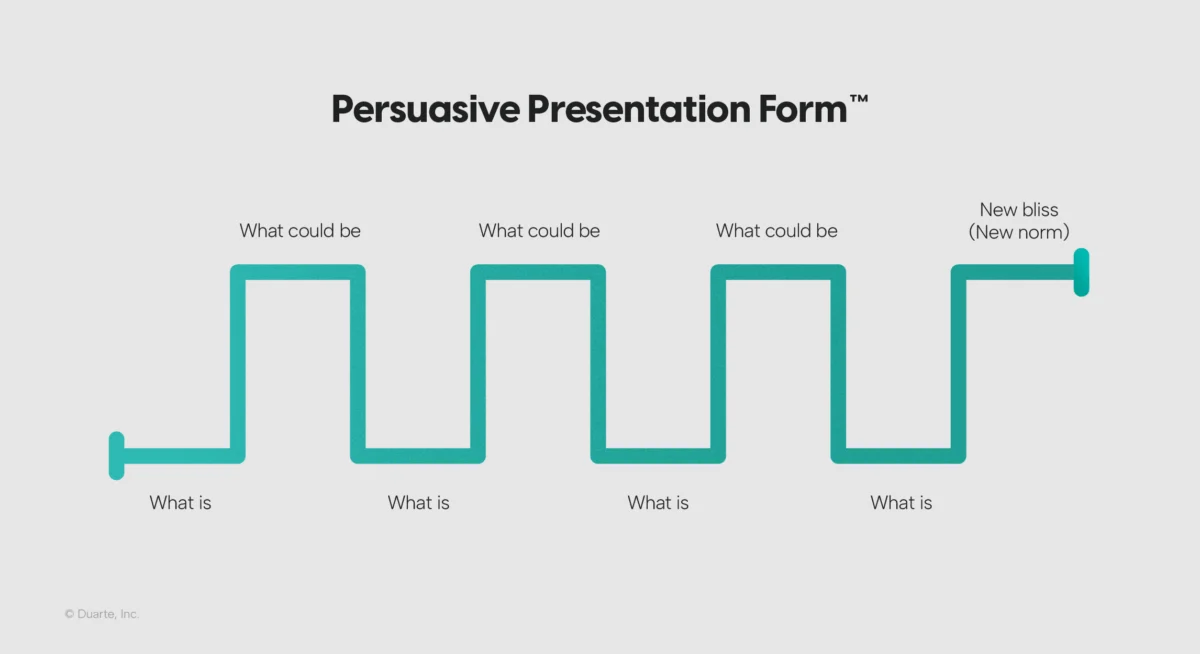
4. The Power of Contrast: Navigating "What Is" and "What Could Be" with the Presentation Sparkline™
Linear presentations, which simply list facts or sequentially describe events, often fail to maintain audience engagement. The human mind thrives on contrast and tension. The Presentation Sparkline™ framework, developed by communication experts like Nancy Duarte, leverages this cognitive preference by constantly alternating between "what is" (the current reality, often problematic) and "what could be" (the desired future state, enabled by the solution). This rhythmic back-and-forth creates a compelling narrative arc, moving beyond a simple "and then" progression to a more dynamic "but then" structure.
The Sparkline reveals that typical reports often dwell on "what is" with a brief recommendation, while pitches might overly emphasize "what could be" without fully acknowledging present realities. Both approaches can be disengaging. The persuasive Sparkline, however, strategically oscillates between the two, highlighting the gaps and opportunities. Nancy Duarte’s analysis of iconic speeches, such as Steve Jobs’ 2007 iPhone launch and Dr. Martin Luther King Jr.’s "I Have a Dream" speech, demonstrates this principle. Jobs brilliantly contrasted the cumbersome existing smartphones with the revolutionary simplicity of the iPhone, while King vividly depicted the harsh realities of racial injustice ("what is") against the hopeful vision of equality and justice ("what could be"). This constant interplay creates intellectual and emotional tension, keeping the audience actively engaged in the journey towards resolution.
5. Crafting Unforgettable Moments: The S.T.A.R. Moment™ Strategy
In a world drowning in data, memorability is a precious commodity. A S.T.A.R. Moment™ (Something They’ll Always Remember) is a deliberately crafted segment within a presentation designed to be singularly impactful and sticky. These moments are not just about conveying information; they are about creating an experience that resonates long after the presentation concludes.

A powerful illustration comes from Al Gore’s presentation on climate change, which inspired his Academy Award-winning documentary, An Inconvenient Truth. Faced with the challenge of communicating the projected drastic rise in CO2 concentration over 50 years, Gore didn’t just display a chart. Instead, he employed a hydraulic lift that literally raised him alongside the soaring data line on a massive screen, physically demonstrating the magnitude of the impending crisis. This visual, visceral moment transformed abstract data into a profound, unforgettable experience, effectively driving home the urgency of the message. Neuroscience research indicates that emotionally charged experiences are processed and stored differently in the brain, leading to significantly enhanced recall. S.T.A.R. Moments tap into this mechanism, ensuring critical messages are not just heard, but deeply felt and remembered.
6. Transforming Data into Dialogue: The Art of Data Storytelling
For many business professionals, communicating data in a compelling way remains a significant hurdle. Raw data, by itself, lacks inherent meaning; it requires a narrative framework to translate numbers into insights and action. Data storytelling is the art of giving data a voice, making it accessible, relevant, and persuasive. This can be achieved through several techniques: marveling at the magnitude of a data point, humanizing the data to connect with personal experiences, or surprising the audience with unexpected revelations.
Steve Jobs, a master of data storytelling, exemplified the "surprise with the unexpected" approach during the 2008 MacBook Air reveal. Instead of merely stating the laptop’s slimmest point was 0.16 inches and its thickest 0.76 inches—measurements that might not fully convey its revolutionary thinness—Jobs famously slid the entire device out of a standard manila envelope. This unexpected visual metaphor instantly communicated the MacBook Air’s unprecedented design in a way that dry specifications never could. It created a collective gasp of understanding and wonder, anchoring the data in a tangible, memorable experience. Effective data storytelling leverages such creative approaches to ensure that insights are not just presented, but truly understood and acted upon.
7. Envisioning the Future: Concluding with "New Bliss"
Every effective story culminates in a resolution, and business presentations are no exception. The "happily ever after" in a business context is what is termed the "new bliss"—a clear, inspiring, and attainable vision of the future that the proposed solution makes possible. This is not a fanciful fairytale ending, but a realistic and desirable outcome that directly addresses the hero’s (audience’s) initial challenge.
The "new bliss" serves as the ultimate motivator, providing the audience with a tangible sense of what they stand to gain by adopting the presenter’s idea, product, or service. It ties together all elements of the narrative, demonstrating how the mentor’s guidance (the solution) empowers the hero (audience) to achieve a superior future state. By articulating this future with clarity and conviction, presenters solidify their argument, reinforce the value proposition, and provide a compelling call to action that resonates on both rational and emotional levels, driving commitment and investment.

Broader Strategic Implications: Storytelling as an Organizational Competency
The application of storytelling principles extends far beyond individual presentations, permeating various facets of organizational life. Business storytelling is not merely a personal skill; it is a critical organizational competency that propels work forward on multiple fronts. In internal communications, compelling narratives can align teams, articulate strategic vision, and manage change initiatives more effectively than directives or memos. A well-crafted corporate story can define a brand’s identity, attract top talent, and foster a strong, cohesive culture. For instance, companies like Nike and Apple have built global empires not just on product innovation, but on powerful, consistent narratives that resonate with consumer aspirations and values.
Moreover, in an increasingly competitive global landscape, the ability to articulate a unique value proposition through storytelling is paramount for market differentiation and customer loyalty. The ethical dimension of storytelling also cannot be overlooked; while powerful, narrative techniques must be employed with integrity, authenticity, and a commitment to truth, avoiding manipulation and fostering genuine connection.
Conclusion: Investing in Narrative for Enduring Impact
In conclusion, mastering business storytelling is no longer an optional skill but a fundamental requirement for success in the modern professional world. By intentionally structuring presentations around the Hero’s Journey, positioning the audience as the protagonist, adopting the role of a guiding mentor, leveraging the power of contrast through frameworks like the Presentation Sparkline™, crafting unforgettable S.T.A.R. Moments™, transforming data into engaging narratives, and culminating with a clear vision of "new bliss," business leaders can elevate their communication from mere information dissemination to genuine inspiration and action. The investment in developing these narrative capabilities, whether individually or across an organization, promises not just improved presentation skills, but a profound impact on sales, leadership effectiveness, team cohesion, and ultimately, the enduring success of any enterprise.
