

In today’s information-saturated business landscape, the ability to convey complex ideas, secure critical approvals, and galvanize teams through periods of change has evolved beyond mere factual recitation. Leaders are increasingly recognizing that compelling storytelling is not a soft skill but a strategic imperative, transforming flat data into memorable narratives that drive action and foster deep engagement. This shift reflects a fundamental understanding of human psychology: people connect with stories, not just statistics. A business presentation infused with narrative techniques frames information in a way that resonates, moving audiences from passive reception to active commitment.
The pervasive nature of "storytelling" in business circles is well-founded. Those adept at shaping information into a cohesive, impactful story are the individuals who consistently close deals, navigate budget approvals with greater success, and effectively steer their teams through transformative initiatives. This doesn’t necessitate opening every meeting with a personal anecdote, though such personal touches can be powerful. Rather, it means constructing a presentation that consciously employs narrative structures, character roles, and dramatic tension to elevate facts into an experience, ensuring that ideas are not just heard, but truly understood and acted upon.
The Evolution of Narrative in Professional Communication
The human inclination towards narrative is ancient, predating written language. From campfire tales to epic sagas, stories have served as primary vehicles for transmitting knowledge, values, and cultural identity. In a business context, this innate preference for narrative has only recently gained prominence. For decades, the dominant paradigm in professional communication prioritized objective data, bullet-point lists, and linear reports, often assuming that the sheer weight of facts would compel decision-makers.
However, the late 20th and early 21st centuries witnessed a paradigm shift. With the advent of the internet and the subsequent explosion of information, attention became the scarcest commodity. Business leaders and communication experts began to observe that while data was necessary, it was insufficient to cut through the noise. Pioneers in communication strategy, recognizing the power of emotional connection and memorability, started advocating for the integration of storytelling principles into business presentations. This movement gathered momentum as cognitive science provided evidence that stories activate more areas of the brain, making information significantly more memorable and persuasive than abstract data points. Studies from Stanford University, for instance, have indicated that information presented as a story is up to 22 times more memorable than facts alone. This compelling data underscored the practical benefits of narrative approaches.

Seven Essential Storytelling Frameworks for Business Presentations
To effectively harness the power of narrative, presenters can adopt several proven frameworks that transform conventional presentations into engaging storytelling experiences. These methodologies provide a structured approach to captivate audiences and inspire desired outcomes.
1. The Hero’s Journey: Structuring Your Business Narrative
At the core of effective storytelling lies a universal structure: the hero’s journey. Popularized by mythologist Joseph Campbell, this archetypal narrative pattern translates seamlessly into business contexts. It begins with a hero in their ordinary world, who encounters a challenge that disrupts their status quo. Unable to overcome this challenge alone, they meet a mentor who provides guidance, tools, and a path forward. The hero then embarks on a journey, facing trials and tribulations, ultimately overcoming the challenge and returning to a "new world" transformed.
In a business presentation, this translates to:
- Beginning (The Ordinary World & Call to Adventure): Establish the audience’s current situation ("what is") and highlight a significant problem or opportunity ("the challenge"). This immediately resonates, as the audience recognizes their own struggles.
- Middle (The Road of Trials & Meeting the Mentor): Introduce your solution or proposal as the mentor’s guidance. Detail the steps, features, or benefits, showing how these "tools" address the challenge. This is where the contrast between "what is" and "what could be" becomes central.
- End (The Return with the Elixir & New Bliss): Paint a vivid picture of the successful future state, the "happily ever after" that the audience will experience by adopting your solution. This "new bliss" must be tangible and desirable.
Crucially, for this structure to succeed, a clear delineation of roles is paramount: the audience must be the hero, and the presenter, the mentor.
2. The Audience as the Hero: Shifting the Focus
A common pitfall in business presentations is for the presenter to inadvertently cast themselves or their company as the hero. This often manifests as lengthy recitations of company history, impressive client lists, or numerous accolades. While credibility is important, an overdose of self-congratulation alienates the audience, who are primarily concerned with their own problems and how they can be solved.

The most effective storytelling presentations unequivocally position the audience as the hero. They are the ones facing the challenge, seeking a solution, and striving for a better future. By placing the audience at the center of the narrative, presenters tap into their innate desire for resolution and improvement. This empathetic approach fosters a stronger connection, as the audience feels understood and valued. For example, instead of touting "our innovative software features," a presenter focusing on the audience as the hero might say, "You’re spending countless hours on manual data entry, preventing you from focusing on strategic growth. Our software is designed to liberate your team from this burden."
3. The Presenter as the Mentor: Guiding the Journey
If the audience is the hero, then the presenter’s role is that of the mentor. This involves providing the necessary tools, insights, and guidance to help the hero overcome their challenge. A mentor is not interested in personal glory but in empowering the hero.
Consider a presentation for a meal kit delivery service. A "hero-centric" presenter might declare, "We are the industry leader with the freshest ingredients, most creative menus, and over a thousand five-star reviews." While factual, this approach is self-serving. A "mentor-centric" presenter, however, would frame the problem from the audience’s perspective: "Many parents struggle daily with the dilemma of cooking healthy meals while also dedicating quality time to their children. Our meal kit service acts as your trusted partner, delivering pre-portioned, fresh ingredients that cut your cooking time in half, freeing up five crucial hours a week. We empower you to enjoy both wholesome family meals and precious moments with your loved ones." This narrative directly addresses the audience’s pain point and positions the service as the solution, the guiding tool. This approach builds trust and demonstrates genuine understanding, fostering a much stronger persuasive impact.
4. The Power of Contrast: The Presentation Sparkline® Framework
Engaging narratives thrive on contrast, moving beyond a simple linear progression of events. The "and then, and then" style of storytelling, like "Sarah wakes up and gets in her car and goes to work," often lacks dramatic tension. True engagement arises from "but then" moments, where an unexpected obstacle or new possibility alters the trajectory: "Sarah wakes up and gets in her car to go to work, but then she has a flat tire."
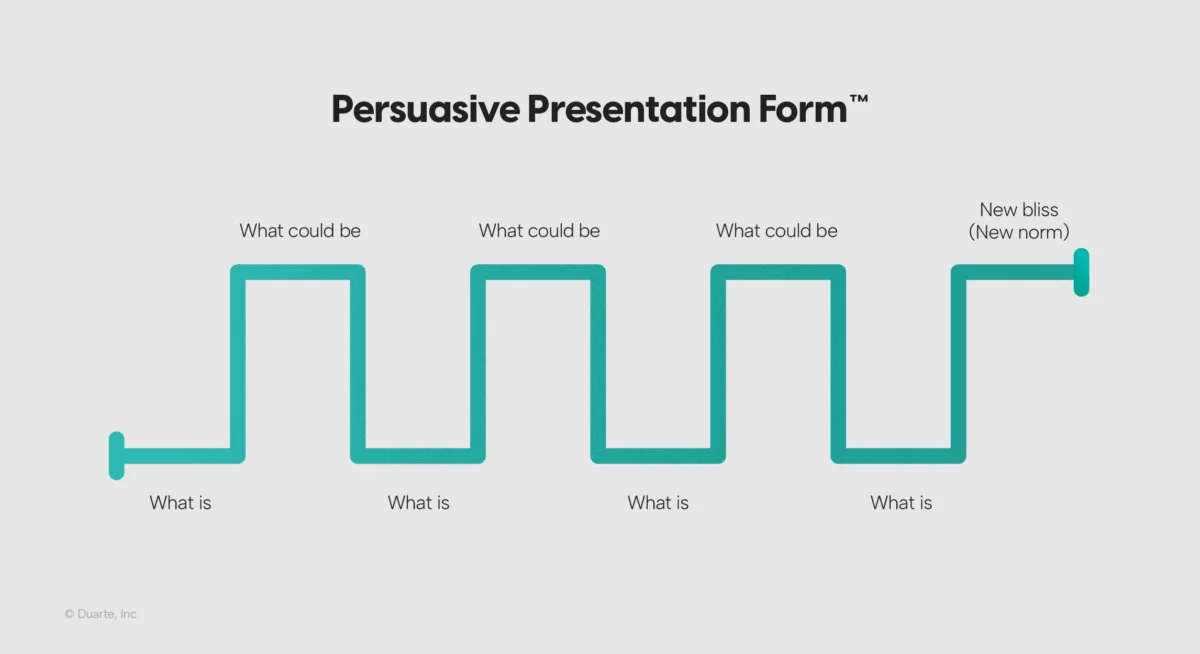
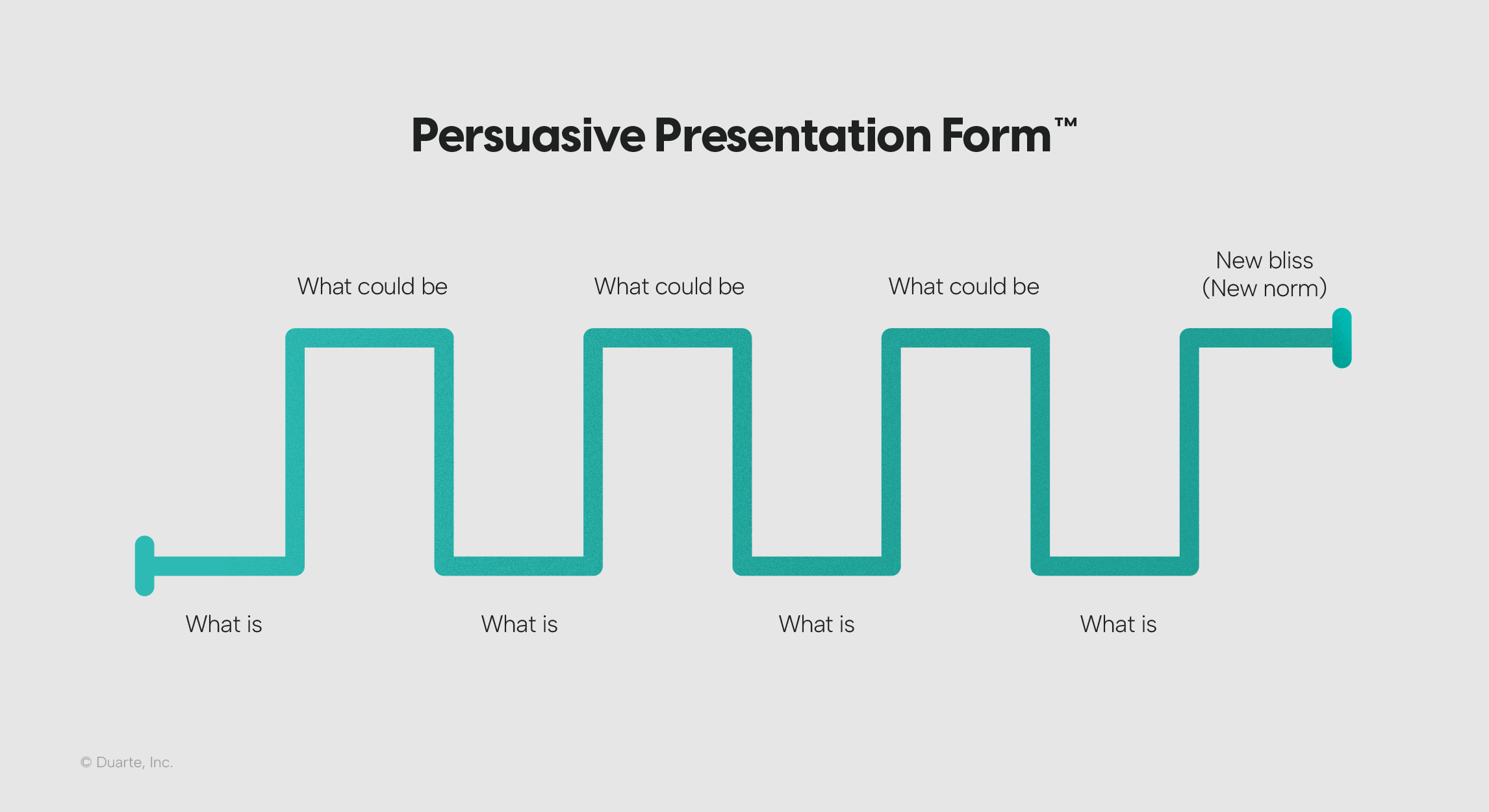
In business presentations, this principle is encapsulated by Duarte’s Presentation Sparkline® framework, or Persuasive Presentation Form™. Most presentations adopt one of two shapes:
- The Report: Primarily focuses on "what is" – the current state, challenges, and facts – with a brief suggestion for "what could be" at the end. This can be informative but often lacks dynamism.
- The Pitch: Opens with "what is" but quickly transitions to an extended vision of "what could be" – often sounding too optimistic or lacking grounding in reality.
The Sparkline framework, in contrast, constantly oscillates between "what is" (the problem, the current reality) and "what could be" (the solution, the ideal future). This rhythmic interplay creates tension and maintains audience engagement. By repeatedly highlighting the gap between the present challenge and the proposed solution, the presenter demonstrates a deep understanding of the problem while building anticipation for the transformative impact of their ideas. Iconic examples include Steve Jobs’ 2007 iPhone launch, where he meticulously contrasted existing phones’ limitations with the revolutionary capabilities of the iPhone, and Dr. Martin Luther King, Jr.’s "I Have a Dream" speech, which powerfully juxtaposed the grim realities of racial injustice ("what is") with an eloquent vision of an equitable future ("what could be"). Both masterfully used contrast to ignite emotion and drive change.

5. Crafting Unforgettable Moments: S.T.A.R. Moments™
In an era of information overload, where attention spans are fleeting, creating moments that resonate and stick with the audience is paramount. A S.T.A.R. Moment™ (Something They’ll Always Remember) is a specific, impactful segment of a presentation designed to lodge a key idea firmly in the audience’s memory. These moments are often visual, experiential, or emotionally charged, making abstract data or complex concepts tangible and unforgettable.
People struggle to recall exhaustive lists of facts, but they vividly remember specific, well-crafted moments. When Al Gore presented his findings on climate change, which later became the documentary An Inconvenient Truth, a critical challenge was to convey the alarming scale of predicted CO2 concentration rise over 50 years. Instead of merely showing a graph, Gore created a S.T.A.R. Moment: he literally ascended a hydraulic lift that rose alongside a projected graph, visually representing the drastic increase. This immersive, physical demonstration transformed a dry data point into a visceral experience, making the magnitude of the problem undeniably real and deeply memorable. Such moments bypass the rational filter and embed information directly into emotional memory.
6. Data Storytelling: Illuminating Insights with Narrative
One of the most significant challenges in business communication is making data compelling. Raw numbers, charts, and graphs, while essential for credibility, rarely speak for themselves. They require a presenter to imbue them with meaning, to transform them into a narrative that educates, persuades, and inspires. Data storytelling involves three primary strategies:
- Marvel at the Magnitude: Use analogies or comparisons to make large or complex numbers relatable. For instance, instead of stating "the company processed 500,000 transactions," one might say, "that’s enough transactions to circle the globe three times if each represented a step."
- Humanize the Data: Connect statistics to individual experiences or the real-world impact on people. A percentage increase in efficiency can be reframed as "saving 10,000 hours of labor, equivalent to giving 5 full-time employees back an entire year of their lives."
- Surprise with the Unexpected: Subvert audience expectations to highlight a data point’s significance. A classic example is Steve Jobs’ 2008 MacBook Air reveal. Instead of simply stating the laptop’s .76-inch thickness, he dramatically slid it out of a standard manila envelope. This unexpected visual demonstration instantly conveyed its unprecedented slimness more powerfully than any numerical specification, creating an enduring memory and solidifying the product’s innovative claim.
Ethical data storytelling ensures that while the narrative illuminates the data, it does not distort or manipulate it. The goal is clarity, impact, and a deeper understanding of the underlying truths.
7. Ending with "New Bliss": The Visionary Conclusion
Every effective story requires a satisfying conclusion, and business presentations are no exception. The final moments of a presentation are crucial for solidifying the message and prompting action. This is where the concept of "new bliss" comes into play – a clear, inspiring vision of the attainable future that awaits the audience if they embrace the proposed solution.
The "new bliss" is the "happily ever after" for the hero (the audience). It’s not a fantastical dream but a credible, desirable future state made possible by the mentor’s (presenter’s) solution. By clearly articulating what this transformed future looks like – increased efficiency, greater market share, improved employee morale, a healthier planet – the presenter provides a powerful incentive for action. This concluding vision must be concrete, emotionally resonant, and directly address the challenges introduced at the beginning of the narrative. It reinforces the value proposition and leaves the audience with a sense of hope, possibility, and a clear path forward.

Broader Impact and Implications
The growing emphasis on storytelling in business communication reflects a deeper understanding of human decision-making. In an increasingly complex and data-driven world, the ability to synthesize information into a coherent, emotionally resonant narrative is no longer a niche skill but a fundamental leadership competency.
- Organizational Alignment: Storytelling fosters a shared vision and purpose within organizations, aligning teams around common goals and values. A compelling corporate narrative can motivate employees, attract top talent, and differentiate a brand in the marketplace.
- Enhanced Decision-Making: By presenting options and their implications within a narrative framework, leaders can help stakeholders grasp complex issues more readily, leading to more informed and confident decisions.
- Change Management: Stories are incredibly effective tools for navigating organizational change. They can address fears, build empathy, and articulate the benefits of new directions, making transitions smoother and more successful.
- Competitive Advantage: Companies and individuals who master business storytelling gain a significant competitive edge, capable of influencing markets, securing investments, and building stronger customer relationships.
As communication channels diversify and information overload intensifies, the art and science of business storytelling will only grow in importance. It represents the bridge between raw data and human understanding, between a proposal and a committed action. Leaders who cultivate this muscle, whether through personal development or team training, are not just moving work forward; they are shaping perceptions, building consensus, and driving tangible success in an increasingly narrative-driven world.
Frequently Asked Questions
What is a storytelling presentation?
A storytelling presentation is a business presentation structured around a narrative arc rather than a mere recitation of facts. It frames information by establishing an audience-as-hero, a challenge, and a resolution, guiding listeners through a compelling journey. This approach significantly enhances engagement and makes the core message far more memorable than traditional, data-heavy formats.
How do you tell a story in a presentation?
To tell a story effectively in a presentation, begin by establishing a clear structure, often based on the Hero’s Journey. Position your audience as the hero facing a specific challenge, and yourself as the mentor offering a solution. Build dynamic contrast throughout, alternating between "what is" (the current problem) and "what could be" (the ideal future). Incorporate "S.T.A.R. Moments" – memorable, impactful segments – and use data storytelling techniques to make statistics compelling. Conclude with a vivid vision of the "new bliss," the positive future enabled by your idea.
What are some compelling storytelling presentation examples?
Some of the most impactful storytelling presentations come from renowned figures. Nancy Duarte’s TED Talk on the secret structure of great talks itself exemplifies the Sparkline framework. Al Gore’s use of a hydraulic lift to illustrate rising CO2 levels in An Inconvenient Truth is a prime example of a S.T.A.R. Moment that made abstract data visceral. Similarly, Steve Jobs’ dramatic unveiling of the MacBook Air by sliding it from a manila envelope masterfully employed data storytelling to surprise and captivate, turning a technical specification into an unforgettable demonstration of innovation. Each of these examples transforms information into an experience that deeply resonates and sticks with the audience.
