

The verb haben, translating to "to have," represents one of the primary pillars of the German linguistic structure, serving not only as a marker of possession but as the fundamental auxiliary engine for the German past tense. For students of the German language, mastering haben is often cited by educators as the single most important milestone after learning the verb sein (to be). Its utility extends across every level of the Common European Framework of Reference for Languages (CEFR), from A1 beginners identifying personal belongings to C2 experts articulating complex hypothetical scenarios in the subjunctive mood. Understanding the nuances of haben is essential for navigating the Perfekt tense, which is the primary vehicle for spoken communication regarding past events in modern German.
The Structural Role of Haben in the German Language
Linguistically, haben is classified as a "mixed" verb, meaning it displays characteristics of both weak and strong verb categories. While it follows the dental suffix pattern of weak verbs in its past forms, it undergoes a stem change that is more characteristic of irregular or strong verbs. This dual nature is a result of centuries of phonetic erosion—a process where high-frequency words are shortened by speakers to increase efficiency.
In the German "Perfekt" (Present Perfect) tense, haben acts as the auxiliary for the vast majority of verbs. Statistics from linguistic corpora suggest that approximately 80% of German verbs utilize haben to form their past tense, while the remaining 20%—primarily verbs of motion or change of state—utilize sein. Consequently, a learner’s ability to communicate past experiences is almost entirely dependent on their fluency with haben conjugation.
Chronological Learning Path: From Possession to Hypotheticals
The acquisition of haben typically follows a specific pedagogical timeline in language schools across the DACH region (Germany, Austria, and Switzerland).
Stage 1: The Present Tense (Präsens) and Possession
The first encounter with haben occurs in the context of literal possession. Learners use it to describe what they own or what exists in their immediate environment. The present tense conjugation is the first hurdle, specifically the irregular forms in the second and third person singular.
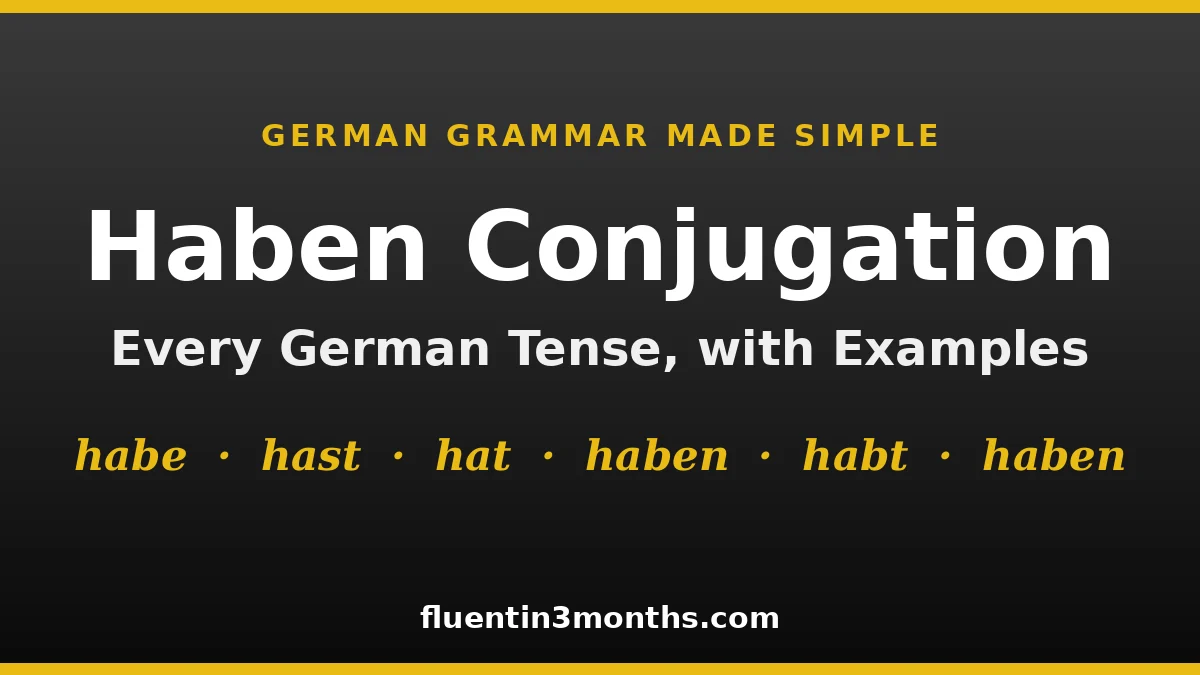
- ich habe (I have)
- du hast (you have – informal)
- er/sie/es hat (he/she/it has)
- wir haben (we have)
- ihr habt (you all have – informal)
- sie/Sie haben (they/you have – formal)
The disappearance of the "-b-" in "du hast" and "er hat" is a critical point of focus for instructors. This contraction mirrors the English transition from "have" to "has," illustrating a shared Germanic evolutionary trait designed to streamline oral communication.
Stage 2: The Narrative Past (Präteritum)
While the Perfekt is used for speech, the Präteritum (Simple Past) of haben is frequently used in both written literature and spoken conversation. Unlike most other verbs, where the Präteritum can sound overly formal in speech, "hatte" (had) is the standard way to express past possession even in casual dialogue.
- ich hatte (I had)
- du hattest (you had)
- er/sie/es hatte (he/she/it had)
- wir hatten (we had)
- ihr hattet (you all had)
- sie/Sie hatten (they had)
Stage 3: The Perfekt and Compound Tenses
As learners progress, they use haben to build compound tenses. The Perfekt is formed by combining the present tense of haben with the Partizip II (past participle) of another verb. Interestingly, haben is its own auxiliary; to say "I have had," a speaker says "Ich habe gehabt."
In the Plusquamperfekt (Past Perfect), used to describe actions that happened before another past action, the Präteritum form "hatte" is paired with the participle: "Ich hatte gehabt."
Technical Analysis of Conjugation Patterns
To provide a clear reference for students and professionals alike, the following data outlines the conjugation of haben across all primary moods and tenses used in contemporary German.
Simple Tenses: Präsens and Präteritum
| Pronoun | Präsens | Präteritum |
|---|---|---|
| ich | habe | hatte |
| du | hast | hattest |
| er/sie/es | hat | hatte |
| wir | haben | hatten |
| ihr | habt | hattet |
| sie/Sie | haben | hatten |
Compound Tenses: Perfekt and Futur
| Pronoun | Perfekt | Futur I |
|---|---|---|
| ich | habe gehabt | werde haben |
| du | hast gehabt | wirst haben |
| er/sie/es | hat gehabt | wird haben |
| wir | haben gehabt | werden haben |
| ihr | habt gehabt | werdet haben |
| sie/Sie | haben gehabt | werden haben |
The Subjunctive Mood: Konjunktiv II
The Konjunktiv II is perhaps the most socially significant form of haben. It is used to express "would have" or to make polite requests. The phrase "Ich hätte gern…" (I would like…) is the standard polite formula for ordering in restaurants or requesting assistance in retail settings.
- ich hätte (I would have)
- du hättest (you would have)
- er/sie/es hätte (he/she/it would have)
- wir hätten (we would have)
- ihr hättet (you all would have)
- sie/Sie hätten (they/you would have)
Idiomatic Usage and Cross-Linguistic Comparisons
One of the most frequent sources of error for English, French, and Spanish speakers is the use of haben in idiomatic expressions where other languages might use "to be."
The "To Be" vs. "To Have" Conflict
In German, physical and emotional states are often "had" rather than "been."
- Hunger/Durst haben: In English, one "is hungry." In German, one "has hunger" (Ich habe Hunger).
- Angst haben: In English, one "is afraid." In German, one "has fear" (Ich habe Angst).
- Recht haben: In English, one "is right." In German, one "has right" (Du hast recht).
The Age Exception
A notable trap for speakers of Romance languages (French avoir… ans or Spanish tener… años) is the expression of age. While these languages use their equivalent of "to have," German aligns with English in using "to be" (sein). Saying "Ich habe 25 Jahre" is a common "false friend" error; the correct form is "Ich bin 25 Jahre alt."
Implications for Language Proficiency and Fluency
The mastery of haben has broader implications for a learner’s trajectory toward fluency. According to data from frequency dictionaries of German, haben consistently ranks within the top ten most frequently used words in the language. Its role as an auxiliary means that a learner’s ability to describe history, tell stories, and report news is directly proportional to their comfort with haben.
Furthermore, the distinction between haben and sein as auxiliaries serves as a diagnostic tool for language examiners. Misusing these auxiliaries is often seen as a sign that a learner has not yet internalized the "logic" of German motion and state-change verbs. For instance, "Ich habe gegangen" (I have gone) is a fundamental error, as "gehen" (to go) requires sein.
Expert Perspectives on Morphological Evolution
Linguists often point to haben as a case study in "language economy." The transition from the Old High German habēn to the modern hast and hat illustrates how the most essential words in a language are the most susceptible to change. Dr. Benny Lewis, a prominent polyglot and author, emphasizes that high-frequency verbs "wear down into shorter, easier shapes" because they are used thousands of times daily by native speakers.
This morphological evolution continues to impact how the language is taught today. Modern pedagogical approaches often suggest that students focus on the "Präteritum" of haben early on, even before they tackle the simple past of regular verbs, simply because of its ubiquity in spoken narrative.
Conclusion: The Gateway to German Communication
The verb haben is far more than a simple vocabulary word; it is a structural necessity. From the foundational levels of describing one’s family and possessions to the advanced levels of debating hypothetical political outcomes or recounting historical events, haben remains the primary tool in the German speaker’s arsenal. By understanding its irregular present tense, its role as a "mixed" past tense verb, and its idiomatic quirks, learners unlock the ability to navigate the majority of German syntax. As the saying goes in many German language classrooms, "Wer ‘haben’ und ‘sein’ beherrscht, hat schon halb gewonnen"—he who masters ‘to have’ and ‘to be’ has already half won the battle.
