


The rapid evolution of artificial intelligence has thrust organizations worldwide into a delicate, often tumultuous dance between leadership vision and workforce reality. Nowhere is this tension more palpable than in the ongoing efforts around AI adoption, a transformation marked by a wide spectrum of opinions, from fervent enthusiasm to profound skepticism and even outright aversion. This dynamic landscape necessitates an approach that transcends mere technological implementation, emphasizing the critical role of human-centric communication in uniting diverse perspectives.
The Bifurcated Workforce: Hopes and Fears in the AI Era
A casual survey of employees within any organization would likely reveal a stark divergence in sentiment regarding AI. For some, the technology evokes dystopian visions akin to The Terminator, or the fleeting nature of truth, like "tears in rain." These individuals harbor legitimate concerns about job displacement, ethical dilemmas, and the potential erosion of human judgment. Conversely, a significant portion of the workforce embraces AI with optimism, envisioning a future where "super intelligence" tackles humanity’s grandest challenges—from curing cancer to solving climate change and liberating individuals from repetitive tasks. Amidst these extremes lies a segment of ambivalence, workers who would "rather talk about the weather" than engage with the complexities of AI, yet whose passive stance can still impede widespread adoption.
This psychological divide presents a formidable challenge for leaders. Organizations, particularly those that navigated previous technological revolutions with difficulty, are acutely aware of the "fear of missing out" (FOMO). The perceived risk of not adapting to AI’s advancements looms large, threatening competitive standing and future relevance. However, merely pursuing "AI-enablement as an end in itself" can be counterproductive, leading to ill-conceived initiatives that fail to address fundamental questions: Is this AI tool truly necessary? What are the hidden costs of automating this specific workflow? Should an AI agent genuinely wield a company credit card? Without a unifying narrative, AI adoption efforts risk fragmenting across the organization, failing to achieve scalable success.
Bridging the Divide: The Imperative of Human Communication
In such an environment, the pivotal question for leaders becomes: How can everyone be united around a shared, compelling AI message? The answer, as Fortune 50 companies and global brands have long understood, lies in core communication skills. Effective leaders must possess the ability to candidly acknowledge difficulties, thoughtfully challenge pushback, and build sustained momentum behind their vision. This demands a powerful trifecta of time-tested storytelling structures, design principles, and presentation strategies designed to foster collective investment in a shared outcome.
Crucially, these deeply human qualities—empathy, persuasion, and inspirational leadership—cannot be automated. While AI excels at processing data and generating content, it cannot step onto a stage, capture a moment with an evocative story, or genuinely move a reluctant audience to action. The burgeoning fields of "prompt engineering" and "vibe-coding," while valuable for technical execution, are ultimately insufficient for catalyzing profound organizational change. The human element of leadership, particularly in communication, remains irreplaceable.
Duarte’s Illuminate™: A Framework for AI Transformation

The good news is that proven methodologies exist for guiding organizations through significant transformations. Duarte’s Illuminate™ change communication framework offers a structured pathway for shifting from entrenched practices to a "new bliss" of innovation. In the age of AI, this framework underscores the enduring power of three-act narratives, symbolic ceremonies, impactful speeches, and clear, concise visuals as essential ingredients for inspiring lasting change. This journey, like most visions, begins with a dream, but critically, it first requires an honest acknowledgment of reality.
Understanding the Workforce: What Teams Are Saying About AI
To craft an effective AI vision, leaders must first understand the prevailing sentiments within their own ranks. While broad polls and academic studies offer general insights into AI perception, a granular understanding of your target audience—your employees—is paramount.
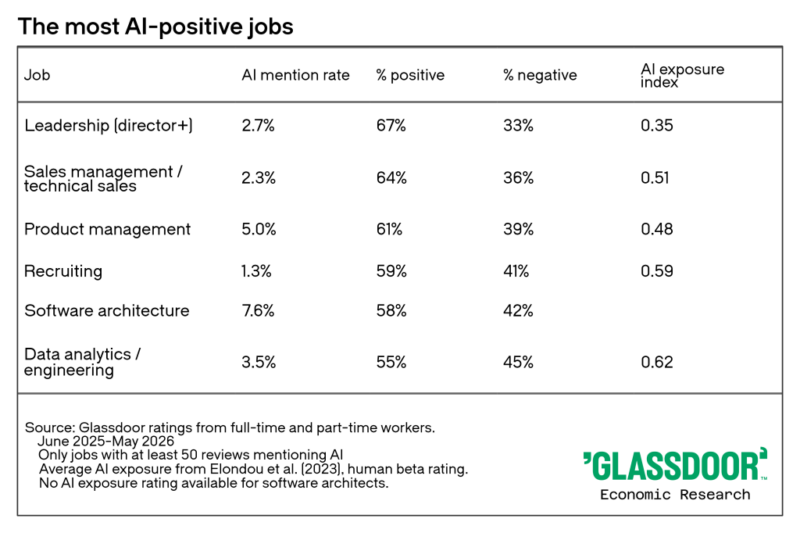
An August 2026 study by Glassdoor, analyzing employer reviews, revealed a varied landscape of opinions across roles, demographics, and industries. The study highlighted significant trends for and against AI usage:
-
AI-Positive Roles: Certain professional categories showed a notably favorable view of AI, indicating a perception of direct benefit and enhancement. These included:
- Leadership (director+): 67% positive mentions
- Sales Management / Technical Sales: 64% positive mentions
- Product Management: 61% positive mentions
- Recruiting: 59% positive mentions
- Software Architecture: 58% positive mentions
- Data Analytics / Engineering: 55% positive mentions
These roles likely see AI as a powerful enabler for strategic decision-making, efficiency gains, and enhanced problem-solving.
-
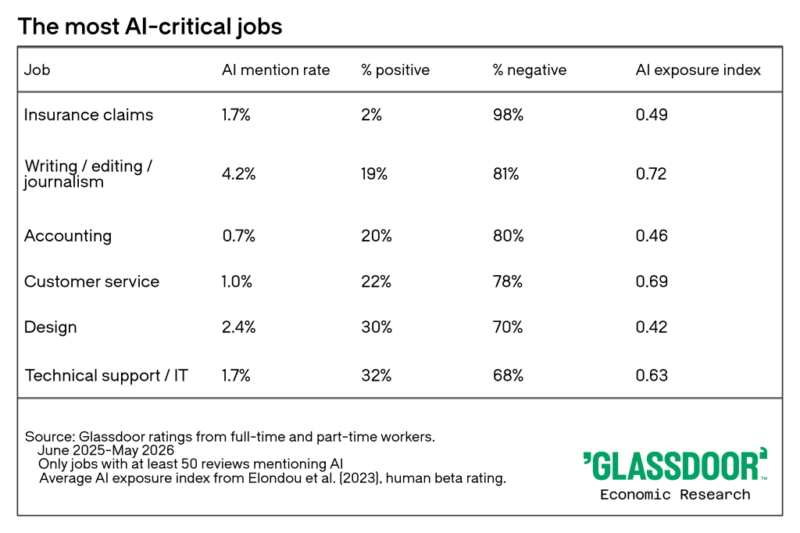
AI-Critical Roles: Conversely, roles demanding extreme precision, nuanced interpersonal skills, or specific creative outputs often expressed significant negative sentiment:
- Insurance Claims: 98% negative mentions
- Writing / Editing / Journalism: 81% negative mentions
- Accounting: 80% negative mentions
- Customer Service: 78% negative mentions
- Design: 70% negative mentions
- Technical Support / IT: 68% negative mentions
These findings suggest fears of automation degrading the quality of work, replacing human expertise, or complicating intricate processes. For instance, the high negativity in insurance claims might stem from concerns about AI missing subtle human factors, while creative roles fear the loss of originality or voice.
Beyond perception, a study from the University of Konstanz further illustrated a critical misalignment: "In many organizations, the major AI revolution has not unfolded as a planned transformation process so far," explained Florian Kunze, head of the study. "Instead, many employees are experimenting with AI, while employers are still lagging behind when it to establishing clear policies, providing training and implementing secure AI solutions." This highlights a dangerous gap where employee initiative outpaces organizational governance, leading to potential risks and inefficiencies.
Reinforcing this, a Gallup poll revealed that a staggering "only 25% of workers say their company has communicated a clear plan for AI integration." This means the vast majority of businesses are providing inadequate guidance, issuing confusing mandates, or offering no support whatsoever for their AI initiatives. The consequences are tangible: unfocused AI usage can lead to skills atrophy, where employees lose proficiency in core tasks; sloppy brand assets due to unchecked AI-generated content; and "runaway token spend" as unmanaged AI tools consume resources inefficiently.
In their haste, leaders often inadvertently send mixed messages or fail to address the concerns of AI-averse or agnostic workers. Without a scalable message that resonates across all organizational segments, AI strategy will never achieve comprehensive buy-in. Leaders must anticipate pushback, genuinely consider feedback, and transparently articulate a coherent, achievable path forward. An incomplete, incoherent, or inauthentic vision—one that doesn’t align with organizational values—will inevitably stall progress, derail roadmaps, and disillusion top talent.
Fortunately, there is a better way. Committing to a proven change communication strategy can provide AI initiatives with the necessary support to take root and deliver measurable ROI. Duarte’s Illuminate™ methodology serves as a trusted blueprint for motivating teams to embrace the AI era with dedication, grit, and grace. This five-part process offers a clear pathway to success for an organization’s AI adoption journey.
Stage 1: Make AI Adoption a Winnable Dream
The inaugural stage of Duarte’s Illuminate™ framework, the Dream stage, transforms an initial spark of inspiration into a catalyst for profound change. Here, trailblazing leaders, or "torchbearers," illuminate a plausible future, inviting their organizations, industries, and even humanity at large to envision it with them. To ignite change, leaders in this stage strategically contrast "what is" with "what could be," compelling audiences to acknowledge and actively desire a "new bliss." This "new bliss" could manifest as a superior way of working, an innovative product, or a refined mindset towards a revolutionary concept like AI. These deliberate juxtapositions create tension, inspiring audience members to wholeheartedly support the proposed vision.
The Dream stage often involves powerful vision speeches or persuasive communication aimed at establishing the stakes and galvanizing teams around future possibilities. However, crafting truly impactful content requires a deep understanding of the audience’s existing hopes and fears regarding the topic at hand. Leaders should "test the waters" around their vision before making any official announcements, practicing adaptive listening to fully grasp what their teams are thinking and feeling.
As the Glassdoor study indicated, AI resistance often stems from eight core concerns, ranging from job loss (20% of negative replies) to AI distracting from core business objectives (13%), or companies deploying AI in alienating ways like workplace surveillance or as a substitute for executive communications (10%). Given these prevalent reactions, a leader’s vision for AI adoption must extend far beyond a simplistic "just use it, okay?" mandate.
Consider a more nuanced approach:
- What Is: Teams are currently burdened by the manual tracking of data updates, the repetitive nature of content brainstorming, and time-consuming buyer research in an increasingly complex information landscape. While AI presents its own set of challenges, competitors who strategically embrace and clearly define AI adoption are demonstrating accelerated progress and enhanced efficiency through AI-enabled workflows.
- What Could Be: With the implementation of proper AI Standard Operating Procedures (SOPs), robust IT-supported integration, and continuous "temperature checks" to gauge sentiment and effectiveness, teams can systematically eliminate extraneous steps from ingrained processes, significantly boost systems maintenance, and consistently deliver high-quality results that maintain a competitive pace.
- The New Bliss: Empowered by AI, teams can now dedicate themselves to refining their core workflows, enjoying more flexible schedules that facilitate deeper customer connections, pursuing additional accounts, and exploring genuinely creative projects with newly available bandwidth. This isn’t about replacing humans, but augmenting their capabilities and freeing them for higher-value work.
For optimal results during the Dream stage, leaders should engage in clear-eyed reflection around:
- The current state and its inherent pain points.
- The aspirational future that AI enables.
- The specific benefits and improvements for each team and individual.
- The risks and concerns, and how they will be mitigated.
- The overarching purpose and values driving this change.
With the right framing and a compelling justification underpinning your "new bliss," the organization is prepared to take the Leap toward change.
Stage 2: Leaping into AI Adoption
Organizations transition into the Leap stage when torchbearers successfully persuade their teams to commit to action. At this point, leadership’s AI message begins to resonate and amplify across teams, manifesting in "action-oriented words" and phrases that signify growing consensus. AI processes start to roll out, and all-hands meetings and departmental syncs transform into shared adventures of discovery. During this critical stage, maintaining a steady pace and celebrating incremental progress are essential to effectively keep FUD (fear, uncertainty, and doubt) in check.
Leaders can reinforce this burgeoning sense of wonder and commitment with speeches that provide deeper context to the vision or powerfully remind teams of what is at stake. Since successful AI adoption demands broad buy-in and active participation from every level, it is prudent to structure your AI strategy as an incubator of innovation rather than a rigid, top-down mandate. In this period of active discovery, workers should feel empowered to share their individual AI approaches and contribute meaningfully to the company’s broader evolution. Telling the right story from the outset is crucial for cementing this collective commitment.
Duarte’s own journey, for example, included a "summer vibe-coding experiment" that deliberately prioritized time for exploration and learning. Weekly AI Office Hours were instituted to nurture curiosity, providing a dedicated space for employees to share knowledge, collaboratively devise strategies to optimize "token spend," and produce clearer, more effective AI outputs. Teams united to maintain a centralized prompt library, update brand guidelines to incorporate AI-generated content, and rigorously test guardrails for responsible AI usage. Furthermore, employees were actively encouraged to leverage AI as a thought-partner, bouncing and pressure-testing ideas throughout their daily workflows.
While giving a company’s tech stack an AI makeover might not possess the immediate glamour of launching a new product or unveiling a cutting-edge headquarters, with the right support and sustained commitment, organizations can strategically position themselves to harness emerging tools and remain agile in fast-moving environments. This readiness, however, inherently means bracing for both known and unforeseen challenges.
Stage 3: Navigating the Fights and Pivots
During any ambitious quest toward change, the occurrence of setbacks and complications is inevitable. With AI, the potential problems are myriad: inadequate prompts yielding unusable outputs, pervasive accuracy issues and "hallucinations," "AI-optimized" workflows that paradoxically take longer than manual processes, or the relentless stream of contradictory news stories surrounding AI adoption. Rather than attempting to gloss over hardships or suppress dissent, leaders committed to AI adoption should view resistance, frustration, or exasperation as invaluable opportunities to check in with teams, gather critical feedback, and dynamically modify their change plan.
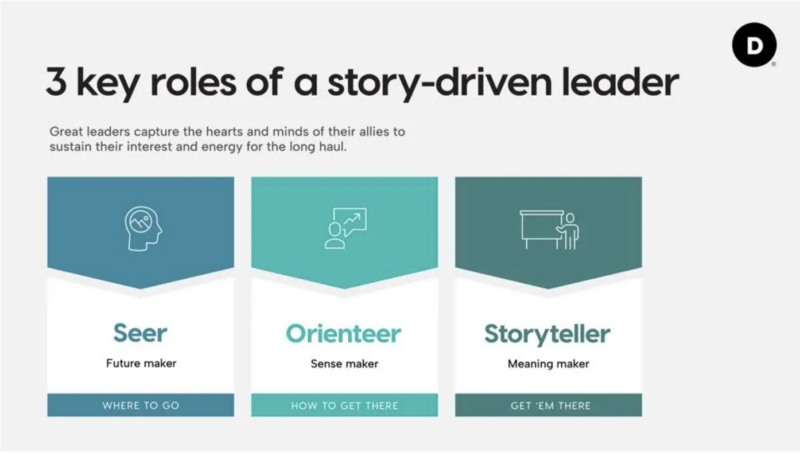
In a September 2026 Forbes column for C200, Duarte CEO Nancy Duarte reflected on her experience announcing a bold AI vision at Duarte’s company kickoff. Over the ensuing months, a blend of "eureka moments" and "patches of rough air" refined her initial vision for change. To successfully launch and implement a new vision, Duarte argues that leaders must embody three critical personas to spark and sustain transformation within their organizations: the Seer, the Orienteer, and the Storyteller.
- The Seer: The "future maker," responsible for defining "where to go." This persona clarifies the ultimate destination, the grand vision that AI adoption aims to achieve. When the destination becomes fuzzy, the Seer brings it back into sharp focus.
- The Orienteer: The "sense maker," charting "how to get there." This role involves mapping the practical steps, identifying resources, and navigating the complexities of implementation. If a pathway stalls, the Orienteer charts a new course.
- The Storyteller: The "meaning maker," tasked with getting "’em there." This persona inspires, motivates, and provides context for the journey, making meaning of struggles and celebrating progress. When competitors seemingly leapfrog a team’s AI outputs, the Storyteller helps the organization understand the struggle, learn from it, and maintain morale.
Every challenge encountered will demand that leaders revisit one or more of these personas. Viewing change through the lens of each persona helps to weave a continuous, coherent thread through the entire transformation process. It contextualizes hurdles and punctuates skirmishes, highlighting both victories and lessons learned. In the Fight stage, leaders must constantly reevaluate whether the most prudent path through a rough patch is sustained perseverance or a strategic pivot. Here, regular, open contact with teams—through initiatives like AI Office Hours—or powerful "battle speeches" at key turning points are absolutely critical for maintaining morale and alignment.
Unacknowledged problems, persistent delays in progress, and a lack of clear guidance are natural breeding grounds for FUD. Keeping the right narrative afloat is essential to help teams stay on track for the long haul. Because if the initial "fights" felt bruising, organizations must now prepare for the demanding "climb."

Stage 4: Proving the Climb is Worth the View
Initiatives invariably lose steam. Deadlines shift. Seemingly surefire fixes prove insufficient. The "messy middle" of transformation can derail even the most meticulously laid plans and overwhelm organizations of all sizes. When teams begin to question their capacity to carry on, congratulations: you have officially entered the Climb stage. It’s crucial to understand that the Climb stage often runs concurrently with the Fight stage; leaders must continuously discern which lever to pull. The Climb stage specifically contrasts the seemingly endless, arduous plodding between sites of conflict and aims to visibly mark the progress made. It is arguably the most trying stage for both teams and leaders: a continuous uphill battle, often without the adrenaline rush of direct conflict.
Where AI’s capabilities feel infinite, human endurance is not. Employees experience exhaustion, burnout, and discouragement. During the Climb stage, existing workloads clash with new AI obstacles, AI-generated results might prove lackluster, and new workflows can inadvertently create new problems. Adoption slows. Teams might backslide into old, familiar habits, even as competitors appear to charge full speed ahead. At this point, even leaders might find themselves questioning: Will we ever truly achieve widespread AI adoption?
Balancing the correct approach requires a holistic understanding of the situation. Maintaining open lines of communication through regular 1:1s with team leaders, anonymous surveys, and live Q&As can help gather the necessary context and accurately measure the scope of the problem. While Fight messaging aims to ready teams for battle, the Climb is fundamentally about leveraging past accomplishments to refuel current change efforts.
"Keep reminding people how far they’ve come and why the destination is still worth reaching."
Every "temperature check" during this phase presents an opportunity to revitalize the core message, acknowledge and reward hard workers who are staying the course, and gain crucial insight into what is impeding the vision. It’s vital to help stragglers realize they are not alone, to reiterate that transformation is a gradual process, and to demonstrate tangibly how the investment of time, energy, and resources is indeed paying off.
As leaders, if you find yourself struggling to defend decisions for change, you might be falling victim to the sunk cost fallacy—a bitter pill to swallow. This underscores why having 360-degree coverage and understanding of your organization is paramount for success with large-scale change efforts. Such comprehensive insight makes it significantly easier to accurately diagnose problems, to know when to strategically abandon a failing change effort, and, most importantly, to recognize when perseverance is finally yielding results.
Stage 5: Arriving at AI Adoption—And Beyond
At long last, the delicate balance between dreaming, delegating, and doing achieves perfect harmony. Leaders have successfully envisioned and articulated a compelling future, and the workforce has mobilized to bring it to fruition. After all the leaping, fighting, and climbing, your "new bliss" becomes a tangible reality. Teams are AI-optimized, workflows exhibit agentic efficiency, and outputs are consistently humming along at an accelerated clip. While dissenters and critics may always retain their private reservations, the overarching message has prevailed. Mission accomplished, right?
Yes, and no. Unlike a discrete product launch or a one-time migration to a new CRM, becoming "AI-enabled" signifies an ongoing commitment to staying current with innovations and best practices. Much like cybersecurity demands regular re-education and updated procedures, AI integration requires continuous dedication. New models and capabilities are constantly emerging, while potential vulnerabilities and exploits perpetually keep organizations on their toes.
This continuous nature should not, however, diminish feelings of accomplishment. Retooling how teams engage with their work, adopting new Standard Operating Procedures (SOPs), defining, and then achieving success are all significant milestones worthy of celebration. While some organizations may be "party-averse," teams require dedicated time to reflect on and process their journey. Schedule an open mic session or a fireside chat where individuals can share their experiences, fostering a sense of collective achievement and taking part in the "mythmaking" that enriches workplace culture.
After the celebratory s’mores (or something stronger) at the closing ceremony, it’s time to settle into the new normal and sustain the change. Workers can continue to refine their AI agility, while leaders can turn their attention to pulling the next transformative initiative from the clouds, ready to navigate the next wave of change.
The Enduring Power of Strategic Communication
Organizations once enjoyed longer runways for reinvention. Today, industry evolution can unfold overnight. This era of accelerated uncertainty and constant "shock and awe" demands prompt and decisive action. Geopolitical friction, supply chain disruptions, and technological advancements are no longer anomalies but integral parts of daily life. Companies must remain nimble, endlessly recalibrating to each new normal. With every team member potentially pulled in different directions, organizational alignment requires a message meticulously crafted, expertly delivered, and robustly supported to withstand the headwinds of constant flux.
Whether your organization is proactively seizing an emerging opportunity like AI or repositioning to weather an impending storm, committing to a proven framework for change communication can significantly ease the transition. If the currents of change have your organization feeling adrift, reaching out to experts in communication strategy can provide the clarity, composure, and conviction necessary for your next initiative. Rallying teams with a story they can’t help but tell is the most effective way to put the future into perspective and navigate the complexities of modern transformation.
