

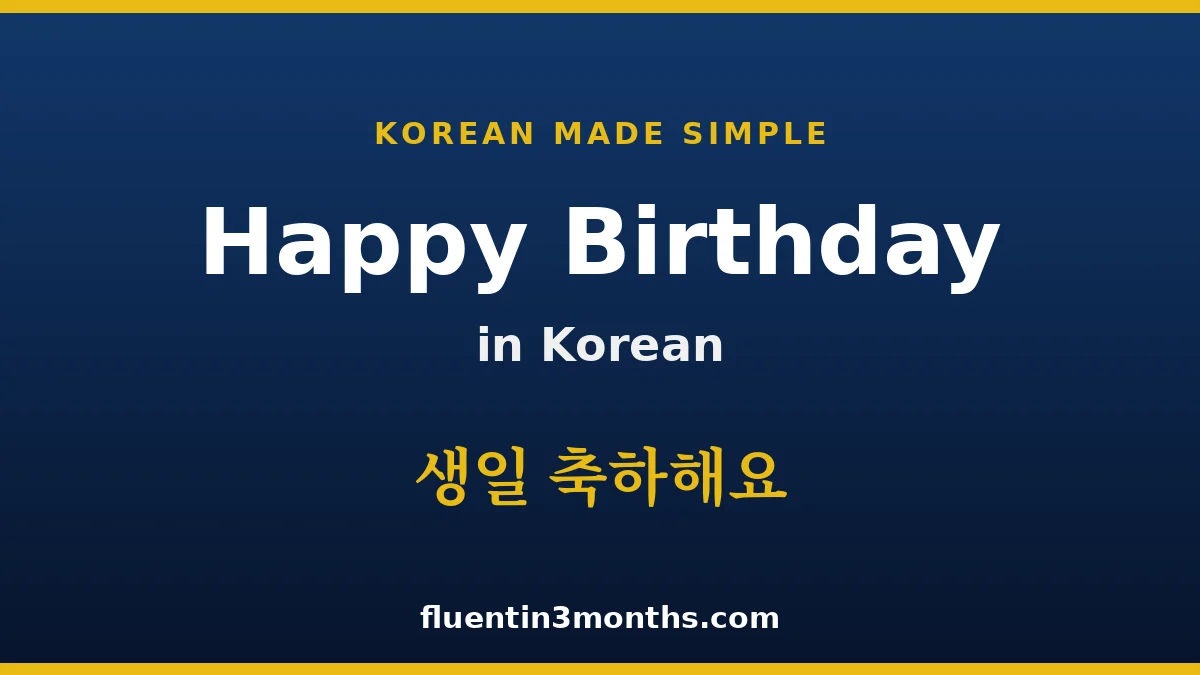
The South Korean linguistic landscape and its accompanying social traditions have undergone a significant transformation in recent years, particularly regarding how milestones such as birthdays are celebrated and calculated. While the phrase saengil chukhahaeyo (생일 축하해요) remains the most prevalent and practical method of wishing someone a happy birthday, the nuances of the Korean language require a sophisticated understanding of social hierarchy, honorifics, and recent legislative changes. In a society where age dictates social standing and interpersonal dynamics, the act of celebrating a birthday is not merely a personal milestone but a complex interaction governed by centuries of Confucian influence and modern administrative standardisation.
Linguistic Precision in Celebratory Greetings
The standard greeting, saengil chukhahaeyo, serves as the primary default for most social interactions. Linguistically, the phrase is a combination of saengil (생일), meaning birthday, and chukhahae (축하해), derived from the verb chukhahada (축하하다), which translates to "to congratulate." The addition of the polite suffix -yo (요) ensures the greeting is appropriate for colleagues, acquaintances, and those of similar social standing. However, the Korean language operates on a spectrum of politeness levels, known as jondaemal (formal/polite speech) and banmal (informal/casual speech).
For a professional journalistic analysis, it is essential to categorize these greetings into four distinct levels of formality. The most casual form, saengil chukhahae (생일 축하해), is strictly reserved for close friends, younger siblings, or instances where both parties have explicitly agreed to drop formalities. Conversely, the most formal version, saengsin chukhadeurimnida (생신 축하드립니다), utilizes the honorific term for birthday, saengsin (생신), and the humble verb deurida (드리다), meaning "to give" or "to offer." This level of deference is mandatory when addressing grandparents, elderly relatives, or individuals of significantly higher social or professional rank.
The June 2023 Legal Transition: Standardizing the International Age System
One of the most significant shifts in Korean society occurred on June 28, 2023, when the South Korean government officially abolished the traditional "Korean age" system in administrative and civil contexts. Under the previous system, known as seneun nai (세는 나이), a person was considered one year old at birth and gained a year every New Year’s Day, regardless of their actual birth date. This often resulted in individuals being one or two years "older" than their international counterparts.
The Ministry of Government Legislation spearheaded this reform to reduce "unnecessary social and economic costs" arising from the confusion of multiple age-counting systems. According to government data released during the transition, nearly 80% of South Koreans supported the move toward the international standard, man nai (만 나이). The shift was intended to streamline legal documents, healthcare records, and retirement eligibility.
However, the transition has not been without complexity. While man nai is now the legal standard, the government maintains a third system called yeon nai (연 나이), or "year age," for specific sectors. This system calculates age by subtracting the birth year from the current year, regardless of the birth month. It remains in use for the Military Service Act and the Protection of Children and Juveniles from Sexual Abuse Act, as well as for the legal age to purchase tobacco and alcohol. This tripartite system—traditional, international, and year-age—continues to influence how birthdays are perceived in social vs. legal contexts.
Historical Context: The Origins of Hangul and Age Calculation
To understand the weight of birthday greetings, one must look at the historical development of the Korean writing system, Hangul. Promulgated in 1446 by King Sejong the Great, Hangul was designed to be a phonetic script that even the common people could learn. Before its creation, Koreans used Hanja (Chinese characters), which were difficult to master and limited literacy to the elite.
The structure of Hangul is intrinsically linked to the physical act of speech. The shapes of the consonants, such as ㄱ (g/k) representing the tongue blocking the throat, reflect a scientific approach to linguistics. This precision carries over into the honorific system used in birthday greetings. The linguistic markers of respect are not merely polite additions but are foundational to the Korean identity, reflecting a historical social structure that prioritized filial piety and seniority.
Symbolism and Sustenance: The Role of Miyeokguk
Beyond the linguistic requirements, Korean birthdays are defined by specific culinary traditions, most notably the consumption of miyeokguk (미역국), or seaweed soup. This tradition is deeply rooted in the concept of maternal health and recovery. Historically, seaweed soup was the primary meal provided to mothers after childbirth due to its high iodine and calcium content, which aided in recovery and lactation.
By eating miyeokguk on their birthdays, Koreans perform a symbolic act of remembering and honoring their mother’s sacrifice and care. Data from cultural surveys suggest that while modern Koreans may opt for Western-style cakes and celebrations, the majority still view seaweed soup as the essential "soul food" of the birthday experience. It serves as a bridge between the individual’s milestone and their family lineage, reinforcing the communal nature of Korean celebrations.
The Doljanchi: A Sociological Perspective on the First Birthday
While every birthday is celebrated, none carries as much historical and cultural weight as the doljanchi (돌잔치), or the first birthday celebration. This tradition dates back to an era when infant mortality rates were high due to poor hygiene and lack of medical resources. Reaching the one-year mark was a significant milestone that signaled a child’s likelihood of survival.
A central feature of the doljanchi is the doljabi (돌잡이), a ritual where the child is placed before various objects. The item the child picks is thought to predict their future:
- Thread or Yarn: Traditionally symbolizes a long and healthy life.
- Money: Predicts future wealth and prosperity.
- Books or Writing Tools: Suggests the child will become a scholar or excel in academics.
- Stethoscope or Gavel: Modern additions predicting careers in medicine or law.
Sociological analysis suggests that the doljanchi remains one of the most expensive and elaborate events in a Korean family’s life, often rivaling weddings in terms of guest lists and catering. It reflects the high value placed on children and the collective hope for the next generation’s success.
Social Implications of the Age Reform
The shift to the international age system has had ripple effects on Korean social etiquette. Because Korean speech levels (jondaemal and banmal) are determined by age, the 2023 law change initially caused confusion in social hierarchies. In schools and workplaces, where even a one-year difference can dictate the use of honorifics, the question of "Who is the senior?" became temporarily muddled.
Reaction from the public has been largely positive, though some older generations expressed nostalgia for the traditional system. "It feels like I’ve gained back two years of my youth," noted one citizen in a televised interview with KBS following the law’s implementation. Conversely, some teachers reported minor "age wars" among students born in the same year who were previously considered the same age but now found themselves in different "international age" brackets.
Despite these social hiccups, the Ministry of Government Legislation has remained firm, stating that the unification of age systems is a "necessary step toward a more globalized and efficient administrative state." The long-term implication is a gradual loosening of the rigid age-based hierarchy in casual settings, although honorific language remains a cornerstone of the culture.
Conclusion: The Enduring Importance of the Birthday Greeting
Whether one is using the formal saengsin chukhadeurimnida for a grandparent or the standard saengil chukhahaeyo for a friend, the act of acknowledging a birthday in Korea is a performance of cultural literacy. It requires an awareness of the recipient’s status, an appreciation for the history of the language, and an understanding of the recent legal shifts that have redefined what it means to "turn a year older."
As South Korea continues to balance its rich traditions with the demands of a modern, globalized society, the birthday remains a vital point of connection. It is a day marked by the memory of a mother’s care (miyeokguk), the celebration of a child’s potential (doljanchi), and the respectful acknowledgement of time passing through the precise application of the Korean language. For the expatriate or the language learner, mastering these nuances is more than a linguistic exercise; it is an entry point into the heart of Korean social harmony.
