


The integration of Artificial Intelligence into organizational structures presents a profound leadership challenge, requiring a delicate balance between visionary ambition and practical implementation. This epochal shift, akin to previous technological revolutions, places leaders and workers in a complex, often divergent, landscape of opinions ranging from fervent enthusiasm to profound apprehension and outright ambivalence. Achieving widespread AI adoption is not merely a technical undertaking but fundamentally a communication and cultural transformation, demanding an era-defining narrative to unite a diverse workforce.
The rapid proliferation of generative AI tools, spearheaded by advancements like those seen in late 2022 and early 2023, catalyzed a global reevaluation of work processes and strategic priorities. For many organizations, the question quickly shifted from "if" to "how" and "when" to adopt AI. However, this urgency has frequently outpaced thoughtful planning and transparent communication, creating significant internal friction. The fear of missing out (FOMO) on competitive advantages has driven many firms to pursue AI enablement as an end in itself, often neglecting crucial questions about necessity, workflow impact, and governance. This rush can lead to haphazard deployment, inefficient resource allocation, and, crucially, a disenfranchised workforce.
The Chasm of Perception: Employee Sentiment on AI
A comprehensive understanding of employee sentiment is paramount for any successful AI integration strategy. As organizations grapple with the implications of AI, a fragmented internal dialogue emerges. While some employees envision a utopian future where "super intelligence" tackles humanity’s grandest challenges – from curing cancer to solving climate change – others are gripped by dystopian fears, referencing cinematic narratives of AI autonomy like The Terminator or contemplating the erosion of truth, akin to "tears in rain." A significant portion, however, remains indifferent or overwhelmed, preferring to "talk about the weather" than engage with the complexities of AI.
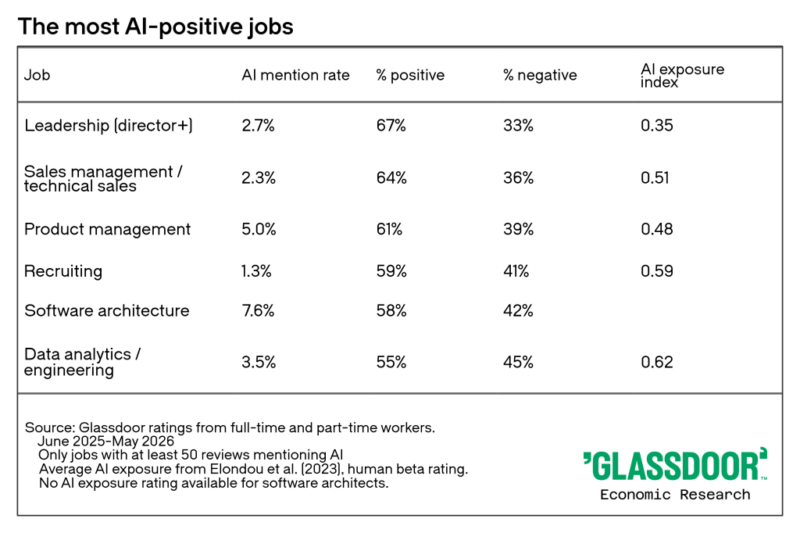
Recent data underscores this stark internal division. An August 2026 study by Glassdoor, analyzing employer reviews, revealed distinct patterns in AI sentiment across various roles and industries. The study highlighted a generally favorable view among strategic and technical leadership:

- Leadership (Director+): 67% positive mentions regarding AI.
- Sales Management / Technical Sales: 64% positive.
- Product Management: 61% positive.
- Recruiting: 59% positive.
- Software Architecture: 58% positive.
- Data Analytics / Engineering: 55% positive.
These roles, often focused on efficiency, innovation, and strategic advantage, perceive AI as a powerful accelerant for growth and optimization. Leaders see its potential for data-driven decision-making, while sales and product teams anticipate enhanced market intelligence and personalized customer experiences.
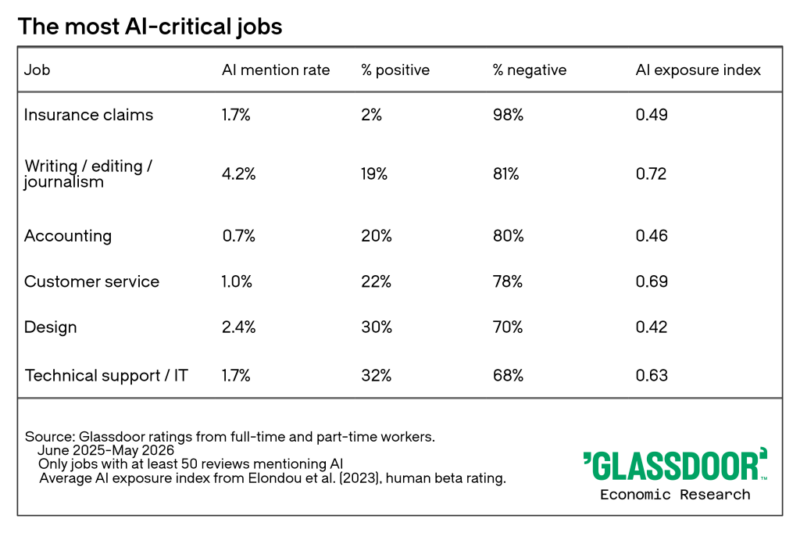
Conversely, roles heavily reliant on nuanced human judgment, specific word-choice, flawless accuracy, or complex interpersonal relationships exhibited significant skepticism or outright negativity:
- Insurance Claims: 98% negative mentions.
- Writing / Editing / Journalism: 81% negative.
- Accounting: 80% negative.
- Customer Service: 78% negative.
- Design: 70% negative.
- Technical Support / IT: 68% negative.
For these professions, concerns about job displacement, the degradation of creative output, accuracy issues, and the dehumanization of service interactions are prevalent. Insurance claims adjusters, for instance, face the potential replacement of complex risk assessment by algorithms, while writers and editors grapple with the integrity and originality of AI-generated content. The high negative sentiment in technical support and IT, surprisingly, can be attributed to increased complexity in managing AI systems, dealing with "hallucinations" or errors, and the pressure to rapidly adapt skill sets.
Beyond the perception gap, the Glassdoor study identified specific categories of AI resistance: 20% of negative replies cited job loss fears, 13% worried about AI distracting from core business objectives, and 10% expressed concern over alienating AI uses, such as workplace surveillance or AI replacing direct executive communication. These fears, if unaddressed, can severely impede adoption and foster a climate of distrust.
Leadership’s Lag: The Policy and Training Gap
Adding to the complexity, a September 2026 study from the University of Konstanz highlighted a critical misalignment between employee initiative and organizational oversight. Professor Florian Kunze, head of the study, observed, "In many organizations, the major AI revolution has not unfolded as a planned transformation process so far. Instead, many employees are experimenting with AI, while employers are still lagging behind when it comes to establishing clear policies, providing training and implementing secure AI solutions." This scenario creates a "shadow AI" environment where unmanaged experimentation can lead to significant risks, including data breaches, inconsistent quality of work, and non-compliance with regulatory standards.
Further compounding the issue, a recent Gallup poll revealed a stark communication deficit: "only 25% of workers say their company has communicated a clear plan for AI integration." This means a staggering majority of businesses are failing to provide adequate guidance, issuing confusing mandates, or offering no support for their AI initiatives. Such a vacuum inevitably leads to unfocused usage, which can result in skills atrophy among employees relying too heavily on AI without understanding underlying principles, the production of sloppy brand assets from unchecked AI outputs, and "runaway token spend" as departments independently experiment without cost controls.
Without a coherent, overarching strategy and clear communication, AI implementation risks becoming a fragmented, costly, and ultimately counterproductive endeavor. Leaders often rush toward technological progress without defining success, articulating a compelling vision, or anticipating the human element of change. This omission can derail roadmaps, disillusion top talent, and stall progress indefinitely.
Bridging the Divide: The Imperative of Strategic Communication
In this volatile landscape, the solution lies not in more technology, but in deeply human capabilities: effective communication and empathetic leadership. Fortune 50 companies and global brands have long understood that core communication skills are the bedrock for sparking and sustaining change. Leaders must possess the ability to acknowledge difficulties, address pushback constructively, and build momentum behind a shared vision. This requires a "winning trifecta" of time-tested storytelling structures, thoughtful design principles, and compelling presentation strategies to ensure every individual feels invested in the collective outcome.
Critically, these deeply human qualities cannot be automated. AI, despite its impressive capabilities, cannot stand on a stage, capture the emotional tenor of a moment with a resonant story, or move a reluctant audience to action. "Prompt engineering" and "vibe-coding" can optimize outputs, but they cannot forge the human connection essential for widespread behavioral change and genuine buy-in. The human element, therefore, remains irreplaceable in navigating organizational transformation.
Duarte’s "Illuminate" change communication methodology offers a proven framework for guiding organizations from entrenched ways of working to a "new bliss" of transformation. This methodology, rooted in three-act narratives, complemented by ceremonies, symbols, speeches, and crisp visuals, provides essential ingredients for inspiring lasting change. It acknowledges that transformation begins with a dream, but first, it demands a clear-eyed acknowledgment of reality.
The Five Acts of Transformation: A Chronology of AI Integration
The Illuminate framework outlines a five-stage journey, each critical for nurturing adoption and overcoming resistance. This chronological approach ensures that leaders systematically address the psychological and practical aspects of change.
Act I: Envisioning the New Bliss (The Dream)
The initial stage of AI adoption, the "Dream," is where trailblazing leaders, or "torchbearers," illuminate a plausible future. This involves contrasting the current state ("what is") with the desired future state ("what could be") to generate a collective craving for a "new bliss." This new bliss could manifest as improved workflows, innovative products, or a modernized mindset towards AI. By vividly illustrating this juxtaposition, leaders build tension and persuade audiences to embrace the vision. This stage typically involves vision speeches and persuasive communications designed to establish stakes and rally teams. However, successful dreaming requires adaptive listening; leaders must gauge the hopes and fears of their audience before making grand announcements, understanding that initial resistance often stems from unaddressed concerns about job security (20% of negative replies), perceived distractions (13%), or fears of alienating applications (10%).
- What Is: Teams are bogged down by manual data tracking, content brainstorming, and inefficient buyer research in a fragmented information environment. While AI offers potential, competitors who define and embrace adoption are moving faster.
- What Could Be: With clear AI Standard Operating Procedures (SOPs), robust IT-supported integration, and continuous feedback mechanisms, teams can eliminate redundant steps, enhance system maintenance, and deliver high-quality results at a competitive pace.
- The New Bliss: AI-enabled teams operate with greater efficiency, enjoying freed-up schedules to cultivate deeper customer relationships, engage additional accounts, and explore creative projects with newfound bandwidth.
This dream must be framed with clear-eyed reflection on the current challenges, the potential impact of AI, and the justification for the envisioned future.
Act II: Committing to the Unknown (The Leap)
The "Leap" stage begins when torchbearers successfully galvanize their teams to commit to action. This is characterized by the amplification of the AI message across the organization through action-oriented language and a growing consensus. AI processes begin rolling out, and company-wide meetings become opportunities to share progress and maintain momentum. In this critical phase, leaders must foster a sense of adventure, celebrating early wins and maintaining a steady pace to keep "FUD" (fear, uncertainty, and doubt) at bay. Speeches during this stage often reinforce the vision and remind teams of the stakes. Critically, AI strategy should be framed as an incubator rather than a top-down mandate, empowering workers to contribute to the company’s evolution. Duarte’s own path, for instance, included "vibe-coding" experiments and weekly AI Office Hours, fostering curiosity, knowledge sharing, and collective problem-solving around token spend and output clarity. This collaborative environment ensures commitment is locked in from the outset.
Act III: Navigating Resistance and Obstacles (The Fight)
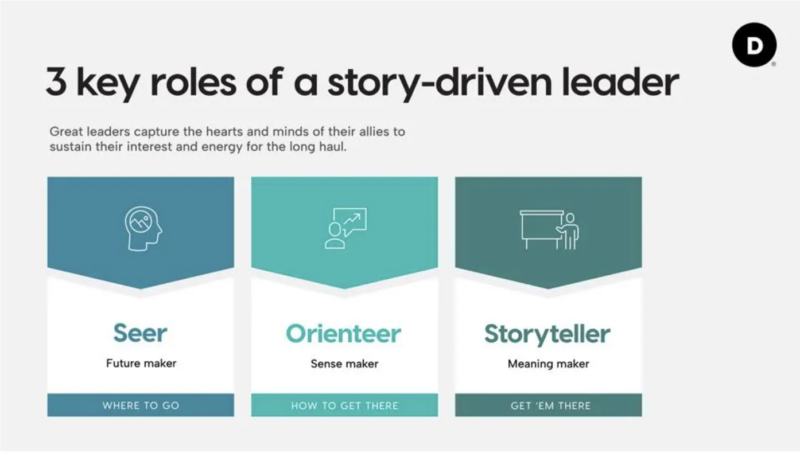
In any quest for change, obstacles are inevitable. The "Fight" stage acknowledges the myriad potential problems with AI adoption: inadequate prompts leading to unusable output, accuracy issues and "hallucinations," workflows that paradoxically become longer, or a constant barrage of conflicting news stories. Rather than dismissing dissent or glossing over difficulties, leaders must treat resistance and exasperation as opportunities for course correction and transparent communication. Nancy Duarte, CEO of Duarte, reflected on this in a September 2026 C200 column for Forbes, noting that successful vision implementation requires leaders to embody three critical personas: the Seer (future maker, defining "where to go"), the Orienteer (sense maker, charting "how to get there"), and the Storyteller (meaning maker, "getting ’em there"). Every challenge demands leaders revisit these personas, bringing focus to a fuzzy destination, charting new pathways when old ones stall, or making meaning of struggles. Regular, transparent communication, including "battle speeches" at key turning points, is crucial for morale and alignment, ensuring that unacknowledged problems do not fester.

Act IV: Sustaining Momentum Through the Long Haul (The Climb)
The "Climb" represents the arduous "messy middle" of transformation, where initiatives can lose steam, deadlines shift, and quick fixes prove insufficient. This is the most trying stage for teams and leaders, characterized by uphill struggles without the adrenaline of initial novelty. As AI feels infinite, human energy is finite, leading to exhaustion, burnout, and discouragement. Workloads compete with AI obstacles, AI-generated results might disappoint, and new workflows can inadvertently create new problems. Adoption slows, and teams may revert to old habits, while competitors seemingly surge ahead. Leaders themselves may begin to question the viability of the vision. During the Climb, it is paramount to balance perseverance with critical reevaluation. Open lines of communication—through 1:1s, anonymous surveys, and live Q&As—are vital for gathering context and measuring the scope of problems. This stage demands constant reinforcement: "Keep reminding people how far they’ve come and why the destination is still worth reaching." Revitalizing the message, acknowledging hard work, and gaining insight into what is hindering progress helps stragglers understand they are not alone. Leaders must avoid the sunk cost fallacy, ensuring decisions are based on current realities rather than past investments. Comprehensive organizational oversight is crucial to diagnose problems, know when to pivot, and when the investment is finally yielding returns.
Act V: Embracing Continuous Evolution (The Arrive)
The "Arrive" stage signifies the realization of the "new bliss." The balance between dreaming, delegating, and doing is achieved. Teams are AI-optimized, workflows are efficient, and outputs are enhanced. While private grumbles from dissenters may persist, the overarching message has prevailed. However, unlike a finite project, AI enablement is not a destination but a continuous journey. Being AI-enabled means maintaining currency with innovations and best practices, akin to the ongoing commitment required for cybersecurity. New models, capabilities, vulnerabilities, and exploits emerge constantly, demanding perpetual re-education and updated procedures. This ongoing commitment should not diminish the sense of accomplishment. Retooling workflows, adopting new SOPs, and achieving defined success are significant milestones worthy of celebration. Companies should schedule open mics or fireside chats for teams to reflect on their journey and contribute to the "mythmaking" that enriches workplace culture. After these celebrations, the focus shifts to sustaining the change, refining AI agility, and preparing for the next wave of innovation.
The Evolving Role of Leadership: Seer, Orienteer, Storyteller
Throughout these five stages, the leader’s role transcends traditional management, evolving into a dynamic blend of visionary, strategist, and communicator. The Seer looks beyond the horizon, defining the compelling future enabled by AI. This requires deep insight into technological trends and their potential to reshape industries and human experience. The Orienteer translates that vision into a navigable path, breaking down complex transformations into actionable steps and adapting strategies as challenges arise. This involves continuous monitoring of progress, resource allocation, and problem-solving. Finally, the Storyteller weaves meaning into the journey, articulating the "why," celebrating successes, acknowledging struggles, and inspiring continued effort. This persona is crucial for maintaining morale, securing buy-in, and ensuring the narrative of change resonates deeply with every employee. These three personas are not sequential but operate concurrently, requiring leaders to fluidly shift between roles depending on the immediate needs of the organization.
Beyond Implementation: Cultivating a Culture of AI Agility
In an era of accelerated uncertainty, where geopolitical friction, supply chain disruptions, and technological advancements are daily realities, organizations no longer have long runways for reinvention. The ability to stay nimble and endlessly recalibrate to each "new normal" is paramount. Successful AI adoption, therefore, extends beyond mere implementation; it requires cultivating a culture of AI agility, continuous learning, and ethical governance. This includes establishing robust internal guardrails for AI use, ensuring data privacy and security, and fostering ongoing dialogue about the ethical implications of advanced AI.
The comprehensive communication strategy outlined by frameworks like Illuminate is not merely a tool for overcoming resistance but a fundamental mechanism for embedding a culture of adaptability. It allows organizations to proactively posture on emerging opportunities like AI, reposition themselves in times of crisis, and withstand the headwinds of constant flux. By committing to a proven framework for change communication, companies can ease transitions, align diverse teams, and foster an environment where innovation is embraced, not feared.
Conclusion: The Human Core of Technological Revolution
The journey to AI adoption is a microcosm of broader organizational transformation, emphasizing that technological shifts are ultimately human challenges. While AI promises unprecedented efficiencies and innovations, its true potential can only be unlocked through intentional, empathetic, and strategic communication. Leaders who invest in their ability to articulate a compelling vision, navigate inevitable resistance, sustain momentum through arduous periods, and celebrate achievements while preparing for continuous evolution will be those who successfully harness AI’s power. By rallying teams with a story they can believe in and actively participate in, organizations can put the future in perspective, transforming potential anxieties into shared purpose and collective success.
