


The electrifying conclusion to the BMW Championship on Sunday, where Wyndham Clark secured a dramatic three-shot victory, offered a compelling, albeit subtle, illustration of fundamental human psychology at play, even among the world’s elite athletes. Clark, who began the final round with a commanding five-stroke lead, saw his advantage dwindle significantly on the back nine before a spectacular three-birdie finish cemented his triumph. This nail-biting drama, watched closely by many, including those with a casual interest in golf, harkens back to significant academic research exploring the psychological nuances of performance under pressure.
Unpacking the Data: A Deeper Look at Putting Performance
Years prior to this weekend’s exhibition of golfing prowess, researchers Devin Pope and Maurice Schweitzer delved into the intricate world of professional golf putting. Their seminal 2011 study, "Is Tiger Woods Loss Averse? Persistent Bias in the Face of Experience, Competition, and High Stakes," published in the prestigious American Economic Review, analyzed an astounding dataset. By leveraging precise ShotLink measurements, the study meticulously examined over 2.5 million putts taken by 421 professional golfers across a five-year span, from 2004 to 2009.
The findings were striking and counterintuitive to a purely objective assessment of the game. The research revealed that professional golfers were consistently, and statistically significantly, between 2 to 4 percentage points more likely to successfully make a par putt than a comparable birdie putt. This disparity, observed across thousands of golfers and millions of attempts, held true even when controlling for factors such as putt distance, golfer experience, and the competitive environment. In essence, the same golfer, facing the same putt distance under similar conditions, exhibited a discernible difference in success rates based on the putt’s implication: par versus birdie.
The Behavioral Economics Behind the Swing: Loss Aversion’s Grip
The explanation for this phenomenon, according to Pope and Schweitzer, lies in the psychological principle of loss aversion, a concept famously articulated by behavioral scientists Daniel Kahneman and Amos Tversky. Loss aversion posits that the psychological impact of a loss is felt more intensely than the pleasure derived from an equivalent gain. In simpler terms, humans are wired to fear losing what they have more than they are motivated to gain something new.
In the context of golf, this principle manifests in the subtle psychological weight attached to different types of putts. When a golfer stands over a birdie putt, they are presented with an opportunity for a gain – shaving a stroke off their score relative to par. While a missed birdie putt is disappointing, the golfer still has the potential to make par with their subsequent stroke, assuming it is holed.
However, the psychological calculus shifts dramatically when facing a par putt. A missed par putt represents a loss – a stroke conceded to the course. While objectively, each stroke holds the same value on the scorecard, the emotional and psychological experience in the moment of decision can be vastly different. This difference in perceived stakes, driven by the fear of losing a stroke, appears to exert a subtle but measurable influence on even the most practiced and skilled putters in the world.
Evolution of the Bias: Tournament Stage and Competitive Focus
Interestingly, Pope and Schweitzer’s research also uncovered a dynamic evolution of this putting bias throughout a tournament. The study noted that the gap between par and birdie putting success rates tended to decrease as a tournament progressed. Specifically, the difference narrowed from approximately 3.8 percentage points in the first round to 2.1 percentage points in the final round. Crucially, however, the phenomenon never entirely disappeared, even in the high-pressure crucible of the final round.
The researchers attributed this reduction in the loss aversion effect in later stages of a tournament to a shift in players’ psychological focus. In the initial rounds, golfers are primarily concerned with their score against par for the course. As the tournament advances, particularly into the final round, their focus intensifies on their position relative to other competitors on the leaderboard. This heightened awareness of the competitive field, and the potential gains or losses in ranking, appears to temper the singular fear of losing a stroke to par.
Broader Implications: Scarcity Beyond the Sales Floor
The implications of this research extend far beyond the greens of professional golf. The findings offer a potent reminder that the principle of scarcity, often associated with marketing tactics like "limited time offers" or "only a few left," can manifest in more nuanced ways. As Brian Ahearn, a renowned expert in ethical influence and faculty member at the Cialdini Institute, highlights, scarcity can also be the perceived risk of losing something that is already possessed or within reach.
In the case of the golfer, the "scarce" element is the avoidance of a dropped stroke. This inherent human tendency to prioritize avoiding loss over pursuing gain has profound implications for understanding decision-making in various domains. Whether it’s a consumer considering a purchase, an investor managing their portfolio, or an individual making a significant life choice, the fear of loss can often exert a more powerful influence than the prospect of an equivalent gain.
Ethical Influence and Self-Awareness
For professionals aiming to ethically influence others, understanding this psychological bias is paramount. The goal, as Ahearn emphasizes, is not to manipulate individuals by exploiting their fear of loss. Instead, it is to foster awareness of how these natural decision-making processes operate and to communicate relevant information truthfully and transparently. By recognizing the power of loss aversion, communicators can frame information in a way that resonates more effectively without resorting to deceptive practices.
This awareness is equally critical for individuals navigating their own choices. The next time a significant decision looms, a conscious self-inquiry can be beneficial: Is the motivation driven by a genuine desire for a potential gain, or is it a stronger reaction fueled by the apprehension of losing something? Recognizing this distinction can lead to more considered and less emotionally driven decisions, ultimately contributing to better outcomes.
The Human Element in Elite Performance
The BMW Championship, with its dramatic swings and eventual triumph for Wyndham Clark, serves as a vibrant backdrop to these psychological insights. It underscores that even athletes who dedicate their lives to honing their craft, competing under immense pressure, and with substantial financial stakes on the line, are still subject to the fundamental workings of the human mind. Their relentless practice, extensive experience, and mental fortitude allow them to mitigate these biases, but not entirely eradicate them.
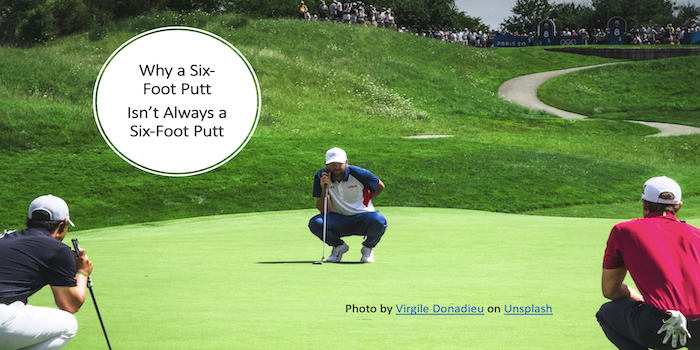
The research by Pope and Schweitzer, grounded in rigorous data analysis, provides a scientific lens through which to appreciate the intricate interplay of skill, pressure, and psychology that defines elite sports. It reminds us that behind every seemingly simple action, like a six-foot putt, lies a complex web of cognitive processes that can influence the outcome.
A Question for the Avid Golfer
For those who actively participate in the sport, the question remains a subject of personal experience. Do you, as a golfer, perceive a tangible difference in your mindset and performance when standing over a six-foot putt intended for birdie compared to one for par? The answer, informed by both scientific research and individual reflection, continues to illuminate the fascinating landscape of human behavior under the watchful eye of competition. The BMW Championship, in its unfolding drama, offered a compelling, albeit unintentional, demonstration of these enduring psychological principles at play.
