


For centuries, the wisdom of philosophers and leaders alike has underscored the paramount importance of listening. From Epictetus’s timeless observation that "We have two ears and one mouth so that we can listen twice as much as we speak," to Ram Dass’s insight that "The quieter you become, the more you can hear," and Richard Branson’s pragmatic assertion that "Nobody learned anything by hearing themselves speak," the message has been consistent: effective listening is often equated with silence, attentiveness, and the absence of interruption. This traditional understanding, ingrained in us from early childhood, typically posits that merely paying attention, maintaining eye contact, and nodding in agreement are the hallmarks of a good listener. While these foundational elements are indeed crucial, a growing body of research and contemporary workplace dynamics suggest that this long-held philosophy, while valuable, represents merely the baseline of effective communication, particularly within complex professional environments.
The evolution of communication theory reflects a progression from simple reception to more engaged forms of listening. Initially, listening was often viewed as a passive process, the counterpart to speaking. The mid-20th century saw the emergence of "active listening," a concept popularized in the humanistic psychology movement, notably by Carl Rogers. Active listening advocates for demonstrating engagement through verbal and non-verbal cues, such as paraphrasing what has been heard to confirm understanding, asking clarifying questions, and reflecting feelings. This approach marked a significant advancement, moving beyond passive reception to a more empathetic and involved engagement with the speaker’s message. Its integration into workplace training programs aimed to reduce misunderstandings, foster rapport, and improve interpersonal relationships. However, despite its widespread adoption and proven benefits, active listening, primarily focused on accurately receiving and confirming information, often falls short in addressing the diverse and dynamic needs of speakers in a high-stakes professional setting. It ensures comprehension but doesn’t inherently guide the listener on how to respond in a way that truly serves the speaker’s underlying objective.
The Limitations of Conventional Listening in a Dynamic Work Environment
The contemporary workplace is characterized by unprecedented complexity. Global teams, rapid technological advancements, diverse communication styles, and constant pressures for innovation and efficiency demand more than just attentive ears. While active listening techniques like paraphrasing and maintaining eye contact are beneficial for basic information exchange, they often treat all communication interactions as fundamentally similar – a transfer of information to be understood. This approach overlooks the nuanced goals a speaker might have beyond merely being heard or understood. For instance, a colleague sharing a personal challenge may not need their words paraphrased but rather emotional validation. A project manager detailing a critical issue might require not just comprehension but immediate problem-solving or delegation.
Studies on workplace communication consistently highlight that miscommunication is a significant drain on productivity and morale. A report by the Economist Intelligence Unit, for example, revealed that poor communication leads to lower morale (44%), delays or failures in project completion (18%), and missed performance objectives (25%). While active listening can mitigate some of these issues by ensuring clarity, it doesn’t equip listeners to proactively identify and meet the deeper, often unstated, needs that drive a speaker’s communication. This gap underscores the necessity for a more sophisticated, adaptive approach to listening that goes beyond mere attention or confirmation of understanding.
Introducing Adaptive Listening™: A Goal-Oriented Framework
To address the limitations of traditional and even active listening, the concept of Adaptive Listening™ has emerged as a refined methodology designed specifically for the multifaceted demands of professional interaction. Adaptive Listening shifts the focus from "What am I hearing?" or "Do I understand?" to the more profound question: "What does the person speaking need from me?" This empathetic, goal-oriented approach posits that effective listening is not a monolithic skill but rather a spectrum of responses tailored to the speaker’s specific objectives and emotional state. It requires critical analysis, keen observation, and an understanding that different situations call for different listening strategies.

This framework is particularly vital in environments where stakes are high, decisions are critical, and collaboration is paramount. It encourages listeners to move beyond self-focused internal monologues ("What’s in it for me?" or "How does this impact my job?") and instead prioritize the speaker’s agenda. By consciously seeking to understand the speaker’s underlying need, Adaptive Listeners™ are better positioned to provide a response that truly supports, advances, immerses, or discerns, leading to significantly better outcomes for individuals, teams, and the organization as a whole. This proactive and empathetic stance is increasingly recognized by organizational psychologists as a core competency for modern leadership and team effectiveness.
The S.A.I.D.™ Framework: Four Pillars of Adaptive Listening
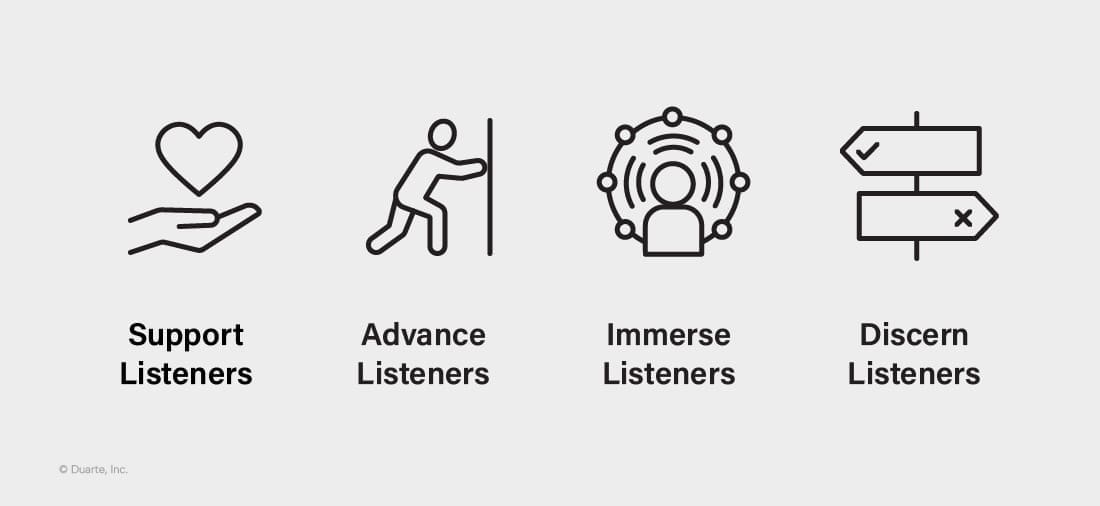
Adaptive Listening™ is structured around four distinct, yet interconnected, listening goals, easily remembered by the acronym S.A.I.D.™ (Support, Advance, Immerse, Discern). These categories represent the primary objectives speakers typically seek to achieve when communicating in a professional context. Understanding and applying these goals allows listeners to tailor their responses, moving beyond generic attentiveness to targeted, impactful engagement.
1. Support Listening™: Fostering Connection and Psychological Safety
Support Listening™ is activated when a speaker’s primary need is emotional validation, connection, or empathy. This often arises during challenging times, such as stress, setbacks, or personal difficulties, but also during moments of triumph and celebration. In these instances, the speaker is not necessarily seeking solutions or advice, but rather a confidant, a cheerleader, or simply someone who acknowledges their feelings.
Characteristics and Application: When a colleague expresses, "I’m having a horrible day" after a project failure, or exclaims, "I have the best news!" upon securing a new client, these are clear signals for Support Listening. The listener’s role is to mirror the speaker’s emotions, offering words and actions that validate their experience. This might involve expressing commiseration ("That sounds incredibly frustrating, I’m sorry you’re going through that") or genuine celebration ("That’s fantastic news! You absolutely deserve it!"). The goal is to create psychological safety, allowing the speaker to feel heard, understood, and connected. Research consistently demonstrates that environments rich in psychological safety lead to higher employee engagement, increased innovation, and better team performance. By providing empathetic support, Adaptive Listeners contribute directly to a more resilient and cohesive work culture, reducing feelings of isolation and burnout.
2. Advance Listening™: Driving Progress and Overcoming Obstacles
Advance Listening™ is employed when the speaker needs assistance in moving a person, project, or process forward. This often occurs when individuals feel overwhelmed, stuck, or are facing time constraints and require tangible help or a clear path to the next step. The speaker is actively seeking solutions, delegation, or direct intervention to lighten their load or accelerate progress.
Characteristics and Application: Cues for Advance Listening include statements such as, "I don’t think I’ll have time to finish all of this," or "I don’t know how I’m going to keep this project moving." An Adaptive Listener recognizes these as calls for action. Responses might include offering direct assistance ("I can take some of this off your plate and handle X task"), proposing solutions ("Have you considered reaching out to [team member] for Y?"), or facilitating delegation ("Let’s brainstorm who else could contribute to accelerate this"). The effectiveness of Advance Listening is directly tied to productivity and project success. By actively helping to unburden colleagues or streamline processes, Adaptive Listeners become catalysts for efficiency and problem-solving, preventing bottlenecks and fostering a culture of proactive support. This contributes to better resource management and timely project completion, which are critical metrics for organizational success.
3. Immerse Listening™: Absorbing Information and Fostering Understanding
Immerse Listening™ is essential in situations where the speaker’s primary goal is to deliver information, updates, or even entertainment, without necessarily seeking immediate feedback, judgment, or action. The listener’s role is akin to a sponge – to absorb the content, learn, and internalize the message without interrupting or injecting personal opinions.
Characteristics and Application: When a presenter states, "I’m here to give you an update today," or a team leader says, "Sit back and enjoy this overview of our quarterly results," these indicate a need for Immerse Listening. The Adaptive Listener’s task is to focus intently on comprehending the material. This involves active note-taking, mentally cataloging key points, and perhaps asking clarifying questions after the delivery, purely for the purpose of ensuring accurate understanding rather than challenging the content. Failure to immerse effectively can lead to misinformation, missed deadlines, or a lack of alignment within teams. Conversely, proficient Immerse Listening ensures that crucial knowledge is transferred efficiently, supporting effective training programs, successful onboarding processes, and well-informed strategic planning across the organization. This underpins the collective intelligence and informed decision-making capacity of the workforce.
4. Discern Listening™: Critical Evaluation and Risk Assessment
Discern Listening™ is invoked when a speaker requires critical feedback, evaluation, or an objective assessment of an idea, project, presentation, or even a situation involving people. This form of listening is crucial for identifying strengths, weaknesses, potential risks, and opportunities that might otherwise go unnoticed. It underpins quality control, strategic adjustments, and innovation.
Characteristics and Application: Cues for Discern Listening often include phrases such as, "I need some feedback on this," or "I’m not sure if this makes sense." The Adaptive Listener’s responsibility is to engage in critical thinking, analyzing the information presented to pinpoint both positive aspects and potential red flags. This might involve asking probing questions to uncover assumptions, offering constructive criticism, suggesting alternative perspectives, or highlighting unforeseen consequences. For example, in reviewing a new marketing strategy, a Discern Listener might ask, "Have we considered the ethical implications of this approach?" or "What are the potential competitive responses?" This objective evaluation is vital for avoiding costly mistakes, optimizing processes, and fostering a culture of continuous improvement. Organizations that encourage Discern Listening are better equipped to innovate, manage risks, and make robust, well-considered decisions, ultimately strengthening their competitive advantage.
The Broader Impact and Implications of Adaptive Listening
The implementation of Adaptive Listening™ extends far beyond individual interactions, profoundly influencing organizational culture and performance. By consciously adopting an empathetic, goal-oriented listening stance, professionals cultivate a workplace where:
- Trust and Psychological Safety Flourish: When employees feel genuinely heard and understood according to their needs, trust levels increase. This fosters an environment where individuals are more willing to take risks, share ideas, and admit mistakes without fear of retribution, accelerating innovation and problem-solving.
- Decision-Making is Enhanced: With varied listening approaches, especially Discern Listening, organizations can make more informed and robust decisions. Critical evaluation from diverse perspectives minimizes blind spots and ensures comprehensive analysis of opportunities and risks.
- Productivity and Efficiency Improve: Advance Listening directly translates into more streamlined workflows and proactive problem resolution, reducing project delays and increasing overall operational efficiency.
- Employee Engagement and Retention Rise: Feeling supported, understood, and having one’s contributions valued through appropriate listening strategies significantly boosts morale and engagement, reducing turnover rates and fostering a more committed workforce.
- Conflict is Mitigated: By addressing the underlying needs of speakers, Adaptive Listening reduces misunderstandings and emotional friction, leading to more constructive conflict resolution and healthier team dynamics.
- Leadership Effectiveness is Amplified: Leaders who master Adaptive Listening can better understand their teams’ challenges, aspirations, and needs, enabling them to provide more targeted support, delegate effectively, and inspire greater performance.
The shift towards Adaptive Listening represents a crucial evolution in communication skills, moving beyond merely hearing words to understanding and responding to the speaker’s true intent. This framework acknowledges the dynamic nature of human interaction in the workplace, where a single conversation might require a blend of different listening types, or a quick pivot from one to another. Mastering this adaptability is not an innate talent but a learnable skill, cultivated through conscious practice, self-awareness, and a genuine commitment to understanding the "why" behind what is being communicated.
In an era where remote work, global collaboration, and rapid change are the norm, the ability to discern and meet the diverse needs of communicators is no longer a soft skill but a critical competency for organizational resilience and success. Resources like dedicated training programs and publications, such as the book "Adaptive Listening: How to Cultivate Trust and Traction at Work," are emerging to guide professionals in integrating these sophisticated listening strategies into their daily interactions, ultimately fostering more effective, empathetic, and productive workplaces. By continually asking, "What does the person speaking need from me?" individuals and organizations can unlock new levels of trust, collaboration, and collective achievement.