

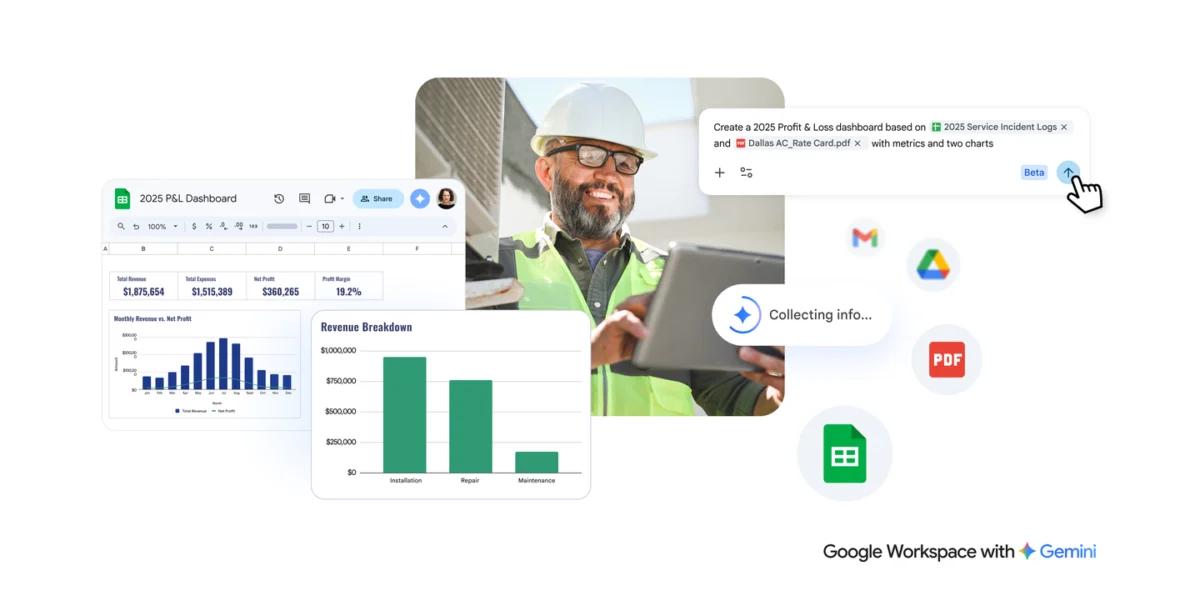
Google has officially transitioned into a new era of automated data management with the announcement of comprehensive beta features for Gemini in Google Sheets, designed to provide users with the ability to create, organize, and edit complex spreadsheets through natural language processing. This update represents a significant shift from passive AI assistance to autonomous agentic behavior, allowing the AI to handle everything from basic formatting tasks to sophisticated data analysis. According to the company’s latest performance metrics, Gemini in Sheets has achieved a state-of-the-art success rate of 70.48% on the SpreadsheetBench dataset. This public benchmark evaluates the proficiency of large language models in executing real-world spreadsheet manipulations, and Gemini’s latest score places it within close proximity to the accuracy levels typically exhibited by human experts.
The rollout of these features is part of a broader ecosystem update that spans Google Drive, Docs, and Slides, reinforcing Google’s commitment to integrating generative AI across its entire productivity suite. By enabling Gemini to interact directly with the structure and content of spreadsheets, Google is addressing one of the most significant pain points in enterprise productivity: the manual labor associated with data entry, cleaning, and complex formula construction.
The Evolution of Gemini in Google Sheets
The integration of Gemini into Google Sheets has evolved through several developmental phases, beginning with simple formula suggestions and progressing toward the current state of autonomous manipulation. Earlier iterations of AI in spreadsheets were largely confined to "Help me organize" sidebars, which could generate templates based on a prompt. However, the new beta features allow for a much deeper level of interaction.
Users can now describe a desired outcome—such as "analyze the Q3 sales data, highlight the underperforming regions in red, and create a summary table on a new tab"—and Gemini will execute the multi-step process autonomously. This capability relies on Gemini’s ability to understand the spatial relationships within a grid, a task that has historically been difficult for large language models (LLMs) which are primarily trained on linear text.
The move toward "state-of-the-art proficiency" in spreadsheet manipulation is a direct response to the increasing complexity of modern data environments. As businesses move away from static documents toward dynamic, interconnected data sets, the demand for an AI that can navigate these structures without constant human oversight has grown.
Analyzing the SpreadsheetBench Milestone
The 70.48% success rate on the SpreadsheetBench dataset is the central pillar of Google’s latest announcement. SpreadsheetBench is a rigorous, public evaluation framework designed to test how well AI models can handle the nuances of real-world spreadsheet tasks. These tasks often include cross-sheet references, complex conditional formatting, data cleaning (such as removing duplicates or standardizing date formats), and the generation of advanced pivot tables.
A success rate of over 70% is statistically significant in the field of AI-assisted productivity. Most previous models struggled to surpass the 50-60% threshold due to the "hallucination" problem—where an AI might suggest a formula that looks correct but is syntactically invalid—or a failure to understand the context of specific columns. By nearing human-expert ability, Gemini in Sheets demonstrates a reduction in these errors, making it a viable tool for professional-grade data analysis.
Comparatively, earlier benchmarks for AI in spreadsheet tasks showed that models often failed when a task required more than three sequential steps. Gemini’s performance suggests a breakthrough in long-context reasoning and task planning, allowing the model to hold the entire state of a multi-tab workbook in its "memory" while performing edits.
Chronology of AI Integration in Google Workspace
The journey to this March 2026 update has been marked by several key milestones in Google’s artificial intelligence roadmap:
- Early 2023: Introduction of Duet AI. Google first introduced AI-driven features under the "Duet AI" branding, focusing on generative text in Docs and Gmail.
- Early 2024: The Rebranding to Gemini. Following the launch of the Gemini 1.0 and 1.5 models, Google rebranded its Workspace AI to align with its most powerful underlying technology.
- Late 2024: Long-Context Integration. The introduction of the 1-million-plus token context window allowed Gemini to "read" entire folders in Drive, setting the stage for more complex data handling in Sheets.
- 2025: Autonomous Agent Beta. Google began testing "agents" that could perform tasks across multiple Workspace apps, such as pulling data from a Doc to populate a Sheet.
- March 2026: The SpreadsheetBench Breakthrough. The current announcement marks the point where Gemini’s spreadsheet-specific reasoning reached the 70% proficiency mark, leading to the release of the current beta features for complex autonomous editing.
Supporting Data and Technical Infrastructure
The success of Gemini in Sheets is attributed to the underlying Gemini 1.5 Pro architecture, which utilizes a "mixture-of-experts" (MoE) approach. This allows the model to activate only the most relevant pathways for a given task, such as mathematical reasoning or code generation, when processing a spreadsheet prompt.
Data provided by Google indicates that the "describe what you need" interface has reduced the time spent on repetitive formatting tasks by approximately 40% in internal pilot groups. Furthermore, for complex tasks involving "VLOOKUP" or "INDEX MATCH" functions—functions that are notoriously difficult for novice users to master—Gemini’s success rate in generating the correct syntax on the first attempt has improved by nearly 30% compared to the 2025 model versions.
The SpreadsheetBench results also highlight Gemini’s superiority over contemporary competitors. While other enterprise AI solutions have focused on "chat-over-data" (where the AI answers questions about the data), Google has focused on "action-on-data" (where the AI modifies the data itself). This distinction is critical for users who need to transform raw data into a finished report rather than just receiving a summary.
Official Responses and Industry Reaction
While official statements from Google executives emphasize the democratization of data science, industry analysts have noted the competitive implications for the broader software market.
"The ability to manipulate spreadsheets with a 70% success rate is a watershed moment for the ‘No-Code’ movement," says one industry report from a leading technology consultancy. "It effectively turns every Workspace user into a data analyst. The gap between knowing what you want to do with data and knowing how to write the specific formula is finally closing."
Internal sources at Google, as referenced in the Keyword and Workspace blog posts, suggest that the feedback from early beta testers has been instrumental in refining Gemini’s "reasoning steps." Users reported that the AI is now better at asking clarifying questions—such as "Should I include the header row in this calculation?"—rather than making assumptions that could lead to data errors.
Broader Impact and Implications for the Future of Work
The implications of Gemini reaching human-expert proficiency in spreadsheet manipulation are profound. For small businesses, it reduces the need for specialized data entry or accounting staff. For large enterprises, it allows highly skilled analysts to offload "spreadsheet drudgery" to the AI, freeing them to focus on high-level strategy and interpretation.
However, this advancement also brings to the forefront questions regarding data governance and accuracy. With an AI achieving a 70.48% success rate, there remains a nearly 30% margin where human oversight is essential. Professional journalistic analysis suggests that while the AI can handle the "heavy lifting," the role of the human worker is shifting from "creator" to "editor" and "validator."
Furthermore, the integration across Sheets, Drive, Docs, and Slides hints at a future where a single prompt can trigger a chain of events: Gemini analyzes a dataset in Sheets, writes a summary in Docs, saves the source files in an organized Drive folder, and generates a presentation in Slides. This "inter-app autonomy" is the logical next step in Google’s AI strategy.
Conclusion and Future Outlook
The March 2026 update to Gemini in Sheets represents a milestone not just for Google, but for the field of applied artificial intelligence. By achieving state-of-the-art results on the SpreadsheetBench dataset, Google has demonstrated that LLMs are capable of mastering the non-linear, logic-heavy environment of the spreadsheet.
As the beta features roll out to more Workspace users, the focus will likely shift toward closing the remaining 30% gap in proficiency. Future updates are expected to focus on "zero-error" reliability for financial and legal data, where even minor discrepancies can have significant consequences. For now, the 70.48% success rate stands as the new benchmark for the industry, challenging competitors to match Gemini’s ability to turn natural language descriptions into complex, functional data structures.
Users interested in exploring these capabilities can access the beta features through their Google Workspace Labs account, with a full commercial rollout expected to follow later this year. The convergence of high-level reasoning and autonomous action suggests that the spreadsheets of the future will not be built cell by cell, but through a collaborative dialogue between human intent and machine execution.