

The Greek language, a cornerstone of Western civilization with a documented history spanning over 3,400 years, possesses a unique and intricate system of endearment that reflects the profound importance of interpersonal relationships in Hellenic culture. Beyond mere vocabulary, these terms of affection—ranging from romantic epithets to familial diminutives—serve as a linguistic bridge connecting ancient philosophical concepts of love with the modern daily interactions of the Greek-speaking world. In contemporary Greece and Cyprus, the use of endearments is not merely a stylistic choice but a fundamental social lubricant that fosters intimacy, reinforces family hierarchies, and maintains the "pathos" or emotional depth for which the Mediterranean region is renowned.
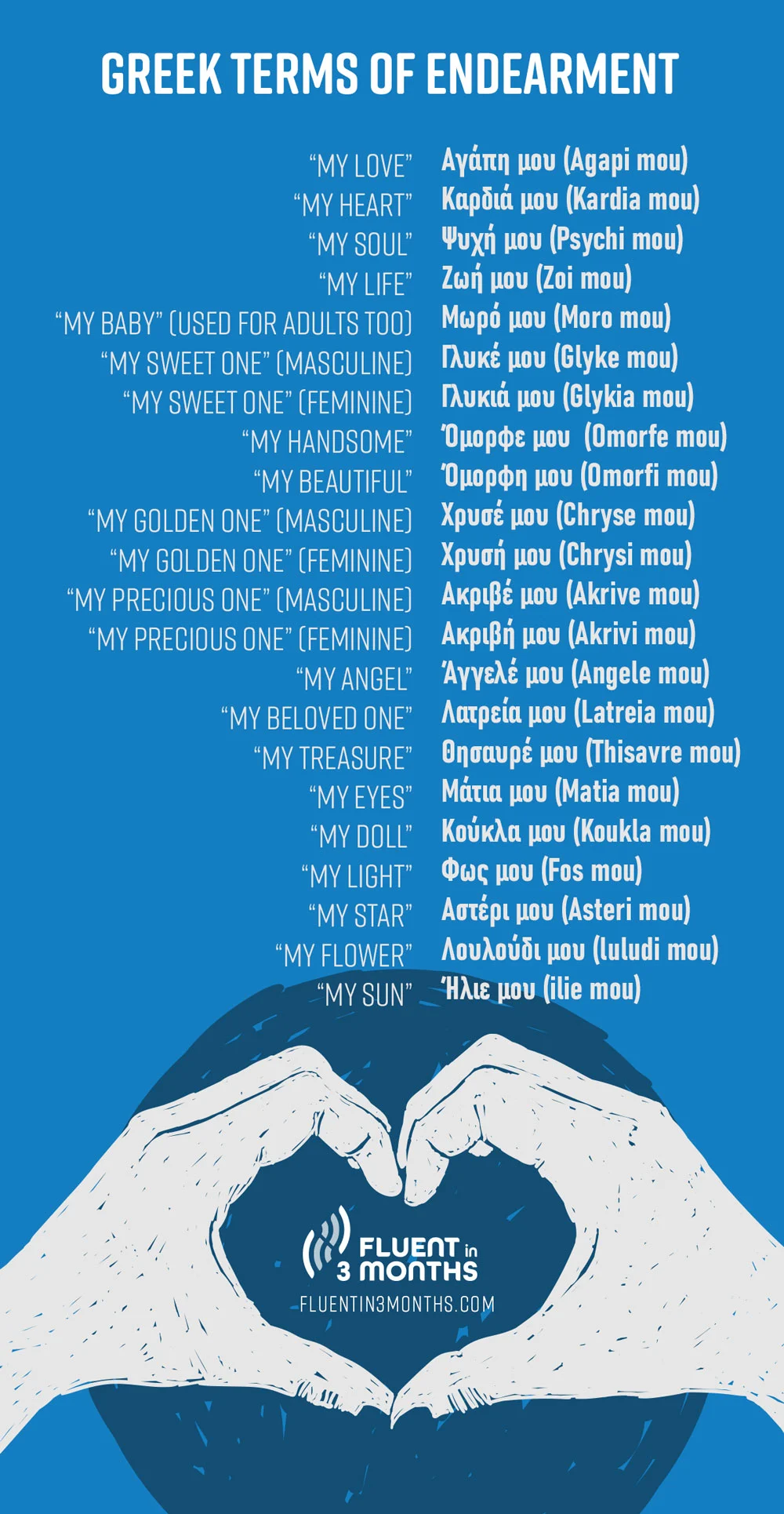
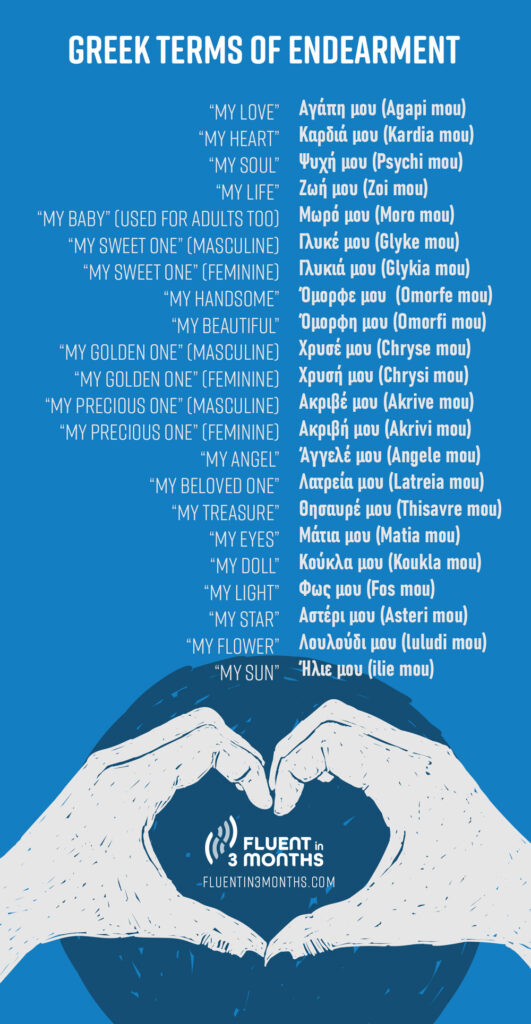
Linguistic scholars note that the architecture of Greek affection is built upon the possessive pronoun "mou" (my), which almost universally follows the noun of endearment. This grammatical structure, as seen in the ubiquitous "agapi mou" (my love), creates an immediate sense of belonging and personal connection. Unlike English, where "my" precedes the noun, the Greek placement emphasizes the emotion first, followed by the personal bond, a nuance that highlights the culture’s emphasis on shared emotional states over individual possession.
The Philosophical Roots of Hellenic Affection
To understand the modern Greek lexicon of love, one must examine the classical foundations of the language. Ancient Greek famously distinguished between at least eight different types of love, a complexity that remains embedded in the modern vernacular. These include Eros (romantic, passionate love), Philia (affectionate, virtuous love between equals), Storge (familial love and the bond between parents and children), and Agape (unconditional, selfless love).
In modern usage, these categories often bleed into one another through terms of endearment. For instance, "agapi mou" derives from Agape, suggesting a love that is profound and enduring, yet it is the standard term for romantic partners. This linguistic evolution demonstrates how the high-minded ideals of ancient philosophy have been democratized into everyday speech. Other categories, such as Ludus (playful love) and Pragma (enduring, long-term love), find their expression in the playful diminutives and respectful titles used within marriages and long-standing friendships.
The Mechanics of the Diminutive: Suffixes and Social Intimacy
A primary feature of the Greek language is its extensive use of diminutive suffixes to transform standard names and nouns into "nicknames" of endearment. This process, known as the diminutive form, involves adding specific endings—such as -aki, -itsa, -oulis, -oula, and -akis—to the root of a word.
Data regarding Greek naming conventions suggests that the application of these suffixes follows gendered and phonetic patterns. Female names frequently adopt "-aki" or "-itsa," turning "Eleni" into "Elenitsa." Male names often utilize "-akis" or "-oulis," transforming "Yiorgos" into "Yiorgaki." These modifications serve a dual purpose: they signal a lack of formality and indicate a protective or affectionate stance toward the subject. Interestingly, these suffixes are not reserved solely for children; they are frequently applied to adults in romantic or close-knit social circles to denote a "sweetness" of character or a deep level of familiarity.
Beyond names, common nouns are also subject to this linguistic softening. For example, "mati" (eye) becomes "matakia" (little eyes), often used when speaking to infants or romantic partners. This structural flexibility allows Greek speakers to navigate various levels of social distance with precision, adjusting the "warmth" of their speech through simple morphological changes.
A Categorical Breakdown of Modern Endearments
The modern Greek vocabulary of affection can be categorized into three primary domains: romantic, familial, and platonic. Each domain utilizes specific terms that carry distinct weights of emotional intensity.
Romantic Endearments
In the romantic sphere, terms often refer to vital organs or essential elements of life, reflecting a "totalizing" view of love. Common terms include:
- Kardia mou (My heart): One of the most frequent expressions, equating the partner with the center of life.
- Psychi mou (My soul): A term used to denote a spiritual or metaphysical connection.
- Zoi mou (My life): An expression indicating that the partner is essential to the speaker’s existence.
- Moro mou (My baby): Used widely among adults, similar to the English "babe" or "baby," but often carrying a more protective connotation.
Familial Endearments
The Greek family unit is notoriously tight-knit, a sociological fact reflected in its specific "cute" versions of titles. The standard "mitera" (mother) is almost always replaced by "manoula" (mommy) in affectionate contexts, while "pateras" (father) becomes "bambakas" or "bamboulis." Children are often referred to as "vlastari mou" (my sprout) or "asteri mou" (my star), terms that emphasize growth and the future of the family lineage.
Platonic and Social Endearments
Greek social interaction is characterized by a high degree of "philoxenia" (hospitality/friendliness toward strangers). This often results in the use of endearments even among casual acquaintances. Men may refer to each other as "file mou" (my friend), while women frequently use "koukla mou" (my doll) or "glikia mou" (my sweet one). These terms serve to break the ice and establish a baseline of mutual respect and friendliness.
Sociolinguistic Analysis: The Role of "Mou" and Pronunciation
From a sociolinguistic perspective, the correct application of these terms requires an understanding of the vocative case. In Greek, when addressing someone directly, the endings of names and certain nouns change. This grammatical necessity ensures that the act of "calling out" to a loved one is distinct from simply talking about them.
Pronunciation also plays a vital role in the delivery of endearments. Linguists point to the "gamma" (γ) and "chi" (χ) sounds as particularly challenging for non-native speakers, yet these sounds are essential for terms like "agapi" and "psychi." The soft, breathy "ch" in "psychi" (soul) is said by some cultural historians to mimic the sound of a breath, further linking the word to its literal meaning of "breath of life."
Cultural Implications and Global Context
The prevalence of these terms has broader implications for how Greek identity is perceived globally. In the Greek diaspora—spanning from Astoria in New York to Melbourne, Australia—these terms of endearment act as cultural anchors. For second and third-generation Greeks who may not be fully fluent in the language, terms like "yayiaka" (grandma) or "agapi mou" often remain part of their core vocabulary, serving as a primary link to their ancestral heritage.
Furthermore, the "emotional heavy-lifting" performed by the Greek language has influenced Western romantic literature and cinema. The concept of "my soul" or "my heart" as a casual address is often viewed by Northern European and North American cultures as intensely poetic, yet in the Greek context, it is a standard element of domestic life. This disparity highlights a fundamental difference in "emotional temperature" across cultures, where Greek linguistic norms favor high-intensity expression as a baseline for sincerity.
Chronology of Linguistic Integration
The integration of these terms into the modern "Demotic" (popular) Greek language occurred over several centuries, particularly during the transition from the Byzantine era to the modern Greek state. During the Ottoman period, the Greek language served as a primary tool for maintaining national and religious identity. Endearments used within the family and the local community (the "koinotita") became a way to reinforce internal bonds in the face of external pressure.
In the 20th and 21st centuries, the rise of Greek popular culture—including "Laïko" music and television "telenovelas"—has standardized these terms across different regional dialects. While a Cypriot speaker might use specific local variations, the core list of endearments like "agapi mou" and "moro mou" has become a universal currency of affection across the Hellenic world.
Conclusion: The Enduring Power of the Spoken Word
The rich tapestry of Greek endearments offers more than just a list of "cute" words; it provides a window into a culture that prioritizes emotional expression and familial solidarity. By combining ancient philosophical roots with a flexible system of modern diminutives, the Greek language allows its speakers to articulate the various shades of love with unparalleled precision. Whether used to soothe a child, woo a partner, or greet a friend, these terms remain a vital part of the Greek identity, ensuring that the "pathos" of the Hellenic spirit continues to be felt in every "s’agapo" whispered across the Mediterranean.