


The integration of Artificial Intelligence into the modern enterprise presents a complex, multifaceted challenge, demanding a delicate balance between visionary leadership and employee engagement. While the potential for AI to revolutionize workflows and unlock unprecedented efficiencies is undeniable, its widespread adoption hinges less on technological prowess alone and more on an organization’s ability to communicate a compelling, unified vision. The current landscape is characterized by a stark divergence in perceptions, ranging from fervent enthusiasm for AI’s transformative power to deep-seated anxieties about job security and ethical implications, with a significant segment of ambivalence in between. This fractured sentiment underscores the urgent need for an era-defining narrative that can coalesce diverse perspectives and propel collective action.
The AI Revolution: A Landscape of Promise and Peril
The rapid acceleration of AI capabilities, particularly in generative models, has thrust Artificial Intelligence from the realm of speculative fiction into a tangible corporate imperative. Companies worldwide are grappling with the pressure to innovate, streamline operations, and maintain competitive edge by embracing AI. This urgency often stems from a pervasive "fear of missing out" (FOMO), driven by the understanding that early adopters could gain significant market advantages. However, history teaches us that technological revolutions, from the advent of the internet to the widespread adoption of cloud computing, are rarely smooth. They often expose existing organizational fissures and test leadership’s capacity to manage profound change.
The dual nature of AI itself contributes to the internal friction. On one hand, it promises "super intelligence" capable of solving humanity’s grand challenges, from curing diseases to mitigating climate change, and within the corporate context, automating mundane tasks, enhancing decision-making, and fostering innovation. On the other hand, it evokes fears reminiscent of dystopian narratives like The Terminator, or concerns about the erosion of human truth and skills, akin to "tears in rain." These deeply held beliefs and anxieties are not easily dismissed; they are integral to the human element of technological adoption.
Navigating the Internal Divide: Employee Sentiments on AI
To achieve successful AI integration, leaders must first comprehend the nuanced perspectives percolating through their ranks. A blanket mandate or a purely technical rollout will inevitably falter without addressing the underlying hopes and fears of the workforce. Surveys and studies consistently reveal a significant divide in how different roles and demographics perceive AI.

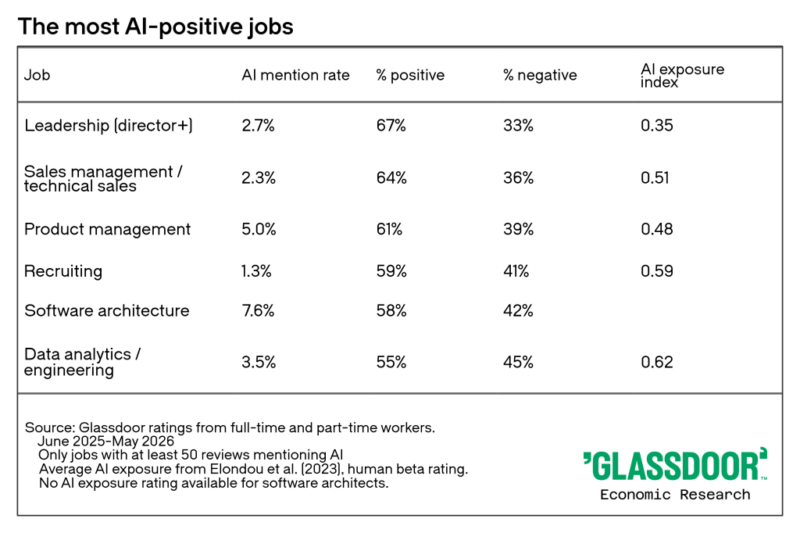
An August 2026 study by Glassdoor, which analyzed employer reviews by workers, offered critical insights into this internal schism. The findings indicated that certain roles exhibited significantly higher optimism regarding AI integration:
- Leadership (Director+): 67% positive mentions, reflecting a strategic outlook on AI as a driver of growth, efficiency, and competitive advantage.
- Sales Management / Technical Sales: 64% positive, likely seeing AI as a tool to enhance lead generation, personalize customer interactions, and optimize sales processes.
- Product Management: 61% positive, recognizing AI’s potential in product innovation, feature development, and market analysis.
- Recruiting: 59% positive, anticipating AI’s role in streamlining candidate sourcing, screening, and improving hiring efficiency.
- Software Architecture: 58% positive, viewing AI as a powerful component for building more intelligent and robust systems.
- Data Analytics / Engineering: 55% positive, as AI tools directly augment their core functions of data processing, analysis, and model development.
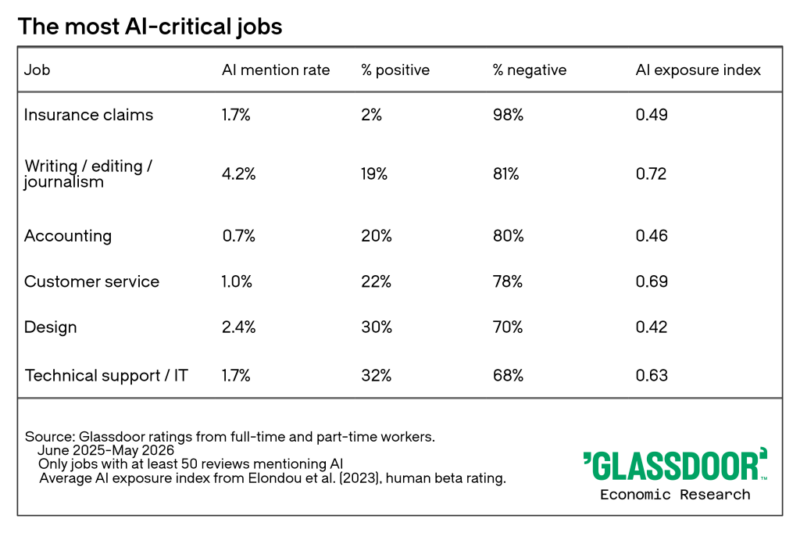
Conversely, roles that heavily rely on human nuance, specific linguistic precision, interpersonal relationships, or meticulous numerical accuracy often expressed significantly more critical views:
- Insurance Claims: 98% negative, suggesting concerns about AI’s ability to handle complex, empathetic, or highly subjective claims assessments.
- Writing / Editing / Journalism: 81% negative, fearing job displacement, the degradation of original thought, or the loss of distinct human voice and critical analysis.
- Accounting: 80% negative, likely due to concerns about accuracy, regulatory compliance, and the intricate human judgment required in financial operations.
- Customer Service: 78% negative, anticipating AI chatbots replacing human interaction and diminishing the quality of customer relationships.
- Design: 70% negative, potentially worried about AI stifling creative originality or reducing the need for human aesthetic judgment.
- Technical Support / IT: 68% negative, possibly fearing automation of troubleshooting, or a shift in the nature of their problem-solving roles.
This data paints a clear picture: the perception of AI is not uniform. Leaders, often positioned to see the strategic benefits, are generally more optimistic, while many frontline and specialized workers, whose roles might be directly impacted, express significant apprehension. These "eight buckets" of resistance – ranging from fears of job displacement (20% of negative replies) and AI distracting from core business (13%) to concerns about alienating uses like workplace surveillance or replacing executive communications (10%) – must be directly addressed.
Further compounding this challenge is the disconnect between employee initiative and organizational strategy. A study from the University of Konstanz highlighted that "the major AI revolution has not unfolded as a planned transformation process so far." Instead, many employees are experimenting with AI independently, while employers lag in establishing clear policies, providing adequate training, and implementing secure solutions. This ad hoc approach, coupled with a lack of guidance, creates fertile ground for confusion and potential misuse. Indeed, a Gallup poll revealed that a staggering "only 25% of workers say their company has communicated a clear plan for AI integration." This means the vast majority of businesses are operating without a coherent strategy, leading to unfocused usage, potential skills atrophy among employees, sloppy brand outputs, and inefficient "runaway token spend."
Without a unified message and a structured approach, AI initiatives risk becoming fragmented experiments rather than strategic transformations. Leaders must anticipate pushback, genuinely consider feedback, and articulate a transparent, achievable path forward that aligns with organizational values.
The Critical Role of Leadership Communication in AI Adoption
In this complex environment, the ability to communicate effectively is not merely a soft skill; it is a strategic imperative. Fortune 50 companies and global brands have long relied on core communication principles to spark and sustain change. For AI adoption to succeed at scale, leaders need more than technical roadmaps; they need an "era-defining story" that unites everyone. This demands the capacity to acknowledge difficulties, challenge skepticism constructively, and build momentum behind a shared vision. It requires a powerful blend of time-tested storytelling structures, design principles, and presentation strategies to foster collective investment in the desired outcome.
Crucially, these deeply human qualities—empathy, vision-casting, motivational speaking—cannot be automated. While AI can assist with prompt engineering or content generation, it cannot stand on a stage, capture the emotional tenor of a moment, or move a reluctant audience to action. The human touch remains indispensable in galvanizing commitment and navigating the emotional landscape of profound organizational change.
Duarte’s Illuminate™ change communication methodology offers a proven framework for guiding organizations from ingrained practices to a "new bliss" of transformation. This methodology emphasizes three-act narratives, ceremonies, symbols, powerful speeches, and clear visuals as essential ingredients for inspiring lasting change, even in the age of AI. It recognizes that successful transformation begins with acknowledging the current reality before daring to dream of a better future.
Duarte’s Illuminate™ Framework: A Phased Approach to AI Transformation
The Illuminate™ framework outlines five critical stages for leaders, or "torchbearers," to guide their organizations through significant change, including the complex journey of AI adoption.
Stage 1: Envisioning the New Bliss – The Dream Stage
The initial stage focuses on creating a moment of inspiration, transforming a nascent idea into a compelling vision for the future. Torchbearers illuminate a possible future, asking their organizations, industries, and even broader society to envision it with them. The core of the Dream stage is contrasting "what is" with "what could be" to build tension and cultivate a yearning for a "new bliss." This "new bliss" could manifest as more efficient workflows, innovative products, or a modernized mindset toward revolutionary concepts like AI.
To effectively craft this vision, leaders must deeply understand their audience’s hopes and fears. Before making official announcements, it is vital to "test the waters" through adaptive listening, carefully gauging employee sentiments. For instance, addressing the Glassdoor study’s identified resistances, a leader’s dream for AI adoption could be framed as:
- What Is: Teams are currently burdened by repetitive data tracking, time-consuming content brainstorming, and inefficient buyer research in an overwhelming digital environment. While AI has its drawbacks, competitors embracing it with clear adoption strategies are achieving greater speed and scope in their AI-enabled workflows.
- What Could Be: With well-defined AI Standard Operating Procedures (SOPs), robust IT-supported integration, and continuous feedback mechanisms, teams can eliminate superfluous steps, enhance system maintenance, and deliver high-quality results that outpace the competition.
- The New Bliss: Empowered by AI, teams can refine their processes, free up valuable time for deeper customer engagement, pursue additional accounts, and explore creative projects with newly available bandwidth, ultimately leading to greater job satisfaction and organizational growth.
Achieving this powerful framing requires clear-eyed reflection on: the current state of the organization, the desired future state, the specific challenges AI addresses, the needs and concerns of all stakeholders, and the ethical considerations involved.
Stage 2: Committing to Action – The Leap Stage
Once the dream has been successfully articulated and accepted, organizations enter the Leap stage, where the vision translates into tangible commitment and action. Leadership’s AI message begins to resonate and be amplified across teams through "action-oriented words." AI processes start to roll out, and collaborative meetings become integral to the journey. During this critical period, maintaining a steady pace and celebrating incremental progress are paramount to keeping "fear, uncertainty, and doubt" (FUD) at bay.
Leaders can reinforce the sense of collective adventure through contextual speeches that elaborate on the vision or remind teams of the stakes involved. Recognizing that widespread AI adoption requires participation from everyone, structuring the AI strategy as an "incubator" rather than a top-down solution can be highly effective. This approach empowers workers to experiment, share their AI insights, and actively contribute to the company’s evolution. Duarte’s own journey included a "summer vibe-coding experiment" that prioritized exploration. Weekly AI Office Hours fostered curiosity, providing a platform to share knowledge, pool strategies to optimize token spend, and produce clearer outputs. Teams collaborated to maintain a prompt library, update brand guidelines, and test guardrails, with AI serving as a collaborative "thought-partner." This collaborative spirit helps lock in commitment from the outset.
Stage 3: Navigating Obstacles – The Fight Stage
Inevitably, any significant quest for change will encounter setbacks. With AI, the potential pitfalls are numerous: inadequate prompts yielding unusable output, accuracy issues and "hallucinations," "AI-optimized" workflows that paradoxically consume more time, or the relentless stream of conflicting news stories about AI’s societal impact. Rather than ignoring hardship or suppressing dissent, leaders committed to AI adoption should view resistance or exasperation as valuable opportunities to check in with teams and modify their change plan.
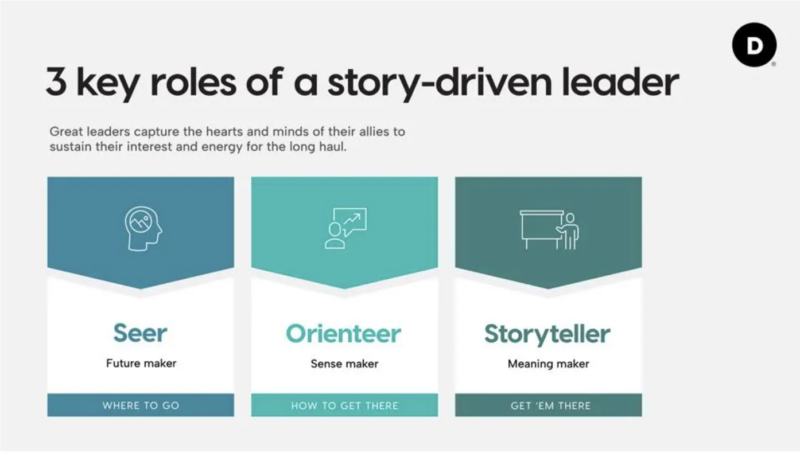
As Duarte CEO Nancy Duarte reflected in a C200 column for Forbes, successfully launching and implementing a new vision requires leaders to embody three critical personas: the Seer, the Orienteer, and the Storyteller.

- The Seer: The "future maker" who defines "where to go." When the destination becomes fuzzy amidst technical glitches or external pressures, the Seer brings the ultimate vision back into sharp focus, reminding everyone of the overarching purpose.
- The Orienteer: The "sense maker" who determines "how to get there." If a pathway stalls, an implementation proves ineffective, or a new challenge emerges, the Orienteer charts a new course, adapting strategies and tactics to overcome the immediate obstacle.
- The Storyteller: The "meaning maker" who helps "get ’em there." When competitors gain ground, or teams feel overwhelmed by the struggle, the Storyteller frames setbacks as learning opportunities, celebrates resilience, and makes meaning of the ongoing effort, inspiring continued perseverance.
Every challenge will demand leaders revisit one or more of these personas. Regular, transparent communication – through mechanisms like AI Office Hours or decisive "battle speeches" at key turning points – is crucial for maintaining morale and alignment. Unacknowledged problems, delays, and a lack of guidance are natural breeding grounds for FUD. By proactively addressing these issues and maintaining a consistent narrative, leaders can ensure teams stay on track for the long haul.
Stage 4: Sustaining Momentum – The Climb Stage
The "messy middle" of transformation, often referred to as the Climb stage, is where initiatives can lose steam, deadlines may be missed, and initial fixes prove insufficient. This is arguably the most trying stage for both teams and leaders, characterized by an uphill grind without the initial adrenaline rush of the Leap. It’s also concurrent with the Fight stage, requiring leaders to constantly discern whether to push through or pivot.
In the context of AI, the Climb stage sees workloads competing against new AI obstacles, AI-generated results falling short of expectations, and new workflows inadvertently creating new problems. Adoption can slow, and teams may revert to old habits, especially as external news highlights competitors’ perceived faster progress. Doubts begin to creep in: Will we ever truly achieve AI adoption?
During this period, leaders must balance continuous pressure with profound empathy. Open lines of communication through 1:1s with team leaders, anonymous surveys, and live Q&As are essential for gathering context and measuring the scope of problems. While Fight messaging prepares teams for battle, the Climb is about leveraging past accomplishments to refuel current efforts. Leaders must "keep reminding people how far they’ve come and why the destination is still worth reaching."
Each "temperature check" offers an opportunity to revitalize the message, acknowledge the hard work of those staying the course, and gain insights into what might be hindering the vision. It’s about reassuring stragglers that they are not alone, that transformation is a gradual process, and that the investment of time, energy, and resources is indeed yielding returns. Critically, leaders must also guard against the "sunk cost fallacy." If defending decisions for change becomes increasingly difficult, a holistic understanding of the organization’s current state is paramount to objectively diagnose problems, know when to strategically abandon an effort, and when perseverance is about to pay off.
Stage 5: Embedding the Transformation – The Arrive Stage
Finally, the organization reaches a point where the balance between dreaming, delegating, and doing achieves harmony. Leaders’ vision for the future has materialized, and the workforce has mobilized to achieve it. After all the leaping, fighting, and climbing, the "new bliss" becomes reality. Teams are AI-optimized, workflows are more efficient and agentic, and outputs are consistently improving. While some dissenters may always harbor private reservations, the overarching message has prevailed.
However, "arrival" in the context of AI adoption is not a static endpoint. Unlike launching a new product or migrating to a CRM, being AI-enabled means committing to continuous evolution. Just as cybersecurity demands regular re-education and updated procedures, AI requires an ongoing commitment to staying current with innovations and best practices. New models, capabilities, vulnerabilities, and ethical considerations are constantly emerging, requiring organizations to remain agile and adaptable.
Despite this perpetual evolution, the achievement of widespread AI adoption is a significant milestone worthy of celebration. Retooling how teams engage with their work, adopting new SOPs, and successfully defining and achieving transformative goals are monumental accomplishments. Leaders should create opportunities for teams to reflect on and process their journey – perhaps through open mics, fireside chats, or celebratory events – fostering a sense of shared accomplishment and contributing to the organization’s evolving cultural narrative. After the initial celebrations, the focus shifts to sustaining the change, refining AI agility, and preparing for the next wave of innovation.
Beyond Adoption: The Perpetual Evolution of AI in the Enterprise
The modern corporate environment offers shorter runways for reinvention. Industry evolution can now occur almost overnight, driven by geopolitical shifts, supply chain disruptions, and relentless technological advancement. This accelerated pace of change necessitates prompt, agile action and an endless recalibration to each "new normal." When everyone is pulled in different directions, consistent team alignment requires a message meticulously crafted, expertly delivered, and robustly supported to withstand the headwinds of constant flux.
Whether an organization is proactively seizing an emerging opportunity like AI or repositioning to weather an impending storm, committing to a proven framework for change communication can significantly ease the transition. It transforms what could be a chaotic and divisive process into a structured, unifying journey. Organizations like Duarte offer such frameworks, providing strategists, designers, speaker coaches, and training facilitators to instill clarity, composure, and conviction into any change initiative. By rallying teams around a story they can embrace and share, leaders can put the future in perspective and navigate the AI era with confidence and collective purpose.
