

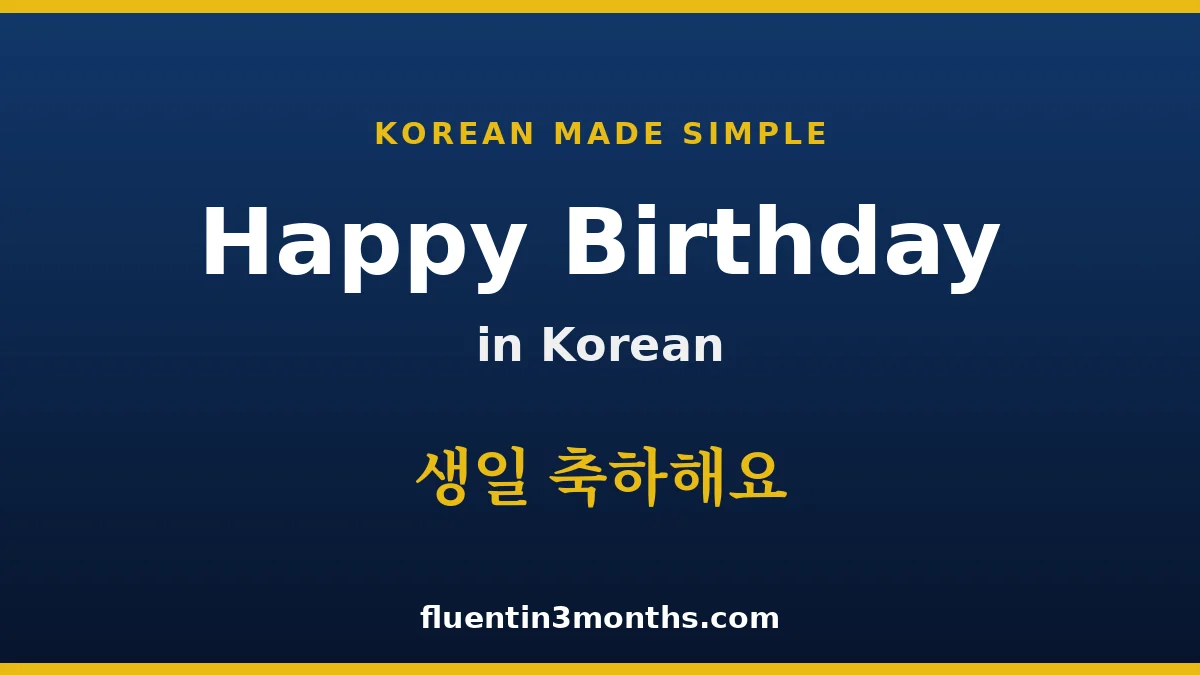
The linguistic and cultural framework surrounding birthdays in South Korea serves as a profound reflection of the nation’s deeply ingrained social hierarchy, Confucian heritage, and recent legislative shifts toward international standardization. While the most common expression for wishing someone a happy birthday is saengil chukhahaeyo, the application of this phrase is governed by a complex system of honorifics and speech levels that dictate social interactions across the peninsula. Understanding these nuances is essential for navigating Korean social circles, as the choice of words often signifies the level of respect, intimacy, and relative status between the speaker and the recipient. This comprehensive analysis explores the multifaceted nature of Korean birthday celebrations, ranging from specific linguistic structures to the historic 2023 transition in age calculation laws.
The Sociolinguistic Architecture of Korean Birthday Greetings
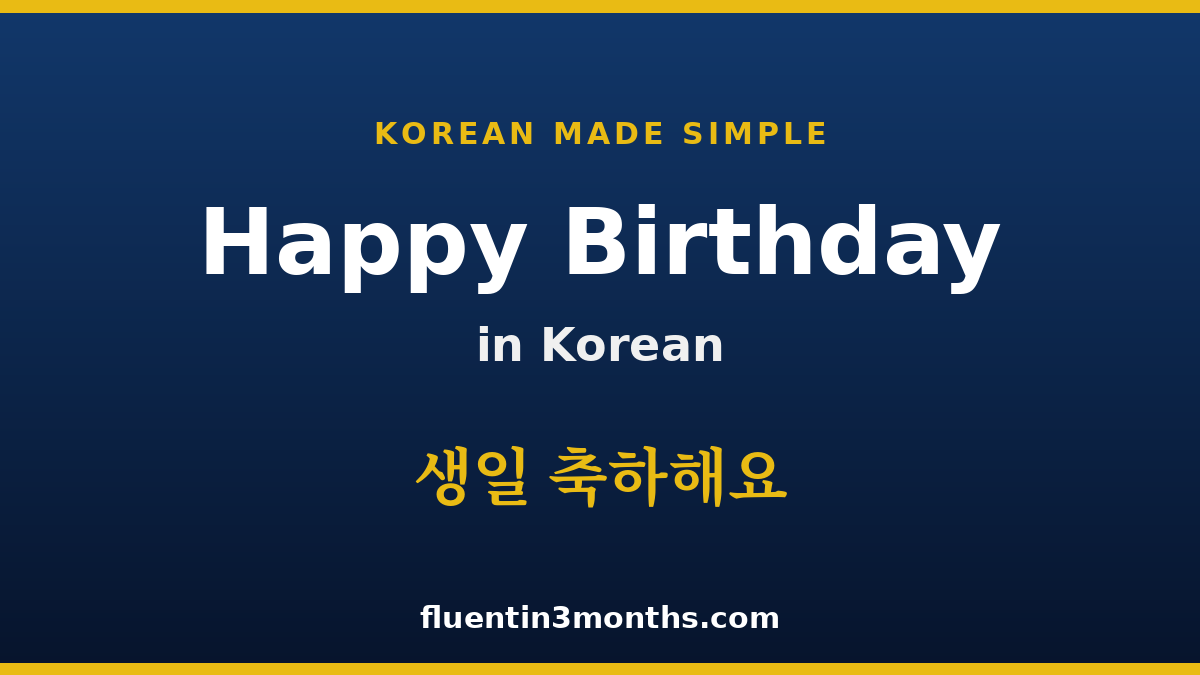
In the Korean language, a greeting is rarely a static phrase; instead, it is a dynamic construction that adapts to the social context. The standard polite form, saengil chukhahaeyo, is composed of the noun saengil (birthday), the verb chukhahada (to congratulate), and the polite sentence ending -haeyo. This version is considered the safest and most versatile option for general use, appropriate for acquaintances, colleagues, and individuals of similar social standing with whom the speaker is not on intimate terms.
However, the Korean language operates on a tiered system of politeness known as jondaemal (formal/polite speech) and banmal (casual/informal speech). The selection of a birthday greeting depends heavily on the relationship’s "closeness" and the age gap between participants. For instance, saengil chukhae—the casual version—is strictly reserved for close friends, younger siblings, or children. Conversely, when addressing individuals of significantly higher status or age, such as grandparents, parents, or high-ranking mentors, the vocabulary itself undergoes a transformation. The word for birthday shifts from saengil to the honorific saengsin, and the verb chukhahada is replaced with chukha-deurimnida, a humble form of offering congratulations. This linguistic stratification ensures that social order is maintained even during celebratory moments.
The 2023 Legislative Shift: Standardizing Korean Age
One of the most significant developments in recent Korean history is the official abolition of the traditional "Korean age" system in administrative and civil contexts. On June 28, 2023, South Korea officially adopted the international age system (man nai), bringing an end to a centuries-old practice that often led to confusion and administrative inefficiency.
Under the traditional system, known as seneun nai, a person was considered one year old at the moment of birth, accounting for the time spent in the womb. Furthermore, everyone in the country gained a year simultaneously on New Year’s Day, regardless of their actual birth date. This meant that a child born on December 31 would technically turn two years old on January 1, despite having lived for only two days.
The transition to the international standard was a key campaign promise of the Yoon Suk-yeol administration. According to the Ministry of Government Legislation, the shift was designed to reduce socio-economic costs and legal disputes arising from the coexistence of multiple age-counting methods. While the international system is now the legal standard for contracts, medical records, and official documents, the social transition remains ongoing. Many South Koreans still refer to their "Korean age" in casual settings, and certain laws, such as those governing the legal drinking age and military conscription, utilize a third system called yeon nai (year age), which calculates age by subtracting the birth year from the current year.
Cultural Foundations: The Significance of Miyeokguk and Doljanchi
Korean birthday traditions are deeply rooted in the concept of maternal gratitude and the historical struggle for survival. Central to any birthday celebration is the consumption of miyeokguk, or seaweed soup. This tradition is a direct homage to the postpartum recovery process; seaweed is rich in iodine and calcium, and it has been the standard nutritional staple for Korean mothers for centuries. By eating miyeokguk on their birthday, individuals symbolically reconnect with their mothers and acknowledge the care provided during their infancy.
Beyond the annual celebration, the first birthday, or doljanchi, remains one of the most significant milestones in a Korean person’s life. Historically, high infant mortality rates meant that reaching the one-year mark was a momentous achievement for the family and the community. The highlight of the doljanchi is a ritual known as doljabi. During this ceremony, the child is placed before a variety of symbolic objects. The first item the child picks up is believed to predict their future:
- Thread: Symbolizes a long and healthy life.
- Money: Represents future wealth and financial success.
- Pencil or Book: Indicates a future as a scholar or intellectual.
- Gavel or Stethoscope: Modern additions representing careers in law or medicine.
While modern doljanchi celebrations are often held in specialized banquet halls with elaborate catering, the core sentiment remains a communal prayer for the child’s prosperity and health.
The Linguistic Legacy of King Sejong the Great
The ability to communicate these birthday wishes in writing is made possible by Hangul, the Korean phonetic alphabet commissioned by King Sejong the Great in the 15th century. Before the creation of Hangul, Korea utilized Chinese characters (Hanja), which were difficult for the common population to learn, leading to widespread illiteracy.
In 1443, King Sejong and his scholars completed the Hunminjeongeum ("The Correct Sounds for the Instruction of the People"), a writing system designed to be easily learned by all social classes. The consonants of Hangul are unique in that they are "featural," meaning their shapes mimic the position of the tongue, teeth, and throat when producing the sound. This logical structure has allowed South Korea to maintain one of the highest literacy rates in the world, facilitating the modern digital exchange of birthday greetings via platforms like KakaoTalk, where "Gifticons" (digital gift vouchers) have become the contemporary standard for birthday gift-giving.
Evolution of the Korean Birthday Song
The auditory component of a Korean birthday is characterized by the "Happy Birthday" song, which utilizes the globally recognized melody composed by Patty and Mildred Hill. However, the lyrics are adapted to the Korean formal style. The phrase Saengil chukhahamnida is used in the song regardless of the singers’ usual relationship with the recipient. This use of the formal -hamnida ending provides a ceremonial weight to the performance, marking the event as a distinct departure from everyday casual interaction.
In contemporary celebrations, it is common for groups to substitute the name of the birthday person with affectionate terms or titles, reflecting the group’s collective dynamic. This blend of Western musical influence and traditional Korean linguistic etiquette illustrates the nation’s ability to modernize while preserving its core cultural identity.
Implications of Social and Linguistic Changes
The ongoing evolution of Korean birthday customs reflects a broader societal trend toward balancing tradition with global integration. The 2023 age law change, while primarily administrative, has sparked national conversations about social hierarchy. Since Korean social interactions and speech levels are often determined by age, the shift to international age has occasionally created ambiguity in how peers address one another.
Sociologists note that as South Korea continues to engage with the global community through the "Hallyu" (Korean Wave), the interest in these linguistic nuances has expanded far beyond the peninsula. International students and fans of Korean culture are increasingly required to understand the distinction between saengil and saengsin to avoid social faux pas.
Ultimately, the act of wishing someone a happy birthday in Korea is more than a mere congratulatory gesture. It is an exercise in social awareness (nunchi), a tribute to maternal sacrifice, and a nod to a writing system that democratized communication over half a millennium ago. Whether through a traditional bowl of seaweed soup or a formal bow to an elder on their saengsin, these customs continue to serve as the connective tissue of Korean society, bridging the gap between a storied past and a rapidly modernizing future.
