

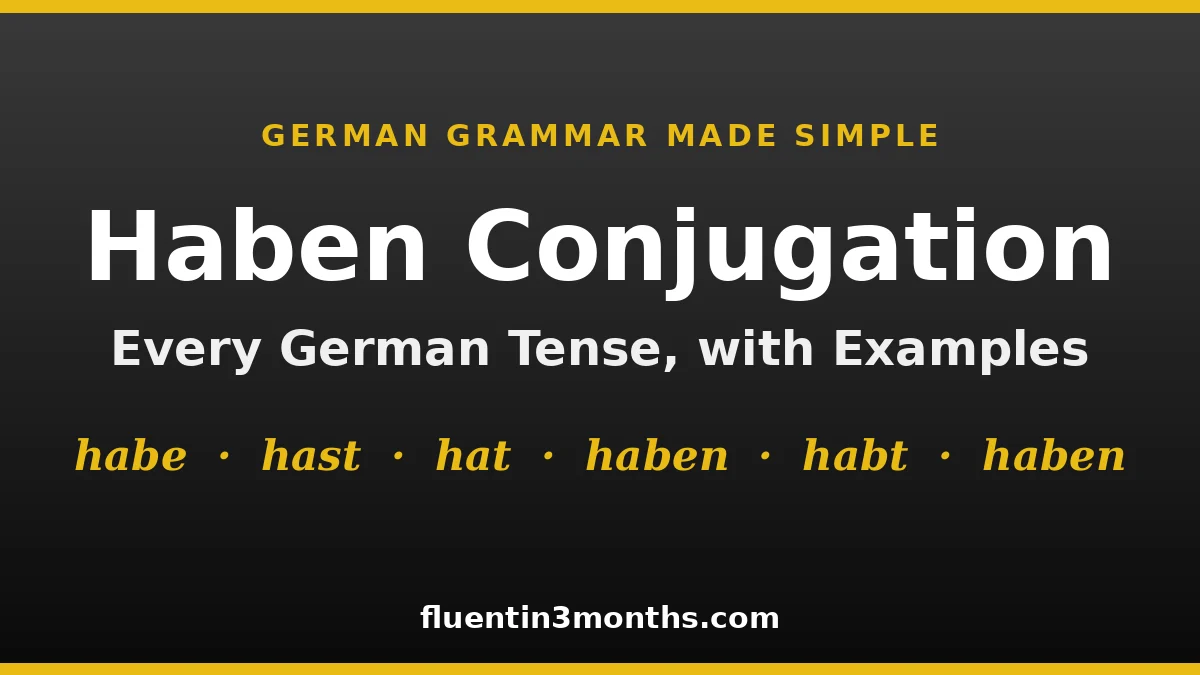
The verb haben, translating fundamentally to "to have" in English, represents one of the most critical structural pillars within the German language, serving not only as a primary indicator of possession but also as the essential auxiliary verb for the formation of the past tense. In the context of modern linguistics and pedagogy, the mastery of haben is considered a non-negotiable milestone for students of the German language. This necessity arises from its dual role: it functions as a lexical verb denoting ownership and as a grammatical engine that powers the Perfekt (Present Perfect) tense, which is the standard mode of communication for discussing past events in daily German discourse. Educational experts suggest that a comprehensive understanding of haben provides learners with immediate access to approximately 80% of all past-tense constructions, making it a high-leverage asset in language acquisition.
The Morphological Evolution and Modern Conjugation of Haben
To understand the current form of haben, one must examine its historical and morphological development. Linguistically, haben is classified as a "mixed verb," a category that exhibits traits of both "weak" (regular) and "strong" (irregular) verbs. While it follows the dental suffix pattern (-te, -t) characteristic of weak verbs in its past forms, it undergoes a significant stem change and contraction in the present tense that distinguishes it from standard regular verbs.
In the present tense (Präsens), haben exhibits a phonetic contraction in the second and third-person singular. While a regular verb would retain its stem, haben drops the medial "-b-", resulting in "du hast" and "er/sie/es hat." This phenomenon is a result of centuries of linguistic erosion, where high-frequency verbs are streamlined for ease of pronunciation. This mirrors the English evolution of "haves" into "has."
Present Tense Conjugation (Präsens)
The present tense remains the most frequently utilized form of the verb, serving as the foundation for possession and the auxiliary for the Perfekt.
| Pronoun | Conjugation | English Equivalent |
|---|---|---|
| ich | habe | I have |
| du | hast | you have (informal) |
| er/sie/es | hat | he/she/it has |
| wir | haben | we have |
| ihr | habt | you all have |
| sie/Sie | haben | they/you have (formal) |
Data from linguistic frequency studies indicates that "hat" and "habe" are among the top 20 most used words in the German language. Consequently, pedagogical frameworks emphasize the "b-drop" early in the curriculum to prevent the fossilization of errors such as "habst" or "habt" in the singular.
Historical Context and the Development of the Mixed Verb Pattern
The history of haben traces back to the Proto-Germanic root habjan, which originally meant "to take" or "to grasp." Over a millennium, the meaning shifted from a physical action to a state of possession. By the Middle High German period, the verb began to take on its role as an auxiliary.
The transition to a "mixed verb" occurred as the Präteritum (Simple Past) form "hatte" and the Partizip II (Past Participle) "gehabt" emerged. Unlike "strong" verbs that change vowels (like singen to sang), haben utilizes the weak verb "-te" ending but modifies the stem from "hab-" to "hatt-". This unique structural identity is shared with a small but vital family of verbs including wissen (to know) and bringen (to bring).
Simple Past (Präteritum) and Past Participle (Partizip II)
| Pronoun | Präteritum | English Equivalent |
|---|---|---|
| ich | hatte | I had |
| du | hattest | you had |
| er/sie/es | hatte | he/she/it had |
| wir | hatten | we had |
| ihr | hattet | you all had |
| sie/Sie | hatten | they/you had |
While the Präteritum of most verbs is reserved for formal writing and literature, haben is a notable exception. In spoken German, speakers almost universally prefer "ich hatte" over the compound "ich habe gehabt," citing efficiency and phonetic clarity.
The Functional Role of Haben as a Tense Auxiliary
The most significant linguistic impact of haben is its role in forming compound tenses. In German, the Perfekt (Present Perfect) is formed by combining a conjugated auxiliary verb with the Partizip II of the main verb. Haben serves as the auxiliary for all transitive verbs (verbs that take a direct object), all reflexive verbs, and most intransitive verbs that describe a state of being or a specific duration.
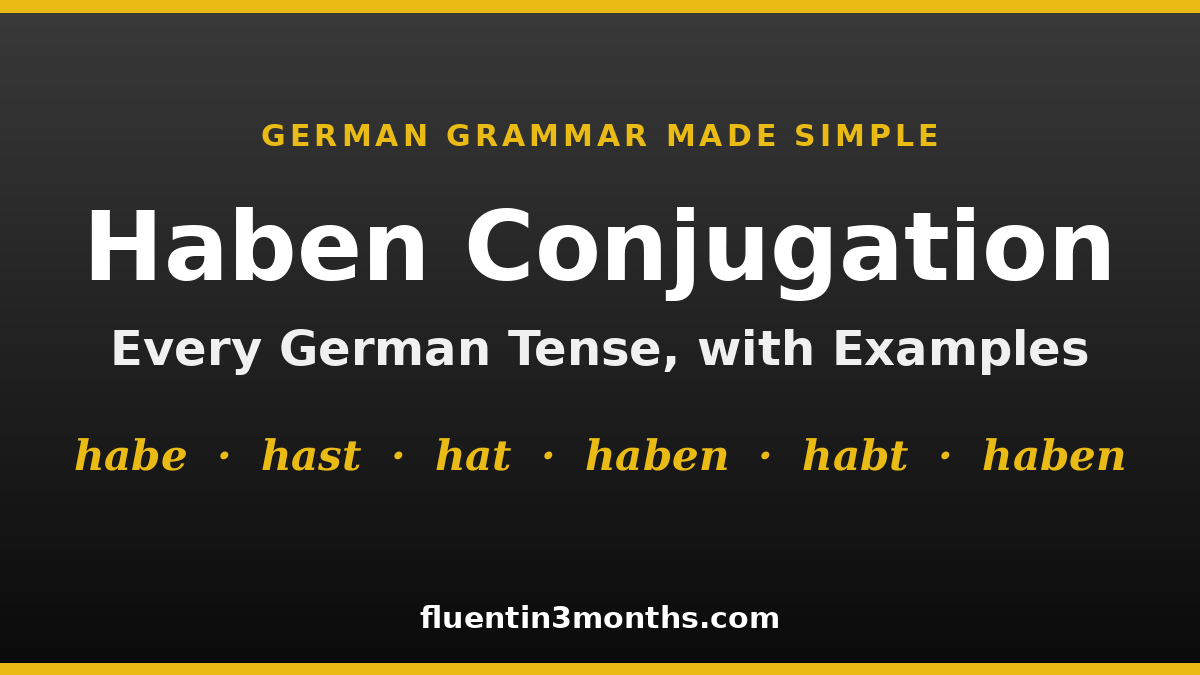
Compound Tense Formation
| Tense | Structure | Example |
|---|---|---|
| Perfekt | Präsens of haben + Partizip II | Ich habe gegessen (I have eaten) |
| Plusquamperfekt | Präteritum of haben + Partizip II | Ich hatte gegessen (I had eaten) |
| Futur I | Präsens of werden + Infinitive | Ich werde haben (I will have) |
| Futur II | Präsens of werden + Partizip II + haben | Ich werde gehabt haben (I will have had) |
Linguistic analysis shows that the choice between using haben or its counterpart sein (to be) as an auxiliary is a common point of confusion for non-native speakers. The general rule dictates that sein is used for verbs of motion (e.g., gehen, fahren) or a change of state (e.g., aufwachen, sterben). Haben, however, remains the "default" auxiliary, covering the vast majority of the German lexicon.
The Subjunctive Mood and Social Etiquette: Konjunktiv I and II
In the realm of advanced communication, haben plays a vital role in the Konjunktiv (Subjunctive) mood. Konjunktiv II is used to express hypothetical situations, wishes, and, most importantly, polite requests. The form "hätte" (would have) is ubiquitous in German social interactions.
Konjunktiv II Conjugation
| Pronoun | Konjunktiv II | Usage Example |
|---|---|---|
| ich | hätte | Ich hätte gern einen Kaffee. (I’d like a coffee.) |
| du | hättest | Wenn du Zeit hättest… (If you had time…) |
| er/sie/es | hätte | Er hätte das getan. (He would have done that.) |
| wir | hätten | Wir hätten gewonnen. (We would have won.) |
| ihr | hättet | Wenn ihr Geld hättet… (If you all had money…) |
| sie/Sie | hätten | Sie hätten Fragen. (They would have questions.) |
The phrase "Ich hätte gern" (literally: I would have gladly) is the standard polite formula for ordering in restaurants or requesting assistance in retail environments. Linguists note that using the indicative "Ich will" (I want) can be perceived as aggressive or impolite, making the mastery of the subjunctive "hätte" a prerequisite for cultural integration.
Konjunktiv I, by contrast, is primarily used in indirect speech and journalism to report statements without vouching for their veracity. While less common in speech, it remains a staple of German news media.
Idiomatic Discrepancies: When "To Be" Becomes "To Have"
A critical area of study for linguists is the idiomatic use of haben in instances where English-speaking logic would dictate the use of the verb "to be." These expressions represent a fundamental difference in how internal states are conceptualized in the German language.
Common Idiomatic Constructions
- Hunger/Thirst: In German, one does not "be" hungry; one "has" hunger (Ich habe Hunger).
- Fear: Fear is possessed rather than a state of being (Ich habe Angst).
- Time/Patience: Similar to English, these are possessed (Ich habe Zeit, Ich habe Geduld).
- Right/Wrong: In a debate, a German speaker "has" rightness (Du hast recht).
A notable exception that frequently traps students is the expression of age. While French (avoir 25 ans) and Spanish (tener 25 años) use their respective equivalents of "to have," German aligns with English in using sein (to be): Ich bin 25 Jahre alt. Data from language proficiency exams suggests that this "age trap" is one of the most persistent errors for learners transitioning from Romance languages to German.
Pedagogical Implications and Learning Strategies
Language acquisition experts emphasize a "staged" approach to mastering haben. The chronology of learning typically follows this trajectory:
- A1 Level: Focus on literal possession and basic idioms (hunger, thirst) using the present tense.
- A2 Level: Introduction of the Perfekt auxiliary role and the simple past form hatte.
- B1 Level: Mastery of Konjunktiv II for polite requests and hypothetical "if-then" scenarios.
- B2 Level and Above: Nuanced use of Konjunktiv I and complex tenses like Futur II.
The consensus among educators is that drilling the present tense "b-drop" is the most effective way to build a foundation. By automating the forms hast and hat, learners reduce their cognitive load when later attempting to form complex past-tense sentences.
Broader Impact on German Communication
The centrality of haben extends beyond grammar into the very fabric of German social logic. As an auxiliary, it is the gatekeeper to the past; as a subjunctive, it is the key to politeness; and as a lexical verb, it defines the relationship between the individual and their environment.
Analysis of contemporary German literature and news media confirms that the verb’s frequency shows no signs of waning. Despite the occasional simplification of grammar in colloquial "Kiezdeutsch" or youth slang, the structural necessity of haben remains intact. For any individual seeking professional or academic success in a German-speaking country, the comprehensive mastery of this verb is not merely a linguistic exercise but a vital step toward functional fluency and cultural competence. Through its varied tenses and moods, haben provides the necessary tools to navigate the complexities of time, reality, and social interaction in the German-speaking world.
