

In the landscape of Germanic linguistics, few elements are as foundational as the verb "haben." While its literal translation corresponds to the English "to have," its utility within the German grammatical framework is far more expansive. As one of the three primary auxiliary verbs—alongside "sein" (to be) and "werden" (to become)—"haben" serves as the structural backbone for the majority of past-tense constructions and a myriad of idiomatic expressions. For the student of German, mastering "haben" is not merely a matter of vocabulary acquisition but a prerequisite for functional literacy and spoken fluency.
The importance of this verb is underscored by its frequency in both the "Duden" corpus and the Digital Dictionary of the German Language (DWDS). Statistical analysis of German texts reveals that "haben" consistently ranks among the top five most frequently used verbs, appearing in nearly every form of communication, from legal statutes to casual street slang. This guide provides a detailed examination of its conjugation, historical evolution, and the nuanced rules that govern its application in modern German.
The Structural Foundation of Haben: Conjugation Patterns
At its core, "haben" is classified as an irregular or "mixed" verb. This designation stems from the fact that it exhibits characteristics of both "weak" (regular) and "strong" (irregular) verbs. In the present tense, the verb undergoes a specific contraction in its singular second- and third-person forms, a phenomenon that often serves as the first hurdle for novice learners.
Present Tense (Präsens)
The present tense of "haben" is the most frequently utilized form. The primary irregularity occurs in the "du" and "er/sie/es" forms, where the medial "-b-" found in the infinitive stem is dropped.
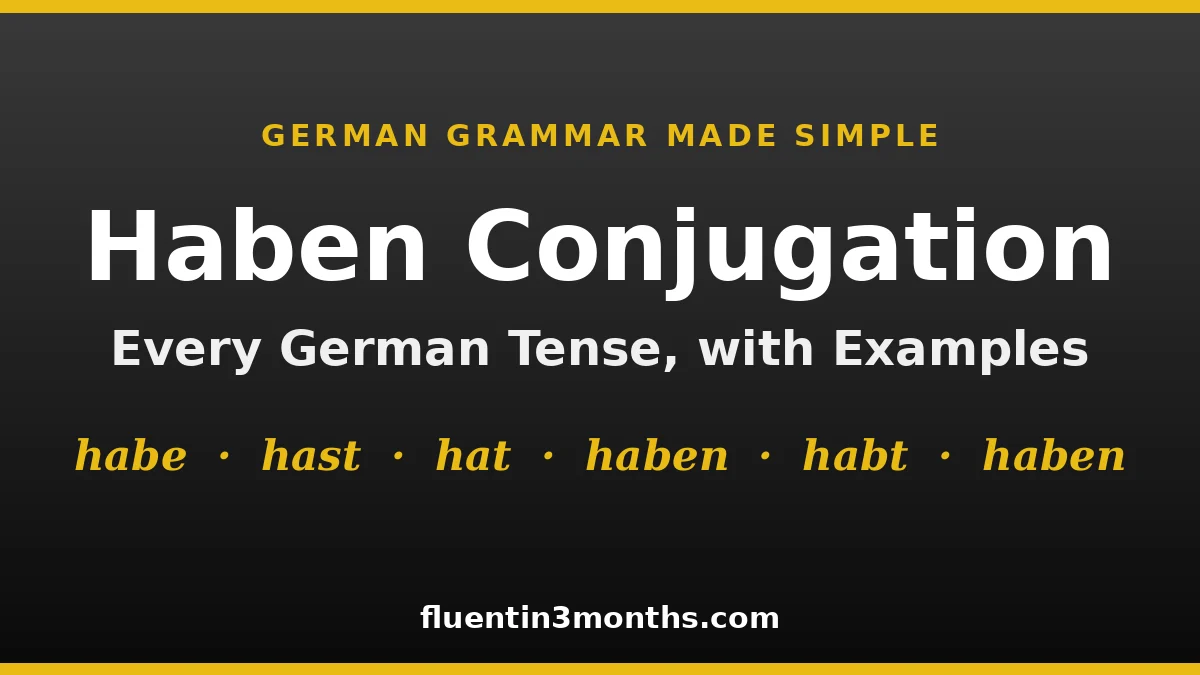
- ich habe (I have)
- du hast (you have – informal)
- er/sie/es hat (he/she/it has)
- wir haben (we have)
- ihr habt (you all have)
- sie/Sie haben (they/you – formal have)
Linguists point out that this contraction is not unique to German; it mirrors the English evolution of "haves" into "has." This smoothing of the consonant cluster is a common trait in high-frequency verbs across Indo-European languages, as speakers naturally gravitate toward forms that require less articulatory effort.
Historical Evolution and Morphological Shifts
To understand why "haben" behaves as it does, one must look at the chronology of the Germanic languages. The verb traces its roots back to the Proto-Indo-European root kap-, meaning "to grasp" or "to take." This is cognate with the Latin capere. Over centuries, the meaning shifted from the physical act of seizing to the abstract concept of possession.
In Old High German (750–1050 AD), the verb appeared as habēn. During the Middle High German period (1050–1350 AD), the language began to see the systemic weakening of unstressed syllables, leading to the contractions we see today in "hast" and "hat." The transition to the "mixed verb" category occurred as the verb adopted the dental suffix "-te" for the past tense (typical of weak verbs) while simultaneously undergoing a stem vowel change or consonant shift (typical of strong verbs).
The Simple Past (Präteritum)
The Präteritum is the narrative past tense, used primarily in writing, journalism, and formal storytelling. Unlike many other verbs where the Perfect tense is preferred in speech, "haben" (along with "sein" and modal verbs) is frequently used in the Präteritum even in spoken conversation.
- ich hatte (I had)
- du hattest (you had)
- er/sie/es hatte (he/she/it had)
- wir hatten (we had)
- ihr hattet (you all had)
- sie/Sie hatten (they/they had)
The shift from the "hab-" stem to the "hatt-" stem in the Präteritum is a defining characteristic of its mixed status. This doubling of the "t" also carries over into the subjunctive forms, which are vital for polite discourse.
The Auxiliary Function: Building the German Past Tense
One of the most critical roles of "haben" is its function as an auxiliary verb in the formation of the "Perfekt" (Present Perfect) and "Plusquamperfekt" (Past Perfect) tenses. In German, the Perfekt is the standard tense for discussing completed actions in spoken language.
Approximately 80% of German verbs use "haben" as their auxiliary. The remaining 20%—primarily verbs indicating a change of place (e.g., gehen, fahren) or a change of state (e.g., aufwachen, sterben)—utilize "sein."
Comparative Data: Haben vs. Sein Auxiliary Selection
| Verb Category | Auxiliary Verb | Example |
|---|---|---|
| Transitive Verbs (take an object) | Haben | Ich habe den Apfel gegessen. |
| Reflexive Verbs | Haben | Ich habe mich geduscht. |
| Intransitive (no change of state/place) | Haben | Ich habe geschlafen. |
| Verbs of Motion | Sein | Ich bin nach Berlin gefahren. |
| Change of Condition | Sein | Die Blume ist aufgeblüht. |
Linguistic experts note that for learners, defaulting to "haben" when in doubt is a statistically sound strategy, given its dominance in the language. However, the misuse of the auxiliary is one of the most recognizable markers of a non-native speaker.
The Subjunctive Mood: Konjunktiv II and Social Etiquette
In German, the "Konjunktiv II" is used to express hypotheticals, wishes, and, perhaps most importantly, polite requests. The form "hätte" (would have) is indispensable in German social life.
The phrase "Ich hätte gern…" (I would like to have…) is the standard, polite way to order in a restaurant or request an item in a shop. Using the indicative "Ich will" (I want) is often perceived as blunt or rude in a service context.
Konjunktiv II Conjugation:
- ich hätte
- du hättest
- er/sie/es hätte
- wir hätten
- ihr hättet
- sie/Sie hätten
This form is derived from the Präteritum stem with the addition of an umlaut, a common Germanic marker for the subjunctive mood.
Contrastive Linguistics: Idiomatic Deviations
A significant point of confusion for English speakers—and those coming from Romance languages like Spanish or French—is the use of "haben" in physical and mental states. In English, one "is" hungry; in German, one "has" hunger.
Common Idioms Using Haben:
- Angst haben (To be afraid / Literally: To have fear)
- Hunger/Durst haben (To be hungry/thirsty / Literally: To have hunger/thirst)
- Recht haben (To be right / Literally: To have right)
- Glück haben (To be lucky / Literally: To have luck)
- Zeit haben (To have time)
Interestingly, German differs from French (avoir 25 ans) and Spanish (tener 25 años) regarding age. While those languages use "to have," German aligns with English, using the verb "sein" (to be): Ich bin 25 Jahre alt. Data from language acquisition studies suggest that this specific cross-linguistic interference is one of the most persistent errors for students transitioning between Romance and Germanic languages.
Technical Analysis of Compound Tenses
For advanced communication, "haben" must be conjugated in compound forms such as the Future I, Future II, and the Pluperfect. These forms are essential for establishing a clear chronology in complex reporting.
- Futur I: Used for future intentions or assumptions. (Ich werde haben – I will have).
- Futur II: Used for actions that will have been completed in the future. (Ich werde gehabt haben – I will have had).
- Plusquamperfekt: Used for the "past of the past." (Ich hatte gehabt – I had had).
While the Futur II is rarely used in casual conversation, it remains a staple of formal journalistic writing and academic discourse, particularly when discussing historical projections or legal conditions.
Educational Impact and Pedagogical Perspectives
In the field of German as a Foreign Language (DaF), the teaching of "haben" has shifted over the last two decades. Modern pedagogical approaches, such as those advocated by the Goethe-Institut, emphasize "chunking"—learning the verb within the context of useful phrases—rather than rote memorization of conjugation tables.
Research into lexical frequency suggests that students who prioritize the "hast/hat" irregularity and the "hätte gern" polite form reach functional communicative competence significantly faster than those who focus on the rarer tenses first. Furthermore, instructors emphasize the "imperative" forms (Hab keine Angst! – Don’t be afraid!) as essential tools for immediate social integration.
Broader Implications for Linguistic Competence
The mastery of "haben" is more than a grammatical exercise; it is a gateway to the German conceptualization of the world. The distinction between "having" a feeling (like hunger or fear) versus "being" a certain way reflects a subtle but profound difference in how states of being are categorized in the Germanic mind.
Furthermore, as the primary auxiliary for the Perfekt tense, "haben" is the engine of German narrative. Without it, a speaker is trapped in the present tense, unable to recount history, share experiences, or build complex arguments. As the German language continues to evolve in the digital age, with trends toward shortening and simplifying certain structures, "haben" remains remarkably stable, its irregularities preserved by its sheer necessity in every sentence.
For the student, the journalist, or the business professional, "haben" is the most versatile tool in the German linguistic toolkit. Its tables may seem daunting at first glance, but they represent the very architecture of the language. To have "haben" under control—haben im Griff—is to truly begin the journey into the heart of the German-speaking world.
