

Google DeepMind has officially announced the release of the Gemini Decisions API, a specialized endpoint designed to provide high-speed, closed-set decision-making capabilities powered by the newly developed Gemini Decision 1 model. This launch represents a significant pivot in the evolution of Large Language Models (LLMs), moving away from the traditional autoregressive, token-by-token generation toward a more efficient, discriminative scoring system. Developed by a team led by Product Manager Min Choi and Principal Scientist Felix Yu, the Gemini Decisions API is engineered to handle up to 1,000 independent questions in a single forward pass across a variety of data formats, including text, images, audio, video, and PDFs. By streamlining the evaluation process, Google aims to provide developers with a "control plane" for AI applications that requires near-instantaneous logic without the overhead of full text generation.
A New Paradigm in Model Architecture and Efficiency
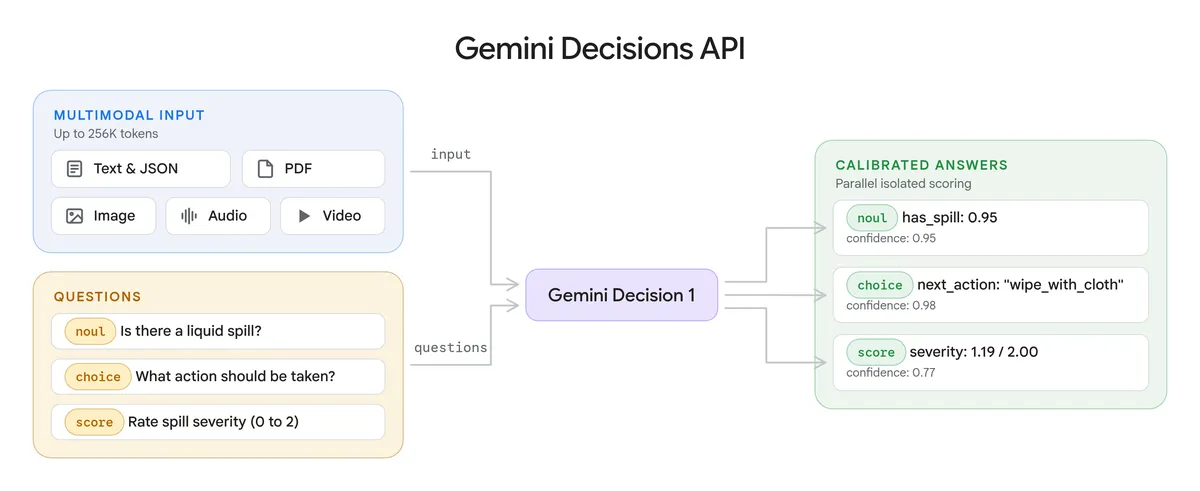
The Gemini Decision 1 model (gemini-decision-1) introduces a fundamental shift in how AI processes information for specific tasks. Unlike standard generative models that predict the next token in a sequence—a process that is computationally expensive and introduces latency—the Decisions API utilizes a scoring mechanism. In a single forward pass, the model evaluates candidate options and returns probabilities and confidence scores. This architecture allows the system to achieve an end-to-end latency of approximately 150 to 250 milliseconds, with model compute time often falling between 50 and 100 milliseconds.
This speed is particularly notable because it remains nearly flat even as the number of questions increases from one to 100 per request. For enterprise-scale applications where a single input—such as a long video or a complex legal document—needs to be checked against dozens of policy requirements, this efficiency offers a dramatic improvement over traditional methods. Furthermore, the model supports a context window of up to 256,000 tokens, allowing for the analysis of massive datasets in a single interaction.
Economic Implications and Pricing Structure
One of the most disruptive aspects of the Gemini Decisions API is its pricing model. Google has set the rate at $0.10 per one million input tokens, while completely eliminating charges for output tokens. This "zero-output-billing" strategy is possible because the model does not generate new text; it merely selects from or scores existing options. In comparison to Gemini 1.5 Flash-Lite, which is already considered a high-efficiency model, the Gemini Decisions API is nearly five times cheaper across shared benchmark suites.

For developers, this eliminates the unpredictability of "thinking tokens" or variable output lengths that can often lead to budget overruns in generative AI projects. The shared input billing further enhances cost-effectiveness; an input—whether it is a high-resolution image or a 20-minute audio recording—is billed only once per request, regardless of how many yes/no, multiple-choice, or rubric-scoring questions are evaluated against it. Each additional question only adds a marginal cost based on its specific instructions and criteria tokens.
Technical Specifications and Multimodal Capabilities
Built on the foundation of Gemini’s native multimodal architecture, Decision 1 does not rely on separate subsystems for different media types. There are no additional costs for Optical Character Recognition (OCR) or audio transcription because the model processes these modalities directly. This allows for complex cross-modal reasoning. For example, a logistics company could pair a call recording of a customer complaint with a scanned PDF of a shipping claim and a photo of a damaged package. The API can then simultaneously verify if the damage matches the claim, if the customer’s tone was urgent, and what the next logistical step should be.
The API supports three primary decision types:
- Yes/No Checks: Binary evaluations of specific conditions or policy adherence.
- Multiple Choice: Selection of the best fit from a predefined list of options, such as tool selection or model routing.
- Rubric Scoring: Qualitative assessments based on a set of criteria, providing a numerical score and a confidence interval.
Every response includes a confidence score ranging from 0 to 1. This metadata is crucial for industrial and safety-critical applications, as it allows developers to programmatically route ambiguous cases (e.g., those with a confidence score below 0.7) to human reviewers or more powerful, slower models.
Performance Benchmarks and Calibration
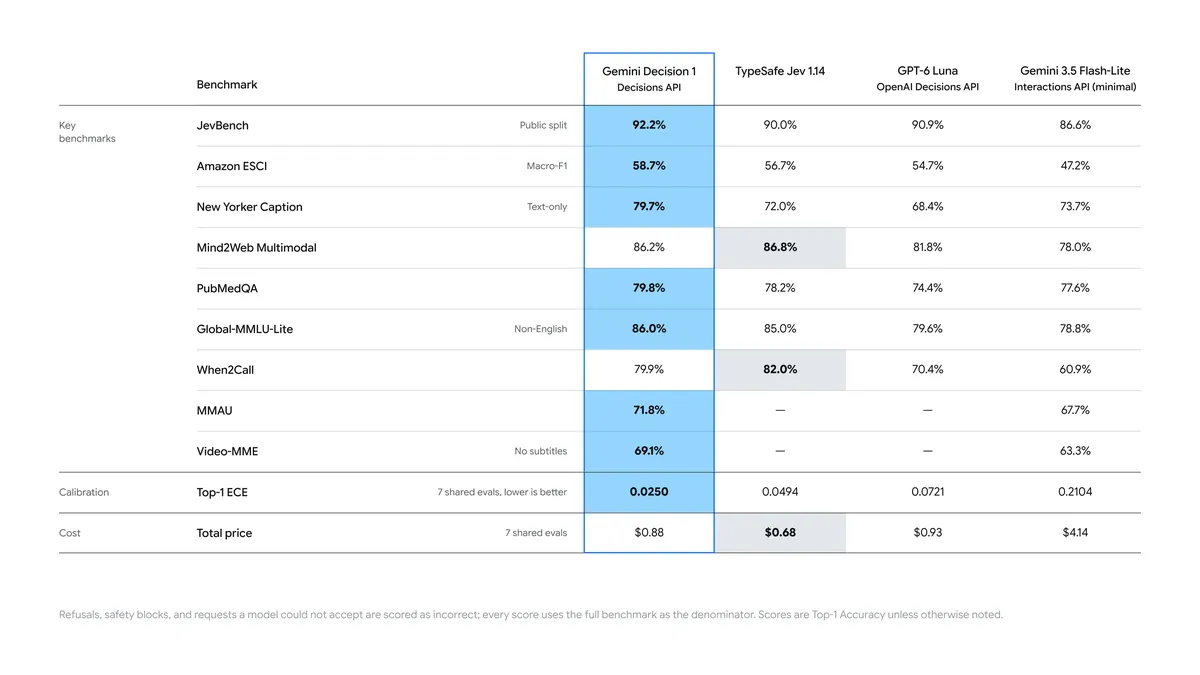
In rigorous testing, Gemini Decision 1 has demonstrated leadership across a suite of benchmarks focusing on agent routing, reasoning, ranking, and multimodal understanding. Perhaps more importantly for enterprise reliability, the model exhibits the lowest calibration error in its class. Calibration refers to the alignment between a model’s predicted probability and the actual likelihood of being correct. A well-calibrated model that claims a 90% confidence level should be correct 90% of the time. This reliability is often a weak point for generative LLMs, which are prone to "hallucinations" or overconfidence in incorrect answers. By optimizing for calibration, Google DeepMind ensures that the Decisions API can be trusted as a gatekeeper in automated workflows.
Chronology of Development and Google’s AI Strategy
The release of the Gemini Decisions API follows a year of rapid iteration within Google DeepMind. Since the unification of the "Brain" and "DeepMind" divisions in 2023, the company has focused on creating a tiered ecosystem of models. The journey began with Gemini 1.0, followed quickly by the massive context window of Gemini 1.5 Pro. Earlier this year, the introduction of Gemini 1.5 Flash addressed the need for speed.
The Gemini Decisions API represents the next step: task-specific optimization. Industry analysts suggest that this move is a response to the growing "AI Agent" market, where models are increasingly used not to chat with humans, but to make micro-decisions within a software stack. The development timeline suggests that Google has been testing this model internally for several months, using it as a low-latency control plane for its own internal features before bringing it to the public via Google AI Studio.
Industry Use Cases and Early Adoption
Teams across Google and several early-access partners are already utilizing the Decisions API to replace custom-trained classifiers. In the realm of smart home technology, for instance, the model can be used to analyze video doorbell feeds. Instead of a generic motion alert, the API can determine in milliseconds whether a package has been left, if the person at the door is a known delivery driver, and if the package is in a secure location.
Other use cases include:
- Content Moderation: Rapidly checking images and text against complex community guidelines.
- Customer Support: Routing incoming tickets to the correct department based on a rubric of urgency and subject matter.
- Financial Services: Initial screening of loan documents or insurance claims to ensure all required fields are present and consistent with provided photos.
- Industrial Safety: Analyzing "breakroom counter checks" or factory floor photos to identify spills, hazards, or maintenance needs.
Ecosystem Integration and Developer Tools
Google has ensured that the Gemini Decisions API is accessible through a wide range of popular developer frameworks. Ecosystem integrations are currently rolling out for:
- OpenRouter and LangChain: For developers building complex chains of thought or multi-model applications.
- Vercel and LiteLLM: Streamlining the deployment of AI-powered web applications.
- Pydantic AI and LiveKit: Providing robust data validation and real-time communication capabilities.
- Pipecat and OpenCode: Supporting voice and coding-specific workflows.
The google-genai SDK now supports the Decisions API, and Google has released several demo applications—including "Doorstep Parcels," "Speed Sketch," and "Find the Zoo Keeper"—to showcase the model’s multimodal speed. Support for the API within the broader Google Cloud Vertex AI platform is expected to follow shortly, providing enterprise-grade security and compliance features.
Analysis of Market Impact
The introduction of a high-speed, low-cost decision model could potentially disrupt the market for specialized "small language models" (SLMs). While many companies have turned to SLMs to reduce costs and latency, the Gemini Decisions API offers the reasoning power of a large model with the performance metrics of a much smaller one. By decoupling decision-making from text generation, Google is addressing the "efficiency wall" that many developers hit when trying to scale LLM-based agents.
Furthermore, the focus on "calibrated" decisions addresses one of the primary hurdles to AI adoption in regulated industries. When a model can quantify its own uncertainty, it becomes a much more viable tool for legal, medical, and financial sectors where "black box" generation is often deemed too risky.
Future Outlook
As AI moves from "chatbots" to "agents," the demand for fast, reliable, and cheap decision-making will only grow. Google’s release of the Gemini Decisions API signals a maturing of the AI market, where the emphasis is shifting from the novelty of generative capabilities to the utility of discriminative precision. With a pricing model that aggressively targets high-volume users and an architecture that minimizes latency, Google DeepMind is positioning Gemini as the essential "operating system" for the next generation of autonomous digital agents.
Developers can start prototyping today in Google AI Studio using the API’s no-cost tier, with full documentation and SDKs available for Python, JavaScript, and REST. As this technology integrates further into the Google Cloud ecosystem, it is likely to become a standard component in the toolkit of modern software engineering.
