

What truly distinguishes high-performing companies and enduring brands in today’s competitive landscape? While attracting top-tier talent is undeniably crucial, and developing exceptional products and services forms the bedrock of market leadership, these achievements are ultimately ephemeral without a robust foundation of employee retention. Building and sustaining blockbuster offerings demands not only significant time and commitment but also a stable, engaged workforce dedicated to seeing initiatives through. The true litmus test for any organization, therefore, lies in its capacity to keep its star performers. A resilient organizational structure is mission-critical for safeguarding institutional knowledge, consistently achieving quarterly and long-term objectives, and fostering a cohesive, vibrant company culture. Conversely, sudden employee turbulence precipitates missed deadlines, system degradation, and a critical inability to adapt to evolving customer needs. The persistent challenge for leadership remains: identifying and implementing the most effective strategies for supporting and enhancing employee retention.
The early days of Silicon Valley epitomized a distinctive work culture, characterized by a "rec room vibe" and an intense "work-hard-play-hard" ethos. Foosball tables offered moments of decompression after intense hackathons, while beanbag chairs facilitated brainstorming sessions for the next market-defining move. Employees were also supported by highly competitive salaries and comprehensive benefits packages, setting a high bar for compensation across industries. However, as the workplace matured, a critical realization emerged: these tangible perks, while attractive, often fell short when more complex, intrinsic needs—particularly those related to career progression and meaningful growth opportunities—failed to materialize. Casual dress codes, an endless supply of gourmet snacks, and kombucha on tap, it became clear, could only satisfy employees for so long. The stark reality is that if employees perceive their careers as lacking momentum or a clear pathway for advancement, they are overwhelmingly likely to seek opportunities elsewhere.
This fundamental shift in employee expectations underscores the indispensable role of clearly defined leadership development opportunities and proactive messaging that encourages employees to explore these pathways. From establishing foundational cultural and workplace standards to recognizing and supporting team members in ways that genuinely resonate with their individual "languages of appreciation," a committed and holistic approach to development yields far-reaching returns on investment. Beyond the immediate benefit of seeing more visions and product roadmaps come to successful fruition, leadership development programs serve as critical instruments for bolstering employee retention across organizations of all sizes and sectors.
The Economic and Human Cost of Attrition: A Growing Crisis
The scale of the employee retention challenge is sobering. A 2025 Gallup poll revealed that approximately 52% of employees are either actively searching for a new job or open to new opportunities, a statistic that highlights pervasive dissatisfaction or ambition within the global workforce. This finding is further corroborated by data from Forbes, which reported in 2023 that the financial cost of replacing a single employee can exceed three times the position’s annual salary. This staggering figure encompasses not only direct recruitment expenses (advertising, interviewing, background checks) but also significant indirect costs such as lost productivity during the vacancy, onboarding and training new hires, decreased team morale, and the potential impact on client relationships and project continuity. Imagine the profound financial and operational strain if even one in two workers departed an organization. Turning the tide on employee attrition is not merely a matter of fostering stability; it represents a direct pathway to substantial cost savings. Yet, beyond mere cost avoidance, the benefits of establishing a clear, consistent cadence for upskilling and professional advancement ripple positively through every level of an organization, enhancing innovation, resilience, and overall competitive advantage.
The current landscape of employee mobility and dissatisfaction is not an isolated phenomenon but rather the culmination of several overlapping trends, notably the "Great Resignation" (or "Great Rehiring") era that commenced in 2021. This period, characterized by millions of workers voluntarily leaving their jobs, forced organizations to fundamentally re-evaluate their employee value propositions. Factors like burnout, a desire for greater work-life balance, and a profound search for purpose and growth beyond mere remuneration drove this exodus. While the initial surge has stabilized, the underlying drivers persist, shaping a workforce that is more discerning and empowered than ever before. Companies that fail to adapt their retention strategies risk being consistently outmaneuvered by competitors who prioritize talent development.
Leadership Training: Unlocking Latent Potential and Fostering Agility
In the natural world, animals engage in elaborate mating rituals—songs, dances, vibrant plumage, or the meticulous gathering of objects—all serving the singular purpose of securing a partner. In professional environments, the hiring process mirrors this courtship, demanding a compelling performance from both candidates and organizations. Resumes are meticulously crafted to meet intricate role descriptions, while expectations are carefully weighed against demonstrated skillsets. However, even the most rigorous hiring procedures, designed to identify the "perfect candidate," can eventually lead to friction. Shifting organizational priorities, unforeseen pivots in market strategy, and the gradual shedding of initial pretenses from both parties inevitably reveal the true state of play. It is in this crucial "dust-settling" phase that organizations have the opportunity to embrace candor, honestly assess emerging skill gaps, and strategically guide new hires toward refining their abilities in alignment with their evolving roles and the company’s future trajectory.
Effective talent retention, therefore, demands a continuous commitment that extends far beyond initial onboarding. It necessitates a dynamic response to the constant flux experienced by employees, organizations, and entire industries. The relentless pace of technological advancement, epitomized by new tech stacks, innovations like artificial intelligence, and other disruptive forces, often arrives with considerable fanfare. However, true organizational resilience and individual agility are forged not merely through platform- or tool-specific knowledge, but through investment in a robust foundational skillset that is "upstream" of these transient technologies. This approach empowers employees to become agile and multi-faceted problem-solvers, capable of tackling a diverse range of challenges. Consider data analysts who are trained to "think like designers," enhancing their ability to visualize and communicate insights effectively; or designers who cultivate strong "data storytelling" capabilities, translating aesthetics into actionable narratives; or indeed, any professional who masters two-way communication channels through methodologies like Adaptive Listening®. These cross-functional skills are the bedrock of future-proof careers.
Building a Comprehensive Toolkit for Leadership in a Dynamic Era
Today’s decision-makers and executive-level leaders require an increasingly well-rounded skillset to effectively digest, interpret, and apply vast quantities of information, not merely to survive but to thrive. Establishing a clear framework for continuous professional refinement provides employees with tangible pathways for unlocking their potential in previously unexplored directions. For designers, data analysts, marketers, and sales professionals branching out to become more adept problem-solvers and communicators, cross-training across roles yields manifold benefits. It fosters shared skillsets and experiences, which tighten workflows, strengthen organizational commitment, and enable individuals to tap into new reservoirs of potential.
Whether implemented within a select cohort of future leaders or scaled across an entire enterprise, such practices establish clear benchmarks for progress and empower workers to aspire beyond their current capabilities. Bolstering core communication skills, for instance, unlocks new vectors of development for aspiring leaders, functional teams, and entire departments when purposefully applied. These efforts cultivate the discernment and critical eye necessary to extract clear, concise recommendations from cluttered dashboards. They enable more effective, "right-the-first-time" prompt building in an AI-driven world, thereby reducing wasted resources. Crucially, they help ensure that essential information remains intact and accurately conveyed as it traverses the organizational hierarchy, preventing misinterpretations and inefficiencies. As the adage attributed to hockey legend Wayne Gretzky suggests, organizations that "skate to where the puck is going" – that is, anticipate industry trends – are best positioned to prepare their employees for the future. This foresight must inherently include understanding how employees envision their own futures within the company.
Top Talent Envisions a Future with Your Organization
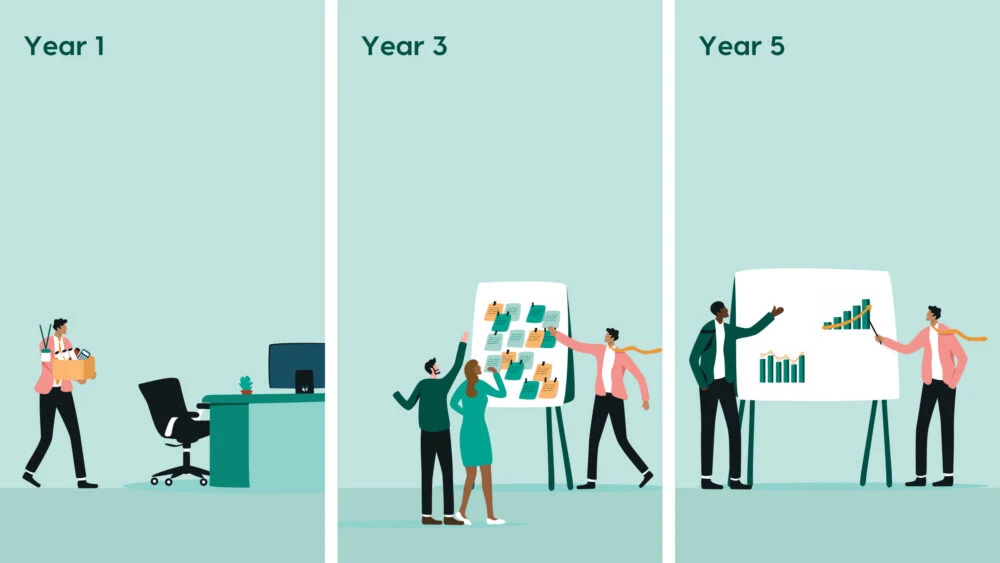
From college admissions interviews to first dates and job applications, a pervasive question lingers in our collective consciousness: "Where do you see yourself in five years?" This forward-looking gaze persists even when current circumstances are favorable. Messages to strive for betterment, achieve more, and leave a lasting legacy are deeply embedded in popular culture and constantly amplified across social media platforms. Given this incessant societal encouragement, it is hardly surprising that workers often feel a compelling tug toward the possibility of "something more," despite platitudes about the pitfalls of constantly searching for greener pastures. Effective employee retention strategies directly address this fundamental human drive by helping workers authentically envision a fulfilling future within your organization. Guiding them to this crucial realization necessitates a leadership development program that respects this inherent ambition and proactively meets it head-on, creating a mutually beneficial trajectory for both employee and enterprise.
However, merely making growth opportunities available is insufficient to catalyze genuine employee retention. A concerted effort across Human Resources (HR), Learning & Development (L&D) departments, line managers, and C-suite executives is required to align on how best to promote and embed these initiatives. When communicated with crystal clarity and consistently supported by a regular cadence of assessments, targeted training, and constructive feedback, the path ahead becomes demystified. Data analysts who perceive a lack of creative expression should be encouraged to explore novel approaches to presenting their data insights. Product leaders who are naturally inclined to chase groundbreaking innovations should be equipped with robust strategies to effectively communicate their discoveries and visions. When employees are provided with the psychological space and the necessary resources to reimagine and expand their professional toolkits, their future prospects within the company take on a significantly brighter hue. Perceived ceilings that once confined roles give way to newfound confidence, and expanded opportunities within the workplace reveal that "greener pastures" are indeed accessible without the need to endlessly scroll through job boards.
While certain skills and training modules should be mandated to ensure a cohesive company culture and maintain critical operational standards, HR, L&D, and executive leadership should also empower workers to pursue specialized development in approved fields. Frontline talent, by virtue of their direct involvement in daily operations, often possesses the most valuable insights into how workflows can be optimized and what additional skills would contribute to superior outcomes. Cultivating a collaborative spirit and maintaining open lines of communication can significantly enhance the overall efficacy of leadership development programming, while simultaneously fostering a bespoke experience that is unique to each role and individual. Implementing simple mechanisms such as regular surveys, feedback forms, or brief developmental interviews can be instrumental in initiating this employee-centric approach within your organization. And to effectively kick things off, you already know the perfect question to ask.
Workers Invest in Organizations that Invest in Them: Combating Burnout and Fostering Loyalty
The profound impact of organizational culture and investment on employee well-being is undeniable. According to a 2025 report from Forbes, employee burnout reached a staggering 66%. This alarming statistic underscores a workforce grappling with exhaustion, making it entirely comprehensible why nearly half of all employees are actively seeking to improve their professional circumstances. The Forbes piece further suggests that organizations must critically reexamine their approach to promoting work-life balance and strategically integrate professional development opportunities as a means to reinvigorate staff commitment. In an era marked by the breakneck pace of AI innovation and the often-exaggerated promises touted by its proponents, the report also cites rising anxieties among workers who fear their current roles—or even their entire industries—may soon face obsolescence.
To effectively assuage these legitimate doubts and anxieties, organizations can strategically embed professional and leadership development opportunities alongside routine compliance and security training. Rather than treating training as a mere software update—a necessary but often uninspiring chore—departments can provide engaging learning and skill-building workshops or ongoing courses that specifically nurture distinctly human skills. These include critical thinking, complex problem-solving, emotional intelligence, collaborative communication, and adaptive leadership. Such deliberate investments signal to team members that their unique contributions are profoundly valued and worthy of sustained development, preventing them from feeling like interchangeable cogs in a machine. Development training that extends beyond mere industry standards can serve as a powerful differentiator, setting an organization apart from competitors who fail to demonstrate a similar level of care and commitment to their workforce. Furthermore, it serves as a crucial, continuous reminder to both current and prospective employees that careers within your organization are always in motion, offering dynamic pathways for growth and evolution.
Leadership and professional development opportunities play a vital role in dismantling psychological barriers such as doubt, fear, and anxiety by providing dedicated space for teams to recalibrate and grow. Targeted training courses and workshops actively combat burnout by guiding workers to rediscover their inherent talents, cultivate new competencies, and view their roles with a refreshed, invigorated perspective. Acquiring new skillsets sparks a renewed sense of purpose, jettisoning feelings of stagnancy and, in severe cases, even professional regression. In turn, professionals regain stamina, deepen their appreciation for their contributions, and experience a powerful sense of validation. After receiving tangible confirmation that their work matters to the overall health and success of the organization, it becomes significantly easier to summon the necessary energy and dedication. This positive feedback loop invariably leads to an uptick in both the quality and timeliness of work, allowing burnout to recede as a dominant force.
To successfully embed ongoing improvement as a fundamental habit within an organization, partnering with a trusted external expert can prove invaluable. Such partners can deliver the specialized experiences and meticulously crafted materials needed to keep employees consistently engaged, positive, and productively contributing to organizational goals.
Strategic Partnerships for Sustained Employee Retention
While data can offer a stark awakening to problems that have escalated, a palpable talent exodus often precedes the alarm bells. For organizations contending with widespread burnout and precarious employee retention rates, the urgent need for improvement is self-evident. Strategic partners, like Duarte, bring decades of experience in navigating complex organizational challenges. With a history spanning over 40 years, assisting Fortune 50 companies and global brands through periods of intense disruption—from the volatile Dot Com era and the Great Recession to the unfolding "omnicrisis"—these experts are uniquely positioned to help. Their expertise ranges from reinforcing core communication skillsets critical for internal cohesion to delivering bespoke materials and messaging designed to meet the precise demands of the current moment.
Regardless of an organization’s current talent landscape, external partners can play a crucial role in stabilizing the org chart and preparing for an inherently uncertain future. A preliminary, no-pressure consultation with a solutions architect can provide an objective assessment of an organization’s current health metrics and offer tailored recommendations to prevent negative trends from escalating. Whether teams are misaligned on complex projects, or leadership struggles to articulate a compelling vision for the future, a strategic partnership can intervene at every level to address skill gaps and prevent the hemorrhaging of top talent. In practice, proactively shoring up existing initiatives or implementing new processes before an organization enters a state of free fall is not only more efficient but fundamentally more sustainable.
For organizations seeking to delve deeper into effective strategies and resources for enhancing employee retention, comprehensive guides on leadership development are readily available. These resources offer valuable insights and actionable frameworks to foster a culture of growth, engagement, and loyalty.
