

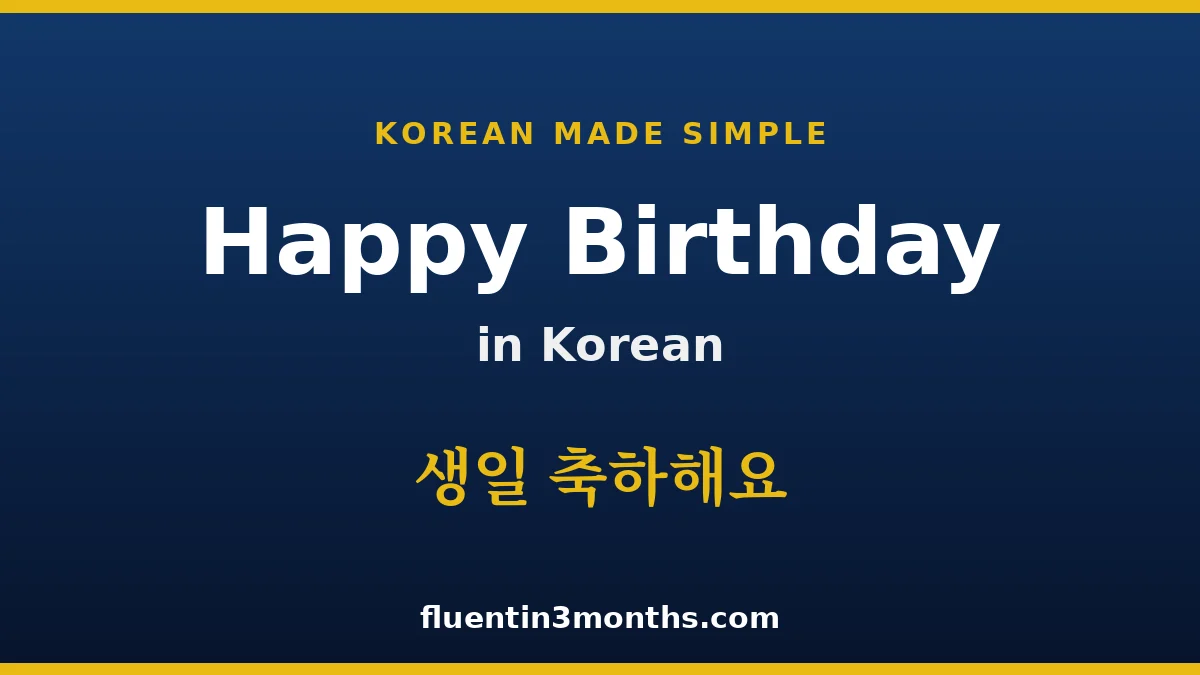
In the complex sociolinguistic landscape of the Korean Peninsula, the act of wishing someone a happy birthday involves a sophisticated interplay of social hierarchy, age-based respect, and linguistic precision. The most versatile and widely utilized phrase for this occasion is saengil chukhahaeyo, yet this expression represents only one facet of a deeply rooted system of honorifics. Understanding the cultural and legal frameworks surrounding birthdays in South Korea requires an examination of traditional customs, recent legislative shifts regarding age calculation, and the specific vocabulary used to navigate various social settings.
The Linguistic Architecture of Korean Birthday Greetings
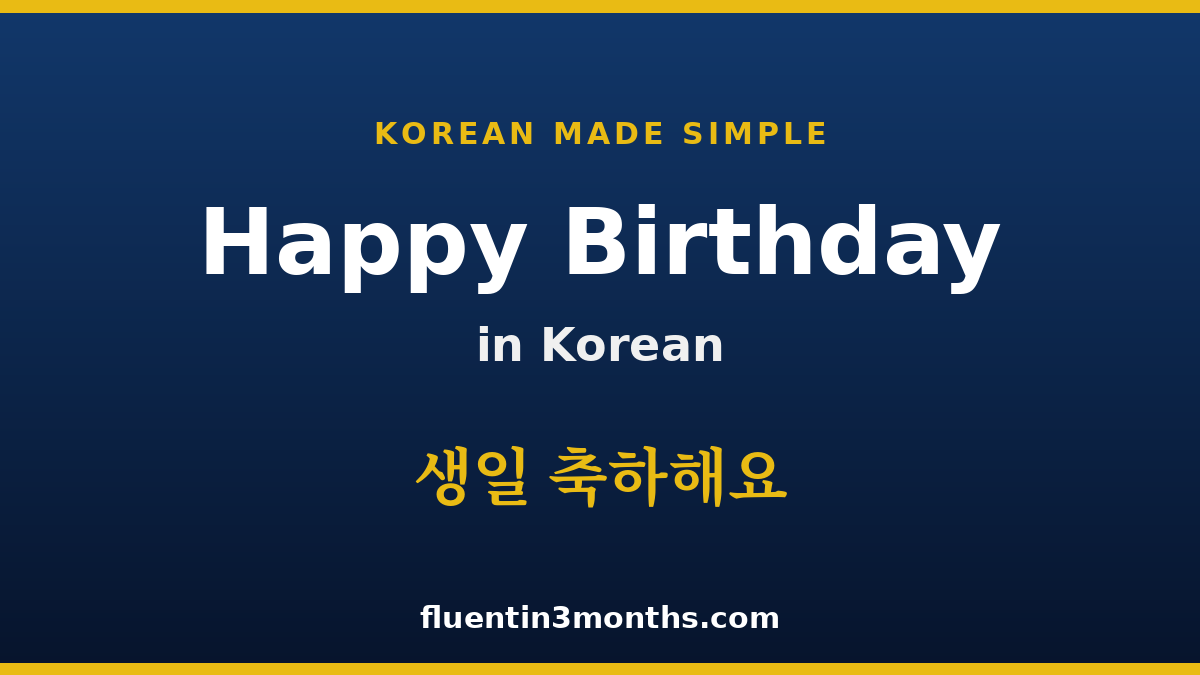
The standard polite greeting, saengil chukhahaeyo, is constructed from three distinct components that illustrate the mechanics of the Korean language. The noun "saengil" translates directly to "birthday," while "chukha" denotes "congratulations" or "celebration." The suffix "-haeyo" is a conjugated form of the verb "hada" (to do), rendered in the polite informal style. This version serves as the "default" greeting in South Korea, appropriate for use with colleagues, acquaintances, and those of a similar social standing where a degree of professional distance is maintained.
However, the Korean language operates on a spectrum of politeness known as speech levels. These levels are determined not merely by the chronological age of the participants but by their relative social status and the degree of intimacy between them. In situations of high formality—such as official ceremonies, military environments, or when addressing a large public audience—the greeting shifts to saengil chukhahamnida. This version utilizes the "-hamnida" ending, which is the formal polite suffix, signaling a high degree of respect and situational gravity.
Conversely, in intimate settings among close friends or when an older individual addresses a significantly younger person with whom they share a bond, the greeting is shortened to the casual "banmal" form: saengil chukhae. It is a common social faux pas for non-native speakers to use this casual form prematurely. In South Korean culture, the transition to casual speech (banmal) typically requires an explicit agreement between both parties, often initiated by the elder or the person of higher status.
The highest tier of the birthday greeting is reserved for those who command the utmost respect, such as grandparents, elderly parents, or high-ranking mentors. In these instances, the vocabulary itself changes to reflect the honorific status of the recipient. The word for birthday, "saengil," is replaced by the honorific "saengsin." Furthermore, the standard verb for "to give" or "to congratulate" is replaced with "deurida," a humble verb used when an inferior is offering something to a superior. The resulting phrase, saengsin chukha-deurimnida, represents the pinnacle of linguistic deference in a birthday context.
The 2023 Age Standardization Law: A Landmark Shift
On June 28, 2023, South Korea underwent a historic administrative transformation that fundamentally altered how birthdays are perceived and recorded. For centuries, the "Korean age" system (seneun nai) was the cultural standard. Under this traditional method, a child was considered one year old at birth, accounting for the time spent in the womb. Furthermore, everyone in the population would collectively "age up" by one year on New Year’s Day, regardless of their actual birth date. This meant that a child born on December 31 would technically turn two years old on January 1, despite having lived for only two days.
The confusion caused by this system—where an individual could have three different ages (their international age, their "year age" for certain laws, and their "Korean age" for social interactions)—led the administration of President Yoon Suk Yeol to implement the "Man Age" Law. This legislation mandated the use of the international age system for all judicial and administrative matters.
The implications of this change are significant. Government officials noted that the standardization was intended to reduce "unnecessary social and economic costs" arising from the mixed use of age systems. While the law has streamlined legal documents, medical records, and administrative procedures, the cultural transition remains in progress. Socially, many South Koreans still refer to their traditional age when establishing the hierarchy necessary for proper speech levels. In a culture where even a one-year difference can dictate the choice between casual and polite language, the 2023 law represents a modernizing force clashing with deeply ingrained social traditions.
Cultural Traditions: From Seaweed Soup to the First Birthday
The celebration of a birthday in South Korea is inextricably linked to specific culinary and ritualistic traditions that emphasize family lineage and maternal sacrifice. The most iconic birthday dish is miyeokguk, or seaweed soup. This tradition is rooted in the postpartum recovery process; seaweed is high in iodine and calcium, making it a staple for new mothers in Korea to aid in recovery and breast milk production. By consuming miyeokguk on their own birthdays, individuals perform a ritual of remembrance and gratitude for their mother’s labor and care.
While every birthday is celebrated, the first birthday, known as doljanchi, holds a place of particular prominence in Korean culture. Historically, when infant mortality rates were high due to disease and limited nutrition, reaching the one-year milestone was a significant achievement for a child. A doljanchi is a large-scale event involving extended family and traditional attire (hanbok).
The centerpiece of the doljanchi is the doljabi, a fortune-telling ritual. A variety of symbolic objects are placed before the child, who is encouraged to pick one or two. The selected items are believed to predict the child’s future:
- Thread or Yarn: Symbolizes a long and healthy life.
- Money or Rice: Indicates future wealth and financial stability.
- Books or Calligraphy Brushes: Suggests a future as a scholar or intellectual.
- Stethoscope or Gavel: Modern additions representing careers in medicine or law.
The doljanchi serves as a community affirmation of the child’s health and a collective wish for their prosperous future, bridging the gap between ancient survival milestones and modern family celebrations.
The Linguistic Evolution: Hangul and Modern Learning
The precision of Korean birthday greetings is supported by the scientific structure of the Korean alphabet, Hangul. Created by King Sejong the Great in 1443 and promulgated in 1446, Hangul was designed to be easily learned by the common people, who previously struggled with complex Chinese characters. The shapes of the consonants in Hangul are modeled after the physical morphology of the mouth and tongue during speech, a feature that linguists often cite as a pinnacle of phonetic design.
For modern learners and members of the Korean diaspora, mastering the nuances of birthday greetings is often a gateway to understanding the broader "honorific system" (jondaemal). Experts in Korean linguistics emphasize that the difficulty for English speakers lies not in the vocabulary, but in the constant social calibration required to choose the correct suffix. The 2023 age law has added a layer of complexity to this calibration, as individuals must now decide whether to base their linguistic choices on the new legal age or the traditional social age.
Chronology of Korean Age and Birthday Customs
- 1443: King Sejong the Great completes the development of Hangul, providing the phonetic tools to record native Korean greetings.
- Traditional Era: The "Korean Age" system becomes the standard, rooted in East Asian cultural traditions.
- Post-War Era: The international age system is introduced for some official purposes, but the traditional system remains dominant in social life.
- 2022: The South Korean National Assembly passes the amendment to the Civil Act and the General Act on Public Administration to standardize age.
- June 28, 2023: The "Man Age" law officially takes effect, making South Koreans one or two years younger on paper and aligning the nation with global administrative standards.
Analysis of Social Impact
The shift toward the international age system is more than a clerical change; it is a reflection of South Korea’s evolving identity as a global leader. By aligning with international standards, the government has simplified cross-border interactions and reduced ambiguity in insurance contracts and labor laws. However, the linguistic impact is subtle. Because the Korean language relies so heavily on relative age for social hierarchy, the "year age" (the birth year) often remains the primary factor in determining who is an "eonni" (older sister) or an "oppa" (older brother).
Sociologists suggest that while the law has changed, the "social age" will likely persist for generations. The act of saying saengil chukhahaeyo remains a vital social lubricant, a phrase that acknowledges an individual’s personal milestone while simultaneously reinforcing the respect and hierarchy that define Korean social cohesion. As South Korea continues to balance its rapid technological and legal modernization with its rich cultural heritage, the traditions of the birthday—from the seaweed soup to the precisely chosen honorific—remain a steadfast anchor of national identity.
