

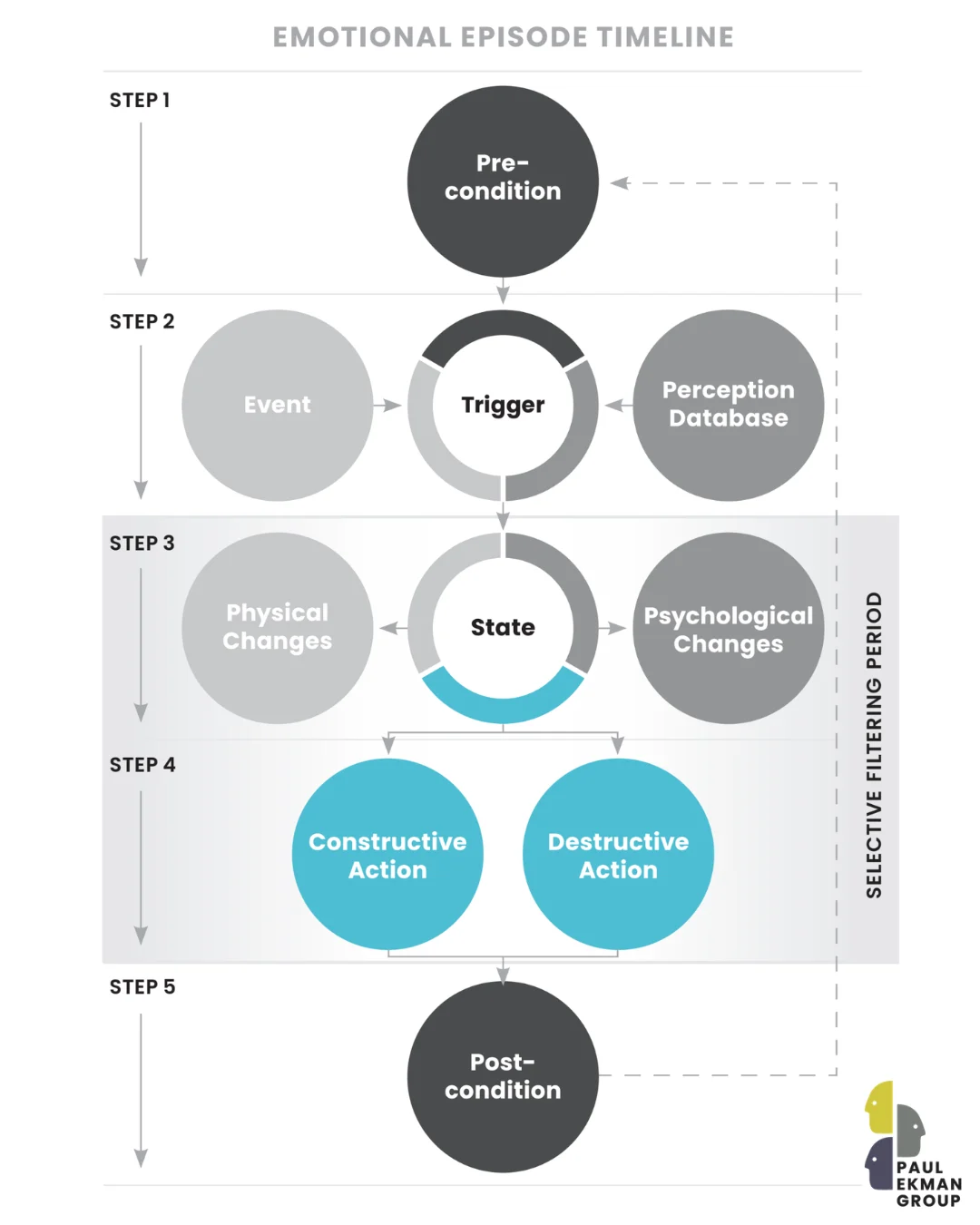
Our emotional lives, often perceived as a torrent of unpredictable reactions, can be demystified through a structured understanding of how they unfold. While it may feel as though emotions strike without warning, a closer examination reveals a predictable, three-step process that governs every emotional experience. This sequence, influenced by our present circumstances and the accumulation of our past, is known as the Emotional Episode Timeline. By dissecting this timeline into five distinct stages, individuals can gain valuable insights into their emotional triggers, develop more skillful responses, and ultimately, work towards transforming patterns that no longer serve their well-being.
The Foundation of Emotional Response: A Three-Step Framework
At its most fundamental level, an emotion can be understood as a flow through three core stages: Trigger, Experience, and Response. This basic cycle plays out countless times a day, often in subtle ways that escape our conscious notice. Consider the minor frustration of misplacing keys or a misplaced phone. These seemingly small episodes, though easily forgotten, offer profound clues about our ingrained habits and unconscious biases. Do we immediately default to blaming others, or do we engage in self-criticism? The Emotional Episode Timeline expands upon this fundamental framework, breaking it down into a more granular, five-step process that illuminates the underlying mechanisms of our emotional lives.
Deconstructing the Emotional Episode Timeline: A Five-Stage Journey
The comprehensive Emotional Episode Timeline, as conceptualized by researchers in the field of emotion science, offers a more detailed lens through which to view our affective experiences. This model moves beyond the initial trigger-experience-response paradigm to encompass the crucial preceding and succeeding conditions that shape our emotional landscape.
Step 1: Pre-condition – The Emotional Starting Point
Every emotional journey begins with a pre-condition, which represents the accumulated physical and psychological state we bring into any given moment. This is our "emotional starting point," a complex interplay of factors that primes us for certain emotional responses. It can be influenced by a myriad of elements: a night of insufficient sleep leaving us fatigued and irritable, hunger gnawing at our focus, stress from work creating a sense of unease, or conversely, the exhilaration of good news setting a positive tone. In instances where we feel neutral or at ease, the pre-condition may be minimal, offering a blank slate for incoming stimuli. However, even a subtle pre-existing state can significantly influence the intensity and likelihood of an emotion arising. For instance, someone already experiencing high levels of stress might find themselves disproportionately agitated by a minor inconvenience compared to someone who is well-rested and relaxed. Research on stress physiology indicates that chronic stress can alter neurotransmitter levels and heighten the reactivity of the amygdala, the brain’s fear center, making individuals more susceptible to negative emotional states.
Step 2: Trigger – The Catalyst of Emotion
The trigger is the pivotal moment where an external event or internal thought initiates an emotional response. This stage is not simply about the event itself, but rather a dynamic interplay between the event, our personal appraisal of it, and the vast internal "database" of our past experiences and learned responses. This database, combined with our current pre-condition, dictates how we interpret and react to the world around us.
The Event: External and Internal Stimuli
An event, in this context, is any occurrence that impinges upon our senses or consciousness. This can range from tangible external stimuli such as encountering a person, a specific place, or a complex situation, to internal stimuli like a fleeting thought, a vivid memory, or even a day dream. Our sensory portals – sight, sound, smell, taste, and touch – are constant conduits of information that feed into this process.
Automatic Appraisal: The Brain’s Rapid Assessment
Our minds are in a perpetual state of monitoring and evaluating our surroundings, operating with remarkable speed and often unconsciously. This process, known as "automatic appraisal," involves a swift assessment of potential opportunities or threats. It prepares us for immediate action. A classic example is the reflexive swerving of a car to avoid an animal darting into the road. In a social context, a perceived lack of a timely response to a text message from a new acquaintance can be appraised as a sign of rejection, even if that interpretation is not objectively accurate. Neuroscience studies using fMRI have shown that the ventromedial prefrontal cortex plays a crucial role in this rapid appraisal process, integrating emotional and cognitive information to guide immediate behavioral responses.
Perception Database: Our Internal Emotional Lexicon
Each individual possesses a unique "perception database," a rich internal library of past emotional experiences, learned associations, and ingrained response patterns. This database functions as an "emotional alert system," enabling our minds to rapidly determine the significance of incoming information. This internal archive is shaped by two primary sources:
- Learned Associations: Over time, we associate certain stimuli, situations, or individuals with particular emotional outcomes. For example, a past negative encounter with a particular breed of dog might create an automatic fear response when encountering any dog of that breed in the future.
- Innate Predispositions: While largely shaped by experience, there is also evidence for innate predispositions towards certain emotional sensitivities. These can be influenced by genetic factors and early developmental experiences, contributing to individual differences in emotional reactivity. Research in behavioral genetics suggests that variations in genes related to neurotransmitter systems, such as serotonin and dopamine, can influence an individual’s baseline emotional state and their susceptibility to certain mood disorders.
Step 3: State – The Embodied Experience of Emotion
The "State" represents the emotion itself, encompassing the "Experience" described in the simpler model. This is a holistic mind-body phenomenon, characterized by a complex interplay of physical and psychological changes.
Physical Changes: The Body’s Emotional Symphony
When we experience an emotion, our bodies undergo a series of physiological alterations designed to prepare us for action. These changes can manifest in diverse ways, including an accelerated heart rate, a flushing of the face, tension in the jaw muscles, a fluttering sensation in the stomach, the formation of tears, muscle tightening, or alterations in breathing patterns. Extensive research, notably pioneered by Dr. Paul Ekman, has identified characteristic physiological signatures associated with universally recognized emotions. For instance, anger is often linked to increased blood pressure and muscle tension, while fear can trigger a surge of adrenaline leading to rapid heartbeat and shallow breathing. These distinct physiological patterns are believed to have evolved to facilitate adaptive behaviors, such as fight-or-flight responses in the face of danger. It is important to note that we may not always be consciously aware of the trigger that initiated these changes, but we often become acutely aware of the shifting sensations within our bodies.
Psychological Changes: The Subjective Felt Sense
Beyond the observable physical shifts, emotions are experienced subjectively as a "felt sense." This internal experience is what gives each emotion its unique "flavor" and colors our psychological landscape. Sadness, for example, might be perceived as a heavy, dragging sensation, while anger can feel hot, sharp, and intense. This subjective experience is a crucial component of emotional literacy, allowing us to differentiate between various affective states. The intensity and nuance of these psychological changes can be profound, influencing our thoughts, perceptions, and motivations.
Step 4: Action – The Behavioral Manifestation
Emotions are inherently motivational, propelling us towards action. These actions can be overt and external, such as expressing anger through shouting or reaching out in joy, or they can be internal and subtle, like suppressing anger or softening into compassion. Rather than categorizing emotions as inherently "positive" or "negative," a more constructive approach involves evaluating whether the resulting actions are beneficial or detrimental.
Constructive vs. Destructive Actions
The classification of actions as constructive or destructive is paramount. Constructive actions tend to promote well-being, resolve conflicts effectively, and foster positive relationships. Destructive actions, conversely, can lead to harm, exacerbate problems, and damage connections. For example, while anger is often stereotyped as a negative emotion due to its potential for destructive outbursts, research indicates that "constructive anger" can be a powerful force for positive change, motivating individuals to address injustices or assert their boundaries assertively. The ability to differentiate between these types of actions is a hallmark of emotional intelligence. Studies in social psychology have demonstrated that individuals with higher emotional intelligence are better equipped to regulate their emotional responses and choose actions that are both effective and ethically sound.
Step 5: Post-condition – The Lingering Impact and Learning Opportunity
Every emotional episode leaves a residue, an aftermath that can ripple outwards and influence future experiences. If an individual has yelled in anger, the recipient might retaliate with their own anger, or withdraw defensively. If anger was suppressed, a lingering sense of irritation may persist, potentially festering and influencing subsequent interactions. These "post-conditions" can act as fertile ground for the genesis of new emotional episodes, creating a cyclical pattern. However, they also present a critical opportunity for reflection and learning. By pausing and analyzing the preceding steps, individuals can gain valuable insights into the dynamics of their emotional experiences and identify areas for growth and adjustment. This reflective process is central to building emotional resilience and developing more adaptive coping mechanisms.
The Selective Filtering Period: A Window of Focused Perception
It is crucial to understand that a "selective filtering period" is not a distinct step in the timeline but rather a phenomenon that occurs concurrently with Steps 3 (State) and 4 (Action). When an emotion is actively experienced, our perception tends to narrow, filtering incoming information to align with the prevailing emotional state. In a state of fear, for instance, an individual may become hyper-focused on potential threats, whether real or imagined, while downplaying or overlooking reassuring cues. Similarly, during anger, attention can become fixated on the frustrating aspects of a situation, to the exclusion of anything that is proceeding smoothly. While this focused attention can be advantageous for survival by prioritizing immediate concerns, it can also lead to a distorted perception of reality if not recognized and managed. This concept aligns with research on emotional bias, which highlights how our affective states can significantly influence our cognitive processes and interpretations of events.
Cultivating Emotional Understanding and Skill
The Emotional Episode Timeline provides a powerful framework for understanding the intricate workings of our emotions. By demystifying the process, it empowers individuals to move from reactive patterns to more intentional and skillful responses. The insights gained from dissecting these episodes can inform personal growth and lead to a more balanced and fulfilling emotional life.
For those seeking to delve deeper into the science of emotion and apply these principles to their lives, resources such as "The Feelings Field Guide" offer comprehensive exploration of the Emotional Episode Timeline, alongside practical exercises and foundational knowledge of emotion science. Furthermore, the Atlas of Emotions, an interactive tool developed by Drs. Paul and Eve Ekman, provides a free platform for individuals to explore the origins and unfolding of their emotions, with an upcoming book promising even deeper insights and practical guidance.
Frequently Asked Questions on Emotional Experience
Why do I react before I even know what’s happening?
This phenomenon is attributed to automatic appraisal, a largely unconscious process occurring during the trigger stage. Your brain rapidly evaluates potential help or harm before your conscious awareness fully registers the situation, leading to a swift, pre-conscious emotional and physiological response.
Why do small things set me off more on some days than others?
Your pre-condition plays a significant role. Factors such as fatigue, hunger, stress levels, or overall mental state can lower your emotional threshold, making you more susceptible to being triggered by minor events. A depleted pre-condition can amplify your emotional reactivity.
Why can’t I think clearly when I’m upset?
During the state and action stages of an emotional episode, you enter a selective filtering period. Your perception narrows, focusing intensely on the emotional experience and its perceived causes, which can impede your ability to engage in objective, rational thought.
Can I control how I react to an emotion?
While the trigger and state stages are largely automatic and beyond immediate conscious control, the action stage offers a crucial point of intervention. This is where conscious choice and deliberate action come into play, allowing for the development of more constructive and skillful responses to emotional experiences.
