


The rapid integration of Artificial Intelligence into enterprise operations has ignited a complex dynamic within organizations, placing leaders and workers alike in a delicate dance of adaptation and apprehension. This technological paradigm shift, characterized by its profound potential and inherent uncertainties, demands a nuanced approach to change management, particularly in the realm of internal communication. From enthusiastic advocacy to profound skepticism and outright ambivalence, opinions on AI’s role and impact are as varied as the individuals holding them. Understanding and unifying these disparate perspectives under a cohesive vision is perhaps the most critical challenge facing modern leadership.
The Divided Workforce: A Spectrum of Sentiments
Across industries and organizational hierarchies, the discourse surrounding AI is remarkably fragmented. A casual survey of ten employees within any given company would likely yield a spectrum of responses, ranging from utopian visions of AI solving humanity’s greatest challenges to dystopian fears reminiscent of cinematic narratives like The Terminator, or existential concerns about the erosion of truth and human value. This broad divergence is not merely anecdotal; it is deeply rooted in differing perceptions of AI’s practical implications for individual roles, job security, and organizational culture.
For many organizations, the specter of "fear of missing out" (FOMO) looms large, amplified by the lessons learned from previous technological revolutions. The imperative to adapt is palpable, driven by the understanding that inaction could be detrimental in an increasingly competitive landscape. However, an uncritical rush towards AI enablement, where technology adoption becomes an end in itself, often bypasses essential strategic questions: Is this AI tool truly necessary? What are the unforeseen consequences of automating this particular workflow? Does an AI agent genuinely require a company credit card? Without addressing these foundational queries and the underlying anxieties they represent, achieving widespread AI adoption remains an elusive goal, demanding an era-defining narrative that resonates with every stakeholder.
Leadership’s Communication Gap: Fueling Misalignment
Despite the undeniable urgency, many leaders are struggling to articulate a clear, compelling narrative for AI integration. This communication deficit contributes significantly to internal misalignment and can undermine even the most well-intentioned initiatives. The reliance on time-tested communication skills—the ability to acknowledge difficulties, address pushback, and build momentum—becomes paramount. These deeply human qualities, including empathy, persuasive storytelling, and the capacity to inspire, cannot be automated by even the most advanced AI. While "prompt engineering" and "vibe-coding" might offer superficial gains, they fall short in fostering the deep investment and collective commitment required for profound organizational change.
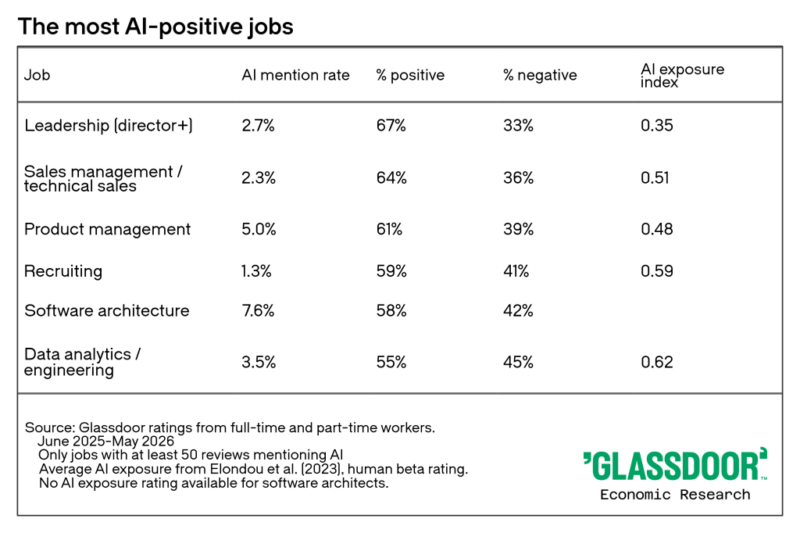
Compounding this challenge is the empirical evidence of a leadership-employee perception gap regarding AI. An August 2026 study by Glassdoor, analyzing employer reviews from workers, revealed significant differences in AI sentiment across various roles and industries. While certain positions express high levels of enthusiasm, others harbor deep reservations:

Most AI-Positive Jobs (per mentions in reviews):
- Leadership (director+): 67%
- Sales Management / Technical Sales: 64%
- Product Management: 61%
- Recruiting: 59%
- Software Architecture: 58%
- Data Analytics / Engineering: 55%
These roles, often at the strategic or technical forefront, tend to view AI as an augmentative tool that enhances decision-making, streamlines processes, or opens new revenue streams. Leaders, in particular, see the strategic advantage and competitive necessity of early adoption.
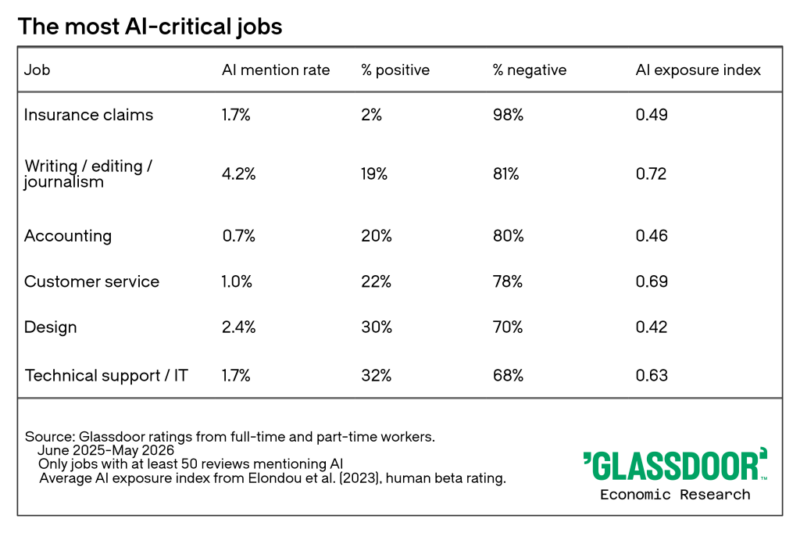
Most AI-Critical Jobs (per mentions in reviews):
- Insurance Claims: 98% negative
- Writing / Editing / Journalism: 81% negative
- Accounting: 80% negative
- Customer Service: 78% negative
- Design: 70% negative
- Technical Support / IT: 68% negative
Conversely, roles requiring high levels of human judgment, creative nuance, interpersonal interaction, or meticulous accuracy often express significant negativity. Professionals in these fields may fear job displacement, the degradation of quality, the loss of unique human skills, or the impersonal nature of automated interactions. The stark contrast underscores the need for leaders to tailor their communication strategies to address specific departmental hopes and anxieties, rather than adopting a one-size-fits-all message.
Further insights into this organizational disconnect come from a September 2026 study by the University of Konstanz, which highlighted a critical flaw in current AI adoption strategies. Professor Florian Kunze, head of the study, noted, "In many organizations, the major AI revolution has not unfolded as a planned transformation process so far. Instead, many employees are experimenting with AI, while employers are still lagging behind when it comes to establishing clear policies, providing training and implementing secure AI solutions." This reactive, fragmented approach not only creates inefficiency but also fosters uncertainty and distrust among employees.
Adding to this, a recent Gallup poll revealed a concerning statistic: "only 25% of workers say their company has communicated a clear plan for AI integration." This indicates that the vast majority of businesses are providing insufficient guidance, issuing confusing mandates, or offering no support whatsoever for their AI initiatives. Such unfocused usage can lead to a cascade of negative consequences, including skills atrophy as employees over-rely on AI without understanding underlying principles, the production of sloppy or inconsistent brand assets, and runaway token expenditure due to inefficient AI prompting and deployment.
Without a scalable and coherent message, AI strategy is doomed to fail in securing comprehensive buy-in. Leaders must proactively anticipate pushback, genuinely solicit and incorporate feedback, and transparently demonstrate their rationale to articulate a clear, achievable path forward. When the vision is incomplete, incoherent, or perceived as inauthentic to organizational values, progress grinds to a halt, strategic roadmaps deviate, and valuable talent becomes disillusioned.
A Strategic Framework for AI Transformation: Guiding the Journey
Successfully navigating the AI era requires a commitment to a proven change communication strategy. Frameworks like Duarte’s Illuminate methodology offer a robust blueprint for inspiring and sustaining organizational transformation. This five-stage process provides a structured pathway for leaders to move their teams from entrenched practices towards a "new bliss" enabled by AI, grounded in dedication, grit, and grace.
Stage 1: Crafting a Compelling Vision (The "Dream")
The initial stage focuses on transforming a nascent idea into a compelling "winnable dream" that galvanizes the workforce. Leaders, acting as "torchbearers," illuminate a potential future, inviting their organizations, industries, and even humanity to envision it alongside them. The essence of this stage lies in contrasting the current state ("what is") with an aspirational future ("what could be") to cultivate a collective yearning for a "new bliss." This new state could manifest as improved workflows, innovative products, or a transformative mindset towards AI. By highlighting these juxtapositions, leaders generate productive tension, persuading audiences to embrace and support their vision.
This "Dream" stage often involves powerful vision speeches and persuasive communication designed to establish the stakes and rally teams around the immense possibilities. Critically, effective content creation at this juncture demands a deep understanding of the audience’s existing hopes and fears regarding AI. Leaders must "test the waters" and engage in adaptive listening before making formal announcements, truly internalizing what their teams are thinking and feeling.
For instance, addressing the common employee concerns identified by Glassdoor – such as fears of job loss (20% of negative replies), AI distracting from core business (13%), or alienating uses like surveillance (10%) – requires a vision that extends beyond a simple directive to "just use AI."
Consider this reframing:
- What Is: Teams are burdened by manual data tracking, repetitive content brainstorming, and inefficient buyer research in a saturated information environment. While AI has its drawbacks, competitors who strategically embrace and clearly define its adoption are achieving greater speed and efficiency with AI-enabled workflows.
- What Could Be: With well-defined AI Standard Operating Procedures (SOPs), robust IT-supported integration, and continuous feedback loops, teams can eliminate extraneous steps, enhance system maintenance, and deliver high-quality results that outpace the competition.
- The New Bliss: Empowered by AI, teams can refine their workflows, enjoy liberated schedules for deeper customer engagement, pursue additional accounts, and explore innovative creative projects with newly available bandwidth, ultimately elevating their strategic contribution.
Successful execution of the Dream stage hinges on clear-eyed reflection, defining the current reality, articulating a desirable future, and building a persuasive case for the transition.
Stage 2: Mobilizing the Workforce (The "Leap")
The "Leap" stage signifies the moment when torchbearers successfully translate their vision into committed action. Leadership’s AI message begins to resonate and amplify across teams, manifesting in "action-oriented words" and a growing sense of consensus. AI processes are initiated, and collaborative meetings become integral to the journey. At this critical juncture, maintaining a steady pace and celebrating incremental progress are essential to mitigate fear, uncertainty, and doubt (FUD).
Leaders can reinforce the initial sense of wonder by providing further context to the vision through speeches or by reiterating the significant stakes involved. Recognizing that comprehensive AI adoption necessitates collective buy-in and participation, the strategy should foster an "incubator" environment rather than a top-down mandate. During this period of discovery, employees should feel empowered to experiment with AI, share their approaches, and actively contribute to the company’s evolving AI strategy. Telling the right story from the outset is crucial for locking in sustained commitment.
Duarte’s own journey, for example, involved a "summer vibe-coding experiment" that prioritized exploration. Weekly "AI Office Hours" nurtured curiosity, provided a forum for knowledge sharing, facilitated collective strategies to optimize token spend, and refined output clarity. Teams collaborated to maintain prompt libraries, update brand guidelines, and test guardrails. By positioning AI as a thought-partner, employees were encouraged to iterate and pressure-test ideas throughout their workflows. This collaborative, experimental approach builds ownership and reduces resistance.
Stage 3: Confronting Challenges and Adapting (The "Fight")
No transformative journey is without its obstacles, and AI adoption presents a unique array of potential problems. These can range from inadequate prompts generating unusable output, to accuracy issues and "hallucinations," or "AI-optimized" workflows ironically consuming more time than traditional methods. Furthermore, the constant barrage of news stories, both extolling and criticizing AI, can fuel internal skepticism. Rather than ignoring hardship or suppressing dissent, leaders must view resistance or exasperation as valuable opportunities to engage with teams and refine the change plan.
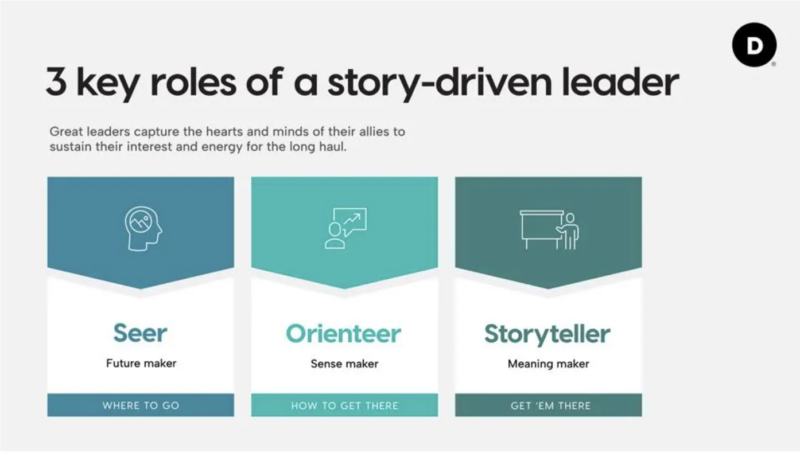
As Duarte CEO Nancy Duarte reflected in a September 2026 C200 column for Forbes, successfully launching and implementing a new vision requires leaders to embody three critical personas: the Seer, the Orienteer, and the Storyteller. The Seer defines the destination, the Orienteer maps the path, and the Storyteller articulates the journey’s meaning.
Every challenge will demand leaders revisit one or more of these personas. When the destination blurs, the Seer brings it back into focus. If a pathway stalls, the Orienteer charts a new course. When competitors seemingly outpace the team’s AI outputs, the Storyteller crafts meaning from the struggle, reframing setbacks as learning opportunities. Successful change requires continuous, transparent communication to maintain alignment and equip teams with up-to-date information. In the "Fight" stage, leaders must constantly evaluate whether perseverance or a strategic pivot is the most prudent course. Regular, open dialogues (like AI Office Hours) or "battle speeches" at key turning points are vital for sustaining morale and fostering resilience. Unacknowledged problems, delays, and a lack of guidance are fertile ground for FUD; a strong narrative keeps teams focused on the long-term vision.
Stage 4: Sustaining Efforts Through the Long Haul (The "Climb")

The "Climb" stage represents the often-arduous "messy middle" of transformation, where initiatives can lose momentum, deadlines shift, and quick fixes prove insufficient. This is where teams begin to question their capacity to carry on, and leaders face the dual challenge of continued fighting and sustained climbing. It is typically the most taxing stage, characterized by uphill effort without the immediate adrenaline rush of early wins.
In this phase, the perceived infinitude of AI contrasts sharply with human limitations. Teams experience exhaustion, burnout, and discouragement. Workloads compete against new AI obstacles, AI-generated results might prove underwhelming, and new workflows can inadvertently create new problems. Adoption rates slow, and teams may regress into old habits, while competitors appear to be surging ahead. Leaders themselves may begin to wonder, "Will we ever truly achieve AI adoption?"
Balancing the strategic approach requires a holistic understanding of the situation. Open lines of communication—through 1:1s with team leaders, anonymous surveys, and live Q&As—are essential for gathering context and accurately assessing the scope of the problem. While "Fight" messaging prepares teams for battle, the "Climb" is about leveraging past accomplishments to refuel current efforts. "Keep reminding people how far they’ve come and why the destination is still worth reaching," becomes the guiding principle.
Each temperature check offers an opportunity to revitalize the message, acknowledge and reward diligent efforts, and gain insights into what might be hindering the vision. It’s crucial to assure stragglers they are not alone, emphasize that transformation is a marathon, not a sprint, and demonstrate how the investment of time, energy, and resources is indeed yielding returns. Leaders who struggle to defend their change decisions might be falling victim to the sunk cost fallacy. Comprehensive organizational awareness is paramount to diagnose problems effectively, discern when to abandon a failing effort, and recognize when the investment is finally paying off.
Stage 5: Embracing Continuous Evolution (The "Arrival")
Finally, the "Arrival" stage marks a moment of harmonious balance, where the dream, delegation, and execution align perfectly. The leaders’ vision of the future has materialized, and the workforce has mobilized to achieve it. After all the leaps, fights, and climbs, the "new bliss" becomes a tangible reality. Teams are AI-optimized, workflows are efficient, and outputs are consistently enhanced. While some dissenters may persist, the overarching message has prevailed. Is the mission accomplished?
Yes, and no. Unlike a finite product launch or a one-time CRM migration, being AI-enabled implies an ongoing commitment to staying current with innovations and best practices. Much like cybersecurity, AI integration demands regular re-education and updated procedures. New models and capabilities emerge constantly, while vulnerabilities and exploits necessitate continuous vigilance.
However, this ongoing commitment should not overshadow the profound sense of accomplishment. Retooling how teams engage with their work, adopting new SOPs, and defining and then achieving success are all significant milestones worthy of celebration. Even in organizations that are typically "party-averse," teams need time to reflect on and process their transformative journey. Scheduling open mics or fireside chats allows individuals to share their experiences, contributing to the "mythmaking" that enriches workplace culture and solidifies the shared narrative of success. After the initial celebration, it’s time to settle into and sustain the change, allowing workers to refine their AI agility while leaders begin to chart the course for the next wave of innovation.
Conclusion: Navigating the Future with Purposeful Communication
In an era where industry evolution can occur overnight, organizations no longer have the luxury of extended runways for reinvention. Geopolitical friction, supply chain disruptions, and technological advancements like AI are now inherent features of daily business life. Companies must remain nimble, constantly recalibrating to each new normal. With diverse forces pulling teams in different directions, aligning the workforce requires a message meticulously crafted, thoughtfully delivered, and steadfastly supported to withstand the headwinds of perpetual flux.
Whether an organization is proactively embracing an emerging opportunity like AI or repositioning defensively, committing to a proven framework for change communication is essential to ease the transition. Strategic communication, rooted in empathy, transparency, and compelling storytelling, serves as the bedrock for successful AI adoption. It’s the human touch that transforms technological mandates into collective endeavors, fostering not just compliance, but genuine commitment. By rallying teams with a story they instinctively embrace, leaders can put the future in perspective and empower their organizations to thrive in the ever-evolving AI landscape.
