

The landscape of professional interaction is undergoing a profound transformation, challenging long-held assumptions about what constitutes effective listening. For generations, the wisdom encapsulated in maxims like Epictetus’s, "We have two ears and one mouth so that we can listen twice as much as we speak," or Ram Dass’s observation, "The quieter you become, the more you can hear," has guided our understanding. Similarly, modern business leaders, such as Richard Branson, reinforce this perspective: "Listen more than you talk. Nobody learned anything by hearing themselves speak." These powerful statements, often echoed from childhood teachings, suggest that the essence of good listening lies in attentive silence, maintaining eye contact, and refraining from interruption. This philosophy, equating effective listening with mere attention, has permeated adult professional life, manifesting prominently in the widespread adoption of "active listening" strategies focused on demonstrating engagement and paraphrasing received information.
However, a growing consensus among communication experts and organizational development specialists suggests that while these foundational practices are indeed beneficial, they represent merely the baseline. Paying attention, even actively, contributes to positive interpersonal dynamics, but the complexities of modern corporate environments demand a more sophisticated, nuanced approach. The prevailing models, while fostering basic comprehension and rapport, often fall short in addressing the diverse and dynamic needs of speakers in high-stakes professional contexts. This gap between traditional listening paradigms and contemporary workplace demands has necessitated the development of more robust frameworks, leading to the emergence of "Adaptive Listening™."
The Inadequacy of Conventional Listening in Dynamic Work Environments
For decades, the concept of listening in professional settings largely revolved around the avoidance of interruption and the demonstration of attentiveness. This passive-receptive model, ingrained from early education, presumed that the listener’s primary role was to absorb information without interjection. As workplaces grew more complex and collaborative, the "active listening" model gained traction. This approach emphasized verbal and non-verbal cues to show engagement—nodding, making eye contact, providing reflective summaries, and asking clarifying questions. Active listening was heralded as a significant improvement, fostering empathy, reducing misunderstandings, and building trust. Indeed, studies on communication effectiveness consistently highlight the positive correlation between active listening and improved team performance, conflict resolution, and employee satisfaction. For instance, a 2018 study by the Project Management Institute (PMI) indicated that poor communication was a primary contributor to project failure in 30% of cases, underscoring the critical need for effective information exchange.
Despite its merits, active listening, centered on the listener’s demonstration of attention and accurate recall, often overlooks a crucial dimension: the speaker’s underlying objective. It assumes a universal need for comprehension and validation, when in reality, speakers in a professional context often have specific, actionable goals they wish to achieve through their communication. They might seek emotional support, practical assistance, objective evaluation, or simply an audience for information dissemination. Failing to identify and address these diverse goals can lead to conversations that, while outwardly attentive, ultimately fall short of achieving their true purpose, potentially leading to stalled projects, unaddressed concerns, or missed opportunities. This fundamental oversight—the listener’s failure to adapt their approach to the speaker’s specific needs—is where traditional models reveal their limitations.
Introducing Adaptive Listening™: A Paradigm Shift in Workplace Communication
Adaptive Listening™ presents a significant evolution in communication strategy, positing that truly effective listening is not a one-size-fits-all skill but rather a dynamic process tailored to the specific goals and needs of the person speaking. Developed and refined by communication experts, this framework moves beyond mere attention or paraphrasing to integrate critical analysis and empathetic observation. At its core, Adaptive Listening™ challenges listeners to fundamentally shift their internal monologue from "What’s in it for me?" or "How does this impact my job?" to a more selfless and strategically oriented question: "What does the person speaking need from me right now?"

This empathetic and goal-oriented approach is designed to enhance communication across all organizational levels—upward, downward, laterally, and externally. By prioritizing the speaker’s intent, Adaptive Listeners™ are better equipped to deliver responses that are not just accurate but also impactful and aligned with the desired outcome of the interaction. The benefits of adopting such a comprehensive listening strategy are multifaceted and profound, impacting key performance indicators and fostering a healthier, more productive work culture. These benefits include, but are not limited to:
- Enhanced Problem Solving: By truly understanding the root cause of issues from the speaker’s perspective.
- Improved Decision Making: Gaining complete context and identifying critical insights.
- Stronger Team Cohesion: Fostering trust and mutual understanding among colleagues.
- Increased Productivity: Streamlining workflows by addressing needs directly and efficiently.
- Reduced Conflict: De-escalating tensions by validating feelings and addressing concerns.
- Boosted Employee Engagement and Retention: Creating an environment where individuals feel heard and valued.
- Greater Innovation: Encouraging open sharing of ideas and constructive feedback.
- Superior Client and Stakeholder Relationships: Building rapport and meeting external expectations more effectively.
The S.A.I.D.™ Framework: Four Strategic Listening Goals
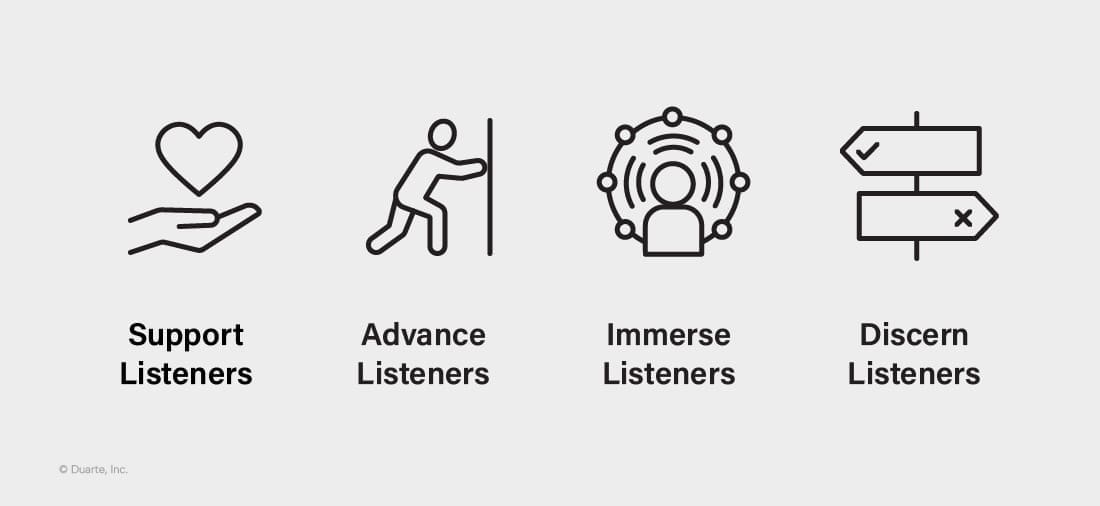
To operationalize Adaptive Listening™, the framework introduces the S.A.I.D.™ acronym, categorizing the four primary goals a speaker might have in a professional interaction: Support, Advance, Immerse, and Discern. This intuitive model provides listeners with a mental roadmap to quickly assess the situation and adjust their approach accordingly, ensuring their response is precisely what the speaker requires.
1. Support Listening™ Skills
Support Listening™ is activated when a speaker seeks emotional validation, empathy, or a confidant, whether in moments of challenge or celebration. This type of listening acknowledges and mirrors the speaker’s feelings, providing a safe space for expression without judgment or immediate problem-solving.
- Trigger Phrases: "I’m having a horrible day," "I have the best news!", "I’m feeling really overwhelmed," "I just wanted to share this."
- Listener’s Role: To be the confidant or cheerleader. This involves active validation ("That sounds incredibly frustrating," "I can see why you’d be so thrilled!"), offering comfort, or sharing in joy. The goal is to provide human connection and emotional resonance, not to fix the problem unless explicitly asked.
- Impact: Fosters psychological safety, strengthens interpersonal bonds, and enhances trust. Employees who feel supported are more likely to share concerns early, reducing the risk of escalation, and also to share successes, boosting morale.
2. Advance Listening™ Skills
When a speaker is pressed for time, overwhelmed, or stuck, they often need help to move a project, process, or decision forward. Advance Listening™ focuses on identifying bottlenecks and taking concrete steps to lighten the speaker’s load or propel progress.
- Trigger Phrases: "I don’t think I’ll have time to finish all of this," "I don’t know how I’m going to keep this project moving," "Can you help me get this over the finish line?", "What’s the next step?"
- Listener’s Role: To be a catalyst for progress. This might involve offering to take on tasks, delegating responsibilities, providing resources, making a decision, or outlining a clear path forward. The key is proactive problem-solving and action-orientation.
- Impact: Increases efficiency, prevents project delays, reduces stress, and demonstrates leadership. It transforms a listener from a passive recipient into an active contributor to operational momentum.
3. Immerse Listening™ Skills
Immerse Listening™ is required when the speaker’s primary goal is to deliver information, instruct, or entertain, and they need the listener to absorb the content without immediate commentary or critique. The listener’s role is to become a "content sponge."
- Trigger Phrases: "I’m here to give you an update today," "Sit back and enjoy!", "This is just for your information," "I want to walk you through this process."
- Listener’s Role: To learn, understand, and retain information. This involves taking diligent notes, mentally cataloging details, and asking clarifying questions solely for the purpose of comprehension (e.g., "Could you elaborate on point three?"). Judgment or critical feedback is withheld unless specifically solicited later.
- Impact: Ensures accurate information transfer, supports training and development, facilitates strategic alignment, and reduces misunderstandings stemming from incomplete absorption. It’s crucial for effective onboarding, policy updates, and informational presentations.
4. Discern Listening™ Skills
Discern Listening™ comes into play when a speaker actively seeks evaluation, critique, or objective analysis of an idea, project, presentation, or situation. This requires the listener to engage in critical thinking, identify strengths and weaknesses, and help pinpoint potential risks and rewards.
- Trigger Phrases: "I need some feedback on this," "I’m not sure if this makes sense," "What are the pros and cons here?", "Can you poke holes in this plan?"
- Listener’s Role: To provide constructive feedback, identify potential pitfalls, and highlight opportunities. This involves careful consideration of the presented material, asking probing questions to uncover underlying assumptions, and offering well-reasoned perspectives. The goal is to help the speaker refine their thinking and improve their output.
- Impact: Essential for quality control, risk management, strategic planning, and continuous improvement. It fosters a culture of critical thinking and accountability, preventing costly mistakes and driving innovation through rigorous evaluation.
Broadening the Impact: Adaptive Listening Across the Organization
The implementation of Adaptive Listening™ reverberates throughout an organization, creating a ripple effect that touches various departments and roles.
- Leadership and Management: Leaders equipped with Adaptive Listening™ skills can better understand their teams’ needs, provide targeted support, make informed decisions, and offer more relevant feedback, fostering stronger engagement and trust. This directly contributes to higher employee retention rates and improved team performance, as managers become more attuned to both the operational and emotional pulse of their direct reports.
- Team Collaboration: In project teams, understanding whether a colleague needs support for a personal challenge, assistance with a task, a clear understanding of new information, or constructive critique on their work, dramatically improves collaboration. It reduces friction, accelerates project timelines, and enhances the quality of deliverables by ensuring communication is always fit for purpose.
- Client and Stakeholder Engagement: For external interactions, Adaptive Listening™ enables sales teams to truly understand client pain points (Discern), customer service to provide empathetic solutions (Support), and account managers to proactively move initiatives forward (Advance). This leads to stronger client relationships, increased customer satisfaction, and ultimately, greater revenue.
- Innovation and Problem Solving: By employing Discern Listening™, teams can critically evaluate new ideas and identify unforeseen challenges or opportunities early in the innovation cycle. Similarly, Advance Listening™ ensures that promising ideas don’t stall due to lack of support or resources. This fosters an environment where innovation is not only encouraged but also effectively nurtured and implemented.
The Path to Mastery: Cultivating Adaptive Listening Skills
While the S.A.I.D.™ framework provides a clear conceptual model, mastering Adaptive Listening™ requires deliberate practice and a conscious shift in communication habits. It demands a heightened sense of self-awareness and empathy, moving beyond the ingrained tendency to filter information through a personal lens. The challenge lies in accurately discerning the speaker’s true goal, which isn’t always explicitly stated. This often requires observing non-verbal cues, considering the context of the conversation, and, when in doubt, asking clarifying questions about their expectations.
Organizations like Duarte, which have pioneered the Adaptive Listening™ methodology, offer resources such as their comprehensive book, "Adaptive Listening: How to Cultivate Trust and Traction at Work." This publication provides practical techniques and real-world scenarios to help individuals and teams navigate the complexities of workplace communication, moving beyond the limitations of active listening. The book emphasizes that whether listening to a direct report, a senior executive, a client, or a team member, the ability to adapt one’s listening strategy is paramount in reducing ambiguity and tension in today’s fast-paced professional environment.
In conclusion, the era of passive or merely active listening in the workplace is giving way to a more dynamic, empathetic, and strategic approach. Adaptive Listening™ represents a critical evolution, recognizing that effective communication is not about rigidly applying a single listening technique, but rather about skillfully adjusting one’s approach to meet the unique and ever-changing needs of the speaker. By consistently asking, "What does the person speaking need from me?", professionals can dramatically enhance their communication effectiveness, foster stronger relationships, and drive superior outcomes across all facets of their work lives. This paradigm shift is not just about being a "better listener"; it’s about fundamentally transforming how individuals and organizations connect, collaborate, and succeed in a complex and interconnected world.
