

The long-held wisdom from philosophical giants like Epictetus, who advised us to listen twice as much as we speak, and modern luminaries such as Richard Branson, who noted that "nobody learned anything by hearing themselves speak," has long guided our understanding of effective listening. These maxims, reinforced from early childhood, ingrained the notion that paying attention, remaining silent, making eye contact, and refraining from interruption constituted the entirety of good listening. This foundational philosophy evolved into what is widely known as "active listening" in professional settings, emphasizing attention and paraphrasing as key components. While these practices represent a crucial baseline for courteous and engaged interaction, a growing body of research and real-world experience indicates they are merely the entry point to truly impactful workplace communication. In an increasingly complex and interconnected global economy, the demands on communication have outpaced traditional listening models, necessitating a more sophisticated, adaptable approach.
The Evolution of Listening Theories in Professional Contexts
For decades, the concept of "active listening," popularized in the mid-20th century, became the gold standard for interpersonal communication training. Developed from client-centered therapy, it advocated for a listener to fully concentrate on the speaker, understand their message, and then reflect that understanding back, often through paraphrasing. This model significantly improved communication by promoting empathy and reducing misunderstandings, moving beyond passive reception to a more engaged process. However, the modern workplace presents challenges that stretch the limits of active listening. With diverse team structures, remote work environments, rapid technological advancements, and a constant influx of information, a one-size-fits-all approach to listening can fall short. The stakes are higher than ever, with miscommunication costing businesses billions annually in lost productivity, project delays, and employee turnover. A 2022 survey by Dynamic Signal found that 80% of U.S. workers reported experiencing miscommunication at work, leading to increased stress and decreased morale. This underscores the urgent need for a more dynamic and purpose-driven listening framework.
Introducing Adaptive Listening™: A Goal-Oriented Framework
Against this backdrop, the concept of Adaptive Listening™ emerges as the next evolution in professional communication. Developed through extensive research and tested rigorously in diverse work environments, Adaptive Listening transcends the foundational principles of attentiveness and paraphrasing by focusing on a fundamental, yet often overlooked, question: "What does the person speaking need from me?" This empathetic, goal-oriented inquiry shifts the listener’s focus from self-interest or mere information absorption to actively fulfilling the speaker’s underlying objective for the interaction. Instead of simply processing information through the lens of "What’s in it for me?" or "How does this impact my job?", an Adaptive Listener consciously seeks to understand the speaker’s desired outcome and tailor their response accordingly.
This strategic shift has profound implications for workplace effectiveness. Organizations adopting Adaptive Listening report marked improvements in project collaboration, faster problem resolution, enhanced team cohesion, and stronger client relationships. A preliminary study conducted by communication specialists Duarte, pioneers of the Adaptive Listening model, indicated that teams trained in these adaptive techniques experienced a 15-20% reduction in communication-related project delays and a significant uptick in perceived psychological safety among team members. The benefits extend to individual career trajectories as well, fostering stronger leadership capabilities and accelerating professional development.
The S.A.I.D.™ Framework: Four Pillars of Adaptive Listening
Adaptive Listening posits that in the workplace, speakers generally have one of four primary goals when they initiate communication. These goals are neatly encapsulated by the acronym S.A.I.D.™: Support, Advance, Immerse, and Discern. Recognizing these distinct needs allows listeners to apply the most appropriate and effective response, moving beyond generic attentiveness to targeted, impactful engagement.

1. Support Listening™ Skills: Fostering Connection and Validation
In the dynamic ebb and flow of professional life, individuals frequently seek emotional resonance and validation. Whether navigating a challenging setback, celebrating a significant achievement, or simply expressing daily frustrations, the human desire for connection remains paramount. Support Listening is the adaptive response to these emotional needs. It requires the listener to acknowledge and mirror the speaker’s feelings, acting as either a confidant in moments of difficulty or a cheerleader during times of success.
When a colleague shares, "I’m having a really tough time with this client," or "I finally closed that major deal!", these are clear signals for Support Listening. The effective response is not to immediately offer solutions or launch into analytical feedback, but to validate their emotional state. This might involve empathetic statements like, "That sounds incredibly frustrating; I can only imagine how you must feel," or enthusiastic congratulations such as, "That’s fantastic news! You’ve worked so hard for this." The objective is to provide comfort, affirmation, and shared experience, thereby strengthening interpersonal bonds and fostering a supportive work environment. Failing to provide Support Listening in these moments can lead to feelings of isolation or a sense of being unheard, eroding trust and team morale.
2. Advance Listening™ Skills: Driving Progress and Overcoming Obstacles
The modern workplace is characterized by relentless deadlines and complex projects. In such an environment, colleagues often communicate because they need help moving forward, whether that involves unburdening themselves, seeking assistance, or identifying pathways to progress. Advance Listening is tailored to these action-oriented needs, focusing on facilitating movement and resolution.
Cues for Advance Listening include statements such as, "I’m swamped and don’t see how I’ll finish this by Friday," or "This project is stalled, and I’m not sure what the next step is." In these instances, the speaker isn’t looking for emotional support or a detailed explanation; they’re seeking tangible assistance to advance their work. An Adaptive Listener employing Advance skills might offer concrete help: "I can take on that report for you," or "Let’s brainstorm some delegation options to get this back on track." This proactive, solution-oriented approach demonstrates initiative and commitment, directly contributing to project timelines and team productivity. It transforms listening from a passive activity into a powerful engine for progress, helping to alleviate bottlenecks and distribute workloads effectively.
3. Immerse Listening™ Skills: Absorbing Information and Knowledge Transfer
Not every conversation in the workplace demands immediate action or emotional response. Many interactions are purely informational, designed to update, educate, or simply share content. Immerse Listening is the skill required when the speaker’s primary goal is for the listener to absorb and retain information without interruption, judgment, or immediate critique.
Signals for Immerse Listening often involve phrases like, "I’m here to provide an update on the Q3 performance," or "Please just listen as I walk you through these new guidelines." In these scenarios, the listener’s role is akin to a "content sponge." The primary objective is to learn, understand, and mentally catalogue the material. This might involve taking detailed notes, asking clarifying questions to ensure comprehension, or summarizing the information to confirm accurate reception. The key is to suspend immediate analysis or opinion-forming and focus entirely on accurate information acquisition. This is crucial for effective training sessions, project briefings, policy updates, and any situation where foundational understanding is the immediate goal. Premature interjections or attempts to "advance" the conversation when immersion is needed can disrupt the speaker’s flow and impede effective knowledge transfer.
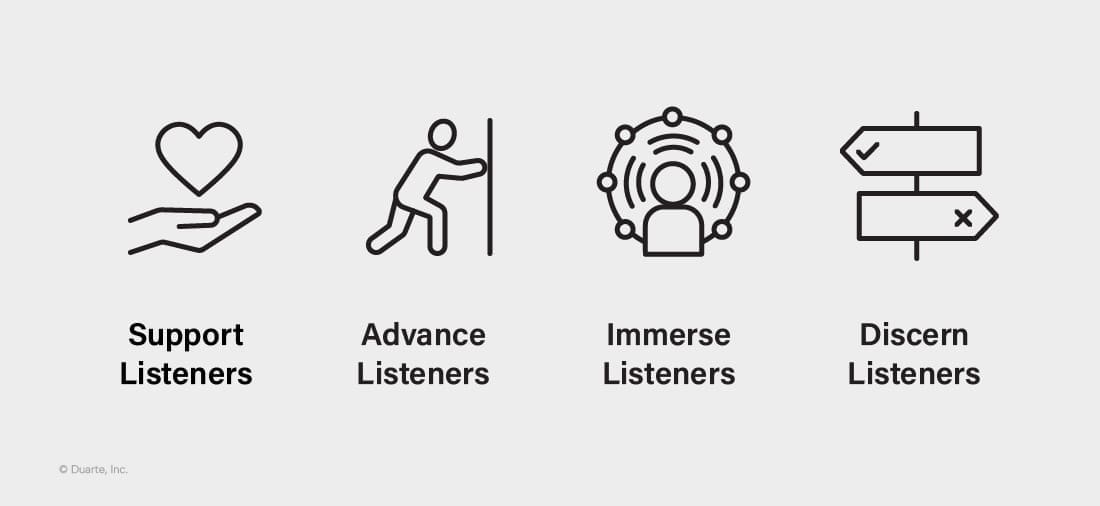
4. Discern Listening™ Skills: Critical Evaluation and Strategic Insight
Critical thinking and constructive feedback are indispensable for organizational growth and risk management. When a speaker presents an idea, a project plan, or even a personal challenge, they often require an objective, analytical ear to help evaluate strengths, identify weaknesses, and pinpoint potential opportunities or threats. Discern Listening addresses this need for critical assessment.
Phrases such as, "I need some honest feedback on this presentation," or "I’m not sure if this strategy makes sense, what do you think?" are clear indicators for Discern Listening. Here, the listener’s job is to engage in critical analysis, weigh the pros and cons, and help the speaker refine their thinking. This involves providing balanced critique, highlighting potential red flags, and identifying areas for improvement, all while maintaining a constructive and supportive tone. Effective Discern Listening might involve asking probing questions like, "Have you considered the potential impact on X department?" or offering observations such as, "While the concept is strong, the execution might face challenges in area Y." This mode of listening is vital for innovation, quality control, and strategic decision-making, ensuring that ideas are robustly vetted before implementation, thereby mitigating costly errors and maximizing potential.
Broader Impact and Implications of Adaptive Listening
The implementation of Adaptive Listening extends far beyond individual interactions, shaping the very fabric of an organization’s culture. By encouraging employees at all levels to consider the speaker’s needs first, it fosters a more empathetic, collaborative, and psychologically safe environment.
- Enhanced Leadership: Leaders who master Adaptive Listening are better equipped to understand their team’s challenges, motivate performance, and guide strategic initiatives, leading to more effective leadership.
- Improved Team Dynamics: Teams where members practice Adaptive Listening experience reduced conflict, increased trust, and greater efficiency in decision-making and project execution.
- Customer and Client Relations: External communication also benefits immensely. Adaptive Listeners can more accurately identify client needs, respond with tailored solutions, and build stronger, more enduring relationships, directly impacting business growth and customer loyalty.
- Innovation and Problem-Solving: By engaging in Discern Listening when appropriate and providing Support when needed, organizations can create spaces where innovative ideas are critically refined, and challenges are addressed proactively and collaboratively.
- Adaptability in Hybrid Work: In remote and hybrid work environments, where non-verbal cues can be diminished, the deliberate practice of Adaptive Listening becomes even more crucial for clarity, connection, and preventing misunderstandings.
In essence, Adaptive Listening represents a crucial evolution from merely hearing words to understanding intentions and fulfilling needs. It moves beyond the passive reception of information to an active, strategic engagement that empowers individuals and organizations to communicate with unprecedented clarity, empathy, and effectiveness. As the workplace continues its rapid transformation, cultivating these advanced listening skills will not merely be beneficial, but essential for sustained success and meaningful professional relationships.
For those committed to elevating their communication prowess, the comprehensive guide, "Adaptive Listening: How to Cultivate Trust and Traction at Work," offers detailed methodologies and practical exercises. This researched and tested resource provides a roadmap for professionals to navigate the complexities of workplace dialogue, reducing ambiguity and fostering stronger connections in the realities of a hectic workday. By embracing the fundamental question, "What does the person speaking need from me?", professionals can unlock a powerful capacity for connection, productivity, and personal growth. Further free resources and expert insights are available at Duarte’s dedicated platform on improving listening skills at work.
