


For generations, the bedrock of effective listening has been distilled into simple maxims: "We have two ears and one mouth so that we can listen twice as much as we speak," as Epictetus wisely observed, or Richard Branson’s more direct counsel, "Listen more than you talk. Nobody learned anything by hearing themselves speak." These age-old philosophies, often reinforced in early education, typically equate good listening with silence, maintaining eye contact, and refraining from interruption. While foundational, a growing consensus among communication experts suggests that this traditional understanding, even the more contemporary concept of "active listening," falls short of the dynamic demands of the modern professional landscape. A new paradigm, termed Adaptive Listening™, is emerging as a critical framework designed to elevate workplace communication beyond mere attentiveness to a strategic asset.
Redefining Listening: Beyond Passive Reception
The conventional wisdom that equates effective listening with simply "paying attention" has long been a default in both personal and professional settings. This approach, often manifested as silent observation, nodding, and perhaps paraphrasing to confirm understanding—the hallmarks of what has been broadly known as active listening—is certainly a step above complete inattention. However, its limitations become apparent when navigating the intricate web of objectives, emotional states, and practical needs inherent in daily workplace interactions. Active listening, while valuable for ensuring message reception, primarily focuses on the listener’s comprehension. It often overlooks the speaker’s underlying intent and desired outcome, which is a crucial distinction.
Studies consistently highlight the profound impact of communication breakdowns on organizational efficiency and morale. According to various industry reports, poor communication can cost companies millions of dollars annually in lost productivity, project delays, and decreased employee engagement. A 2018 Holmes Report, for instance, estimated that ineffective communication costs U.S. and U.K. businesses alone $37 billion annually. These figures underscore the urgent need for a more nuanced and responsive approach to listening—one that transcends the basic act of hearing and processing information.
The Genesis of Adaptive Listening™: A Chronological Shift
The journey towards Adaptive Listening™ can be viewed as an evolutionary progression in understanding human interaction. Initially, listening was often implicitly understood as a passive reception of information, where the listener’s role was largely to absorb. The mid-20th century saw the formalization of "active listening," popularized by figures like Carl Rogers, which introduced the elements of empathy, non-judgmental acceptance, and reflective feedback. This was a significant leap, recognizing that listening is an active process requiring engagement. However, as workplaces became more complex, global, and fast-paced, with diverse teams and project-centric structures, the need for an even more tailored approach became evident.
The concept of Adaptive Listening™ emerges from this recognition, positing that effective listening is not a one-size-fits-all skill. Instead, it argues that the most impactful listeners are those who can discern and respond to the specific, evolving needs of the speaker in real-time. This model, developed and championed by communication experts, is a direct response to the inadequacy of generic listening strategies in a professional environment characterized by varying objectives, emotional contexts, and desired actions. It shifts the fundamental question from "What am I hearing?" to "What does the person speaking need from me?" This empathetic, goal-oriented inquiry forms the cornerstone of Adaptive Listening™.

The Core Tenet: Meeting the Speaker’s Needs
At its heart, Adaptive Listening™ is about aligning the listener’s response with the speaker’s goals. This requires a deeper level of critical analysis and observational skill than simply nodding or paraphrasing. It demands that the listener actively seeks to understand the underlying purpose of the communication, moving beyond the literal words to the speaker’s intended outcome. This fundamental shift in perspective — from self-focused understanding ("What’s in it for me?") to speaker-focused utility ("What can I give the speaker?") — is what differentiates Adaptive Listening™ as a strategic communication tool.
By adopting this approach, professionals are equipped to tailor their listening and subsequent responses to genuinely support the speaker, fostering stronger relationships, accelerating project progress, enhancing knowledge transfer, and facilitating critical decision-making. The benefits are extensive and tangible:
- Building Trust: Demonstrating genuine understanding and support.
- Reducing Misunderstandings: Addressing underlying needs directly.
- Improving Productivity: Streamlining communication and action.
- Boosting Collaboration: Fostering a more supportive team environment.
- Enhancing Decision-Making: Providing targeted feedback and insights.
- Increasing Employee Engagement: Making individuals feel heard and valued.
The S.A.I.D.™ Framework: Four Strategic Listening Goals
To operationalize Adaptive Listening™, a practical framework known as S.A.I.D.™ has been introduced. This acronym represents four distinct listening goals that speakers typically have in a professional setting: Support, Advance, Immerse, and Discern. Recognizing which of these goals a speaker holds at any given moment allows a listener to adapt their approach for maximum impact.
1. Support Listening™ Skills:
This mode of listening is crucial when a speaker needs emotional validation, empathy, or simply a safe space to express themselves, whether during challenging times or moments of triumph. It’s about acknowledging and mirroring the speaker’s feelings, acting as a confidant or a cheerleader. For instance, if a colleague expresses, "I’m having a horrible day," or "I just closed the biggest deal of my career!", the Adaptive Listener understands that the primary need is not for solutions or analysis, but for emotional resonance. Responding with genuine empathy ("That sounds incredibly tough, how can I help?") or shared enthusiasm ("That’s fantastic news! Tell me everything!") builds rapport and psychological safety, essential components of a healthy workplace culture. Research on emotional intelligence consistently shows that leaders who effectively demonstrate empathy foster higher levels of trust and engagement within their teams.
2. Advance Listening™ Skills:
In fast-paced work environments, time is often a critical constraint, and individuals frequently feel overwhelmed. Advance Listening™ is deployed when a speaker needs assistance in moving a task, project, or process forward. The listener’s role here is to identify opportunities to unburden the speaker or facilitate progress. Cues such as "I don’t think I’ll have time to finish this" or "I’m struggling to keep this project moving" signal a need for practical intervention. An Adaptive Listener might offer to take on specific tasks ("I can take some of this off your plate") or strategically delegate responsibilities, effectively becoming a catalyst for action. This proactive approach not only alleviates immediate pressure but also enhances overall team efficiency and project velocity.
3. Immerse Listening™ Skills:
There are numerous occasions in the workplace when the primary objective of communication is the transfer of information, whether for updates, training, or general awareness. Immerse Listening™ involves fully absorbing the material without immediate judgment or extensive commentary. The speaker’s goal is for the listener to become a "content sponge," internalizing the data. Phrases like "I’m here to give you an update today" or "Sit back and enjoy the presentation" are clear indicators. In this mode, the Adaptive Listener focuses on note-taking, mental cataloging, and asking clarifying questions solely for the purpose of understanding. This ensures accurate knowledge acquisition and prevents premature conclusions, which can be particularly vital during critical briefings, policy updates, or learning sessions. The ability to immerse oneself in new information is fundamental for continuous professional development and organizational learning.
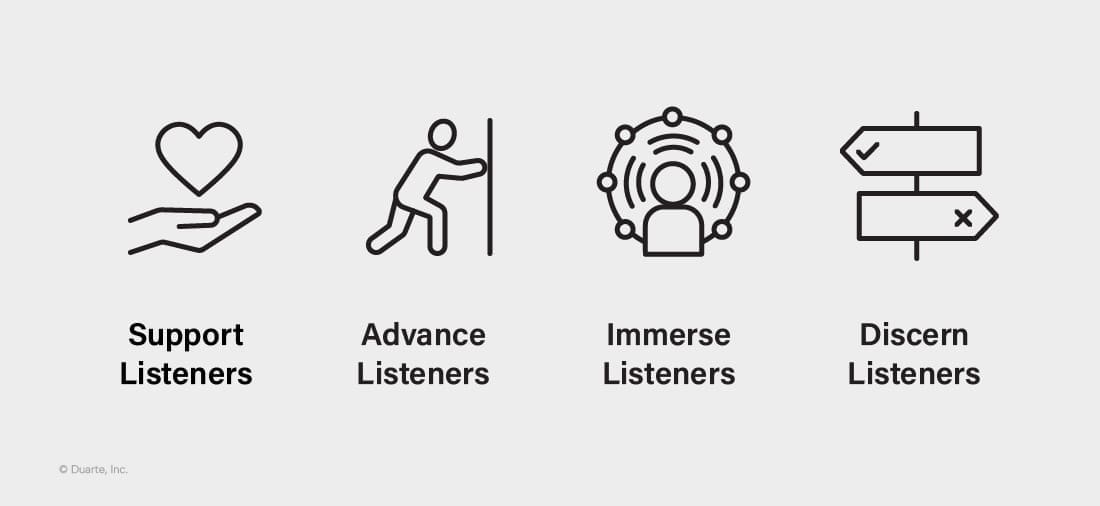
4. Discern Listening™ Skills:
Critical evaluation is indispensable in any professional setting. Discern Listening™ is employed when a speaker requires objective feedback, critique, or assistance in identifying strengths, weaknesses, risks, and opportunities. This skill is vital for improving presentations, refining projects, optimizing processes, and even assessing individual performance. When a colleague states, "I need some feedback on this," or "I’m not sure if this makes sense," they are explicitly asking for a critical lens. The Adaptive Listener’s role is to provide constructive analysis, helping the speaker to pinpoint what is working well and what requires adjustment. This active, evaluative engagement helps mitigate potential risks, foster innovation, and ensures the highest quality of work, preventing costly errors and driving continuous improvement.
Broader Implications for the Modern Workplace
The implementation of Adaptive Listening™ represents more than just an improvement in individual communication skills; it signifies a strategic shift in how organizations approach internal and external interactions. By embedding this model into corporate training and leadership development programs, companies can cultivate a culture where communication is not merely transactional but deeply empathetic and goal-oriented.
This paradigm fosters a more psychologically safe environment, where employees feel genuinely heard and understood, leading to increased job satisfaction and reduced turnover. It empowers leaders to be more responsive and effective, as they are better equipped to understand and address the diverse needs of their teams. For project managers, it means smoother execution and fewer roadblocks, as team members are adept at identifying and addressing emergent needs. For sales and client-facing roles, it translates into stronger client relationships built on trust and a clear understanding of client objectives.
The framework’s emphasis on empathy and goal alignment also positions it as a powerful tool for diversity, equity, and inclusion initiatives. By encouraging listeners to consciously consider the speaker’s needs, it naturally promotes a more inclusive dialogue, ensuring that varied perspectives are not only heard but truly understood and acted upon.
Conclusion: A Strategic Imperative for Organizational Success
In an era defined by rapid change, remote work challenges, and complex global collaborations, effective communication is no longer a soft skill but a strategic imperative. While the traditional tenets of listening provide a baseline, they no longer suffice for the intricate demands of contemporary professional life. Adaptive Listening™ offers a robust, actionable framework that moves beyond mere attentiveness to a responsive, empathetic, and goal-oriented approach.
By consistently asking, "What does the person speaking need from me?" and applying the S.A.I.D.™ framework, professionals at all levels can dramatically enhance their listening capabilities. This not only improves individual interactions but also contributes to a more cohesive, productive, and innovative organizational culture. As businesses continue to navigate an increasingly interconnected world, investing in advanced communication strategies like Adaptive Listening™ will be paramount to cultivating trust, driving traction, and securing sustained success. For organizations and individuals seeking to up-level their communication infrastructure, resources like the forthcoming book, "Adaptive Listening: How to Cultivate Trust and Traction at Work," offer practical, research-backed guidance to implement these transformative skills.
