

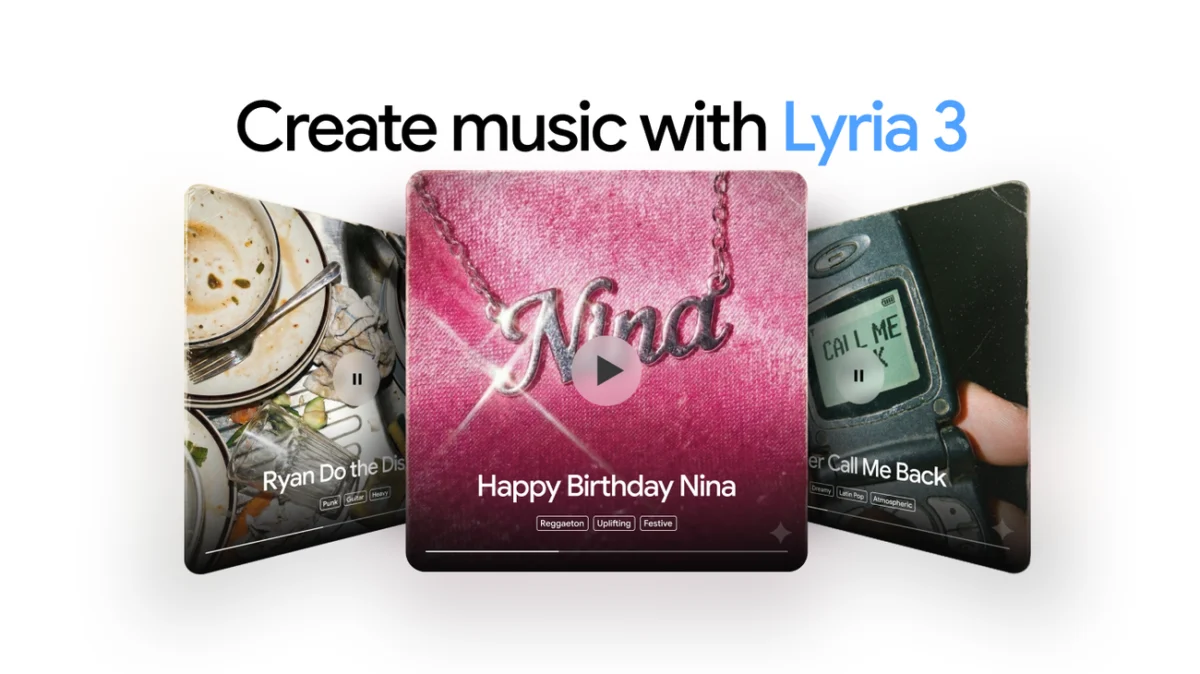
Google has officially announced the integration of advanced music generation capabilities into its Gemini artificial intelligence application, marking a significant expansion of the platform’s multimodal creative tools. This development is powered by Lyria 3, the latest generative music model from Google DeepMind, which is now rolling out in beta to Gemini users globally. The update allows individuals to transform text descriptions or uploaded images into high-quality, catchy musical tracks in a matter of seconds, positioning Google at the forefront of the rapidly evolving generative audio landscape.
The introduction of Lyria 3 represents the next stage in Google’s strategy to democratize creative expression. While previous iterations of Gemini focused heavily on text, image, and video generation, the addition of custom music provides a more comprehensive suite for digital creators. According to the company, the model is designed to handle complex prompts, such as "a comical R&B slow jam about a sock finding its match," translating these concepts into 30-second audio tracks accompanied by custom cover art.
Technical Foundations of Lyria 3
Lyria 3 is the culmination of extensive research by Google DeepMind into the nuances of acoustic modeling and musical theory. The model improves upon its predecessors in three primary categories: audio fidelity, stylistic versatility, and prompt adherence. Unlike earlier generative audio models that often struggled with "hallucinations"—distortions in rhythm or unrealistic vocal textures—Lyria 3 utilizes a refined architecture capable of maintaining consistent melody and harmonic structure throughout the duration of a clip.
One of the standout features of the new update is its multimodal input capability. Users are not limited to text-based prompts; they can also upload photographs to serve as creative inspiration. For instance, a photo of a sunset over a city skyline could be used by the AI to determine the tempo, mood, and instrumentation of a generated track. This "visual-to-audio" pipeline utilizes Gemini’s existing image-recognition capabilities to extract emotional and thematic data, which Lyria 3 then interprets musically.
The generated tracks are currently limited to 30 seconds, a duration specifically chosen to facilitate quick sharing on social media platforms and to serve as background audio for short-form video content. To complement the audio, Google has integrated "Nano Banana," a specialized generative model tasked with creating unique cover art for every track. This ensures that each piece of music is a complete package, ready for immediate distribution via direct download or shareable links.
A Chronology of Google’s Musical AI Development
The release of Lyria 3 is the latest milestone in a timeline that began several years ago with Google’s exploration of neural audio synthesis. In early 2023, Google Research introduced MusicLM, a model that demonstrated the ability to generate high-fidelity music from text descriptions. While MusicLM was a breakthrough, it was primarily a research project with limited public accessibility.
By late 2023, Google DeepMind launched the first iteration of Lyria alongside "Dream Track" for YouTube. This initiative was a collaborative experiment with high-profile artists, including Alec Benjamin, Charlie Puth, and Sia, designed to explore how AI could generate vocal tracks in the style of established musicians with their consent. This period also saw the introduction of the Music AI Sandbox, a professional-grade suite of tools that allowed producers and songwriters to experiment with AI-driven composition.
The transition from these specialized experiments to a general-release feature in the Gemini app signifies a shift in Google’s approach. By moving Lyria 3 into the mainstream Gemini ecosystem, the company is shifting from professional creator tools to consumer-facing creative toys, emphasizing "fun and unique expression" over professional masterpiece production.
Integration with YouTube and the Creator Economy
Beyond the standalone Gemini app, Lyria 3 is being integrated into the YouTube ecosystem, specifically through the Dream Track feature. Initially available only in the United States, Dream Track is now being expanded to creators in additional countries. This integration allows YouTube Shorts creators to generate unique soundtracks for their videos, enhancing the quality of background audio and providing more customization options than traditional stock music libraries.
For creators, the ability to generate a "vibey backing track" or a specific "lyrical verse" on demand reduces the friction of content creation. It also addresses the persistent issue of copyright claims on YouTube, as these AI-generated tracks are original compositions created within the Google ecosystem. Industry analysts suggest that this move is a direct response to the rising popularity of AI-music startups like Suno and Udio, which have gained traction by allowing users to create full-length songs with minimal effort.
Safety, Verification, and Intellectual Property Protections
As generative AI becomes more sophisticated, concerns regarding deepfakes and intellectual property have moved to the forefront of the public discourse. Google has addressed these concerns by embedding SynthID into every track generated by Lyria 3. Developed by Google DeepMind, SynthID is a digital watermarking technology that remains imperceptible to the human ear but can be detected by specialized software even after the audio has been compressed or modified.
In a significant update to the Gemini app’s utility, Google is also introducing new audio verification capabilities. Users can now upload an audio file to Gemini and ask if it was generated using Google AI. The system will check for the SynthID watermark and use internal reasoning to provide a response. This level of transparency is intended to mitigate the risks of misinformation and unauthorized AI content.
Regarding copyright, Google has maintained a cautious stance. The company stated that Lyria 3 is trained in accordance with partner agreements and is designed for "original expression," not for mimicking existing artists. If a user attempts to prompt the AI using the name of a specific artist, the system is programmed to take that name as a "broad creative inspiration" rather than a command to clone the artist’s voice or signature style. Furthermore, Google has implemented filters to cross-reference generated outputs against existing copyrighted content to prevent accidental infringement.
Market Implications and Industry Reaction
The launch of Lyria 3 occurs amidst a broader debate within the music industry. Major record labels, represented by the Recording Industry Association of America (RIAA), have recently filed lawsuits against several AI music companies, alleging massive copyright infringement during the training process of their models. By emphasizing its collaborative approach with the music community and its "responsible development" framework, Google is positioning itself as the ethically sound alternative to more disruptive startups.
Industry reactions have been mixed. While some musicians view generative AI as a threat to the livelihood of songwriters and session musicians, others see it as a powerful new instrument. The Music AI Sandbox has already seen participation from Grammy-winning producers who use AI to brainstorm melodies or generate unique textures that would be difficult to create using traditional synthesis.
From a business perspective, the inclusion of music generation in Gemini provides an additional incentive for users to subscribe to Google’s premium tiers. While the feature is available to all users 18 and older, subscribers to AI Premium, Pro, and Ultra will enjoy higher generation limits and potentially faster processing times. This tiered model is standard across the industry as companies seek to monetize the high compute costs associated with generative audio.
Future Outlook and Global Availability
The rollout of music generation in Gemini is currently focused on desktop users, with mobile app integration expected to follow in the coming days. The feature supports a wide range of languages, including English, German, Spanish, French, Hindi, Japanese, Korean, and Portuguese. Google has indicated that it plans to continue expanding language coverage and improving audio quality as the beta progresses.
The long-term implications of Lyria 3 extend beyond simple 30-second clips. As the technology matures, it is likely that Google will increase the duration limits and provide more granular controls over instrumentation, tempo, and key signatures. This could eventually lead to a scenario where Gemini acts as a full-scale digital audio workstation (DAW) for amateur musicians.
For now, Google’s primary objective remains centered on enhancing daily digital interactions. By allowing users to create a "custom soundtrack to your daily life," the company is betting that the future of AI lies not just in information retrieval, but in providing the tools for personalized, creative storytelling. As users begin to experiment with Lyria 3, the data gathered during this beta phase will likely inform the next generation of Google’s audio AI, potentially blurring the lines between consumer tools and professional creative software even further.
