

For decades, the bedrock of effective communication, particularly in professional settings, has been distilled into a seemingly simple mantra: listen more than you speak. This wisdom, echoing from ancient philosophers like Epictetus ("We have two ears and one mouth so that we can listen twice as much as we speak") to modern business titans such as Richard Branson ("Listen more than you talk. Nobody learned anything by hearing themselves speak"), has shaped our understanding of what it means to be a good listener. Conventional training often reinforces this by equating effective listening with silence, maintaining eye contact, nodding, and avoiding interruption. While foundational, this perspective, often carried from childhood lessons of "paying attention," is increasingly being recognized as insufficient for the dynamic, complex demands of the modern workplace. The prevailing model of "active listening," while valuable for ensuring comprehension through paraphrasing and reflection, represents merely the baseline, a decent human interaction, but not the strategic listening capability critical for organizational success. A new framework, Adaptive Listening™, developed by communication experts at Duarte, Inc., is now emerging to address this gap, proposing a more nuanced, goal-oriented approach that moves beyond mere attentiveness to cultivate deeper understanding, trust, and tangible progress.
The Evolution of Listening Theories in Professional Development
The concept of listening has undergone significant theoretical evolution within professional development circles. Early approaches often focused on passive reception, where the listener’s role was primarily to absorb information without interjection. This evolved into the widespread adoption of "active listening," a term popularized in the mid-20th century, particularly through the work of Carl Rogers and his client-centered therapy. Active listening emphasizes full concentration, empathetic understanding, and the practice of reflecting back what has been heard to confirm understanding. Techniques like paraphrasing, summarizing, and asking clarifying questions became standard in communication training, aiming to reduce misunderstandings and foster rapport.
For many years, active listening served as the gold standard in business, lauded for its ability to enhance interpersonal relationships, improve conflict resolution, and ensure that messages were received as intended. Indeed, numerous studies have demonstrated its positive impact on team cohesion and individual effectiveness. A 2017 survey by the National Association of Colleges and Employers (NACE) found that "listening skills" consistently ranked among the top five attributes employers sought in new hires. However, as workplaces became more fast-paced, globalized, and interdisciplinary, the limitations of a purely attention- and comprehension-focused listening model began to surface. While active listening ensures understanding, it doesn’t inherently guide the listener on how to respond or what action to take, or even why the speaker is communicating in the first place beyond simply conveying information.
The Imperative for Deeper Engagement: Why "Active" Isn’t Enough
In today’s corporate landscape, communication breakdowns are not just inconvenient; they are costly. A 2018 study by David Grossman, a corporate communications expert, estimated that miscommunication costs businesses with 100,000 employees an average of $62.4 million per year. For smaller companies, even a few misaligned messages can derail projects, damage client relationships, and erode employee morale. These breakdowns often stem not from a lack of "active listening" – employees might be paying attention and paraphrasing correctly – but from a failure to grasp the underlying purpose or need behind the communication.
Traditional active listening, while a crucial first step, often operates under the assumption that the speaker’s primary goal is simply to be understood. However, workplace interactions are rarely so one-dimensional. A team member might be expressing frustration, not just relaying a problem; a manager might be seeking strategic input, not just delivering an update; a colleague might be overwhelmed, not just sharing project status. In these scenarios, merely nodding and paraphrasing, while demonstrating attentiveness, fails to meet the speaker’s true objective. This disconnect can lead to wasted time, misdirected effort, and ultimately, a breakdown in trust and traction. The modern professional needs a listening strategy that is dynamic, adaptable, and acutely tuned to the unspoken goals and emotional subtext of every interaction. This is where Adaptive Listening™ seeks to offer a more robust framework.
Introducing Adaptive Listening™: A Goal-Oriented Framework
Adaptive Listening™ is predicated on a fundamental shift in perspective: instead of asking, "What am I hearing?" or "How can I show I’m paying attention?", the Adaptive Listener asks, "What does the person speaking need from me?" This empathetic, speaker-centric approach moves beyond the self-focused internal monologue (e.g., "What’s in it for me?" or "How will this impact my job?") that often characterizes conventional listening. It demands critical analysis, observation, and an understanding that different situations and different speakers require different listening responses.
Developed through extensive research and testing in diverse work settings, Adaptive Listening™ acknowledges that communication is a transactional process with specific objectives. By intentionally aligning the listener’s response with the speaker’s goals, it aims to foster more effective outcomes, build stronger relationships, and drive organizational progress. The benefits are manifold: from enhancing decision-making and problem-solving to boosting team productivity and cultivating a more empathetic, collaborative culture. For leaders, it translates into more informed choices and greater team alignment; for team members, it means reduced ambiguity and increased confidence in their contributions.

The S.A.I.D.™ Framework: Four Pillars of Adaptive Engagement
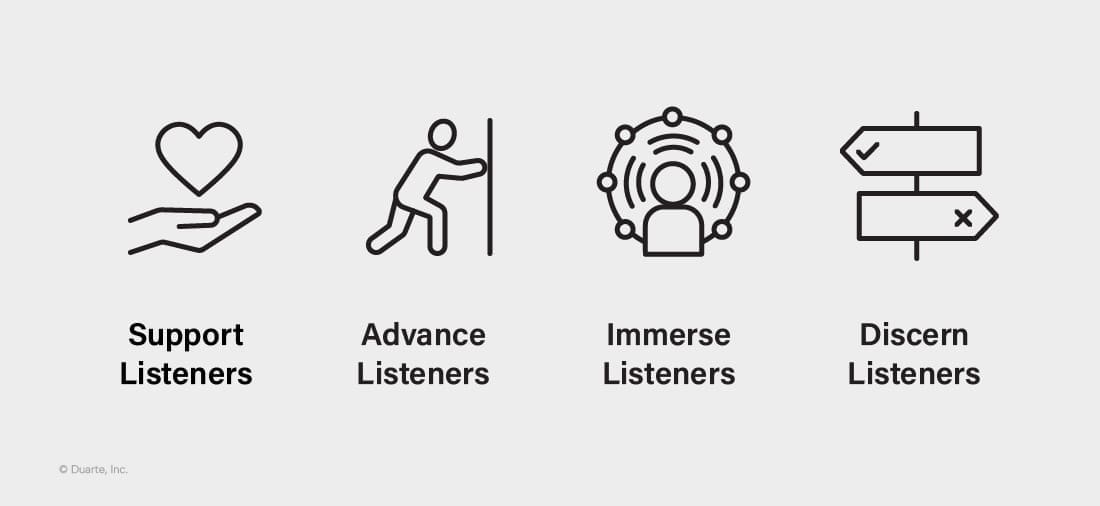
The Adaptive Listening™ model distills the diverse needs of speakers in the workplace into four primary goals, easily remembered through the acronym S.A.I.D.™: Support, Advance, Immerse, and Discern. Each goal dictates a specific listening strategy and corresponding response, ensuring that the listener’s engagement is always purposeful and impactful.
1. Support Listening™ Skills
In the ebb and flow of professional life, individuals frequently encounter moments of both challenge and triumph. From navigating difficult projects and interpersonal conflicts to celebrating project successes and career milestones, these experiences evoke strong emotions. When a speaker’s underlying need is emotional validation or connection, they require Support Listening™. This skill involves acknowledging and mirroring the speaker’s feelings, creating a safe space for expression without judgment.
For instance, if a colleague confides, "I’m having a horrible day; this client project is a disaster," merely paraphrasing, "So, the client project is causing you a lot of stress," while accurate, might fall short. A Support Listener would instead lean into the emotion: "It sounds incredibly frustrating, and I can only imagine how overwhelming that must feel right now." Conversely, if a team member exclaims, "I have the best news! We landed the big account!", a Support Listener acts as a cheerleader, mirroring the excitement: "That’s incredible! Congratulations, you absolutely deserve it!" The key is to be a confidant or a celebrant, aligning words and actions to validate the speaker’s emotional state, fostering trust and psychological safety. Research consistently shows that empathetic support in the workplace significantly boosts morale and reduces burnout.
2. Advance Listening™ Skills
The modern workplace is characterized by relentless deadlines and overflowing task lists. When colleagues, direct reports, or even superiors are feeling overwhelmed or pressed for time, their unspoken request is often for assistance in moving forward. Advance Listening™ focuses on understanding the speaker’s need to progress a task, project, or process, and then taking concrete steps to facilitate that movement. This is about being a catalyst for action.
Consider a scenario where a manager states, "I don’t think I’ll have time to finish all of this before the deadline," or a team leader laments, "I don’t know how I’m going to keep this project moving with all these roadblocks." An Advance Listener recognizes these as calls for practical assistance. Their response might be, "I can take some of this off your plate – let me handle X and Y," or "Have you considered delegating Z to [colleague]? I can help coordinate that." This type of listening goes beyond passive understanding; it actively seeks solutions, offers tangible help, or facilitates delegation, thereby lightening the speaker’s burden and ensuring forward momentum. It transforms a complaint into an opportunity for collaborative problem-solving, directly impacting productivity and project timelines.
3. Immerse Listening™ Skills
Not every workplace interaction requires immediate action, emotional support, or critical evaluation. There are numerous situations where the speaker’s primary goal is simply to impart information, share an update, or even entertain. In these instances, Immerse Listening™ is the appropriate strategy. It demands that the listener absorb the material without comment or premature judgment, acting as a "content sponge" to internalize the information.
If a presenter announces, "I’m here to give you an update today on the Q2 performance metrics," or a trainer says, "Sit back and enjoy this overview of our new software," the cue is for Immerse Listening™. The listener’s role is to focus on learning and retaining the information. This might involve taking diligent notes, mentally cataloging key points, or asking clarifying questions solely for the purpose of ensuring accurate comprehension ("Just to confirm, the Q2 revenue growth was 15% year-over-year?"). The objective is not to critique or offer solutions, but to fully internalize the message, preparing for future application or discussion. This form of listening is crucial for effective learning, onboarding, and staying informed about company-wide developments or market trends.
4. Discern Listening™ Skills
Critical thinking and constructive feedback are indispensable for growth and risk mitigation in any professional environment. When a speaker explicitly seeks evaluation, critique, or an identification of strengths and weaknesses, they require Discern Listening™. This type of listening goes beyond simple understanding to actively analyze, assess, and identify potential issues, opportunities, or areas for improvement.
If a colleague asks, "I need some feedback on this presentation draft – I’m not sure if this section makes sense," or a project lead queries, "What are the potential red flags you see in this proposed strategy?", these are clear signals for Discern Listening™. The listener’s responsibility is to provide thoughtful, objective analysis. This could involve identifying logical inconsistencies, pointing out potential risks, highlighting areas of strength, or suggesting alternative approaches. Responses might include, "While the data is compelling, the flow of argument in slide 7 feels a bit disjointed, potentially confusing the audience," or "The market analysis is robust, but I wonder if we’ve fully considered the regulatory hurdles in that new region." This critical engagement is vital for refining ideas, preventing costly mistakes, and fostering a culture of continuous improvement and strategic foresight.
Quantifiable Impacts and Strategic Advantages
The shift to Adaptive Listening™ offers substantial strategic advantages for organizations. By fostering a culture where communication is not just heard but strategically understood and met, companies can anticipate:
- Improved Decision-Making: Leaders and teams equipped with adaptive listening skills can better ascertain the true needs behind information, leading to more informed, empathetic, and effective decisions. A 2019 study by Salesforce found that 86% of employees and executives cite a lack of collaboration or ineffective communication for workplace failures. Adaptive listening directly addresses this.
- Enhanced Team Cohesion and Collaboration: When individuals feel truly heard and understood, trust deepens. This leads to stronger interpersonal relationships, reduced conflict, and a more collaborative work environment. Research from Google’s Project Aristotle highlighted psychological safety, heavily influenced by effective communication, as the most critical factor for team success.
- Increased Productivity and Efficiency: By directly addressing speaker needs (e.g., advancing a task or resolving an issue), Adaptive Listening reduces rework, clarifies objectives, and streamlines workflows. It minimizes the time spent on misinterpretations and maximizes goal achievement.
- Boosted Employee Engagement and Retention: Employees who feel their contributions are genuinely valued and their concerns are adequately addressed are more engaged and less likely to seek opportunities elsewhere. A Gallup report indicated that highly engaged teams show 21% greater profitability.
- Stronger Client and Stakeholder Relationships: Applying Adaptive Listening to external communications allows organizations to better understand client pain points, anticipate needs, and deliver more tailored solutions, leading to increased client satisfaction and loyalty.
- Accelerated Innovation: By actively discerning feedback and supporting new ideas, organizations can create an environment where innovation thrives, and creative solutions are recognized and acted upon.
Expert Perspectives and Implementation Challenges
Communication experts and organizational development specialists largely concur that while active listening laid essential groundwork, the complexity of modern business necessitates a more sophisticated approach. "The idea that one size fits all for listening is a relic of a simpler time," notes Dr. Eleanor Vance, a leading communication consultant. "Adaptive Listening provides a much-needed framework for intentionality, allowing professionals to consciously choose how they engage based on the specific context and the speaker’s true objective. This is not just about being polite; it’s about strategic effectiveness."
Implementing Adaptive Listening™ within an organization, however, is not without its challenges. It requires a conscious effort to break ingrained habits and a commitment to continuous self-assessment. Training programs, leadership buy-in, and a cultural shift towards empathetic, goal-oriented communication are crucial for successful adoption. HR leaders are increasingly looking for sophisticated communication models to integrate into their learning and development curricula. "We’re seeing a growing demand for programs that move beyond basic communication skills," states Maria Rodriguez, Head of Talent Development at a multinational tech firm. "Adaptive Listening offers a structured way to elevate how our teams interact, which directly translates into better project outcomes and a healthier work environment."
The Future of Workplace Communication
The introduction of Adaptive Listening™ marks a significant milestone in the evolution of workplace communication theory and practice. It provides a robust, empathetic framework that equips professionals to navigate the complexities of modern business interactions with greater precision and impact. By consistently asking the fundamental question, "What does the person speaking need from me?", individuals and organizations can unlock new levels of trust, collaboration, and traction.
This model, extensively researched and tested in real-world professional settings, offers concrete, easy-to-remember techniques that mitigate ambiguity and tension, which are common hallmarks of a hectic workday. Whether listening to superiors, direct reports, colleagues, clients, or even external partners, the S.A.I.D.™ framework provides a versatile toolkit. As our work lives become increasingly dynamic and interconnected, the ability to adapt one’s listening strategy to meet diverse needs will not merely be an asset, but a critical determinant of personal and organizational success. The journey from simply hearing to truly understanding and responding adaptively is poised to redefine effective communication for the next generation of leaders and teams.
