

In the dynamic landscape of contemporary business, the art of listening has long been recognized as a cornerstone of effective communication, yet its execution often falls short of its potential. While foundational advice from philosophers like Epictetus, who advocated for listening twice as much as speaking, and modern entrepreneurs like Richard Branson, who emphasized learning through listening, has permeated popular consciousness, a deeper, more nuanced approach is now emerging. This evolution moves beyond mere passive reception or even traditional "active listening" to embrace a strategy known as Adaptive Listening, which posits that true listening efficacy is defined by meeting the specific, often unstated, goals and needs of the speaker. This shift represents a critical advancement in communication methodology, promising to enhance trust, improve decision-making, and significantly boost organizational traction.
The Evolution of Listening Methodologies in the Workplace
Historically, workplace listening instruction often mirrored childhood lessons: pay attention, remain silent, make eye contact, and avoid interruption. This basic model, while fostering politeness, proved insufficient for the complexities of professional interactions. The late 20th and early 21st centuries saw the rise of "active listening," a more robust technique emphasizing verbal and non-verbal cues, paraphrasing, and reflective feedback to demonstrate understanding. Active listening, with its myriad models and training programs, aimed to ensure the listener was fully engaged and accurately comprehending the message. It correctly identified that simply "hearing" was not enough; one had to actively process and confirm.
However, as organizational structures became flatter, projects more collaborative, and communication channels more diverse, the limitations of even active listening began to surface. While active listening ensures understanding, it does not inherently guide the listener on how to respond in a way that directly serves the speaker’s underlying objective. A speaker might be understood perfectly, yet still feel their core need—be it support, action, information absorption, or critical evaluation—remains unaddressed. This gap between understanding and appropriate response is precisely where Adaptive Listening intervenes, offering a more sophisticated framework for intentional and goal-oriented communication.
The Economic and Organizational Impact of Suboptimal Listening
The costs associated with ineffective listening are substantial and far-reaching, impacting productivity, employee morale, project success rates, and even an organization’s bottom line. Various studies and industry reports consistently highlight the significant financial burden of communication breakdowns. For instance, research from organizations like the Project Management Institute has frequently cited poor communication as a primary cause of project failure, leading to billions of dollars in losses annually across industries. Misunderstandings stemming from inadequate listening can result in duplicated efforts, missed deadlines, errors in execution, and strained interpersonal relationships.
Beyond monetary figures, the intangible costs are equally detrimental. Employees who feel unheard or misunderstood are more prone to disengagement, reduced job satisfaction, and higher turnover rates. Leaders who fail to adapt their listening styles may struggle to inspire trust, solicit honest feedback, or accurately gauge team sentiment, thereby hindering strategic decision-making and innovation. In a competitive global market, the ability to rapidly and accurately exchange information and ideas is paramount. A workplace culture where listening is perceived as a passive activity, rather than a strategic imperative, risks stagnation and inefficiency. Adaptive Listening directly addresses these issues by transforming listening from a reactive process into a proactive, outcome-driven engagement.

Introducing Adaptive Listening: A Paradigm Shift
At its core, Adaptive Listening™ challenges the conventional wisdom that effective listening is merely about paying attention. Instead, it posits that truly effective listening is about aligning the listener’s response with the speaker’s explicit or implicit goals. This model, developed and rigorously tested in professional environments, requires a fundamental shift in perspective: from "What’s in it for me?" or "How does this impact my job?" to the pivotal question, "What does the person speaking need from me?"
This seemingly simple reorientation places empathy and strategic intent at the heart of every interaction. By focusing on the speaker’s needs, Adaptive Listeners transcend the basic act of comprehension and instead strive to deliver tangible value through their listening and subsequent response. This proactive stance cultivates deeper trust, fosters more meaningful collaboration, and ultimately drives better organizational outcomes. The benefits are multifaceted, including enhanced team cohesion, clearer project directives, more robust problem-solving, reduced conflict, and improved leadership effectiveness.
The S.A.I.D. Framework: A Practical Application for Workplace Goals
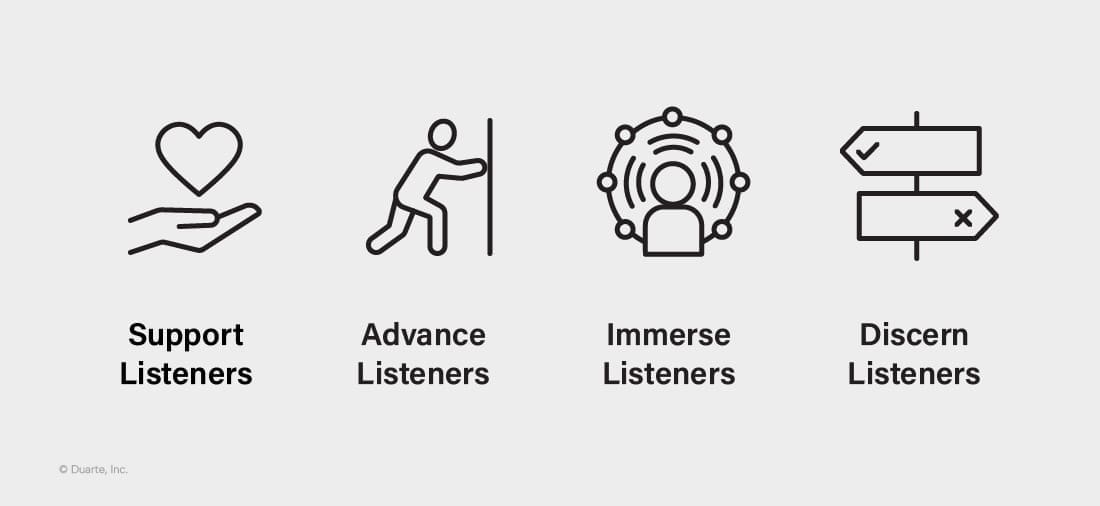
To guide listeners in discerning and meeting a speaker’s needs, Adaptive Listening introduces the S.A.I.D.™ framework, an acronym representing four distinct listening goals prevalent in the workplace: Support, Advance, Immerse, and Discern. This framework provides a practical typology for identifying what a speaker truly seeks, enabling listeners to tailor their approach accordingly.
1. Support Listening™ Skills:
This listening mode is crucial during moments of heightened emotion, whether positive or negative. When colleagues are experiencing challenges, setbacks, or celebrating successes, their primary need is often human connection, validation, and empathy. A speaker expressing frustration ("I’m having a horrible day") or joy ("I have the best news!") is signaling a need for Support Listening.
- Objective: To acknowledge and mirror the speaker’s feelings, providing comfort or celebrating their achievement.
- Listener’s Role: To act as a confidant, a cheerleader, or a sounding board. This involves active validation, offering words of encouragement, expressing shared sentiment, or simply being present without judgment or immediate problem-solving.
- Example Response: Instead of immediately offering solutions to a bad day, a Support Listener might say, "That sounds incredibly frustrating; I’m so sorry you’re going through that." For good news, "That’s fantastic! Congratulations, you totally deserve it!" This demonstrates emotional attunement and builds psychological safety.
2. Advance Listening™ Skills:
In fast-paced work environments, colleagues are frequently overwhelmed, time-constrained, or facing obstacles that impede progress. In these situations, the speaker’s core need is often to offload responsibility, lighten their burden, or find a pathway forward. They are looking for someone to help move a task, project, or process to its next stage.
- Objective: To facilitate progress, remove obstacles, or take action that moves a situation forward.
- Listener’s Role: To identify actionable steps, offer assistance, delegate tasks, or take on parts of the work. This is not just about understanding the problem, but about contributing to its resolution.
- Example Response: When a colleague states, "I don’t think I’ll have time to finish all of this," an Advance Listener might respond, "I can take some of that off your plate," or "Let’s brainstorm who else could assist to keep this project moving." The focus is on tangible solutions and shared responsibility.
3. Immerse Listening™ Skills:
Many workplace interactions involve the transmission of information, updates, or entertainment where the speaker’s goal is simply for the audience to absorb content without immediate critique or extensive discussion. This could range from a project update meeting to a training session or a presentation of new data.
- Objective: To absorb and retain information without interruption, judgment, or immediate critical analysis.
- Listener’s Role: To be a "content sponge," focusing on understanding the material, taking notes, or mentally cataloging key points. Clarifying questions are appropriate if they aid comprehension, but the primary goal is assimilation.
- Example Response: Upon hearing, "I’m here to give you an update today," an Immerse Listener would focus intently, perhaps jotting down notes, and might ask, "Could you elaborate on point three to ensure I fully grasp it?" without introducing personal opinions or new topics.
4. Discern Listening™ Skills:
Critical thinking, evaluation, and constructive critique are indispensable for organizational health and continuous improvement. When a speaker seeks feedback, an assessment of a situation, or help in identifying strengths and weaknesses, they require Discern Listening. This mode is vital for avoiding costly errors and fostering innovation.
- Objective: To critically evaluate information, identify potential risks and rewards, provide constructive feedback, or help refine ideas.
- Listener’s Role: To analyze the situation, offering balanced perspectives, pinpointing positives and negatives, and asking probing questions that encourage deeper thought. The listener acts as a critical sounding board.
- Example Response: If a colleague says, "I need some feedback on this presentation," a Discern Listener might respond, "The data visualization is strong, but I wonder if the conclusion could be more explicitly linked to our strategic objectives to maximize impact." This provides actionable critique rather than mere affirmation or dismissal.
Implementing Adaptive Listening: Challenges and Opportunities
Adopting Adaptive Listening across an organization requires more than just understanding the S.A.I.D. framework; it necessitates a cultural shift. The primary challenge lies in overcoming ingrained listening habits and the natural human tendency to filter information through a personal lens. Many individuals default to "what’s in it for me" or focus on crafting their response rather than fully engaging with the speaker’s true intent.
However, the opportunities presented by widespread Adaptive Listening are profound. Organizations that successfully integrate this methodology can expect:
- Enhanced Decision-Making: By accurately discerning needs, leaders and teams make more informed choices, reducing errors and improving strategic alignment.
- Increased Productivity: Clearer communication reduces rework, streamlines processes, and accelerates project timelines.
- Stronger Collaboration: When individuals feel truly heard and supported, trust flourishes, fostering more effective teamwork and innovation.
- Improved Employee Engagement and Retention: A culture of empathetic and effective listening makes employees feel valued, leading to higher morale and reduced turnover.
- More Effective Leadership: Leaders who master Adaptive Listening can better understand their teams’ needs, motivate performance, and navigate complex organizational challenges.
Expert Perspectives and Future Outlook
Communication experts and organizational psychologists increasingly advocate for listening models that move beyond mere attention. Dr. Evelyn Reed, a prominent organizational development consultant, recently remarked, "The next frontier in workplace communication isn’t just about transmitting information, but about the intentional reception and strategic response to it. Adaptive Listening offers a structured way to bridge that gap, making every interaction more purposeful." Similarly, human resources leaders are exploring Adaptive Listening as a core competency for talent development, recognizing its potential to cultivate stronger leadership pipelines and more resilient teams.
The integration of Adaptive Listening represents a significant step forward from basic attentive and even active listening. By consciously asking, "What does the person speaking need from me?" and applying the S.A.I.D. framework, professionals can transform routine interactions into opportunities for meaningful connection, efficient progress, and critical insight. In an era where information overload and communication fatigue are rampant, the ability to listen adaptively will not merely be a desirable skill but a crucial differentiator for individual career success and organizational excellence. As workplaces become increasingly complex and interconnected, mastering this advanced form of listening will be paramount for cultivating trust, achieving traction, and navigating the future of work.
