

The global shift toward sustainable consumption has reached a critical milestone as consumer interest in secondhand fashion and home decor hits unprecedented levels. In 2026, data from Google Search indicates that search queries for "vintage" and "how to thrift" have ascended to all-time highs, signaling a permanent change in retail behavior rather than a fleeting trend. As the circular economy matures, Google has unveiled a suite of advanced artificial intelligence tools designed to bridge the gap between the chaotic nature of thrift shopping and the precision of modern e-commerce. By integrating generative AI, computer vision, and augmented reality, these tools are transforming how consumers discover, authenticate, and value pre-owned goods.
The Rise of the Resale Economy and Digital Integration
The surge in thrifting is driven by a confluence of economic and environmental factors. According to industry reports, the global secondhand market is projected to reach nearly $350 billion by 2028, growing three times faster than the overall global apparel market. This growth is largely fueled by Gen Z and Millennial consumers who prioritize uniqueness and sustainability over fast-fashion convenience. However, the primary barrier to entry for many would-be thrifters remains the "hunt"—the time-consuming process of sifting through unorganized racks or scrolling through endless digital marketplaces.
Google’s latest updates address these frictions directly. By leveraging the Gemini-powered AI Mode in Search and the expansion of Circle to Search, the company is positioning itself as an essential intermediary in the resale ecosystem. These advancements allow users to move seamlessly between inspiration—such as seeing a vintage item on social media—and the final purchase, often bypassing the traditional difficulties of identifying unbranded or rare vintage pieces.

1. Navigating Complexity with AI Mode in Search
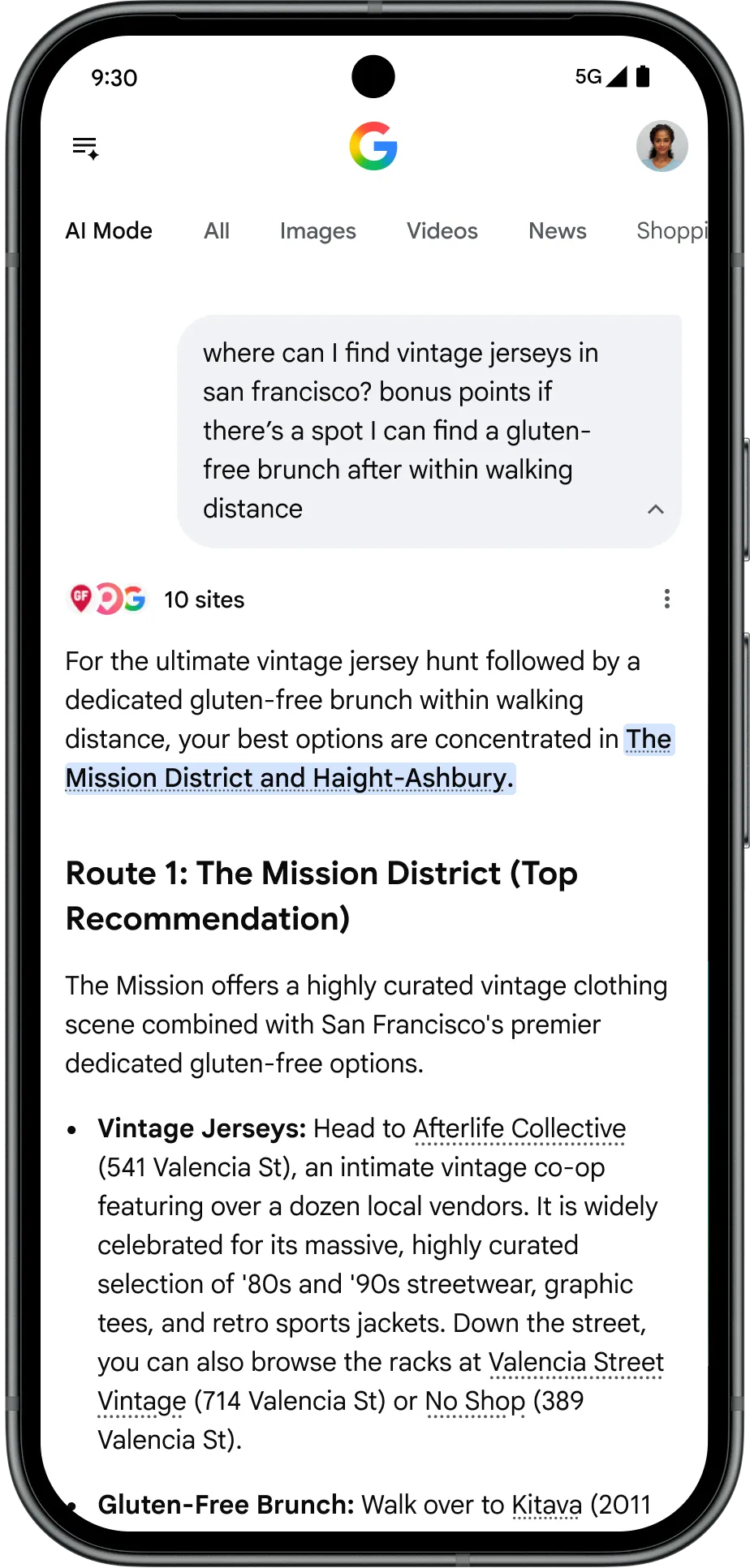
The introduction of AI Mode in Search marks a transition from keyword-based queries to nuanced, conversational discovery. In the context of vintage shopping, this allows users to plan highly specific itineraries that combine shopping with lifestyle preferences. Traditional search engines often struggle with multi-layered requests, but the current generative AI capabilities can synthesize disparate data points into a cohesive plan.
For example, a user seeking a specific 1990s-era sports jersey while also needing to accommodate dietary restrictions for a companion can now input a single, complex prompt: "Where can I find vintage jerseys in San Francisco? Bonus points if there’s a spot I can find a gluten-free brunch after within walking distance."
The AI processes local business data, inventory signals, and restaurant reviews to provide a curated list of recommendations. This level of hyper-local, intent-driven search reduces the "logistical friction" of thrifting, making it as accessible as a trip to a standard shopping mall. By providing links to store hours, maps, and menus, the AI acts as a digital concierge for the modern treasure hunter.
2. Real-Time Authentication and Valuation with Google Lens
One of the most significant challenges in the vintage market is the "information asymmetry" between professional dealers and casual buyers. Identifying the era, designer, or fair market value of a found object often requires years of expertise. Google Lens is effectively democratizing this knowledge through advanced computer vision.

When a shopper encounters an item in a physical thrift store—such as a piece of mid-century modern furniture or a designer handbag—they can use Lens to snap a photo and receive immediate context. The tool identifies visual matches across the web, allowing the user to see what similar items have sold for on platforms like eBay, Depop, or 1stDibs.
Beyond pricing, Lens now utilizes generative AI to provide historical context. A query about a specific crocodile-embossed bag can return an "AI Overview" detailing the silhouette’s popularity in the 1980s and 1990s, along with estimated resale values categorized by brand tier (designer vs. contemporary). This real-time appraisal capability protects consumers from overpaying and helps them identify "hidden gems" that might otherwise be overlooked.
3. The Seamless Transition from Content to Commerce: Circle to Search
As social media platforms like TikTok and Instagram continue to drive fashion trends—such as the current "vintage jersey" craze—the path from seeing an item to owning it has historically been fractured. Users often spend hours in the comments section asking for "ID on the jacket" or searching for vague descriptions.
Circle to Search, now integrated into the Android ecosystem, eliminates this search lag. By holding down the home button or navigation bar, users can circle any image or video on their screen to trigger a visual search without leaving the app they are using. If a user spots a pair of "thrifted heels" in a lifestyle vlog, they can circle them to find identical or similar listings across the internet.

Furthermore, the tool allows for "multisearch" follow-up questions. A user can circle a vintage blazer and type "same style but in wool" or "90s vibe alternatives," allowing the AI to refine results based on material, era, or aesthetic. This creates a feedback loop where digital inspiration is immediately actionable.
4. Solving the Fit Problem with Virtual Try-On
One of the greatest deterrents to buying vintage online is the inconsistency of sizing. A "Large" from 1970 rarely matches a "Large" from 2026. To combat this, Google has expanded its Virtual Try-On (VTO) technology to include a broader range of apparel.
The VTO tool uses a generative AI model that can take a single image of a garment and accurately simulate how it would drape, fold, and fit on a real person. Users can upload a full-body photo of themselves to see a digital rendering of the vintage item on their own frame. This technology moves beyond simple photo overlays; it uses diffusion models to account for the physics of fabric and the specific geometry of the user’s body. By providing a "digital dressing room," Google is helping to reduce the high return rates that plague the online resale industry, thereby increasing consumer confidence in secondhand purchases.
5. Empowering the Circular Economy: Closet Liquidation
Thrifting is a two-way street, and the sustainability of the model depends on the continuous flow of goods back into the market. Google Lens has been updated to assist users in the "de-cluttering" phase of the circular economy.

By photographing items in their own closets, users can ask the AI, "Is this worth reselling?" or "What kind of stores buy this brand?" The AI analyzes the brand’s current market demand and suggests the best platforms for sale—whether it be a high-end consignment shop for luxury goods or a local buy-sell-trade store for trendy streetwear. This lowers the barrier for individuals to participate as sellers, ensuring that "pre-loved" goods find new homes rather than ending up in landfills.
Analysis of Broader Implications and Market Impact
The integration of these AI tools represents a significant shift in the power dynamics of the retail industry. Historically, "vintage" was a niche market reserved for those with the time to hunt and the knowledge to authenticate. By automating these processes, Google is scaling the vintage market to a mass-audience level.
Impact on Traditional Retail
Traditional "fast fashion" retailers are increasingly feeling the pressure from this technological shift. As it becomes easier to find high-quality, unique, and sustainable alternatives through AI-enhanced search, the convenience advantage of big-box retail diminishes. This has led several major brands to launch their own "pre-loved" sections, attempting to capture a share of the resale market that Google is now making more transparent.
Data Privacy and the AI Evolution
While these tools offer immense utility, they also highlight the increasing importance of visual data. Google’s ability to recognize and categorize billions of objects in real-time is the result of years of training on vast datasets. As users upload photos of their homes and bodies for "Virtual Try-On" or appraisal, the importance of secure, ethical AI handling remains a central topic of discussion among tech analysts and privacy advocates.

The Future of "Search"
The evolution of these tools suggests that the future of search is no longer a list of blue links. Instead, it is a multimodal experience where the camera is as important as the keyboard. For the vintage industry, this means that "findability" is no longer dependent on a seller writing the perfect SEO description. If an item is visually distinct, Google’s AI can find it.
Conclusion
As 2026 continues to see record-breaking interest in the "old is new" movement, Google’s AI tools are providing the infrastructure for a more efficient, transparent, and sustainable retail future. From the "vintage desk" that has seen a 190% spike in search interest to the "vintage jersey" hitting all-time highs, the ability to snap, circle, and search is redefining the hunt for the perfect find. By lowering the barriers to both buying and selling, these technological advancements are not just leveling up the thrifting experience—they are accelerating the global transition toward a circular economy.
