

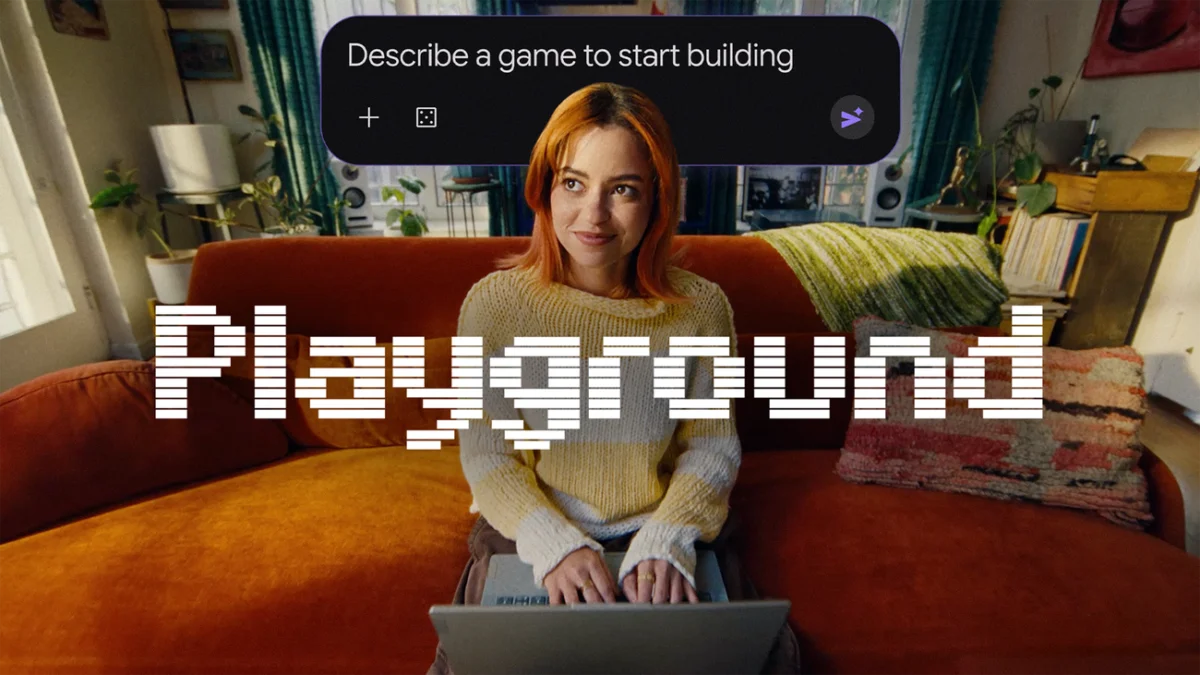
Google has officially announced the launch of Playground, a pioneering experimental gaming platform designed to democratize the process of game development through the power of generative artificial intelligence. Developed by the company’s AI Innovation and Research division, the platform allows users to conceptualize, build, and share interactive digital experiences using simple natural language prompts. By removing the traditional requirement for proficiency in coding or complex game engines, Google aims to shift the role of the creator from a technical specialist to a creative director. This move represents a significant step in Google’s broader strategy to integrate advanced AI into consumer-facing creative tools, effectively lowering the barrier to entry for the next generation of digital creators.
The platform was introduced by Maryam Karimzadehgan, a Software Engineer at Google AI Innovation + Research, who emphasized that while gaming is one of the world’s most vibrant forms of expression, the ability to build games has historically been restricted to those with years of specialized training. Playground seeks to disrupt this dynamic by providing a conversational interface where users can describe their game ideas—ranging from mechanics and physics to character design and environmental aesthetics—and see them realized in real-time.
The Shift Toward Prompt-Based Development
At the core of Playground is a sophisticated generative AI engine that interprets text-based instructions to generate functional game code and assets. Users can begin their creative journey with a blank canvas or choose to "remix" existing starter prompts. This "remix" culture is a cornerstone of the platform, allowing beginners to take an established concept—such as a 2D platformer or a physics-based puzzle—and modify it by asking the AI to "make the gravity lower," "change the protagonist to a sloth," or "set the game in a neon-drenched cyberpunk city."
The immediacy of the feedback loop is one of the platform’s most notable technical achievements. As creators type their requests, the changes are reflected almost instantly, allowing for rapid iterative testing. This "test-as-you-build" philosophy mirrors professional agile development cycles but compresses them into a matter of seconds. For example, if a user decides a level is too easy, they can simply prompt the AI to "add more obstacles and increase the speed of the enemies," and the game environment updates accordingly.
Cross-Platform Accessibility and Social Integration
Unlike traditional high-fidelity games that require heavy downloads or specialized hardware, Playground is entirely browser-based. This architectural choice ensures that the games are accessible across a wide range of devices, including smartphones, tablets, and laptops. By utilizing modern web technologies, Google has ensured that the "play" aspect of the platform is as frictionless as the "create" aspect.
The social ecosystem of Playground is built around the "Explore" gallery, a centralized hub where users can publish their creations for the global community. To foster engagement, the platform includes several social and competitive features:
- Shareable Links: Creators can generate unique URLs to challenge friends and family directly.
- In-Game Leaderboards: High-score tracking is integrated into specific genres, encouraging competitive play.
- Multiplayer Capabilities: Select game types support real-time multiplayer interactions, a feat for AI-generated browser games.
- Play Games Profiles: Integration with Google Play Games allows users to claim custom handles, follow their favorite creators, and curate a library of liked games.
To manage the influx of user-generated content, Google has implemented a dual-layered moderation system. Every published game undergoes an automated safety screening aligned with Google’s Community Guidelines. Additionally, a user-reporting mechanism allows the community to flag content that may have bypassed initial filters, ensuring the environment remains safe for its 18+ target demographic.
The Unity Spark Partnership: A Path to Professionalism
One of the most significant announcements accompanying the launch of Playground is the upcoming integration with Unity Spark. While Playground serves as an entry point for casual creators, Unity Spark is designed to be the bridge to professional-grade development. Unity, a global leader in game engine technology, will provide the infrastructure for users to export their concepts into more robust environments.
Unity Spark will unlock high-fidelity 3D capabilities, complex physics engines, and professional-level mechanics that go beyond the initial capabilities of the Playground text-to-game interface. This partnership suggests a tiered ecosystem: a user might start with a simple text prompt in Playground to "sketch" a concept and then transition to Unity Spark to refine that concept into a commercial-quality product. This workflow could fundamentally change how indie developers prototype their games, potentially saving months of early-stage development time.
Unity Spark is currently in a closed testing phase, with a broader beta expected in the near future. Industry analysts suggest that this collaboration is a strategic move by both Google and Unity to capture the "prosumer" market—users who sit between casual hobbyists and full-time professional developers.
Market Context and the Growth of User-Generated Content
The launch of Playground comes at a time when User-Generated Content (UGC) is dominating the gaming landscape. Platforms like Roblox, Minecraft, and Fortnite’s Creative Mode have proven that players are no longer content with being passive consumers; they want to be active participants in the world-building process. According to recent market data, the UGC gaming sector is expected to grow at a compound annual growth rate (CAGR) of over 10% through 2030.
However, even platforms like Roblox require a degree of technical knowledge, such as learning the Lua scripting language. By utilizing generative AI, Google is attempting to leapfrog these requirements. If successful, Playground could tap into a massive demographic of "non-coders" who have creative ideas but lack the technical vocabulary to execute them.
This move also signals Google’s resilience in the gaming sector following the 2023 closure of Stadia, its cloud gaming service. Rather than competing directly with consoles or high-end PC gaming, Google is pivoting toward its strengths: cloud infrastructure, AI research, and web-based accessibility.
Chronology of Google’s AI Evolution in Gaming
The journey to Playground can be traced through several key milestones in Google’s AI development:
- DeepMind’s AlphaGo (2016): Demonstrated that AI could master complex games through reinforcement learning.
- Generative AI Surge (2022-2023): The release of Large Language Models (LLMs) like Bard (now Gemini) provided the linguistic framework for conversational creation tools.
- The Rise of Game-Specific AI (2023): Google began experimenting with AI that could not only play games but understand the underlying logic of game design.
- Playground Launch (Current): The culmination of these technologies into a user-friendly, consumer-facing product.
Broader Implications and Industry Reactions
The introduction of prompt-based game creation has sparked a variety of reactions within the tech and gaming communities. Proponents argue that it represents the "ultimate democratization" of media. Much like how YouTube democratized video production and Instagram democratized photography, Playground could do the same for interactive software.
Educational experts see significant potential for Playground in STEM (Science, Technology, Engineering, and Mathematics) education. By allowing students to see the immediate results of their logic—even if that logic is expressed in English rather than code—it can serve as a "gateway" to deeper computational thinking.
However, some professional developers have expressed caution. There are ongoing debates regarding the "hallucination" tendencies of AI—where the AI might generate buggy or illogical game mechanics—and the potential impact on the job market for entry-level developers. Furthermore, the question of intellectual property (IP) remains complex: who owns a game that was described by a human but written by an AI? Google’s current guidelines focus on safety and community, but the legal landscape of AI-generated IP is still being defined in courts globally.
Future Outlook and Availability
Playground is currently being treated as an "early experiment," with Google expecting the platform to evolve based on user feedback. The launch is restricted to users in the United States who are 18 years of age or older. Access to the creation tools is tiered, with higher-level capabilities being rolled out to subscribers of Google’s various AI premium services.
As the community grows, Google plans to refine the AI’s understanding of complex game genres and expand the library of assets available for the generator. The eventual full rollout of Unity Spark integration will be a critical litmus test for whether Playground can transition from a novelty "toy" into a legitimate development tool.
For now, Playground stands as a bold testament to the transformative power of generative AI. By turning words into worlds, Google is not just launching a new platform; it is attempting to rewrite the rules of how we interact with technology and how we define the act of creation itself. Users can explore the current gallery and begin building their own games at playground.google.
