

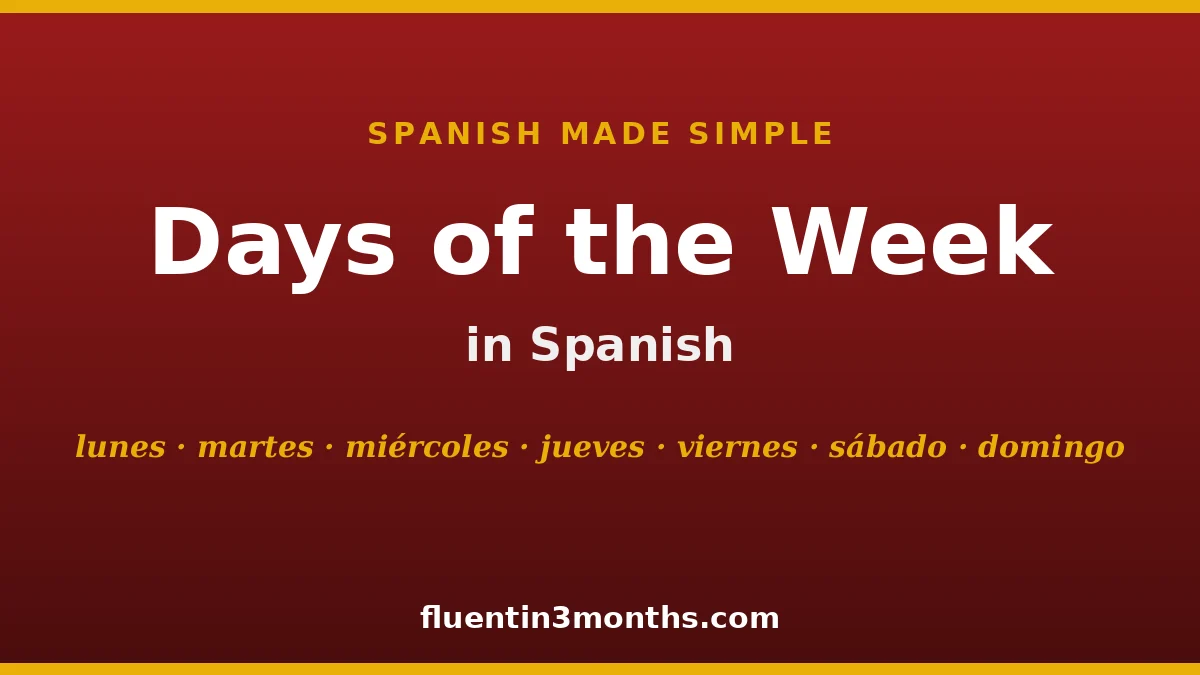
The acquisition of calendar-related vocabulary serves as a fundamental milestone in Spanish language proficiency, providing the essential framework for scheduling, social interaction, and logistical planning. For the estimated 500 million native speakers and the millions of students worldwide, the seven days of the week—lunes, martes, miércoles, jueves, viernes, sábado, and domingo—represent more than just a sequence of time; they are a reflection of a complex history spanning Roman mythology, astronomical observation, and religious evolution. Mastery of these terms requires an understanding of specific grammatical nuances, including gender agreement, unique pluralization rules, and orthographic standards that differ significantly from English conventions.
The Linguistic Framework of the Spanish Week
The Spanish calendar begins with Monday, a standard that aligns with ISO 8601, the international representation of dates and times. This structural difference often presents the first hurdle for learners from the United States or Canada, where calendars traditionally begin on Sunday. In Spain and most of Latin America, the work week is framed by "lunes" (Monday) through "viernes" (Friday), with the "fin de semana" (weekend) consisting of "sábado" (Saturday) and "domingo" (Sunday).
The orthography of these terms is strictly regulated by the Real Academia Española (RAE). Unlike English, where days of the week are proper nouns requiring capitalization, Spanish treats these words as common nouns. Consequently, they are written in lowercase unless they appear at the beginning of a sentence. For example, a student would write, "El lunes tengo clase," rather than "El Lunes." This rule extends to months and seasons, forming a consistent pattern in Spanish syntax that distinguishes it from Germanic languages.
Etymological Chronology and the Influence of Antiquity
The nomenclature of the Spanish week is deeply rooted in the Classical period, specifically the Roman practice of naming days after the celestial bodies known to the ancient world. This "Planetary Week" provides a logical timeline for five of the seven days:
- Lunes (Monday): Derived from the Latin Lunae dies (Day of the Moon).
- Martes (Tuesday): Named for Martis dies (Day of Mars), the Roman god of war.
- Miércoles (Wednesday): Originating from Mercurii dies (Day of Mercury), the messenger god associated with commerce and communication.
- Jueves (Thursday): Rooted in Iovis dies (Day of Jove/Jupiter), the king of the gods.
- Viernes (Friday): Derived from Veneris dies (Day of Venus), the goddess of love and beauty.
The final two days of the week represent a significant shift in the linguistic timeline, moving away from pagan planetary influences toward Judeo-Christian traditions. "Sábado" (Saturday) finds its origins in the Hebrew word Shabbat (Sabbath), meaning "day of rest," which transitioned through the Latin sabbatum. "Domingo" (Sunday) replaced the Roman Solis dies (Day of the Sun). Following the rise of Christianity, the day was renamed dies Dominicus (The Lord’s Day) in Latin, eventually evolving into the modern Spanish "domingo."
Grammatical Conventions and Syntactic Application
Linguists emphasize that the primary difficulty for English speakers learning Spanish days lies not in the vocabulary itself, but in the accompanying grammar. All seven days of the week in Spanish are grammatically masculine. This classification necessitates the use of the masculine definite articles "el" (the, singular) and "los" (the, plural).
A critical distinction in Spanish syntax is the absence of a direct equivalent for the English preposition "on" when referring to days. While an English speaker would say, "I will see you on Tuesday," a Spanish speaker says, "Te veré el martes." In this context, the definite article "el" functions as the temporal marker.
The rules for pluralization further complicate the learning process. The five weekdays (lunes through viernes) are "invariable" nouns. Because they already end in the letter "s," the word itself does not change when moving from singular to plural; only the article changes.
- El lunes (Monday) becomes los lunes (Mondays).
- El viernes (Friday) becomes los viernes (Fridays).
Conversely, the weekend days follow standard pluralization rules by adding an "s" to the end:
- El sábado (Saturday) becomes los sábados (Saturdays).
- El domingo (Sunday) becomes los domingos (Sundays).
Phonetic Precision and Orthographic Accents
Phonetically, Spanish days of the week require attention to specific vowel sounds and stress patterns. Two days, "miércoles" and "sábado," feature written accent marks (tildes). In Spanish, these marks are not optional; they indicate the "stressed" syllable in words that do not follow standard pronunciation rules. "Miércoles" is an esdrújula word, meaning the stress falls on the third-to-last syllable. Failure to include the accent in writing is considered a significant orthographic error.
Furthermore, the pronunciation of "jueves" highlights a common phonetic trap for beginners. The Spanish "j" is an unvoiced velar fricative, similar to the English "h" but often more aspirated. Therefore, "jueves" is pronounced as HWEH-ves, distinctly different from the English "j" sound found in "Judge" or "January."
Supporting Data on Language Acquisition
Educational data from platforms such as SpanishPod101 and Fluent in 3 Months suggests that calendar vocabulary is among the most frequently used lexical sets in daily conversation. According to linguistic studies, the ability to navigate "time markers" is a leading indicator of a learner’s transition from the "Novice-Low" to "Novice-Mid" proficiency levels as defined by the American Council on the Teaching of Foreign Languages (ACTFL).
Research into Spaced Repetition Systems (SRS), such as Anki, indicates that learners who associate the days of the week with their etymological roots (e.g., connecting martes to Mars) retain the vocabulary 40% more effectively than those who rely on rote memorization. This cognitive association leverages existing knowledge of Roman mythology to anchor new linguistic data.
Official Responses and Standardized Use
The Real Academia Española (RAE), the official body responsible for overseeing the Spanish language, maintains strict guidelines on the usage of these terms. In response to the increasing influence of English (Anglicization), the RAE has consistently reaffirmed that days of the week should remain lowercase. This stance is part of a broader effort to preserve the distinct grammatical identity of Romance languages.
In the corporate and diplomatic sectors, the use of the Monday-start calendar is a matter of protocol. International organizations operating in Spanish-speaking territories utilize the "lunes" start to align with local business cycles. For instance, airline booking systems and medical scheduling software in Spain are hard-coded to this format, making it an essential practical consideration for expatriates and international travelers.
Broader Implications for Functional Fluency
The practical application of these terms extends into a wider "bank" of temporal phrases that are essential for fluid communication. Mastery of the days of the week is incomplete without the ability to use them in conjunction with relative time markers. These include:
- Hoy: Today
- Mañana: Tomorrow
- Ayer: Yesterday
- Pasado mañana: The day after tomorrow
- Anteayer: The day before yesterday
- La semana que viene: Next week
- La semana pasada: Last week
The integration of these phrases allows speakers to provide context and precision. For example, "El lunes pasado" (Last Monday) versus "Este lunes" (This Monday). The nuanced use of "el" versus "los" also allows a speaker to distinguish between a one-time event and a recurring habit. "El sábado voy a la playa" implies a specific plan for the upcoming Saturday, whereas "Los sábados voy a la playa" indicates a habitual activity every Saturday.
Conclusion: The Path to Cultural Integration
Understanding the Spanish days of the week is a foundational requirement for any student seeking to move beyond basic memorization toward functional fluency. The transition from viewing these words as a list to using them as tools for social and professional organization marks a significant step in the learner’s journey.
By observing the rules of lowercase orthography, respecting the Monday-start calendar, and utilizing the definite article correctly, learners avoid the common pitfalls that signal non-native status. Ultimately, these seven words serve as a gateway to the broader Spanish-speaking world, facilitating everything from the simplest "hasta mañana" (see you tomorrow) to complex logistical coordination across the 21 countries where Spanish is an official language.
