

The Spanish verb ir (to go) represents one of the most fundamental yet linguistically complex elements of the Romance languages. As a pillar of Spanish communication, its utility spans from describing basic movement to forming the periphrastic future, a construction essential for daily interaction. However, for the student of linguistics or the second-language learner, ir presents a unique challenge due to its extreme irregularity. It is classified as a "suppletive" verb, meaning its various conjugated forms are derived from entirely different Latin roots. This guide provides an exhaustive analysis of ir, exploring its historical evolution, its diverse conjugation patterns across all moods and tenses, and its strategic importance in achieving Spanish fluency.
The Linguistic Genesis of Ir: A History of Suppletion
To understand why the conjugations of ir appear so disparate—ranging from voy and iba to fui—one must examine the historical development of the Spanish language from Latin. Unlike regular verbs that maintain a consistent stem, ir is a hybrid of three distinct Latin verbs. This process, known in linguistics as suppletion, occurred over centuries as Vulgar Latin evolved into the various Ibero-Romance dialects.
The first root, the Latin ire, provides the basis for the Spanish infinitive (ir), the future tense (iré), and the conditional tense (iría). The second root, vadere, which means "to advance" or "to hurry," serves as the source for the present indicative (voy, vas, va) and the present subjunctive (vaya). The third root, esse (to be), is perhaps the most surprising contributor. In the development of the Spanish language, the preterite (past) and imperfect subjunctive forms of ir were completely overtaken by the corresponding forms of the verb ser (to be). This explains why fui serves as both "I was" and "I went," a phenomenon that necessitates heavy reliance on context for interpretation.
The Strategic Importance of the Present Indicative
In the hierarchy of Spanish verbal structures, the present indicative of ir holds a position of primary importance. It is one of the most frequently used verbs in the Spanish corpus, appearing in nearly every conversational context. Beyond its literal meaning of physical movement, the present tense forms serve as the engine for the "near future" construction, which is the most common way to express intent in spoken Spanish.
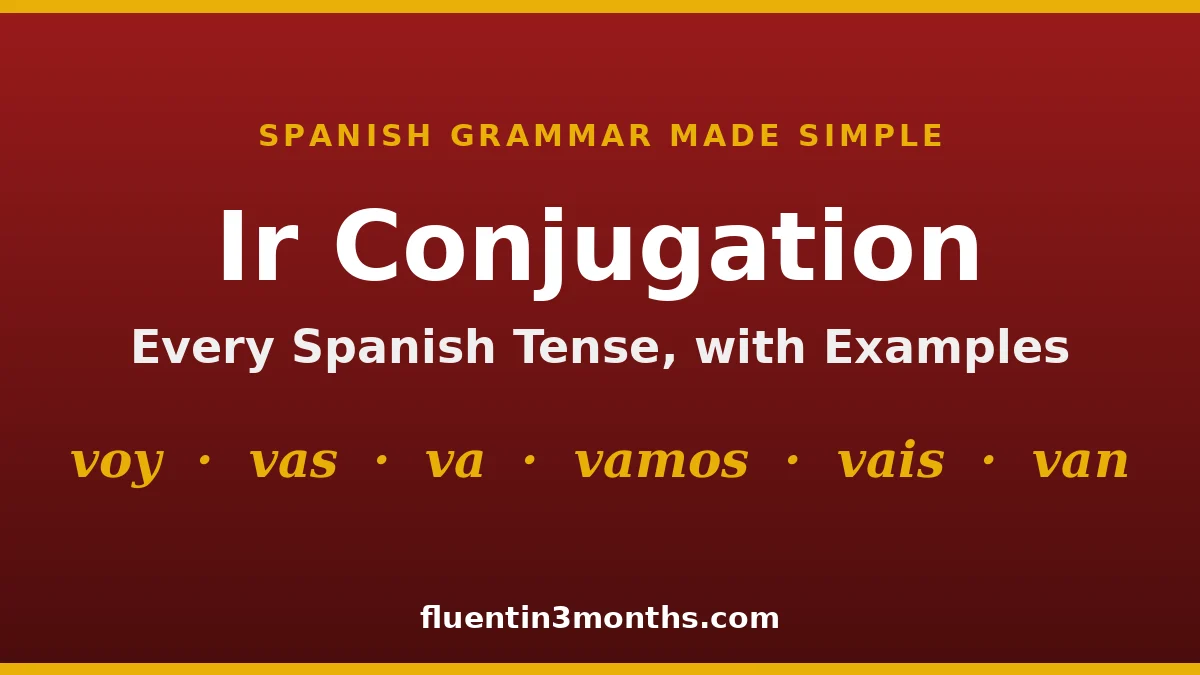
Table 1: Present Indicative Conjugations of Ir
| Pronoun | Conjugation | English Equivalent |
|---|---|---|
| Yo | voy | I go / I am going |
| Tú | vas | You go (informal) |
| Él / Ella / Usted | va | He / She / You (formal) go |
| Nosotros / Nosotras | vamos | We go |
| Vosotros / Vosotras | vais | You all go (Spain) |
| Ellos / Ellas / Ustedes | van | They / You all go |
The construction ir + a + infinitive (e.g., Voy a comer—I am going to eat) allows speakers to bypass the more complex synthetic future tense. Data from linguistic frequency studies suggest that in many Latin American dialects, this periphrastic future accounts for over 75% of all future-tense references in speech.
Analysis of Simple Past Tenses: Preterite vs. Imperfect
The past tenses of ir highlight the verb’s suppletive nature more clearly than any other mood. The preterite tense is used for completed actions at a specific point in time, while the imperfect is used for ongoing or habitual actions in the past.
The Preterite Tense
The preterite forms of ir are identical to those of the verb ser. This overlap is a rare occurrence in global linguistics and represents a point of significant interest for etymologists.
- Yo fui (I went)
- Tú fuiste (You went)
- Él/Ella/Usted fue (He/She/You went)
- Nosotros fuimos (We went)
- Vosotros fuisteis (You all went)
- Ellos/Ellas/Ustedes fueron (They/You all went)
The Imperfect Tense
The imperfect of ir is one of only three irregular imperfects in the entire Spanish language (the others being ser and ver). It utilizes the "ib-" stem derived from the Latin ibam.
- Yo iba (I used to go / I was going)
- Tú ibas (You used to go)
- Él/Ella/Usted iba (He/She/You used to go)
- Nosotros íbamos (We used to go)
- Vosotros ibais (You all used to go)
- Ellos/Ellas/Ustedes iban (They/You all used to go)
Compound Tenses and the Role of the Past Participle
Compound tenses in Spanish are formed by combining the auxiliary verb haber with the past participle. For the verb ir, the past participle is ido. These tenses are used to describe actions that have been completed in relation to the present or another point in time.
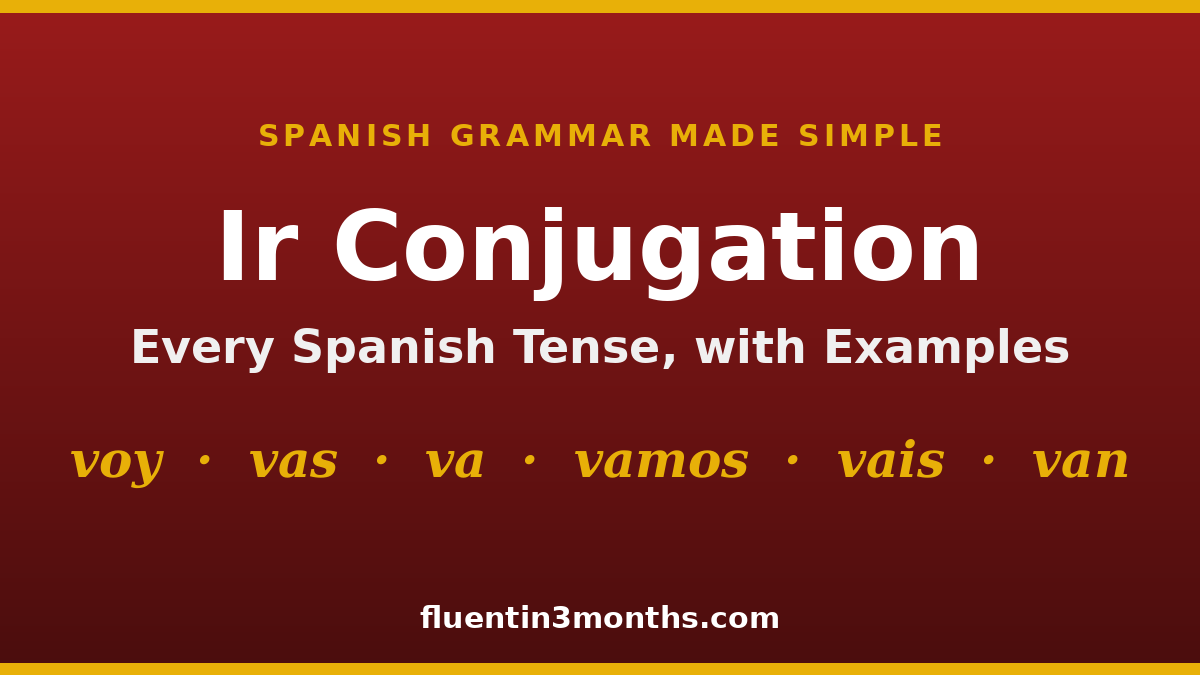
Table 2: Compound Indicative Tenses
| Pronoun | Present Perfect (He ido) | Pluperfect (Había ido) | Future Perfect (Habré ido) |
|---|---|---|---|
| Yo | he ido | había ido | habré ido |
| Tú | has ido | habías ido | habrás ido |
| Él/Ella/Usted | ha ido | había ido | habrá ido |
| Nosotros | hemos ido | habíamos ido | habremos ido |
| Vosotros | habéis ido | habíais ido | habréis ido |
| Ellos/Ustedes | han ido | habían ido | habrán ido |
The pretérito anterior (hube ido), while technically part of the Spanish grammatical canon, is largely obsolete in contemporary journalism and speech, appearing almost exclusively in classical literature.
The Subjunctive Mood: Expressing Subjectivity and Doubt
The subjunctive mood is utilized to express desires, doubts, emotions, and hypothetical situations. The present subjunctive of ir is built on the vaya stem, while the imperfect subjunctive follows the fuera or fuese stems derived from the preterite.
Table 3: Subjunctive Conjugations
| Pronoun | Present Subjunctive | Imperfect Subjunctive (-ra) | Imperfect Subjunctive (-se) |
|---|---|---|---|
| Yo | vaya | fuera | fuese |
| Tú | vayas | fueras | fueses |
| Él/Ella/Usted | vaya | fuera | fuese |
| Nosotros | vayamos | fuéramos | fuésemos |
| Vosotros | vayáis | fuerais | fueseis |
| Ellos/Ustedes | vayan | fueran | fuesen |
Linguistic experts note that the -ra ending for the imperfect subjunctive is significantly more prevalent in Latin American media and speech, whereas the -se ending maintains a presence in formal Iberian Spanish writing and oratory.
The Imperative Mood: Command Structures
The imperative mood of ir is notable for its brevity and its distinct forms. The informal singular command (tú) is ve, which is often confused by learners with the third-person singular of ver (to see).
- Tú: ve / no vayas
- Usted: vaya / no vaya
- Nosotros: vamos / no vayamos
- Vosotros: id / no vayáis
- Ustedes: vayan / no vayan
A specific grammatical quirk exists in the nosotros command. While the standard affirmative command for "let’s go" is vamos, the negative command must revert to the subjunctive: no vayamos. This exception is a standard feature of modern Spanish syntax and is strictly observed in professional broadcasting and publication.
Practical Distinctions: Ir vs. Venir
A frequent area of confusion in Spanish linguistics involves the distinction between ir (to go) and venir (to come). In English, the choice often depends on the location of the speaker or the listener. However, in Spanish, the distinction is more rigid.
- Ir is used for movement away from the speaker’s current location toward a different destination.
- Venir is used for movement toward the location where the speaker currently is.
If a person is at home and a friend calls to invite them to a party, the person at home must say "Voy para allá" (I am going there), whereas in English, one might say "I’m coming over." Using vengo in this context would imply the speaker is already at the party.
Broader Impact and Global Usage
The verb ir is more than a grammatical tool; it is a cultural bridge. Its role in the periphrastic future makes Spanish one of the most accessible languages for initial communication, as it allows speakers to discuss the future with minimal morphological complexity. Furthermore, the reflexive form irse (to leave/to go away) adds a layer of nuance, shifting the focus from the destination to the act of departure.
From a pedagogical perspective, the Real Academia Española (RAE) emphasizes the correct usage of ir as a benchmark for linguistic competency. Misuse of its irregular forms, particularly in the preterite or subjunctive, is often the primary marker of non-native speech. As Spanish continues to grow as a global lingua franca in business and diplomacy, the mastery of high-frequency irregulars like ir remains a non-negotiable requirement for professional-grade fluency.
In conclusion, while the verb ir may appear chaotic due to its three-root ancestry, it follows a strict internal logic shaped by centuries of linguistic evolution. By understanding the historical suppletion, mastering the present-tense "hack" for the future, and distinguishing between its many moods, one gains a powerful instrument for navigating the Spanish-speaking world. The complexity of ir is not merely a hurdle for the learner, but a testament to the rich, layered history of the Spanish language itself.
