

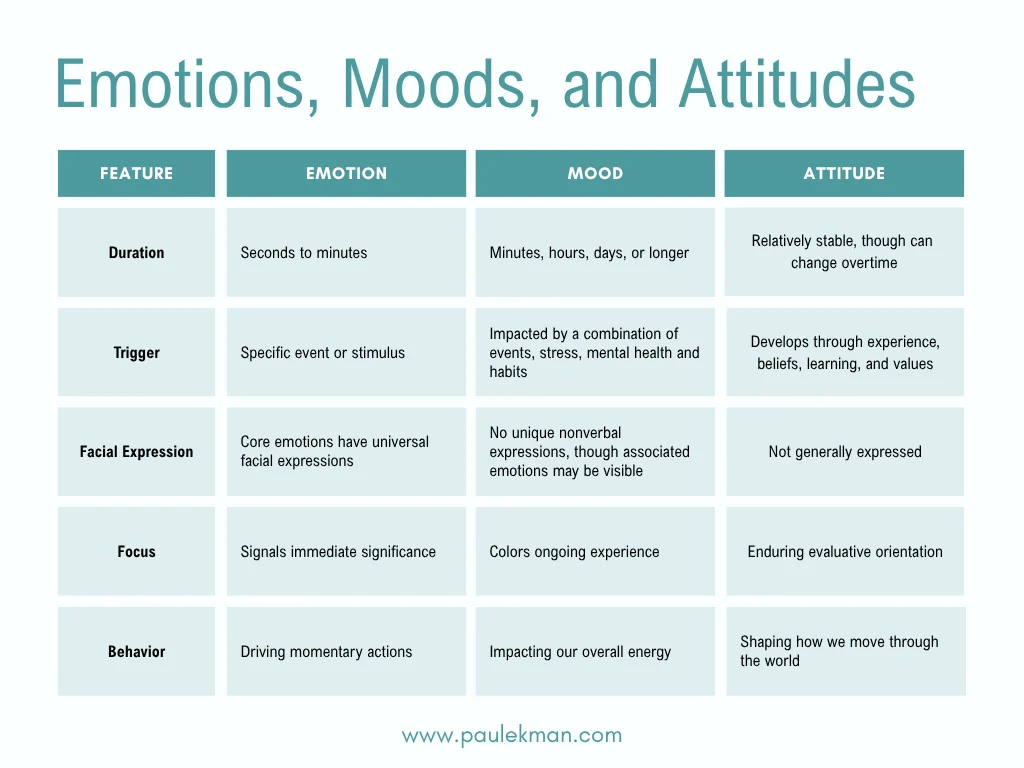
The intricate tapestry of human consciousness is woven with threads of emotions, moods, and attitudes, each playing a distinct yet interconnected role in shaping our perception of self and the world. While often used interchangeably in casual conversation, these psychological constructs operate on different temporal scales and serve unique functions. Building upon previous discussions that differentiated between moods and emotions, this comprehensive exploration delves into the multifaceted nature of attitudes and illuminates the dynamic interplay between all three, offering a deeper understanding of emotional intelligence, regulation, and the patterns that guide our thoughts and behaviors.
The Fleeting Intensity of Emotions
Emotions, at their core, are rapid, automatic appraisal processes deeply rooted in our evolutionary heritage and shaped by individual life experiences. They are triggered by events deemed significant in relation to our personal goals, fundamental needs, or overall well-being. This appraisal initiates a cascade of coordinated psychological and physiological changes, preparing us for immediate action or response. Research published in journals such as Psychological Science has consistently demonstrated the near-instantaneous nature of emotional processing, often occurring within milliseconds of stimulus detection.
By their very definition, emotions are transient, typically lasting from fractions of a second to a few minutes. This brevity is crucial for their adaptive function. During an emotion, the body undergoes notable transformations. This includes physiological shifts, such as changes in heart rate, respiration, and the activation of the autonomic nervous system, as detailed in studies on neurobiological correlates of emotion. Furthermore, emotions are often accompanied by distinct facial expressions, a universal language of human affect, as extensively documented by pioneers in the field of emotion research. These outward manifestations serve as vital communicative signals, conveying our internal state to others and facilitating social interaction. For instance, a sudden expression of fear, characterized by widened eyes and an open mouth, signals potential danger, prompting vigilance or avoidance behaviors in both the individual and those who observe it.
The Pervasive Influence of Moods
In stark contrast to the ephemeral nature of emotions, moods represent more enduring and diffuse affective states. They can persist for hours, days, or even longer, casting a pervasive emotional hue over our daily lives. Unlike emotions, moods frequently lack a clearly identifiable trigger or specific object of focus. We might wake up already experiencing a particular mood, or find ourselves gradually slipping into one without any discernible external cause. This lack of specific causality can make moods more challenging to pinpoint and manage.
While emotions often manifest in distinct facial expressions, moods tend to be more subtle. Observable signs might include shifts in muscle tension, posture, or overall energy levels, but these are less pronounced than the overt expressions associated with discrete emotions. Rather than prompting a specific, immediate response, moods function more as an emotional backdrop. They can significantly influence the likelihood and intensity with which certain emotions are triggered. For example, a person in a generally cheerful mood might be less susceptible to becoming overly frustrated by minor inconveniences, whereas someone experiencing a prolonged irritable mood may find themselves reacting with disproportionate anger to even small setbacks. Scientific investigations into the impact of mood on cognition have shown that prevailing moods can bias our interpretations of events, social interactions, and even our own internal thoughts, leading to a more positive or negative perception of our experiences throughout the day. This phenomenon underscores how moods can act as a powerful filter through which we process incoming information.
The Enduring Framework of Attitudes
Attitudes, unlike emotions or moods, are not themselves emotional states. Instead, they represent relatively stable and enduring evaluations of people, ideas, objects, behaviors, or experiences. Psychologists typically conceptualize attitudes as comprising three interconnected components, often referred to as the ABC model: Affective, Behavioral, and Cognitive.
- Affective Component: This refers to the emotional associations we have with the attitude object. For example, a positive attitude toward a particular brand of coffee might be accompanied by feelings of comfort and pleasure associated with its taste and aroma.
- Behavioral Component: This component relates to our tendency to act in a particular way toward the attitude object. If you have a positive attitude toward exercise, you are more likely to engage in physical activity regularly.
- Cognitive Component: This involves our beliefs and thoughts about the attitude object. For instance, the belief that a certain political policy is beneficial for the economy contributes to a positive attitude toward that policy.
Attitudes can also be categorized as either explicit or implicit. Explicit attitudes are those we are consciously aware of and can readily report, such as our declared preference for a certain political party. Implicit attitudes, on the other hand, are unconscious biases or preferences that still influence our behavior and judgments, even if we are not aware of them. A common example of an implicit attitude might be an unconscious preference for people who share similar backgrounds, which can subtly affect hiring decisions.
Consider the example of public speaking. An attitude toward public speaking might encompass a range of components: the belief that it is an important skill for career advancement (cognitive), the memory of feeling embarrassed during a past presentation (affective), and a subsequent tendency to avoid or actively seek out speaking opportunities (behavioral).
While attitudes are generally more stable than fleeting emotions or pervasive moods, they are not immutable. They are dynamic constructs that evolve over time. This development occurs through a complex interplay of repeated emotional experiences, learning processes (including classical and operant conditioning), exposure to social and cultural norms, interpersonal relationships, and personal introspection. New experiences can either reinforce existing attitudes, weaken them, or gradually reshape them.
Crucially, attitudes are always directed toward a specific object or entity. We can hold attitudes toward individuals, inanimate objects, abstract policies, significant events, or even toward our own internal emotional experiences. Because attitudes significantly influence how we interpret new information and how we are predisposed to respond, they function as an evaluative lens through which we perceive and navigate the world. This lens can either open us up to new perspectives or reinforce existing biases.
The Interconnected Dynamics: How They Influence One Another
While emotions, moods, and attitudes are distinct psychological constructs, they exist in a constant state of dynamic interaction, influencing and being influenced by each other in a complex feedback loop.
Mood as a Precursor to Emotion
Our prevailing mood significantly impacts the ease with which specific emotions are triggered and the intensity with which they are experienced. A person in an upbeat mood might find it easier to quickly bounce back from momentary frustration, viewing it as a minor inconvenience. In contrast, someone experiencing an irritable mood may find themselves reacting with amplified anger or annoyance to similar minor setbacks. Scientific literature on affective science suggests that a series of short, intense emotions, such as periods of worry or frustration, can coalesce over time to form a more prolonged and generalized state, evolving into an anxious or irritable mood. This highlights how the cumulative effect of our emotional experiences can shape our underlying affective disposition.
Attitudes as Architects of Emotional Response
Attitudes play a pivotal role in both shaping and being shaped by our emotional landscape. Imagine two individuals receiving the same piece of constructive feedback. One individual, holding a positive attitude toward feedback as a valuable opportunity for learning and growth, might experience feelings of excitement and motivation. The other individual, however, who perceives feedback as a personal threat or criticism, may experience anxiety and annoyance. The external situation remains identical, but their pre-existing attitudes dictate their interpretation of the event and, consequently, the emotions they experience. This demonstrates how our evaluative frameworks can fundamentally alter our emotional responses to similar circumstances.
Attitudes Toward Emotions: The Meta-Layer
A particularly influential type of attitude is our attitude toward emotions themselves. We may develop beliefs and judgments about specific emotions – for instance, viewing anger as inherently dangerous, sadness as a sign of weakness, fear as something to be suppressed, or joy as an emotion that should always be openly shared. These evaluative stances are often cultivated over years, influenced by family dynamics, cultural upbringing, educational experiences, and personal histories. Our attitudes toward emotions directly impact our willingness to acknowledge, accept, express, and learn from them. Furthermore, these attitudes are closely linked to the concept of "display rules," which are learned social norms dictating how and to whom emotional expressions are deemed appropriate. While certain facial expressions of emotion are considered universal across human cultures, the application of display rules can vary significantly, leading to diverse patterns of emotional expression worldwide and influencing how individuals manage and present their emotional states in different social contexts.
Cultivating Emotional Awareness for a More Resilient Self
At the Paul Ekman Group, the foundational belief is that genuine emotional awareness begins with the cultivation of the ability to observe our internal experiences with enhanced clarity and an attitude of genuine curiosity. By developing the capacity to recognize our discrete emotions, understand the pervasive influence of our moods, and become acutely aware of the attitudes that shape our interpretations, we can foster more insightful and compassionate responses to ourselves and those around us.
The development of these crucial skills is an ongoing practice, and their strength can be significantly enhanced over time through dedicated effort and engagement with evidence-based approaches. For individuals seeking to deepen their understanding of the science of emotion and further cultivate their emotional awareness, the Paul Ekman Group offers a range of research-backed resources. These include comprehensive training programs and accessible materials designed to equip individuals with the knowledge and tools necessary to navigate their emotional lives with greater wisdom and resilience. By embracing the interconnectedness of emotions, moods, and attitudes, we embark on a transformative journey toward a more profound understanding of ourselves and a more harmonious engagement with the world.
