

This paradigm shift in presentation strategy is rooted in fundamental human psychology. For millennia, stories have been the primary vehicle for transmitting knowledge, culture, and values. The human brain is inherently wired to process and retain information presented in a narrative format more effectively than raw data or abstract concepts. Neuroscientific studies, such as those conducted at Princeton University and Emory University, reveal that stories activate multiple brain regions, including those associated with emotion, memory, and even motor functions, leading to greater engagement and comprehension. In a business context saturated with data and competing demands for attention, a well-crafted story cuts through the noise, fostering connection, understanding, and ultimately, action.
The move towards narrative-driven presentations addresses the growing challenge of audience disengagement. Traditional presentations often overwhelm listeners with an onslaught of statistics, bullet points, and technical jargon, leading to diminished recall and a lack of emotional investment. Research from companies like Microsoft indicates that the average human attention span in 2024 is approximately eight seconds, highlighting the urgent need for communication strategies that can capture and sustain focus. Storytelling offers a potent antidote by creating a memorable and emotionally resonant experience that transforms passive listening into active participation.
The Foundational Power of Narrative: Crafting the Hero’s Journey
At the core of effective business storytelling lies the universal structure of the "Hero’s Journey," a narrative archetype identified by mythologist Joseph Campbell. This structure, which underpins countless myths, legends, and blockbuster films, provides a robust framework for business presentations, ensuring a clear beginning, middle, and end. The journey begins with the "Ordinary World," where the hero exists in a state of normalcy, often encountering a "Call to Adventure" – a problem or challenge that disrupts their status quo. Unable to overcome this challenge alone, the hero meets a "Mentor" who provides guidance, tools, and wisdom. This leads to a series of "Trials, Allies, and Enemies," culminating in an "Ordeal" where the hero confronts their greatest fear or obstacle. Upon overcoming this, they receive a "Reward," enabling their "Return with the Elixir" to the ordinary world, now transformed and capable of creating a "New Bliss."
In a business presentation, understanding who embodies the hero and who plays the mentor is paramount. Often, presenters mistakenly cast themselves or their company as the hero, recounting their achievements, impressive client lists, or numerous accolades. While establishing credibility is important, an audience-centric approach positions the audience as the hero. This strategic pivot recognizes that the audience is the one facing the challenge, seeking a solution, and ultimately, striving for a better future. By making the audience the protagonist, the presenter fosters empathy and allows the audience to envision themselves successfully navigating their own journey with the proposed solution.
Consequently, the presenter assumes the vital role of the mentor. A mentor is not interested in personal glory but in empowering the hero. They provide the necessary tools, insights, and support for the hero to overcome their obstacles. Consider a presentation for a meal kit delivery service. A "hero-centric" presenter might emphasize their company’s market leadership, superior ingredients, and five-star reviews. While factual, this approach centers on the company’s achievements. A "mentor-centric" presenter, however, would frame the narrative around the audience’s struggle: "One of the most challenging aspects of modern parenting is balancing quality time with children against the desire to prepare fresh, healthy meals. What if you could reclaim five hours a week, transforming kitchen duty into shared family moments? Our meal kit service provides the solution, delivering pre-portioned, fresh ingredients directly to your door, eliminating the dilemma between time in the kitchen and time with your loved ones." This approach immediately connects with the audience’s pain point, positions the service as the solution, and the presenter as the guide. This fosters trust and relevance, demonstrating a genuine understanding of the audience’s needs rather than merely promoting a product.
Beyond the Linear: Engaging Audiences with Contrast and the Sparkline Framework

Traditional presentations often unfold in a linear, additive fashion, presenting one fact after another with "and then, and then, and then." While logical, this structure often fails to capture and sustain audience attention. The most engaging stories, and by extension, presentations, thrive on contrast. They replace "and then" with "but then," introducing tension, conflict, and a sense of unfolding drama. For example, "Sarah wakes up and gets in her car to go to work, but then she has a flat tire. She catches a ride to an important meeting, but then realizes she’s in the wrong conference room." This dynamic shift creates intrigue and keeps the audience invested in the outcome.
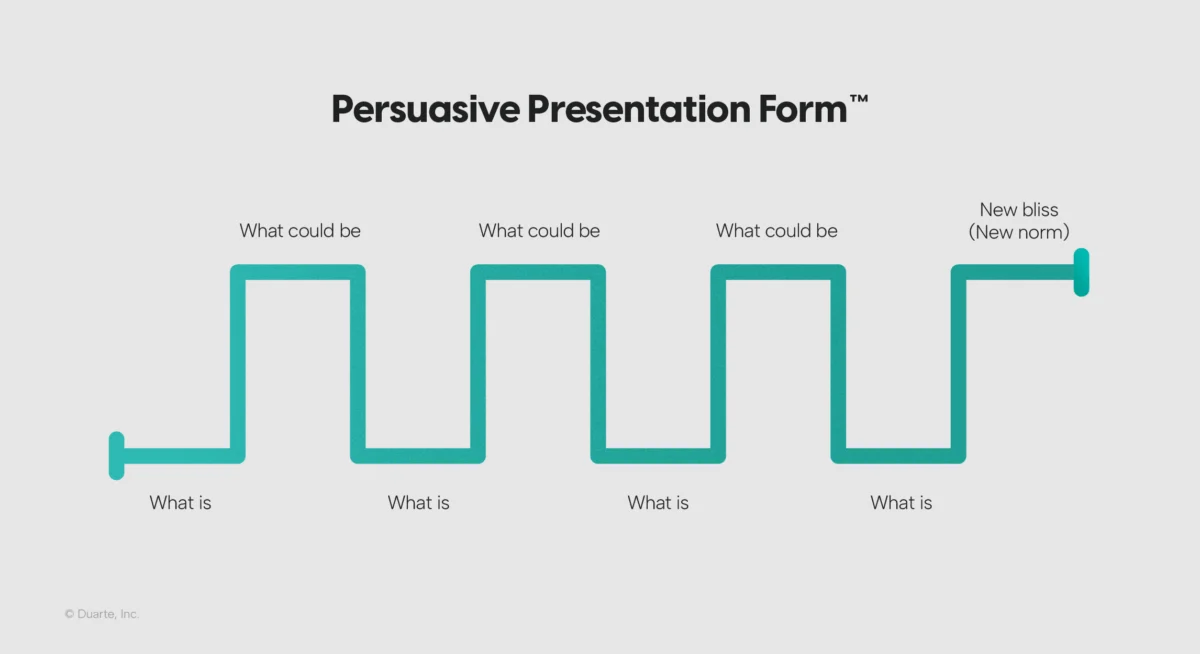
In business presentations, this principle of contrast is powerfully encapsulated by the Presentation Sparkline™ framework. Developed by communication expert Nancy Duarte, the Sparkline visually represents the dynamic interplay between "what is" (the current problematic reality) and "what could be" (the aspirational future state). Most business presentations fall into two predictable shapes:
- The Report: Primarily focuses on "what is," detailing current status, challenges, and data, with a brief suggestion for "what could be" at the end. This can be informative but often lacks persuasive power and can become monotonous.
- The Pitch: Opens with "what is," then quickly transitions to an extended focus on "what could be," highlighting the ideal future with the proposed solution. While inspiring, it can feel overly optimistic or even disingenuous if it doesn’t acknowledge the effort and challenges involved in the transition.
The Persuasive Presentation Form™, or Sparkline, however, weaves back and forth between "what is" and "what could be." It acknowledges the current reality and its associated problems, then offers glimpses of a better future, only to return to the difficulties of the present, thus creating a rhythmic pattern of tension and release. This dynamic structure mirrors the natural ebb and flow of a compelling narrative, maintaining audience engagement by constantly shifting perspectives and building anticipation for the eventual resolution. Influential speeches, such as Steve Jobs’ 2007 iPhone launch and Dr. Martin Luther King, Jr.’s "I Have a Dream" speech, are classic examples of the Sparkline in action. Jobs meticulously outlined the limitations of existing phones ("what is") before unveiling the revolutionary capabilities of the iPhone ("what could be"), cycling through these contrasts to build excitement. Similarly, King painted a vivid picture of racial injustice ("what is") before articulating his powerful vision of equality and harmony ("what could be"), creating an unforgettable persuasive arc.
Forging Unforgettable Moments: The Art of S.T.A.R. Moments™
In an era of information overload, the ability to create "Something They’ll Always Remember" – or a S.T.A.R. Moment™ – is invaluable. While audiences may struggle to recall a cascade of facts and figures, they are far more likely to retain a specific, vivid moment that captures the essence of a message. These moments serve as emotional anchors, embedding the core idea into the audience’s memory.
S.T.A.R. Moments can take many forms: a dramatic demonstration, a powerful visual metaphor, an unexpected prop, a startling statistic presented in a unique way, or a concise, impactful anecdote. The key is to break from the expected and create a sensory or emotional experience that resonates. A seminal example comes from Al Gore’s presentation on climate change, which formed the basis for his Academy Award-winning documentary, An Inconvenient Truth. Faced with the challenge of communicating the alarming projected rise in CO2 concentration over 50 years, Gore moved beyond a simple chart. He used a lift to physically ascend alongside the projected data line, dramatically illustrating the magnitude of the increase. This immersive, visual experience transformed abstract data into a tangible, memorable moment that underscored the urgency of the climate crisis. Such moments bypass purely rational processing and engage the audience on a deeper, more emotional level, significantly enhancing message retention and impact.
Transforming Data into Insight: The Practice of Data Storytelling
One of the most significant hurdles for business presenters is making data compelling and comprehensible. Raw data, on its own, lacks inherent meaning; it requires a presenter to provide context and narrative. Data storytelling transforms static numbers into dynamic insights that drive understanding and action. This involves three primary strategies:

- Marvel at the Magnitude: Instead of simply stating a number, articulate its scale in relatable terms. For instance, rather than saying "Our market share grew by 0.5%," explain "That 0.5% growth translates to reaching an additional 50,000 new customers, equivalent to the entire population of a small city."
- Humanize the Data: Connect statistics to individual experiences or real-world impacts. A statistic about healthcare costs becomes far more impactful when it’s linked to the story of a patient struggling to afford treatment.
- Surprise with the Unexpected: Present data in a way that defies expectations or challenges conventional wisdom. Steve Jobs’ 2008 MacBook Air reveal remains a masterclass in this technique. Instead of merely stating the laptop’s thickness as 0.76 inches, he dramatically slid the device out of a standard manila envelope. This unexpected visual demonstration instantly communicated the product’s revolutionary slimness in a way that mere numbers could not, creating a powerful, memorable S.T.A.R. Moment that also served as a brilliant piece of data storytelling. This creative contextualization makes complex information accessible and actionable, preventing "death by data" and ensuring that critical insights are understood and remembered.
The Visionary Conclusion: Guiding Audiences to "New Bliss"
Every compelling story requires a satisfying conclusion, and business presentations are no exception. The ending is not merely a summary but an opportunity to galvanize the audience with a vision of "new bliss." This "happily ever after" is not a fairytale but a tangible, attainable future state that addresses the challenges faced by the audience (the hero) through the solutions provided by the presenter (the mentor).
A strong conclusion should clearly articulate what the future will look like once the proposed solution is adopted. It reinforces the transformation the hero will undergo, painting a vivid picture of the benefits and positive outcomes. This "new bliss" must be credible and directly linked to the solutions presented, demonstrating that the journey was worthwhile and the struggles overcome will lead to a genuinely improved reality. For instance, a presentation on a new workflow software shouldn’t just end with "buy our software." Instead, it should conclude with a vision of "Imagine a workday where repetitive tasks are automated, team collaboration is seamless, and you have hours freed up to focus on strategic innovation – that’s the new bliss our software delivers." This aspirational yet realistic vision motivates action by offering a compelling glimpse into a desirable future that the audience can actively help create.
Organizational Implications and the Future of Business Communication
The mastery of business storytelling is not merely a personal skill; it is a critical organizational capability that drives progress across all facets of an enterprise. From securing venture capital and negotiating complex partnerships to aligning internal teams and successfully launching new products, the ability to tell the right story, in the right way, at the right moment, is a defining factor in success. Companies that prioritize and invest in developing storytelling competencies gain a significant competitive advantage in an increasingly crowded marketplace.
The broader implications are profound. Effective storytelling enhances brand identity, fosters stronger customer relationships, and builds greater employee engagement. It simplifies complex strategies, making them understandable and actionable for diverse stakeholders. It transforms abstract corporate visions into shared narratives that inspire collective action and resilience during times of change. In essence, business storytelling cultivates a culture of clarity, empathy, and persuasion, leading to more informed decisions, higher rates of adoption for new initiatives, and ultimately, a more robust bottom line.
As the business landscape continues to evolve, characterized by rapid technological advancements and increasing demands for transparency, the importance of human connection through narrative will only grow. Organizations that equip their leaders and teams with advanced storytelling skills will be better positioned to navigate uncertainty, inspire innovation, and build lasting relationships with customers, employees, and partners. The investment in business storytelling is an investment in the future of effective communication and organizational success.
