

The Spanish verb querer stands as one of the most fundamental pillars of the Romance linguistic tradition, serving as the primary vehicle for expressing both desire and affection. Classified as an irregular, stem-changing verb, its morphology presents a significant hurdle for students of Spanish as a Second Language (L2). However, recent pedagogical shifts emphasize a tiered approach to mastering its various forms, prioritizing high-frequency communicative needs over rote memorization of exhaustive paradigms. This report examines the structural complexities of querer, its etymological roots, and the sociolinguistic nuances that distinguish its usage across the Spanish-speaking world.
Morphological Classification and the Stem-Changing Paradigm
At its core, querer is identified by the Real Academia Española (RAE) as an e→ie stem-changing verb, often referred to in educational settings as a "boot verb." This phonetic shift occurs when the stress falls on the stem of the verb in the present indicative, present subjunctive, and imperative moods. For instance, the transition from the infinitive querer to the first-person singular quiero demonstrates the diphthongization of the vowel ‘e’ into ‘ie’.
Data suggests that querer is among the top 50 most frequently used verbs in the Spanish language. This frequency is attributed to its dual semantic nature. Unlike English, which utilizes distinct lexemes for "to want" and "to love," Spanish employs querer to bridge the gap between material desire and emotional attachment. This duality necessitates a precise understanding of context, as the same verb can facilitate a transaction in a commercial setting or express deep intimacy in a personal one.
Etymological Evolution and Historical Chronology
The evolution of querer can be traced back to the Latin verb quaerere, meaning "to seek," "to inquire," or "to strive for." Over centuries, the Vulgar Latin transition into Old Spanish saw a narrowing of the "seeking" aspect toward "desiring" what is sought.
The chronology of its development reveals why certain irregularities persist in modern Spanish. The shift to the quis- stem in the preterite tense—resulting in quise, quisiste, and quiso—is a remnant of the Latin perfect tense. Similarly, the future and conditional forms (querré, querría) underwent a process of syncopation, where the unstressed ‘e’ of the infinitive ending was dropped, leading to the characteristic double ‘r’ (geminate ‘r’) that marks these tenses.
Structural Analysis of the Indicative Mood
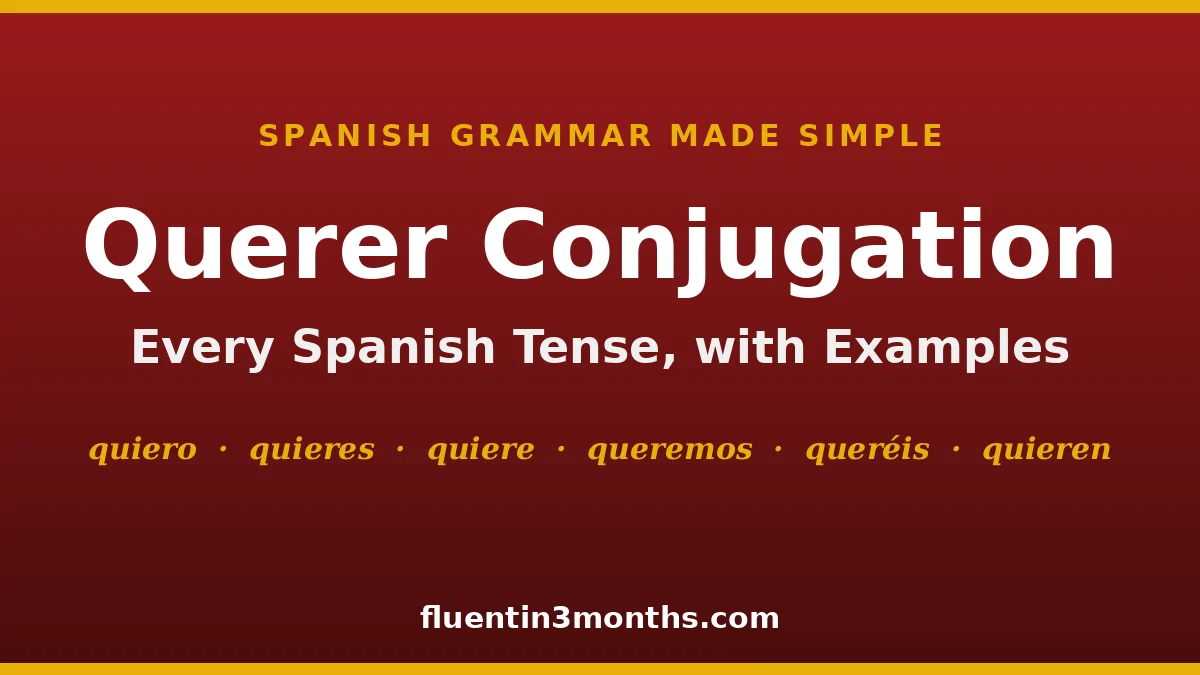
The indicative mood of querer is the primary tool for stating facts and expressing direct desires. In the present tense, the stem change e→ie applies to all persons except nosotros (we) and vosotros (you all, informal Spain), where the stress shifts to the ending.
- Yo quiero (I want/love)
- Tú quieres (You want/love)
- Él/Ella/Usted quiere (He/She/You formal want/love)
- Nosotros/as queremos (We want/love)
- Vosotros/as queréis (You all want/love)
- Ellos/Ellas/Ustedes quieren (They/You all want/love)
In the preterite tense, querer undergoes a total stem change to quis-. This tense is used for completed actions in the past. Interestingly, in the preterite, querer often takes on the nuanced meaning of "tried to" (in the affirmative) or "refused to" (in the negative). For example, Quise salir translates more accurately to "I tried to leave," whereas No quise salir implies "I refused to leave."
The imperfect tense (quería, querías, quería) remains regular relative to its infinitive stem, providing the background or ongoing state of wanting in the past. This distinction between the preterite and imperfect is a critical component of Spanish fluently, as it shifts the meaning from a specific event to a continuous state of mind.
The Subjunctive Mood and the Modal Function of Quisiera
The subjunctive mood is employed to express doubt, desire, emotion, or hypothetical situations. Given that querer inherently deals with desire, it frequently triggers the subjunctive in subordinate clauses. A common construction is Quiero que… (I want that…), which requires the following verb to be in the subjunctive mood.
A significant pedagogical "hack" identified by linguists is the use of quisiera, the first-person singular imperfect subjunctive. While technically a subjunctive form, in modern Spanish, it functions as a polite modal verb similar to the English "I would like." Statistics from linguistic corpora indicate that quisiera is significantly more common in service-industry interactions (restaurants, hotels, retail) than the blunt present tense quiero. Using quisiera softens the request, adhering to the cultural norms of politeness found in both Latin American and Peninsular Spanish.
Sociolinguistic Nuance: Te Quiero vs. Te Amo
One of the most complex areas for English speakers is the distinction between Te quiero and Te amo. While both are translated as "I love you," they occupy different rungs on the ladder of emotional intensity and social context.
- Te quiero: This is the standard expression of affection. It is used between romantic partners in the early to mid-stages of a relationship, between friends, and among family members. It denotes a sense of "I care for you" or "I want you in my life."
- Te amo: This is reserved for profound, often sacrificial or highly romantic love. It is more common in literature, poetry, and "telenovelas" than in daily casual conversation. In many cultures, transitioning from te quiero to te amo represents a significant milestone in a romantic relationship.
Linguistic analysts note that the usage of these terms can vary by region. In some parts of Mexico and Colombia, te amo may be used more freely among family members, whereas in Spain, it remains strictly a high-level romantic declaration.
Pedagogical Implications and Learning Strategies
Educational experts advocate for a "high-frequency first" strategy when approaching querer. Rather than attempting to memorize the 17 possible tenses of the verb simultaneously, students are encouraged to master the "core six" present tense forms and the polite quisiera form.
The compound tenses, which utilize the auxiliary verb haber plus the past participle querido, offer a more streamlined learning path. Since the past participle querido remains constant, the student only needs to conjugate haber to express complex ideas like "I have wanted" (he querido) or "I had wanted" (había querido).
Data from language acquisition studies suggest that learners who focus on the "strong" preterite stem quis- early in their studies find it easier to transition to the imperfect subjunctive, as the latter is derived from the third-person plural of the preterite (quisieron → quisiera).
Broader Impact on Communicative Competence
Mastering querer is more than a grammatical exercise; it is an essential step toward communicative competence. The verb serves as a functional tool for negotiation and personal expression. In a professional context, the ability to use querer in the conditional (querría) or the polite subjunctive (quisiera) can determine the success of diplomatic or commercial interactions.
Furthermore, the verb’s role in expressing negation—no querer—is vital for setting boundaries. In the preterite, no quise is a definitive refusal, a linguistic nuance that carries significant weight in social interactions.
Conclusion and Future Outlook
The Spanish verb querer remains a fascinating subject of study for linguists and a necessary challenge for students. Its irregularities are not random but are the result of a long phonetic evolution from Latin. As Spanish continues to grow as a global language, the pedagogical methods used to teach such foundational verbs are evolving to be more communicative and less reliant on traditional conjugation tables.
By understanding the dual nature of querer—as both a tool for daily transactions and a vessel for deep human emotion—learners can navigate the Spanish-speaking world with greater precision and cultural empathy. The continued study of its forms and functions ensures that the bridge between wanting and loving remains clear for the millions of people who speak and learn the language today. Future linguistic trends may see further simplification of the more obscure tenses, such as the future subjunctive, but the core indicative and subjunctive paradigms of querer will undoubtedly remain central to the Spanish linguistic identity.
