

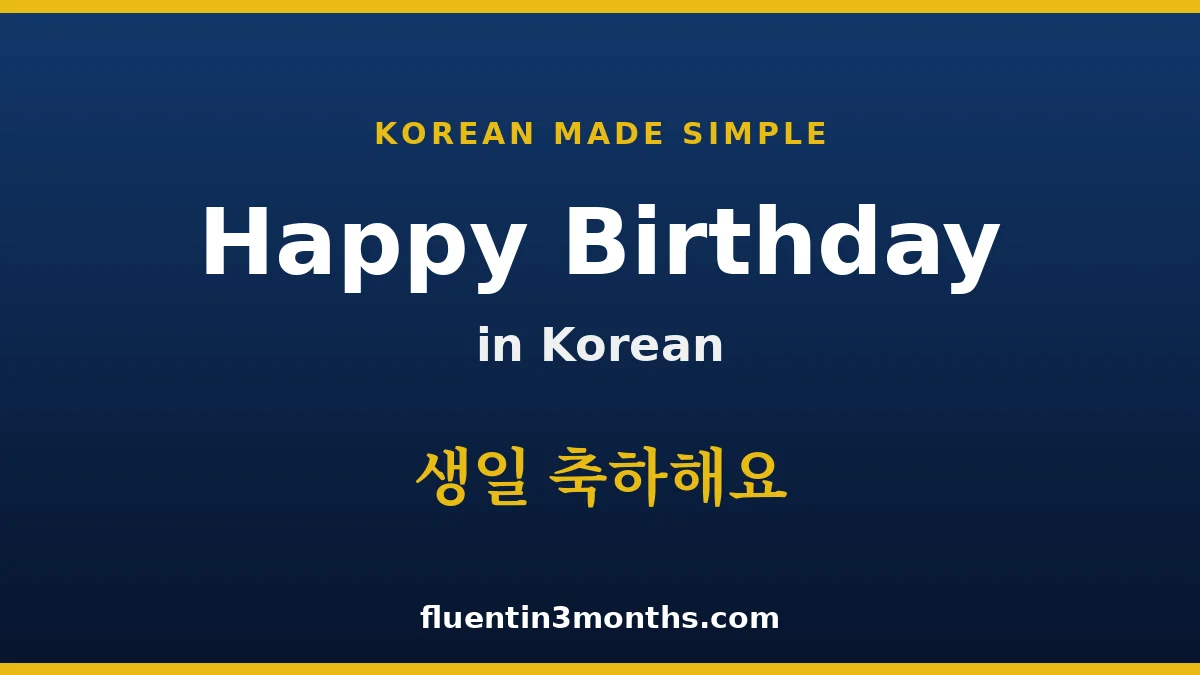
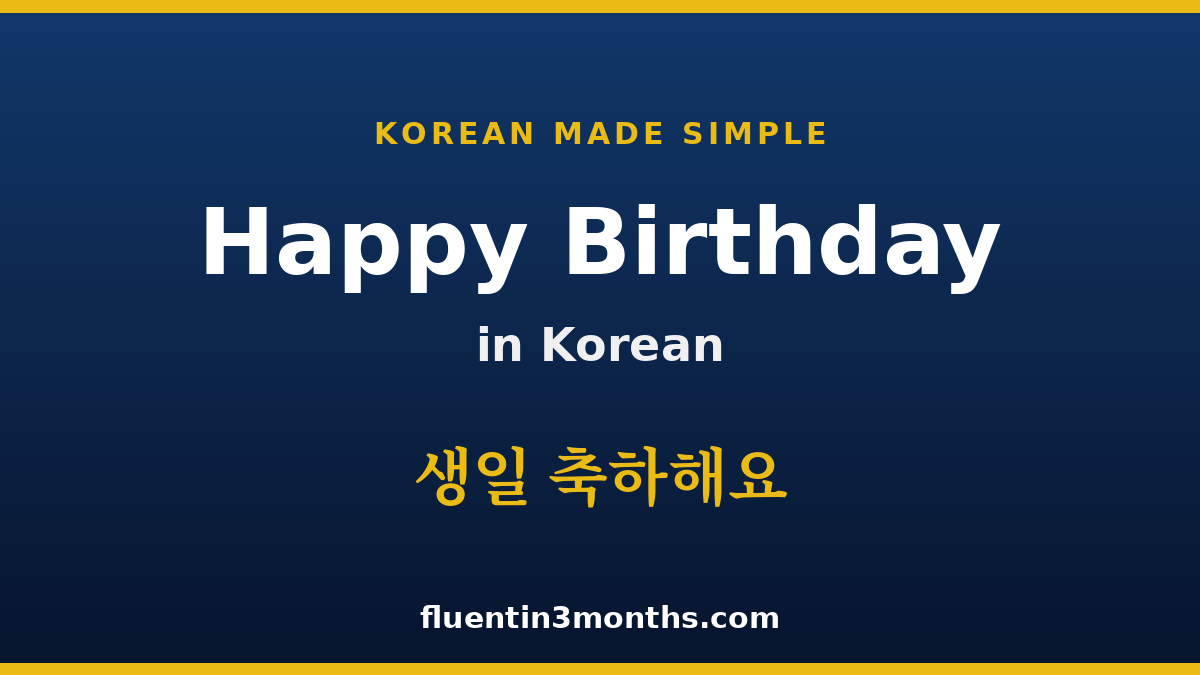
The linguistic landscape of South Korea is defined by a sophisticated system of honorifics and speech levels that dictate social interactions, a reality most evident in the various ways to express the sentiment of a happy birthday. While the standard polite phrase is saengil chukhahaeyo (생일 축하해요), this expression represents only one facet of a complex sociocultural hierarchy. In the Korean language, the choice of vocabulary is not merely a matter of preference but a reflection of the relationship between the speaker and the listener, incorporating factors such as age, professional status, and familial intimacy. Failure to navigate these nuances correctly can result in social friction, ranging from unintended stiffness with peers to perceived disrespect toward elders.
The Linguistic Architecture of Korean Birthday Greetings
The phrase saengil chukhahaeyo serves as the primary benchmark for learners of the Korean language. When deconstructed, the term reveals a fundamental difference between Western and East Asian perspectives on birthdays. The word saengil (생일) translates to "birthday," while chukhahada (축하하다) means "to congratulate." Unlike the English "Happy Birthday," which functions as a well-wish for the day’s duration, the Korean greeting is a formal congratulation on the milestone of reaching another year of life. This reflects a broader cultural emphasis on the endurance and achievement of aging.
The suffix -haeyo (-해요) denotes the "polite" or "informal-polite" level of speech. This level is considered the safest for general use, appropriate for colleagues, acquaintances, or individuals of a similar social standing with whom the speaker is not intimately acquainted. However, the Korean language necessitates further adjustments based on the "Ladder of Politeness," which includes four distinct tiers for birthday greetings:
- Banmal (Casual): Saengil chukha-hae (생일 축하해). This form is reserved strictly for close friends, younger siblings, or children. Using this with a superior is considered a significant breach of etiquette.
- Haeyo-che (Polite): Saengil chukhahaeyo (생일 축하해요). This is the standard "safe" version for most social interactions.
- Hapsyo-che (Formal): Saengil chukha-hamnida (생일 축하합니다). This is used in formal settings, public performances, or when addressing high-ranking officials. It is also the version utilized in the Korean rendition of the birthday song.
- Honorific (Highly Respectful): Saengsin chukha-deurimnida (생신 축하드립니다). This version employs the honorific noun saengsin (생신) instead of saengil and the humble verb deurida (드리다) meaning "to give" or "to offer." This is mandatory when addressing grandparents, parents, or elderly mentors.
The 2023 Standardization of the Korean Age System
A critical context for understanding Korean birthdays is the recent legislative shift regarding how age is calculated. For centuries, South Korea utilized a traditional system known as "Korean age" (se-neun nai), where a child was considered one year old at birth and gained a year every New Year’s Day, regardless of their actual birth date. This meant a child born on December 31 would technically become two years old on January 1, despite having lived for only two days.
In June 2023, the South Korean government officially moved to standardize age based on the international system (man nai) for most legal and administrative purposes. The Ministry of Government Legislation initiated this change to reduce the "unnecessary social and economic costs" caused by the simultaneous use of multiple age-counting methods. While the traditional system persists in casual conversation and certain social rituals, the transition marks a significant moment in the modernization of Korean social life. The shift has simplified the application of birthday greetings, though the underlying requirement for honorifics based on chronological seniority remains unchanged.
Cultural Foundations: The Significance of Seaweed Soup
In South Korea, the culinary centerpiece of a birthday is not the cake, but miyeok-guk (미역국), or seaweed soup. This tradition is rooted in maternal health and filial piety. Historically, seaweed was fed to new mothers for weeks following childbirth due to its high iodine and calcium content, which was believed to aid in recovery and milk production.
By consuming miyeok-guk on their own birthdays, Koreans perform a symbolic gesture of remembrance for their mothers’ sacrifice and the pain of labor. This tradition creates a linguistic and cultural link between the individual’s celebration and the honoring of their ancestry. Conversely, the "slippery" nature of seaweed has led to a modern superstition: students are discouraged from eating the soup on the day of an exam, as it is feared they will "slip" and fail the test.
Milestones and Rituals: The Doljanchi
While every birthday is celebrated, the first birthday, or doljanchi (돌잔치), holds unparalleled importance in Korean society. This tradition dates back to an era when high infant mortality rates made the completion of the first year a major survival milestone.
The highlight of the doljanchi is the doljabi (돌잡이), a fortune-telling ritual. The infant is placed before a variety of symbolic objects, and the item they choose is said to predict their future:
- String or Thread: Symbolizes a long and healthy life.
- Money: Represents future wealth and financial success.
- Books or Pencils: Suggests a career as a scholar or intellectual.
- Stethoscope or Gavel: Modern additions representing careers in medicine or law.
The doljanchi remains a major social event, often held in hotel ballrooms with large guest lists, reflecting the continued importance of community and family structure in Korean life.
The Global Expansion of Korean Language and Culture
The demand for understanding these linguistic nuances has surged globally, driven largely by the "Hallyu" or Korean Wave. According to the 2023 Duolingo Language Report, Korean is currently the seventh most studied language on the platform globally and ranks as the fastest-growing language in major markets such as India and the United States.
This international interest has moved beyond pop culture consumption into a deeper desire for linguistic competency. Educational experts note that learners are increasingly focused on "pragmatics"—the study of how context contributes to meaning. Understanding the difference between saengil and saengsin is no longer just for academic linguists; it is a practical requirement for the millions of tourists and expatriates engaging with South Korea’s economy and society.
Practical Application: Song and Script
For those engaging in celebrations, the Korean birthday song provides a bridge between Western influence and local language. Set to the melody of "Happy Birthday to You," the lyrics are:
- Saeng-il chuk-ha ham-ni-da (Happy birthday to you)
- Saeng-il chuk-ha ham-ni-da (Happy birthday to you)
- Sa-rang-ha-neun (Name)-ssi (Dear [Name])
- Saeng-il chuk-ha ham-ni-da (Happy birthday to you)
Despite being sung to children, the song almost exclusively uses the formal -hamnida ending. This is a common feature of set lyrics and formal compositions in Korea, where the "default" setting for public performance is one of high respect.
Furthermore, the ease of learning these phrases is supported by the logical structure of Hangul, the Korean alphabet. Created by King Sejong the Great in 1443, Hangul was designed to be "featural," meaning the shapes of the consonants mimic the physical position of the tongue and mouth. This scientific approach to literacy has resulted in South Korea having one of the highest literacy rates in the world and allows foreign learners to master the reading of birthday greetings within a matter of hours.
Analysis of Societal Implications
The complexity of Korean birthday etiquette serves a broader purpose than mere communication; it reinforces a social fabric based on mutual respect and the acknowledgement of one’s place within a group. In a professional context, using the correct honorific with a superior during a birthday celebration can signal emotional intelligence and cultural fluency, which are highly valued in the Korean corporate world (K-Business).
As South Korea continues to grapple with demographic shifts, including a rapidly aging population and a declining birth rate, these traditions are evolving. While the doljanchi remains popular, there is a growing trend of "small dol" celebrations, focusing on immediate family rather than grand banquets. Similarly, the standardization of age in 2023 suggests a society that is willing to reconcile traditional values with the requirements of a globalized, digital world.
In conclusion, saying "Happy Birthday" in Korean is a gateway into the heart of the nation’s identity. It requires an awareness of history, a respect for hierarchy, and an appreciation for the subtle shifts in language that define human relationships. Whether through the shared consumption of seaweed soup or the careful selection of a verb ending, the Korean birthday remains a profound intersection of the past and the present.
