

The German verb haben, translating to "to have," serves as a fundamental pillar of the German language, functioning both as a primary lexical verb and a critical auxiliary for constructing past tenses. For the estimated 15.4 million people worldwide currently learning German as a foreign language, according to data from the Goethe-Institut, mastering haben is often cited as the most significant milestone in transitioning from basic vocabulary to functional fluency. Its role extends far beyond simple possession; it is the engine behind the Perfekt tense—the standard form for spoken communication about past events—making it an indispensable tool for daily interaction.
Linguistic experts and educators emphasize that while German is often perceived as a language of rigid rules, high-frequency verbs like haben frequently exhibit irregularities born from centuries of phonetic evolution. Understanding these nuances is essential for students adhering to the Common European Framework of Reference for Languages (CEFR), particularly at the A1 and A2 levels where the foundations of syntax are established.
The Structural Foundation: Present Tense Conjugation
The first hurdle for any learner is the Präsens, or present tense. While German verbs typically follow a predictable pattern of endings, haben undergoes a specific contraction in its second and third-person singular forms. In the forms "du hast" (you have) and "er/sie/es hat" (he/she/it has), the "b" from the stem "hab-" is dropped. This is not a random occurrence but a result of high-frequency usage over time, where sounds are smoothed out for ease of speech—a phenomenon seen in the English transition from "haves" to "has."
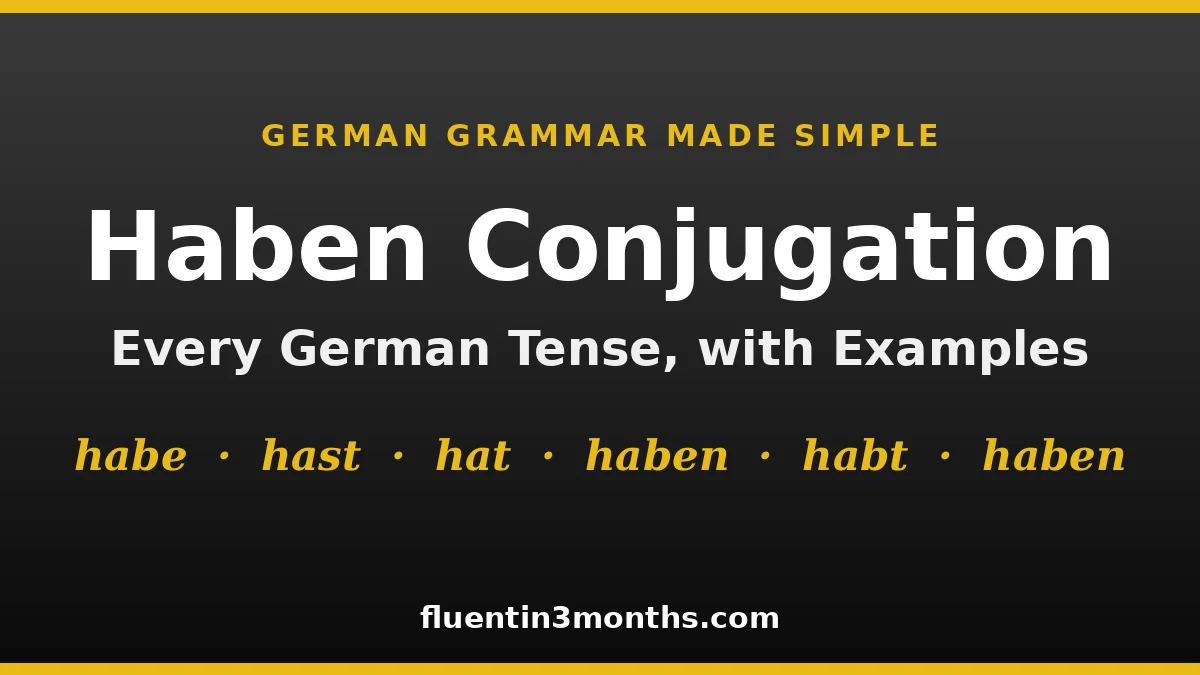
The full present tense paradigm is as follows:
- Ich habe (I have)
- Du hast (You have – informal)
- Er/sie/es hat (He/she/it has)
- Wir haben (We have)
- Ihr habt (You all have – informal plural)
- Sie/sie haben (They have / You have – formal)
Linguistic analysis suggests that mastering this specific "dropped-b" irregularity early prevents the formation of "fossilized errors," where students mistakenly apply regular conjugation rules to irregular stems.
Chronology of Tense Acquisition: From Possession to the Past
The pedagogical timeline for learning haben usually begins with literal possession, such as "Ich habe ein Buch" (I have a book). However, as students progress to the A1.2 level, the verb’s role as an auxiliary becomes paramount.
The Perfekt Tense
In German, the Perfekt (Present Perfect) is the dominant tense for talking about the past in conversation. It is formed by combining a conjugated form of haben (or sein) with the Partizip II (past participle) of another verb. For example, "Ich habe gegessen" (I have eaten). Statistically, the vast majority of German verbs—approximately 80% to 90%—utilize haben as their auxiliary. The remaining verbs, typically those indicating a change of state or motion, utilize sein (to be).
The Präteritum (Simple Past)
While the Perfekt is used for speaking, the Präteritum is more common in writing and formal narration. However, haben is one of the few exceptions where the Präteritum is frequently used in spoken German. Instead of saying "Ich habe Durst gehabt" (I have had thirst), most native speakers will opt for the simpler "Ich hatte Durst" (I was thirsty).
The conjugation for the Präteritum follows a "mixed" pattern:
- Ich hatte
- Du hattest
- Er/sie/es hatte
- Wir hatten
- Ihr hattet
- Sie/sie hatten
Advanced Moods: The Role of Konjunktiv II in Politeness
Beyond basic tenses, haben plays a vital role in the Konjunktiv II, the German subjunctive mood used for hypotheticals, wishes, and polite requests. The form "hätte" (would have) is ubiquitous in German social etiquette.
In a restaurant or retail setting, the phrase "Ich hätte gern…" (I would like to have…) is the standard for polite ordering. Linguists note that using the indicative "Ich will" (I want) can often come across as blunt or demanding in German-speaking cultures. Therefore, the acquisition of the Konjunktiv II form of haben is not merely a grammatical exercise but a socio-linguistic necessity for navigating interpersonal dynamics in Germany, Austria, and Switzerland.
Comparative Analysis: Haben vs. Sein
A significant point of confusion for English speakers is the distinction between when to use haben and when to use sein as an auxiliary. The rule of thumb established by the Duden (the preeminent German dictionary and grammar authority) dictates that verbs involving a transition from point A to point B (motion) or a change of physical or mental state (e.g., waking up, dying) require sein. All transitive verbs (those that take a direct object) and most intransitive verbs that do not involve motion or state change require haben.
Data from learner corpora show that English and Romance language speakers often struggle with specific idioms where the auxiliary choice differs from their native tongue. For instance:
- Hunger/Thirst: In German, one "has" hunger (Ich habe Hunger), whereas in English, one "is" hungry.
- Fear: In German, one "has" fear (Ich habe Angst), whereas in English, one "is" afraid.
- Age: Conversely, in German, one "is" a certain age (Ich bin 25 Jahre alt), whereas in French or Spanish, one "has" years (J’ai 25 ans / Tengo 25 años).
Historical and Etymological Context
The irregularity of haben is deeply rooted in the history of Germanic languages. It is a "mixed verb," meaning it combines characteristics of "weak" verbs (which use a dental suffix like -te for the past tense) and "strong" verbs (which undergo stem vowel changes).
The shift from "hab-" to "hatt-" in the Präteritum is a result of historical consonant assimilation. Over centuries, the "b" sound before the "t" suffix was lost, leading to the modern "hatte." This evolutionary streamlining is a hallmark of the most frequently used words in any language; the more a word is spoken, the more likely it is to be shortened or simplified for efficiency.
Official Responses and Educational Implications
Educational institutions like the Goethe-Institut and the TestDaF-Institut emphasize that auxiliary verbs are the "scaffolding" of the German language. In official curriculum guidelines, the mastery of haben is treated as a prerequisite for all intermediate (B1) and advanced (C1) studies.
A spokesperson for the German Academic Exchange Service (DAAD) noted that "fluency in German is often measured not by the size of one’s vocabulary, but by the precision with which one handles functional verbs like haben and sein. These verbs are the connectors that allow a speaker to navigate time and modality."
Broader Impact and Global Significance
The importance of mastering German grammar, specifically key verbs like haben, has significant economic implications. Germany remains the largest economy in the European Union and the third-largest exporter globally. Proficiency in the language is a high-value asset in sectors such as automotive engineering, pharmaceuticals, and renewable energy.
For professionals entering the German workforce, the ability to use the correct forms of haben—particularly in professional correspondence using the Konjunktiv I for reported speech—is often a marker of high-level integration and education.
Conclusion: The Path to Proficiency
Mastering haben requires a multi-faceted approach: memorizing the present tense irregularities, understanding its role as a past-tense auxiliary, and learning the idiomatic expressions that differ from English.
Summary of Key Forms for Learners:
- Präsens: habe, hast, hat, haben, habt, haben.
- Präteritum: hatte, hattest, hatte, hatten, hattet, hatten.
- Perfekt: habe gehabt (used less in speech than "hatte").
- Konjunktiv II: hätte (essential for "I would like").
- Imperativ: Hab Geduld! (Have patience!).
As the German language continues to be a vital medium for science, business, and philosophy, the study of its core components remains more relevant than ever. Haben is not just a word; it is a structural necessity. By internalizing its patterns and quirks, learners unlock the ability to express their history, their desires, and their needs with clarity and cultural accuracy. In the landscape of linguistic acquisition, having a firm grasp on haben is the first step toward truly "having" the German language at one’s command.
