

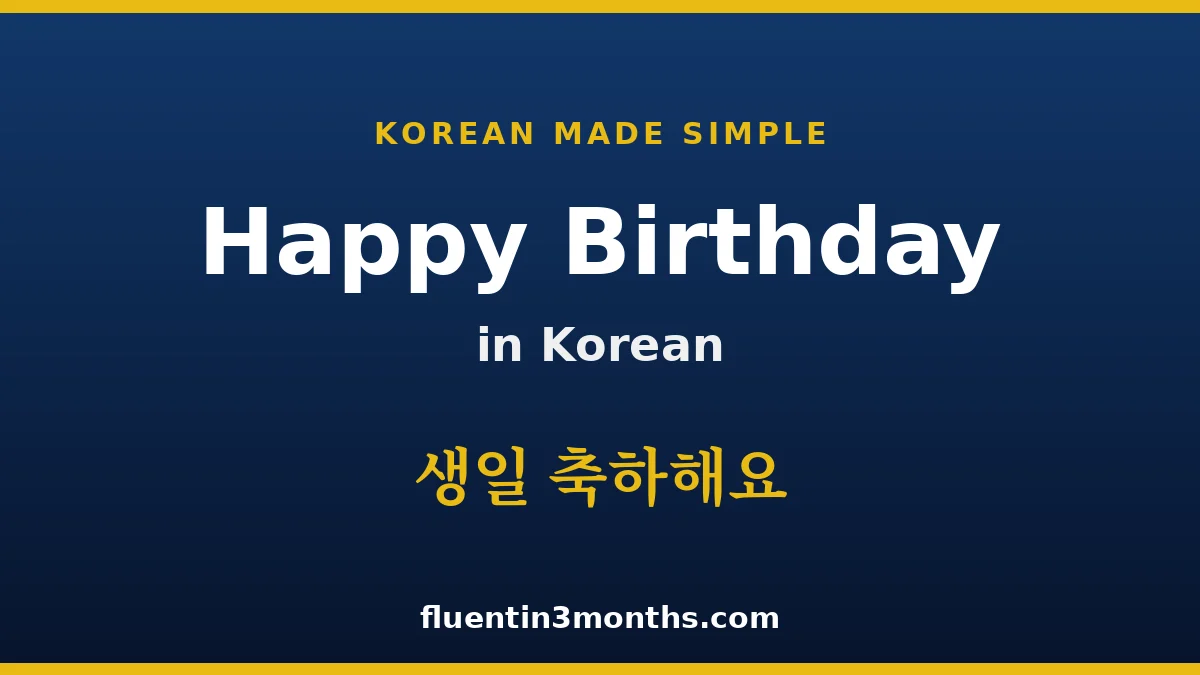
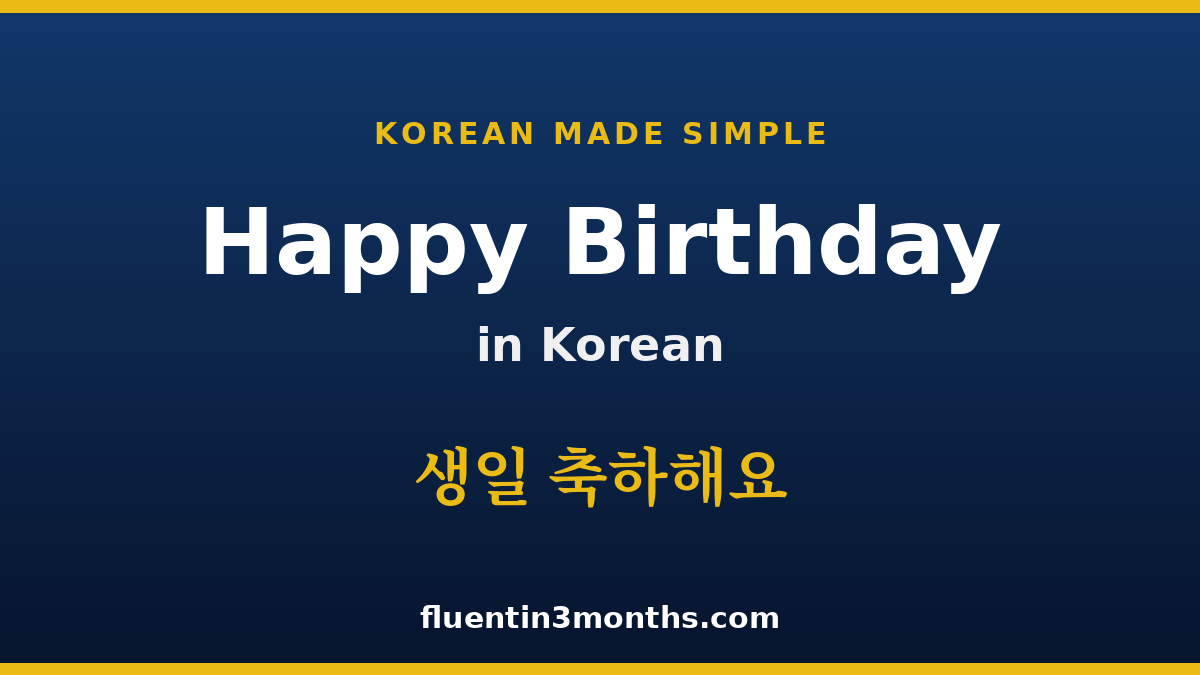
The phrase saengil chukhahaeyo serves as the standard linguistic gateway for wishing someone a happy birthday in South Korea, yet for many non-native speakers, this expression represents only the surface of a deeply complex social hierarchy. In the Korean language, the act of celebration is inextricably linked to the status of the recipient, necessitating a sophisticated understanding of honorifics and politeness levels. To navigate a birthday celebration in Seoul or within the global Korean diaspora, one must balance linguistic precision with an awareness of recent legislative changes regarding age and centuries-old culinary traditions.
The Linguistic Architecture of Korean Birthday Greetings
The primary phrase, saengil chukhahaeyo, is composed of three distinct parts: saengil (birthday), chukha (congratulation), and the polite verb ending haeyo. Unlike the English "Happy Birthday," which functions as a sentiment of well-wishing for the day’s duration, the Korean equivalent is a formal congratulation on the achievement of reaching another year. This linguistic nuance reflects a broader East Asian perspective where aging is viewed through the lens of endurance and accumulated wisdom.
The haeyo ending is considered the "safe" middle ground of Korean speech. It is appropriate for use with colleagues, acquaintances, and individuals of a similar social standing or slightly older. However, the rigid structure of Korean society demands that speakers adjust their register based on the age and status of the person they are addressing. This results in four primary levels of birthday greetings:
- Saengil chukhae: The informal (Banmal) version, used exclusively among close friends, siblings, or towards those younger than the speaker. Using this with a superior is considered a significant social transgression.
- Saengil chukhahaeyo: The standard polite form, suitable for most everyday interactions.
- Saengil chukhahamnida: The formal version, often used in public settings, business environments, or when singing the traditional birthday song.
- Saengsin chukhadeurimnida: The highest honorific form. This version replaces the word saengil with the honorific saengsin and uses the humble verb deurida (to give) instead of the standard verb. This is reserved for grandparents, parents, or highly respected mentors.
Legislative Reform: The 2023 Transition to International Age Standards
A critical component of understanding birthdays in South Korea is the recent shift in how age is calculated. For decades, South Korea utilized a unique "Korean age" system where a person was considered one year old at birth and gained a year every New Year’s Day, regardless of their actual birth date. This often meant a person could be two years older in Korea than they were by international standards.
On June 28, 2023, the South Korean government officially standardized the use of the international age system (Man Nai) for all administrative and legal purposes. The Ministry of Government Legislation spearheaded this change to reduce social and administrative confusion. Minister Lee Wan-kyu stated at the time that the move aimed to resolve legal disputes and social inconveniences caused by the simultaneous use of multiple age-counting methods.
While the legal standard has shifted, the cultural concept of "Korean age" remains a factor in social hierarchies. In South Korea, age determines the register of speech used between two people. Even a one-year difference can dictate who must use honorifics. Therefore, while the government has modernized the counting of years, the linguistic weight of a birthday remains a tool for establishing social order.
Gastronomy and Gratitude: The Role of Miyeok-guk
No analysis of Korean birthday traditions is complete without the inclusion of miyeok-guk, or seaweed soup. While Western traditions often prioritize the birthday cake, the consumption of seaweed soup is the central culinary ritual of a Korean birthday. This tradition is rooted in maternal health and filial piety.
Historically, seaweed soup has been the primary meal for women following childbirth due to its high iodine and calcium content, which is believed to aid in recovery and milk production. By eating miyeok-guk on their birthday, individuals perform a ritualistic act of remembrance for their mother’s sacrifice and the pain of labor.
Data from cultural anthropologists suggests that this tradition serves as a social stabilizer, reinforcing the bond between generations. Interestingly, the soup has also spawned a modern superstition: students are frequently discouraged from eating miyeok-guk on exam days. Because seaweed is slippery, there is a linguistic and metaphorical fear that the student will "slip" (mi-kkeu-reo-ji-da) and fail the test.
Doljanchi: The First Birthday as a National Milestone
While every birthday is celebrated, the first birthday, or Doljanchi, holds a place of prestige in Korean culture that often rivals weddings in scale and expense. The origins of the Doljanchi date back to a period when infant mortality rates were high; reaching the one-year mark was a significant survival milestone.
The centerpiece of the celebration is the Doljabi, a fortune-telling ritual. The child is placed before various objects, each symbolizing a different career path or life outcome:
- String or noodles: Representing a long life.
- Money or rice: Representing future wealth.
- Books or pencils: Representing academic or scholarly success.
- Stethoscopes or gavels: Modern additions representing careers in medicine or law.
The object the child picks is believed to predict their future. In contemporary South Korean society, Doljanchi has evolved into a significant commercial industry, with specialized banquet halls, professional photographers, and traditional Hanbok rentals contributing billions of won to the domestic service economy.
The Science of the Script: Hangul’s Role in Modern Communication
The ease with which international enthusiasts learn Korean birthday greetings is largely attributed to Hangul, the Korean alphabet. Created in 1443 by King Sejong the Great, Hangul was designed to be a featural writing system where the shapes of the consonants mimic the physical position of the tongue and mouth.
Linguistic experts often cite Hangul as one of the most logical and scientific writing systems in existence. This structural clarity allows learners to move from basic phonetic recognition to complex honorifics more rapidly than in languages with non-phonetic scripts. As the "Hallyu" or Korean Wave continues to expand global interest in Korean media, the demand for linguistic proficiency has surged. Digital language platforms report that "Happy Birthday" and basic greetings are among the most searched terms by new learners, often serving as the initial point of contact with Korean culture.
Broader Societal Impact and the Evolution of Celebration
The way birthdays are celebrated in South Korea is currently undergoing a transformation driven by demographic shifts and digitalization. With the rise of "Hon-jok" (people who prefer to do things alone) and a declining birth rate, traditional large-scale family gatherings are increasingly being replaced by small, "Instagrammable" celebrations or digital gift-giving via platforms like KakaoTalk.
The "Gifticon" culture—sending digital vouchers for coffee, cake, or luxury items via mobile messaging—has become the standard for birthday exchanges among the younger generation. According to retail data, birthday-related digital coupons account for a significant portion of annual mobile commerce revenue in South Korea.
Despite these technological shifts, the underlying linguistic requirements remain. Even in a digital text, the choice between chukhae and chukhahaeyo continues to signal the level of intimacy or respect between the sender and the recipient.
Conclusion: A Synthesis of Tradition and Modernity
Understanding how to say "Happy Birthday" in Korean requires more than just memorizing a phrase; it requires an appreciation for a culture that values social harmony, maternal gratitude, and historical continuity. From the strict adherence to honorifics to the ritualistic consumption of seaweed soup and the legislative shift toward international age standards, the Korean birthday is a microcosm of the nation’s broader social fabric.
As South Korea continues to project its cultural influence globally, these traditions are no longer confined to the peninsula. They serve as a bridge for international communities to engage with Korean values, proving that a simple birthday wish can carry the weight of history, law, and deep-seated social respect. Whether it is a toddler grabbing a pencil at their Doljanchi or an adult honoring their mother with a bowl of soup, the Korean birthday remains a profound celebration of life, growth, and the enduring importance of one’s place within the community.
