

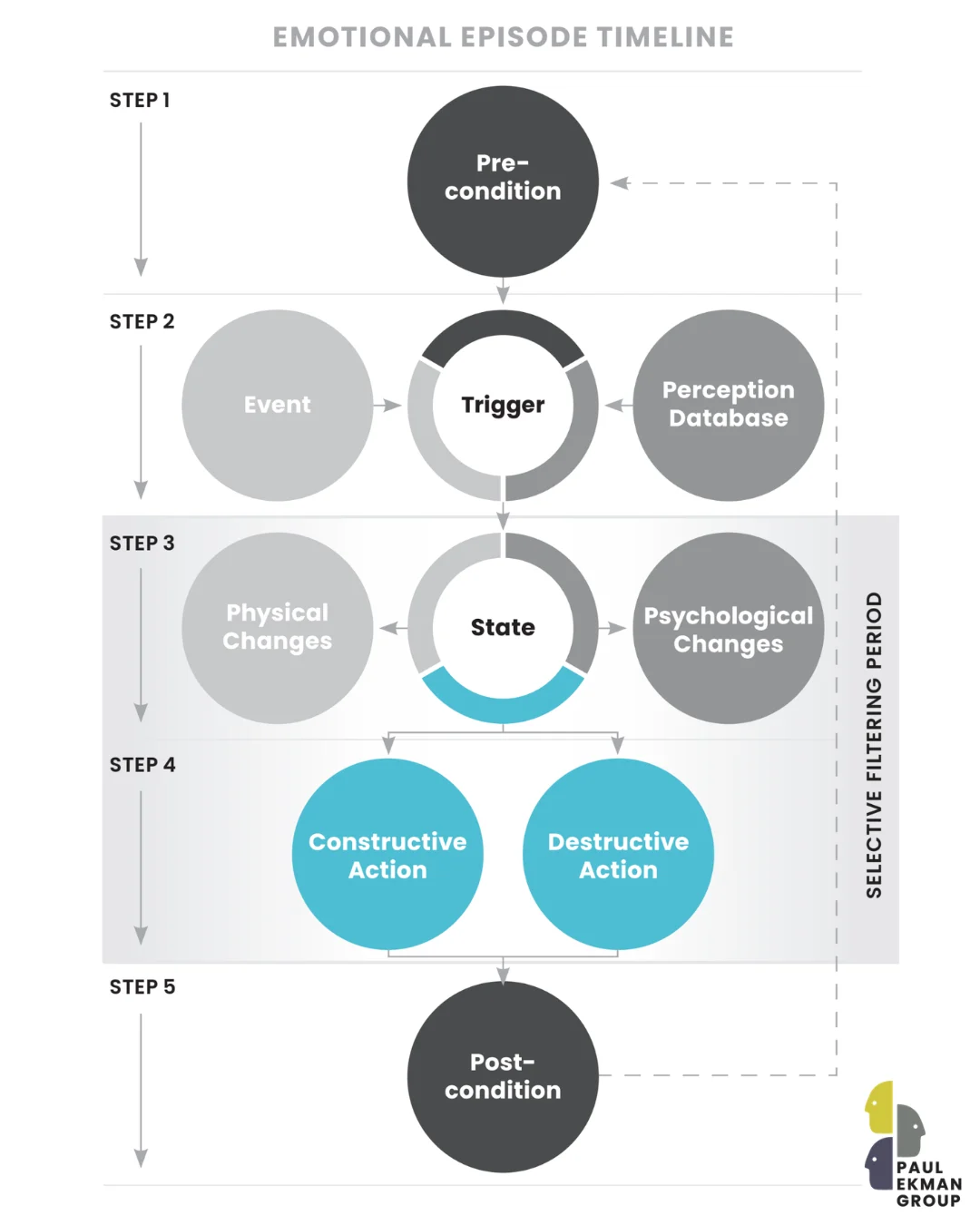
Have you ever found yourself reacting emotionally before you even realized what was happening? This seemingly instantaneous surge of feeling, often perceived as a spontaneous outburst, is in fact a complex and sequential process rooted in our physiological and psychological makeup. While the experience of emotion can feel overwhelming and unpredictable, scientific research, particularly advancements in the field of affective science, reveals a structured, multi-stage journey that governs our emotional lives. This framework, known as the Emotional Episode Timeline, offers a crucial lens through which to understand how emotions arise, unfold, and ultimately shape our interactions with the world. By dissecting this process into five distinct steps, individuals can gain profound insights into their own emotional patterns, enabling earlier recognition, more skillful responses, and the potential to modify deeply ingrained habits that may no longer serve them.
The foundational understanding of emotional experience can be simplified into a three-step sequence: Trigger, Experience, and Response. This basic model captures the essence of how an emotional event unfolds. However, a more granular examination reveals a more nuanced progression, breaking down the journey into five critical stages: Pre-condition, Trigger, State, Action, and Post-condition. This extended timeline provides a more comprehensive understanding of the subtle influences and cascading effects that characterize our emotional lives, from the seemingly trivial frustration of misplacing keys to profound moments of joy or sorrow.
Stage 1: The Pre-Condition – Setting the Emotional Stage
The initial phase of any emotional episode is the Pre-condition. This stage refers to the cumulative physical and emotional state an individual carries into any given moment. It is, in essence, our “emotional starting point.” This pre-condition is not static; it is a dynamic interplay of factors that can significantly influence how readily and intensely an emotion might arise. Considerations such as the quality of recent sleep, levels of hunger or satiety, accumulated stress from work or personal life, excitement stemming from positive news, or simply a state of calm and well-being all contribute to this foundational state.
For instance, an individual who has had a night of restful sleep, is well-nourished, and feels generally at ease is likely to possess a more resilient pre-condition. This state of equilibrium can act as a buffer, making it less likely for minor external events to trigger a strong emotional response. Conversely, a person experiencing sleep deprivation, high stress, or physical discomfort is likely to have a lower threshold for emotional activation. In such scenarios, even a minor inconvenience, which might otherwise be easily dismissed, could precipitate a disproportionately strong emotional reaction. This highlights the crucial role of self-care and stress management in maintaining a more stable emotional baseline, thereby influencing the entire subsequent emotional episode. Research in psychoneuroimmunology, for example, consistently demonstrates the bidirectional relationship between stress, sleep, and emotional regulation, underscoring the physiological underpinnings of our pre-condition.
Stage 2: The Trigger – The Spark of Emotion
The Trigger is the pivotal moment where an emotional episode is initiated. It is not a singular event but rather a complex interplay between an external or internal Event, our Perception Database, and our current Pre-condition. The mind is in a perpetual state of monitoring, constantly evaluating incoming information for potential opportunities or threats. This process, known as automatic appraisal, occurs at an incredibly rapid, often unconscious, pace.
Event: An event can manifest in numerous ways, encompassing anything encountered through our senses or internal cognitive processes. This includes interactions with people, navigating specific environments, engaging in particular situations, or even a fleeting thought, memory, or fantasy. The sensory portals – sight, sound, smell, taste, and touch – all serve as conduits for these events. For example, a sudden honk of a car horn might be an external event, while a distressing memory surfacing unexpectedly is an internal one.
Perception Database: Each individual possesses a unique Perception Database, a sophisticated internal library of past emotional experiences, learned responses, and ingrained beliefs. This database acts as an “emotional alert system,” enabling the mind to quickly assess the significance of incoming events. It is shaped by two primary sources:
- Learned Associations: This component is built upon our life experiences, including upbringing, cultural influences, and specific personal encounters. For instance, a childhood experience of being reprimanded for speaking out might lead to an adult who associates being contradicted with feelings of shame or anger.
- Biological Predispositions: Underlying these learned associations are innate biological tendencies and temperamental factors that influence our baseline emotional reactivity. Some individuals are naturally more sensitive to certain stimuli, predisposing them to specific emotional responses.
The combination of an event and how it is interpreted through our perception database, influenced by our pre-condition, culminates in the trigger. This is why two individuals can experience the same event but react with vastly different emotions. For instance, a critic’s remark might be perceived as constructive feedback by one person (triggering a motivation to improve) and as a personal attack by another (triggering defensiveness and anger), depending on their respective perception databases and current emotional state.
Stage 3: The State – The Embodied Experience of Emotion
The State represents the core emotional experience itself – the “Experience” step in the simplified three-step model. This is a holistic mind-body phenomenon, characterized by a simultaneous convergence of Physical Changes and Psychological Changes.
Physical Changes: When an emotion is experienced, the body undergoes a series of physiological alterations designed to prepare us for action. These changes are often palpable and can serve as the first conscious indicator of an unfolding emotion, even before the cognitive appraisal is fully processed. Examples include an accelerated heart rate, flushing of the face, a tightening in the jaw or chest, the sensation of “butterflies” in the stomach, the onset of tears, muscle tension, or altered breathing patterns. Scientific research, particularly the work on universal emotions, suggests that each distinct emotion is associated with a characteristic pattern of physiological changes. For instance, the physiological signature of fear often involves an adrenaline surge, increased respiration, and heightened muscle tension, preparing the body for fight or flight. Conversely, sadness might manifest as a slower heart rate and a feeling of lethargy.
Psychological Changes: Parallel to the physical shifts, emotions also manifest as subjective, internal experiences. This is the “felt sense” of the emotion – its unique psychological flavor. Sadness might feel heavy and slow, whereas anger can feel hot and sharp. Joy can feel expansive and light, while fear can feel constricting and urgent. These psychological changes color our perception of the world and our internal landscape, influencing our thoughts and motivations. The interplay between these physical and psychological components is crucial; they are not independent but rather co-constitutive aspects of the emotional state.
Stage 4: The Action – The Behavioral Manifestation
Emotions inherently possess a motivational component, compelling us towards Action. These actions can be overt and external, such as verbally expressing anger, reaching out to embrace someone in joy, or physically withdrawing from a perceived threat. Alternatively, actions can be internal, involving the conscious suppression of an emotion, a deliberate effort to cultivate compassion, or a mental rehearsal of a response.
Rather than classifying emotions as inherently “positive” or “negative,” a more productive approach involves evaluating the nature of the resulting actions. Are they Constructive or Destructive?
- Constructive Actions: These are behaviors that are beneficial to oneself and others, promote well-being, and facilitate problem-solving or connection. For example, expressing frustration assertively to address a problem, offering comfort to a distressed friend, or channeling energy into creative pursuits are constructive actions. Even emotions often labeled as negative, like anger, can lead to constructive outcomes when expressed appropriately. Constructive anger, for instance, can be a powerful catalyst for social change or personal boundary setting.
- Destructive Actions: These are behaviors that cause harm to oneself or others, damage relationships, or impede personal growth. Examples include lashing out verbally in anger, withdrawing completely from social interaction out of fear, or engaging in self-destructive coping mechanisms.
The distinction between constructive and destructive actions is paramount. It shifts the focus from judging the emotion itself to understanding and shaping the behavioral consequences of that emotion. This stage offers a critical point of intervention, where conscious choice can significantly influence the trajectory of an emotional episode and its downstream effects.
Stage 5: The Post-Condition – The Lingering Echo and Future Seeds
Every emotional episode leaves a discernible Post-condition, an imprint that influences subsequent states and interactions. The immediate aftermath of an action can set the stage for the next emotional cycle. If anger led to shouting, the recipient might respond with anger or fear, potentially triggering a renewed sense of agitation or regret in the initial actor. Conversely, if an emotion was suppressed, residual irritation or tension might linger, subtly affecting future interactions.
These post-conditions are not merely remnants; they are potent seeds for future emotional episodes. A feeling of regret over a harsh word can lead to anxiety about future interactions, while the positive reinforcement of a kind act can foster a sense of warmth and connection, making future positive interactions more likely.
However, the post-condition also represents a vital opportunity for reflection and learning. By pausing to analyze the preceding episode – the trigger, the state, and the action – individuals can gain invaluable insights into their emotional patterns. This reflective practice is key to identifying habitual responses that may be unhelpful or detrimental and to consciously cultivating more adaptive and skillful ways of navigating emotional experiences. This metacognitive process is central to personal growth and emotional intelligence.
The Selective Filtering Period: A Constant Companion
It is crucial to understand that a Selective Filtering Period is not a distinct sixth step but rather a phenomenon that occurs during the State (Stage 3) and Action (Stage 4) phases. When an emotion is actively present, our perception undergoes a narrowing effect, a process of selective filtering. Information from the environment is processed and prioritized to align with the prevailing emotional state.
For example, during a state of fear, an individual’s attention becomes hyper-focused on potential threats, both real and imagined. This heightened vigilance is adaptive for survival, enabling rapid threat detection. Similarly, when experiencing anger, a person may become acutely aware of only the frustrating aspects of a situation, tuning out any positive or neutral elements. This emotional bias, while serving evolutionary purposes by directing resources towards immediate concerns, can also lead to distorted perceptions of reality. Recognizing this filtering mechanism is essential for maintaining objectivity and making balanced decisions, especially during emotionally charged situations. Research on emotional bias highlights how this narrowing of perception can reinforce existing emotional states and hinder a comprehensive understanding of a situation.
Implications and the Path Forward
The Emotional Episode Timeline, as elucidated by affective science, offers a powerful framework for understanding the intricate architecture of human emotion. By recognizing that our emotional reactions are not random occurrences but rather sequential processes, we gain agency. The pre-condition highlights the importance of self-care and foundational well-being. The trigger emphasizes the role of our internal interpretive framework – our perception database – in shaping our emotional landscape. The state underscores the deeply embodied nature of emotion, connecting our physical and psychological experiences. The action stage provides a critical juncture for conscious choice and the cultivation of constructive responses. Finally, the post-condition reminds us of the lasting impact of our emotional episodes and the continuous opportunity for learning and growth.
The implications of this understanding are far-reaching. In clinical psychology, this model informs therapeutic interventions aimed at helping individuals identify and modify maladaptive emotional patterns. In educational settings, it provides a basis for teaching emotional literacy and regulation skills to young people. In interpersonal relationships, a shared understanding of this process can foster greater empathy and more effective communication.
Resources like "The Feelings Field Guide" and the "Atlas of Emotions" are invaluable tools for those seeking to delve deeper into the science of emotion and apply these principles to their lives. The development of comprehensive guides and interactive platforms signifies a growing societal recognition of the importance of emotional intelligence and the potential for structured learning to enhance our capacity for emotional well-being. As Dr. Eve Ekman’s work on the Atlas of Emotions book continues, it promises to further demystify the complexities of human feeling, offering practical guidance for navigating the rich and often challenging terrain of our emotional lives.
Frequently Asked Questions
Q: Why do I react before I even know what’s happening?
A: This is due to automatic appraisal, a rapid, often unconscious process within the trigger stage. Your brain evaluates potential help or harm before your conscious awareness fully catches up.
Q: Why do small things set me off more on some days than others?
A: Your pre-condition – your level of tiredness, stress, hunger, or overall calm – significantly influences your emotional threshold, determining how easily an emotion can be triggered.
Q: Why can’t I think clearly when I’m upset?
A: During the state and action stages, you enter a selective filtering period where your perception narrows to focus on aspects relevant to your current emotion, which can impair objective thinking.
Q: Can I control how I react to an emotion?
A: While the trigger and state stages are largely automatic, the action stage offers a crucial opportunity for conscious choice and the development of constructive responses.
