

In an increasingly saturated information environment, the ability to distill complex data and strategic objectives into compelling narratives has emerged as a critical competency for leaders across all industries. This is not merely a soft skill but a foundational element of effective business communication, enabling professionals to secure deals, gain budget approvals, and shepherd teams through periods of significant organizational change. Business storytelling transcends the superficiality of anecdotal openings, instead framing information as a cohesive narrative rather than a disparate collection of facts. This approach leverages established psychological principles to engage audiences profoundly and compel them towards desired actions.
The Evolution of Business Communication: From Data Dumps to Dynamic Narratives
For decades, traditional business presentations often adhered to a rigid, fact-centric format, characterized by lengthy reports, dense bullet points, and an overwhelming volume of data. The prevailing belief was that logic and comprehensive information alone would sway decisions. However, as the digital age ushered in an era of information overload and diminishing attention spans, the efficacy of this approach began to wane. Audiences, inundated with data from multiple sources, struggled to retain information, grasp complex implications, or feel personally invested in the outcomes presented.
A significant shift began to accelerate in the early 21st century, recognizing that human cognition is inherently wired for narrative. Research in cognitive psychology consistently demonstrates that stories are up to 22 times more memorable than facts alone. This understanding spurred a movement towards integrating storytelling techniques, traditionally reserved for literature and entertainment, into corporate settings. This chronological evolution saw communication strategists and presentation coaches advocating for a departure from purely linear, data-heavy reports to more dynamic, narrative-driven presentations. The goal was to not only inform but also to persuade, motivate, and inspire action by tapping into the emotional and intuitive aspects of human decision-making.
The implications of this shift are profound. In a competitive market, where products and services often share similar functionalities, differentiation increasingly hinges on the ability to articulate value in a memorable and impactful way. Companies that embrace storytelling in their communication frameworks report higher levels of internal alignment, stronger brand loyalty, and more successful external engagements. It represents a maturation of business communication, acknowledging that while data provides the "what," stories provide the "why" and the "how," creating a holistic and resonant message.
The Core Framework: Understanding the Hero’s Journey in a Business Context
At the heart of compelling storytelling lies a universal structure: the Hero’s Journey. This archetypal narrative pattern, popularized by mythologist Joseph Campbell, details a protagonist who embarks on an adventure, confronts a crisis, triumphs, and returns transformed. In a business presentation, adapting this structure means consciously establishing a clear beginning, a challenging middle, and a triumphant end.
The narrative typically opens by introducing the "hero" in their ordinary world, often facing a problem or challenge. This sets the stage for the conflict that will drive the story. The hero then encounters obstacles, struggles to overcome them alone, and ultimately receives guidance or tools from a "mentor." With this newfound assistance, the hero confronts the challenge, resolves it, and achieves a "new bliss" – a state of improvement or success.
For a business presentation, this translates directly into a sequence where the audience is guided through an understanding of a current problem (the hero’s challenge), presented with a solution (the mentor’s tools), and then shown a vision of a better future (the happily ever after). The critical elements are the clear identification of the problem, the introduction of a credible solution, and a vivid depiction of the positive outcome. Without these three components, the narrative lacks the essential tension and resolution that captivates an audience and drives them toward accepting the proposed solution.
Strategic Role-Playing: Positioning the Audience as the Hero, the Presenter as the Mentor
A common pitfall in business presentations is for the presenter to inadvertently position themselves or their company as the "hero." This manifests in presentations heavily focused on the company’s storied history, impressive client lists, or numerous accolades. While intended to build credibility, this approach often alienates the audience, who are primarily interested in how the information directly impacts them and their challenges.

Effective storytelling in business flips this dynamic: the audience becomes the hero, and the presenter assumes the role of the mentor. This strategy is rooted in the principle of audience-centric communication. When the audience is cast as the hero, the narrative naturally revolves around their struggles, their aspirations, and their potential for triumph. The presenter, as the mentor, then offers the wisdom, tools, or solutions necessary for the audience to overcome their obstacles. This fosters empathy, builds rapport, and makes the audience feel understood and empowered.
Consider the example of a company pitching a meal kit delivery service. A "hero-presenter" might emphasize, "We are the industry leader, boasting the freshest ingredients, the most innovative menus, and over a thousand five-star reviews." This message, while highlighting company strengths, fails to address the customer’s inherent problems. In contrast, a "mentor-presenter" would articulate: "One of the most challenging aspects of modern parenthood is the constant dilemma between nurturing your children and preparing nutritious, home-cooked meals. What if a solution existed that could halve your weekly cooking time, freeing up precious hours? Our meal kit service delivers fresh, pre-portioned ingredients directly to your door, saving the average family five hours each week. This allows you to reclaim time with your children without compromising on healthy eating."
This subtle but powerful shift in perspective fundamentally alters the message’s impact. It transforms a self-serving monologue into a collaborative problem-solving dialogue, establishing the presenter as a trusted guide rather than a mere salesperson. This approach has been shown to significantly increase audience engagement and the likelihood of action, as it directly addresses their needs and positions the solution as a path to their personal or professional success.
The Power of Contrast: The Presentation Sparkline Framework
Beyond linear progression, compelling narratives thrive on contrast. A common storytelling flaw is presenting information as a series of additive statements, often linked by "and." For instance, "Sarah woke up and went to work and attended a meeting and had lunch." While factual, this lacks engagement. True narrative power emerges when "and" is replaced with "but then," introducing tension, conflict, and a shift in direction: "Sarah woke up and went to work, but then she had a flat tire on the way. She hailed a ride to an important meeting, but then realized she was in the wrong conference room." This creates a dynamic that captures attention and sparks curiosity about resolution.
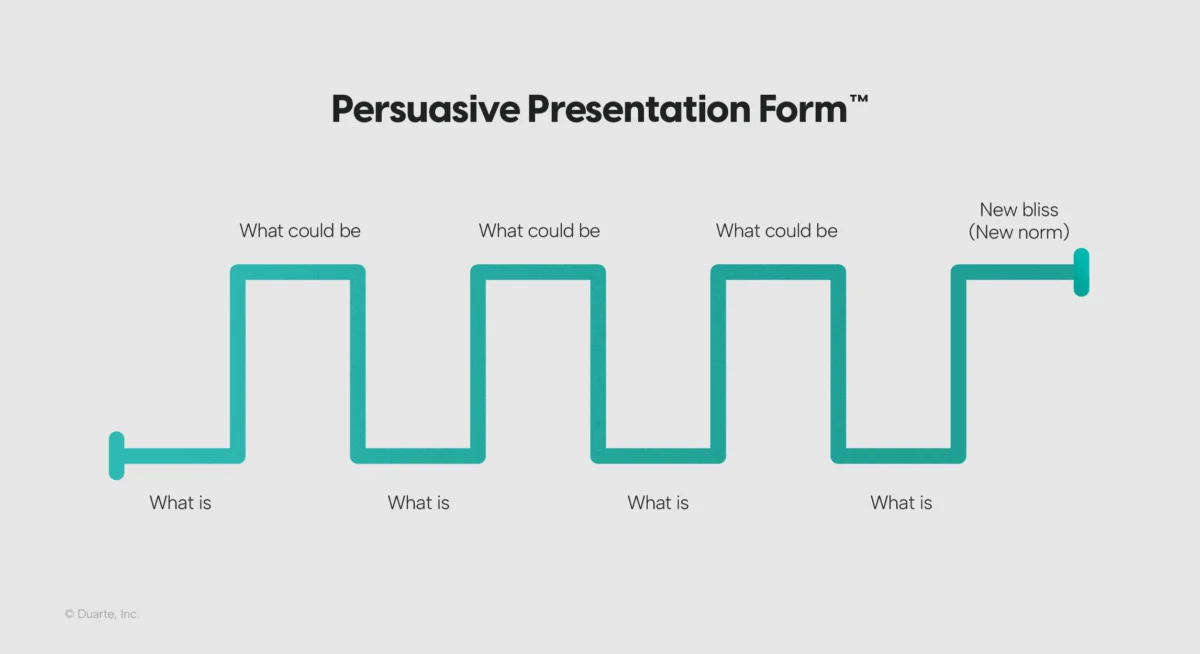
In business presentations, this principle is embodied by the "Presentation Sparkline" framework, which oscillates between "what is" (the current reality or problem) and "what could be" (the proposed solution or desired future state). Traditional reports tend to remain primarily in the "what is" realm, detailing current status without sufficient vision for change, often resulting in a dry, uninspiring delivery. Conversely, a typical sales pitch often jumps directly to "what could be," presenting an overly optimistic future without adequately addressing the current challenges, which can make the proposition seem unrealistic or lacking in empathy.
The Sparkline framework, however, intentionally weaves back and forth between these two states. It acknowledges the current pain points and challenges ("what is") while simultaneously offering glimpses of a superior future ("what could be"). This creates a rhythm of tension and release that mirrors the natural human problem-solving process and keeps the audience cognitively engaged. Nancy Duarte, a renowned communication expert, highlights this structure in her analysis of iconic speeches, noting that both Steve Jobs’ 2007 iPhone unveiling and Dr. Martin Luther King, Jr.’s "I Have a Dream" speech masterfully employed this oscillation. They presented the stark realities of their respective "what is" scenarios before painting vivid pictures of an attainable, transformative "what could be," thereby mobilizing their audiences to action. This strategic use of contrast is fundamental to maintaining audience attention and building a persuasive case.
Crafting Unforgettable Moments: The S.T.A.R. Moment Strategy
In an era of information overload, the human brain struggles to retain vast amounts of data. However, it is exceptionally adept at remembering specific, impactful moments. This understanding underpins the concept of a S.T.A.R. Moment™ – "Something They’ll Always Remember." The most effective storytelling presentations integrate these memorable instances, designed to crystallize key messages and create lasting impressions.
S.T.A.R. Moments are often visual, experiential, or emotionally resonant. They transform abstract data or concepts into concrete, relatable experiences. A prime example is from Al Gore’s climate change presentation, which inspired the documentary An Inconvenient Truth. Faced with the challenge of conveying the alarming projected rise in CO2 concentration over the next 50 years, Gore didn’t just display a chart. Instead, he dramatically illustrated the data by stepping into a scissor lift that physically rose alongside the projected CO2 levels, visually extending beyond the screen. This created a visceral, unforgettable experience that conveyed the magnitude of the problem far more effectively than any numerical graph alone could have.
Such moments are crucial because they bypass the purely rational processing of information and tap into emotional memory, which is significantly more robust. They provide a focal point for audience recall, allowing complex information to be anchored to a vivid, shared experience. Communication experts and psychologists confirm that emotional engagement significantly enhances memory encoding, making S.T.A.R. Moments powerful tools for impact and retention. For business leaders, creating such moments means thinking beyond slides and statistics, finding ways to make their message tangible, surprising, or deeply moving.
Integrating Data with Narrative: The Art of Data Storytelling

One of the most significant challenges in business communication is making data compelling. Raw data, while essential for credibility, rarely speaks for itself. It requires context, interpretation, and often, a narrative to imbue it with meaning and drive action. Data storytelling is the practice of transforming dry statistics into engaging narratives that resonate with the audience.
Presenters have several powerful options for data storytelling. They can "marvel at the magnitude" of a data point, highlighting its sheer scale or significance. They can "humanize the data" by connecting statistics to individual experiences or relatable scenarios, demonstrating the real-world impact behind the numbers. Crucially, they can "surprise the audience with the unexpected," using data to subvert assumptions or reveal a novel insight.
Steve Jobs’ 2008 MacBook Air reveal stands as a classic illustration of surprising the audience with the unexpected. Instead of simply stating the laptop’s slimmest point was 0.76 inches, a number that might not fully convey its revolutionary thinness, Jobs dramatically slid the device out of a standard manila office envelope. This simple, visual act instantly communicated the product’s groundbreaking design in a way that mere specifications could not. It leveraged a common, everyday object as an unexpected unit of measurement, creating a memorable moment that highlighted the data point’s significance through narrative context.
This approach demonstrates that data is most powerful when it is not just presented, but explained within a story arc. It moves beyond reporting numbers to illustrating their implications, fostering understanding and driving conviction. Effective data storytelling transforms abstract figures into tangible insights, making complex information accessible and persuasive for any audience.
Concluding with Vision: The "New Bliss" and Call to Action
Every effective story, particularly in a business context, requires a compelling resolution. This is not merely an ending but a vision of a transformed future, a "happily ever after" that is both desirable and attainable. In business storytelling, this is termed the "new bliss."
The new bliss represents the successful outcome for the audience, the hero, once they embrace the mentor’s solution. It articulates a clear, positive future state, directly addressing the problems and challenges outlined earlier in the narrative. This vision must be realistic and grounded in the solutions provided, offering a tangible path forward rather than an idealistic fantasy. It serves as the ultimate motivator, demonstrating the benefits of adopting the proposed idea, product, or strategy.
Communication strategists consistently emphasize that a strong conclusion is not just a summary; it is an imperative. It should leave the audience with a sense of hope, clarity, and purpose, reinforcing why they should act. By clearly articulating the "new bliss," presenters empower their audience to envision their own success and provide a definitive call to action that guides them towards achieving that desired future state. It transforms passive listening into active engagement, mobilizing individuals and teams towards a shared objective.
Broader Implications: Storytelling as a Core Organizational Competency
The mastery of storytelling in presentations extends far beyond individual speaking engagements; it is a fundamental organizational competency that shapes corporate culture, brand identity, and strategic alignment. When leaders consistently employ narrative techniques, it creates a cohesive internal narrative, fostering shared understanding, vision, and purpose across departments and hierarchies. This internal alignment is critical for navigating change initiatives, driving innovation, and cultivating a robust organizational identity.
Externally, effective storytelling is paramount for brand building and market differentiation. In a crowded marketplace, a compelling corporate story can distinguish a company from its competitors, forging deeper emotional connections with customers, investors, and partners. This resonates with C-suite executives who increasingly recognize that a strong narrative is not just about marketing, but about the very essence of their brand’s value proposition and its ability to attract and retain talent.
In conclusion, the integration of storytelling into business presentations is no longer a mere stylistic preference but a strategic imperative. It equips leaders with the tools to cut through noise, connect with audiences on a deeper level, and ultimately, drive tangible results. By understanding and applying principles such as the Hero’s Journey, strategic role-playing, the power of contrast, S.T.A.R. Moments, data storytelling, and the "new bliss" conclusion, organizations can transform their communication from informative to transformative, ensuring that every message not only informs but also inspires, persuades, and moves people to action. In the modern business landscape, the ability to tell the right story, the right way, at the right moment, is the defining characteristic of influential leadership and enduring success.
