

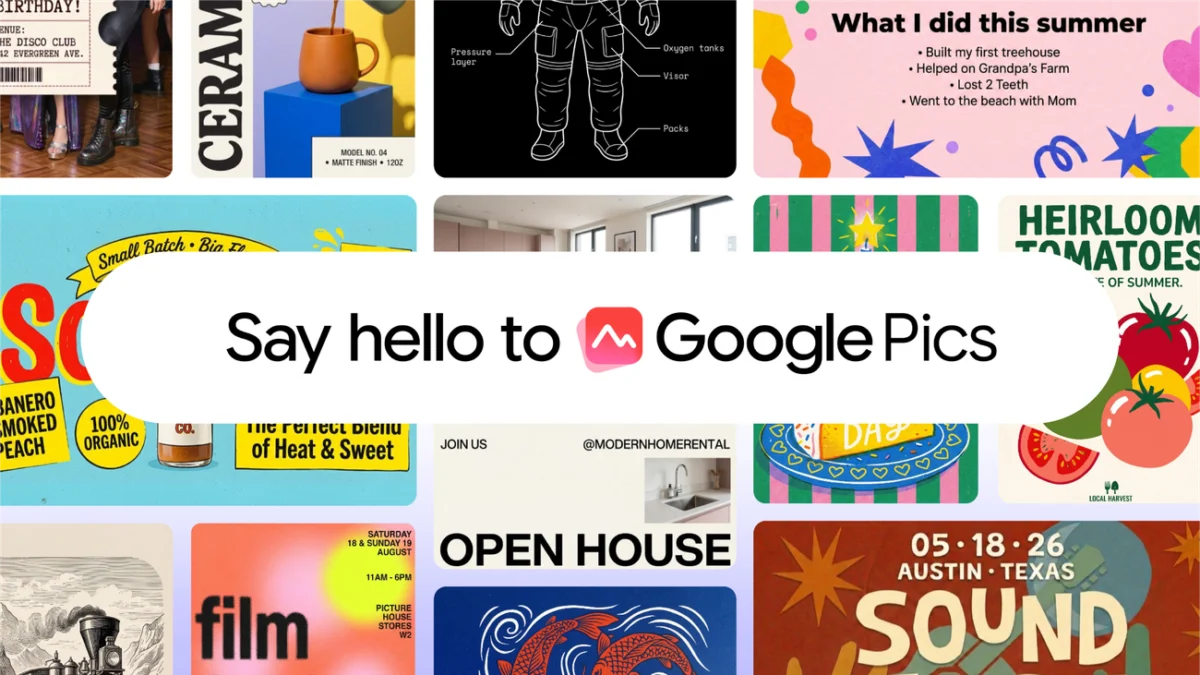
Google Cloud and Google Workspace have officially announced the rollout of Google Pics, a specialized image creation and editing tool designed to bring professional-grade generative artificial intelligence directly into the productivity ecosystem used by millions of businesses worldwide. This new utility, built on the advanced Nano Banana image generation and editing model, represents a significant shift in how visual content is produced within corporate environments. By integrating these capabilities directly into Google Docs, Google Slides, and eventually Google Drive, the company aims to eliminate the friction of switching between disparate creative applications and productivity suites. The rollout is scheduled to take place over the coming weeks, targeting Google AI Pro and Ultra subscribers, as well as the majority of Google Workspace business customers.
The introduction of Google Pics is not merely an incremental update but a strategic move to democratize high-fidelity graphic design. Led by Google Pics Product Manager Meg Whittenberger, the development team has focused on "unparalleled precision," allowing users to not only generate images from text prompts but to refine and co-create them through iterative editing. This functionality addresses a long-standing pain point for office workers who frequently require custom visuals for presentations, reports, and social media but lack the technical training for complex software like Adobe Photoshop or Illustrator.
A New Standard in Integrated Creative Workflows
The primary value proposition of Google Pics lies in its deep integration within the Google Workspace architecture. Historically, creating a visual for a slide deck involved a multi-step process: navigating to a stock photo site or a standalone AI generator, downloading the file, and then uploading it to the presentation. Google Pics streamlines this into a native experience. Users can now access image generation tools via a sidebar or contextual menu within Docs and Slides.
This integration is powered by the Nano Banana model, a name that suggests a highly efficient yet potent iteration of Google’s generative AI research. Unlike previous models that focused primarily on broad interpretations of text prompts, Nano Banana is optimized for "precise control." This means users can specify stylistic elements, adjust compositions, and perform localized edits—such as changing the color of a specific object or altering the lighting of a scene—without needing to regenerate the entire image from scratch.
The rollout follows a tiered strategy. Starting immediately, the functionality is being enabled within Google Docs and Google Slides for eligible users. In the subsequent weeks, the integration will extend to Google Drive, allowing users to drop existing files directly into Google Pics to generate brand concepts or product mockups. For those who prefer a dedicated environment, Google has also launched a standalone destination at pics.new, providing a clean interface for focused creative work.
Chronology of Google’s Generative AI Evolution
To understand the significance of Google Pics, one must view it within the broader timeline of Google’s investment in generative media. The journey began in earnest with the development of the Imagen models, which set early benchmarks for photorealism and linguistic understanding in AI. Following the integration of Gemini (formerly Bard) across the Google ecosystem, the demand for visual synthesis became apparent.
In early 2024, Google introduced "Help me visualize" features in Slides, which served as a precursor to the current Google Pics launch. While those early iterations allowed for basic image generation, user feedback indicated a need for greater granular control and the ability to edit existing assets. The development of the Nano Banana model was the response to this demand. Throughout the summer of 2024, Google conducted closed beta testing with select enterprise partners, refining the interface to ensure that the AI-driven tools felt like a natural extension of the Workspace UI rather than a bolted-on experiment.
The official launch in late 2024 marks the transition from experimental "Labs" features to a production-ready tool supported by enterprise-grade service level agreements (SLAs). This chronology reflects Google’s cautious but steady approach to AI deployment, prioritizing safety and utility over rapid, unvetted releases.
Technical Foundations and the Nano Banana Model
At the heart of Google Pics is the Nano Banana model. While technical specifics regarding parameter counts remain proprietary, the model is characterized by its ability to handle high-resolution outputs with a focus on "semantic consistency." This ensures that when a user asks for a modification—such as "make the sky more sunset-toned"—the rest of the image’s elements, like reflections and shadows, adjust accordingly to maintain a realistic look.
One of the standout features of the model is its "fine-tuned editing" suite. This includes:
- In-painting and Out-painting: Users can add new elements to an existing image or expand the canvas beyond its original borders, with the AI intelligently filling in the background.
- Style Transfer: The ability to apply the aesthetic of one image to another, ensuring brand consistency across different visual assets.
- Object Manipulation: A "click-and-change" interface where users can select specific parts of an image to modify, rather than relying solely on descriptive text prompts.
This technical shift from "prompt-only" generation to "direct manipulation" is what Google believes will set Pics apart from competitors. By providing a bridge between amateur prompt engineering and professional graphic design, Google is positioning itself as the primary tool for the "prosumer" market.
Supporting Data and Market Context
The launch of Google Pics comes at a time of intense competition in the generative AI space. Market data suggests that the demand for AI-driven creative tools is skyrocketing. According to industry reports, the global generative AI market is expected to grow at a compound annual growth rate (CAGR) of over 30% through 2030, with a significant portion of that growth driven by enterprise productivity tools.
Google Workspace currently boasts over 3 billion users, including more than 10 million paying customers. By embedding Google Pics into this ecosystem, Google is instantly providing sophisticated design tools to a massive, pre-existing user base. This moves the competitive needle against rivals like Microsoft, which has integrated DALL-E 3 into its Copilot and Designer apps, and Canva, which has rapidly expanded its "Magic Studio" suite.
Furthermore, internal Google data indicates that millions of users interact with billions of images across Workspace products every month. The efficiency gains of native integration are substantial; Google estimates that reducing the time spent switching between applications can save the average knowledge worker several hours per month, a metric that resonates strongly with IT decision-makers and C-suite executives looking to optimize operational costs.
Ethical Considerations and Safety Protocols
As with all of Google’s generative AI efforts, Google Pics is launched under a framework of responsible AI. One of the most critical components of this framework is the integration of SynthID, a digital watermarking technology developed by Google DeepMind. SynthID embeds a digital watermark directly into the pixels of images generated by Google Pics. This watermark is imperceptible to the human eye but can be detected by specialized software, allowing for the identification of AI-generated content and helping to mitigate the spread of misinformation.
Additionally, Google has implemented rigorous filters to prevent the generation of harmful, explicit, or copyright-infringing content. The Nano Banana model has been trained on diverse datasets to reduce algorithmic bias, ensuring that the images produced are representative and inclusive. For business customers, Google emphasizes that their data is protected; images generated within a corporate Workspace environment are not used to train the underlying models without explicit permission, adhering to strict enterprise privacy standards.
Industry Implications and Analyst Reactions
The reaction from industry analysts has been largely positive, though some note the challenges ahead. "Google is playing a game of ecosystem stickiness," says one senior tech analyst. "By making Docs and Slides a one-stop shop for both text and high-end imagery, they make it much harder for businesses to justify a subscription to a separate design platform."
However, the launch also raises questions about the future of the professional creative industry. As AI makes it easier for non-designers to produce high-quality visuals, the role of graphic designers may shift toward more complex, strategic brand work rather than routine asset creation. Critics of AI-generated art continue to voice concerns regarding the provenance of training data and the potential for the devaluation of human-made art, though Google maintains that its tools are designed to augment, not replace, human creativity.
From a technical standpoint, the "Nano" branding of the model suggests a focus on latency. In a business setting, users cannot afford to wait minutes for an image to generate. If Nano Banana can deliver high-quality results in seconds, it will likely see rapid adoption across marketing and communications departments.
Future Outlook and Expansion
Looking ahead, Google has signaled that the integration of Google Pics is just the beginning. While the initial focus is on Docs, Slides, and Drive, there is potential for expansion into other areas of the Workspace suite. For instance, Google Meet could eventually use Pics technology to generate dynamic, custom backgrounds in real-time, or Gmail could use it to help users design visually compelling newsletters.
The "co-create" aspect of the tool suggests a future where multiple users can edit an AI-generated image simultaneously, much like they do with text in a shared Google Doc. This collaborative approach to AI design could redefine how creative teams brainstorm and execute projects across different geographic locations.
As the rollout continues over the coming weeks, the tech industry will be watching closely to see how Google Pics performs in real-world scenarios. With a combination of precise editing controls, deep integration, and a focus on responsible AI, Google is making a concerted effort to lead the next era of workplace productivity. Users interested in exploring the tool can visit pics.new or look for the new image creation icons appearing in their Workspace applications starting today.
