

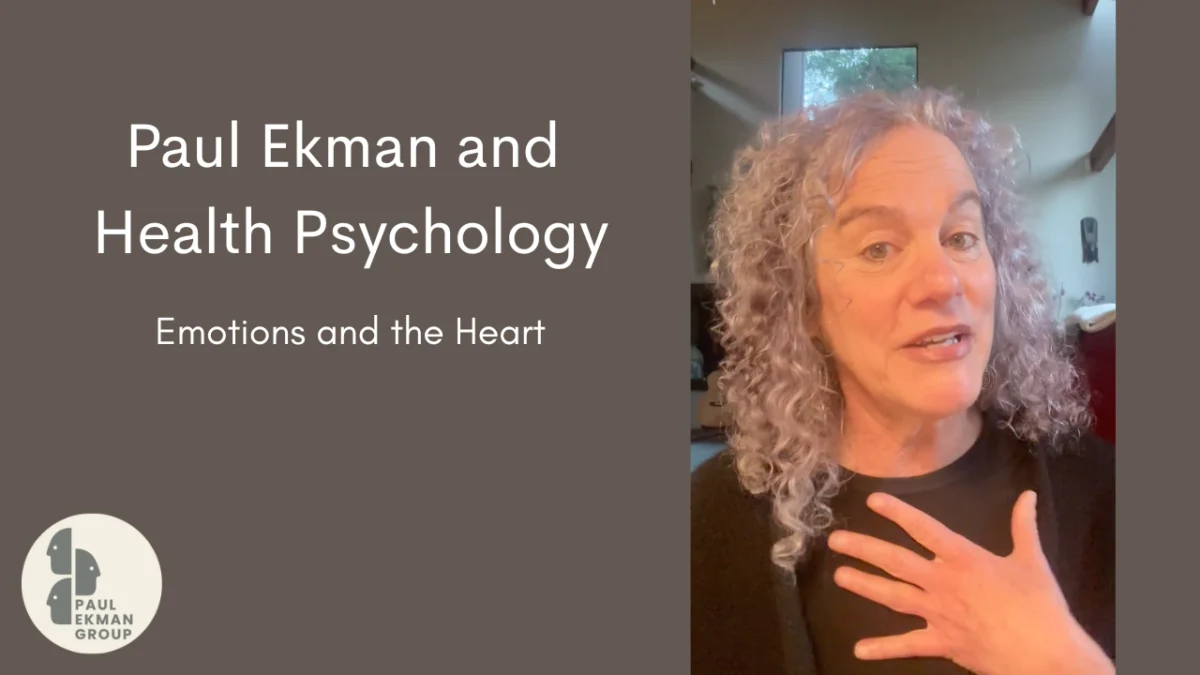
In the wake of Dr. Paul Ekman’s recent passing, the scientific community and the public have widely acknowledged his seminal contributions to the study of facial expressions, universal emotions, and the complex art of deception. However, a significant and profoundly impactful dimension of his illustrious career, particularly his pioneering work at the intersection of emotion and cardiovascular health, has yet to receive the broad recognition it merits. As illuminated by Dr. Erika Rosenberg, a distinguished student, collaborator, and close friend of Dr. Ekman for nearly four decades, this lesser-known facet of his legacy offers critical insights into the intricate connections between our emotional lives and our physical well-being, especially concerning heart disease.
Dr. Rosenberg’s association with Dr. Ekman commenced in 1988 when she joined his research group as a graduate student at the University of California, San Francisco. Over the ensuing 37 years, their professional relationship blossomed into a deep personal friendship, with Dr. Ekman becoming a pivotal mentor and one of the most influential figures in Dr. Rosenberg’s academic and personal journey. Reflecting on his extensive body of work, Dr. Rosenberg emphasizes how Dr. Ekman’s unparalleled expertise in deciphering facial expressions provided a crucial lens through which to advance research into the impact of emotion on cardiovascular health, a field that was only beginning to grasp the depth of this relationship.
Bridging the Gap: FACS and the Assessment of Cardiac Risk
Health psychology, a burgeoning field in the late 20th century, sought to understand the multifaceted interplay between psychological states, emotional experiences, and the onset, progression, and management of physical illnesses. During the late 1980s and early 1990s, Dr. Ekman’s research interests broadened to encompass the behavioral patterns associated with an elevated risk of coronary heart disease, specifically the concept of Type A behavior. While the correlation between Type A personality traits—characterized by competitiveness, time urgency, and hostility—and increased cardiovascular risk was a recognized phenomenon, the precise physiological mechanisms underlying this association remained largely elusive.
It was within this research landscape that Dr. Ekman, in collaboration with prominent researchers such as Dr. Margaret Chesney, ingeniously applied his groundbreaking Facial Action Coding System (FACS). FACS is a comprehensive system for anatomically describing all observable facial movements, each of which corresponds to a specific muscle action. By systematically analyzing video recordings of interviews with individuals identified as exhibiting Type A behavior, Dr. Ekman and his team were able to move beyond subjective assessments and quantify emotional expression with unprecedented precision.
This meticulous application of quantitative facial coding yielded a remarkable discovery: a consistent and distinguishable facial pattern that differentiated individuals at higher risk for coronary heart disease from their counterparts. This pattern, characterized by a "targeted hostile glare," manifested as lowered brows, a lifting of the upper eyelids, and a distinct tension in the lower eyelids. Crucially, this specific facial display was observed during interpersonal interactions and was directed at another individual, signaling a focused and potent form of hostility. This finding was revolutionary because it provided a tangible, observable, and measurable behavioral marker directly associated with cardiac risk. It offered a more objective and repeatable method for assessing health risks, supplementing and even surpassing the limitations of self-reported questionnaires, which are often subject to recall bias and social desirability.
The Visual Language of the Heart: Connecting Facial Emotion to Cardiac Events
The implications of this discovery were profound. As Dr. Rosenberg articulated, "This was the first time anyone had been able to link specific emotions to deleterious cardiac events—showing how what we express on our faces can be directly connected to what’s happening in the heart." This statement underscores the paradigm shift that Dr. Ekman’s work initiated, moving the understanding of heart disease from a purely physiological model to one that explicitly incorporated the impact of observable emotional expression.
Building upon this foundational research, Dr. Rosenberg embarked on her doctoral studies, undertaking a significant collaborative project with Dr. Ekman and a team of researchers at Duke University. This ambitious endeavor aimed to delve deeper into the physiological underpinnings of the observed emotional-cardiac link by employing advanced cardiac imaging techniques. The research focused on a particularly insidious condition known as silent transient myocardial ischemia. This condition involves episodes where the heart’s blood flow is restricted, leading to impaired heart muscle function, yet without the overt, recognizable symptoms typically associated with a heart attack, such as chest pain. While these events might go unnoticed by the individual, they are clinically significant, serving as well-established predictors of future cardiac morbidity and mortality.
During structured, provocative interviews designed to elicit a range of emotional responses from participants, the researchers employed a dual-pronged approach. They simultaneously recorded participants’ facial expressions using FACS and monitored their cardiac activity through state-of-the-art imaging. This groundbreaking methodology allowed for the direct correlation of subtle facial micro-expressions with critical physiological events occurring within the heart. The findings were nothing short of extraordinary: moments when the heart exhibited signs of ischemia—as evidenced by measurable changes in left ventricular function and cardiac wall motion—were consistently and unequivocally linked to facial expressions of anger. For the very first time, researchers possessed empirical evidence that directly connected a specific emotion, visibly expressed on an individual’s face, with harmful physiological events occurring within the cardiovascular system.
A Lasting Impact on Science, Medicine, and Public Health
This body of research, spearheaded by Dr. Ekman and further elucidated by Dr. Rosenberg’s doctoral work, represented a pivotal moment in the evolution of health psychology. It definitively demonstrated that emotional expressions, particularly the nuanced display of anger, are not merely subjective psychological experiences. Instead, they are intimately interwoven with complex physiological processes that can demonstrably influence the progression of disease and contribute to an individual’s risk of mortality. This insight has far-reaching implications for how we understand, diagnose, and potentially treat cardiovascular conditions.
As Dr. Rosenberg reflects on this critical, yet often overlooked, segment of Dr. Ekman’s career, she highlights its profound importance. This research exemplifies Dr. Ekman’s unique genius in transcending disciplinary boundaries, fostering a more holistic understanding of human experience. His work revealed how emotions shape not only our internal lives but also, and with significant consequence, our physical health and ultimately, our longevity. The ability to quantify and link specific emotional expressions to tangible physiological risks provided a powerful new tool for both clinical assessment and public health interventions.
The legacy of Paul Ekman’s contributions to health psychology continues to resonate powerfully within the scientific community. The rigorous methodologies he pioneered, particularly the application of FACS in clinical research, have paved the way for future investigations into the psychosomatic aspects of various diseases. The students he mentored, like Dr. Rosenberg, are now carrying forward this vital research, expanding our knowledge and developing new strategies for promoting well-being. Ultimately, the lives potentially improved and saved through a clearer, empirically supported understanding of the intricate and vital link between emotional states and physical health stand as a testament to Paul Ekman’s enduring and invaluable impact. His work serves as a crucial reminder that our minds and bodies are inextricably connected, and that understanding the language of our emotions is paramount to safeguarding our physical health.
