

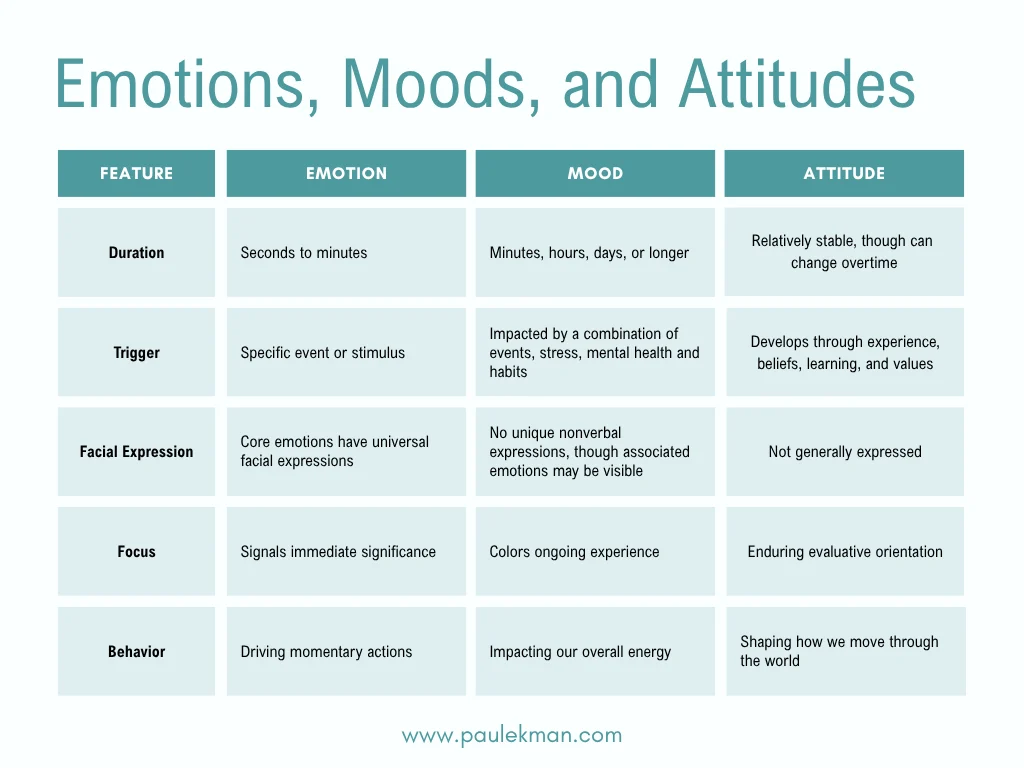
Building upon a foundational understanding of the distinctions between moods and emotions, this comprehensive exploration delves into the intricate interplay of these internal states with a third crucial psychological construct: attitudes. Together, emotions, moods, and attitudes profoundly shape our perception of ourselves and the external world. However, they operate across different temporal scales and fulfill distinct psychological functions. A deeper comprehension of their interactions is paramount for cultivating enhanced emotional awareness, refining emotional regulation strategies, and gaining clearer insights into our ingrained patterns of thought and behavior. This expanded perspective offers valuable tools for navigating the complexities of human experience with greater clarity and efficacy.
The Ephemeral Nature of Emotions
Emotions are characterized as automatic appraisal processes, deeply influenced by both our evolutionary heritage and the cumulative sum of our personal life experiences. They are typically triggered when a significant event or stimulus arises in relation to our overarching goals, fundamental needs, or overall well-being. This activation initiates a cascade of coordinated psychological and physiological responses designed to prepare us for action. By their very definition, emotions are relatively brief, their duration often ranging from fractions of a second to a few minutes. This immediacy is reflected in the observable physiological changes that accompany them, encompassing shifts in autonomic nervous system activity and distinct facial expressions. These physical manifestations are not merely coincidental; they serve a crucial adaptive purpose, enabling rapid and effective responses to situations deemed most important in the immediate moment. For instance, the sudden appearance of a threat might elicit a rapid fear response, characterized by increased heart rate, dilated pupils, and a specific facial configuration designed to signal danger and initiate a fight-or-flight reaction. Conversely, encountering a beloved individual could trigger a positive emotion like joy, leading to smiling, increased energy, and a feeling of connection. The intensity and duration of these emotional experiences are highly variable, influenced by individual differences, the perceived significance of the stimulus, and the individual’s current state. Research in affective neuroscience has identified distinct neural pathways associated with different emotion categories, further underscoring their biological underpinnings and rapid response mechanisms.
The Enduring Influence of Moods
In stark contrast to the fleeting nature of emotions, moods are characterized by their sustained duration. Moods represent more diffuse affective states that can persist for hours, days, or even extended periods. A key distinguishing factor is that moods often lack a clearly identifiable trigger or a specific object of focus. Unlike an emotion that is a reaction to something, a mood can simply emerge, a pervasive backdrop that colors our entire experience. One might wake up in a particular mood, or find oneself gradually slipping into one without a discernible external cause. This pervasive quality means that moods do not typically elicit the distinct and recognizable facial expressions associated with many emotions. However, subtler physiological indicators may be observable, such as changes in muscle tension, posture, or overall energy levels. For example, a person in a generally low mood might exhibit slumped shoulders and a lack of animation, even when not experiencing a specific negative emotion. Instead of responding to a singular event, moods create an overarching emotional climate. This climate can significantly influence the ease with which specific emotions are triggered. An irritable mood, for instance, can lower the threshold for frustration, making minor inconveniences feel disproportionately irritating. Conversely, a cheerful mood can make individuals more resilient to negative experiences and more inclined to interpret ambiguous situations in a positive light. This pervasive influence extends to how we interpret events, engage in social interactions, and even the nature of our internal monologue throughout the day. Studies have indicated that prolonged exposure to stress can contribute to the development of negative mood states, highlighting the cumulative impact of experiences on our affective equilibrium.
The Evaluative Framework of Attitudes
Moving beyond immediate affective states, attitudes represent a distinct psychological construct. Unlike emotions or moods, attitudes are not fleeting emotional experiences themselves. Instead, they are defined as relatively enduring evaluations of people, ideas, objects, behaviors, or experiences. Psychologists commonly conceptualize attitudes as comprising a multifaceted interplay of three core components: beliefs, emotional associations, and behavioral tendencies. This framework is often referred to as the ABC model of attitudes:
- Affective Component: This refers to the emotional responses or feelings associated with the attitude object. For example, a positive attitude toward environmental protection might involve feelings of care and concern for the planet.
- Behavioral Component: This encompasses the predisposition to act in a certain way toward the attitude object. If someone has a positive attitude towards exercise, they are likely to engage in regular physical activity.
- Cognitive Component: This involves the beliefs, thoughts, and knowledge one holds about the attitude object. For instance, believing that regular exercise improves health is a cognitive component of a positive attitude toward physical activity.
Attitudes can also be further categorized as explicit (those we are consciously aware of and can readily report) or implicit (those that operate unconsciously but still exert influence on our thoughts and behaviors). For instance, an explicit attitude toward public speaking might be a conscious acknowledgment that it is a valuable skill. However, an implicit attitude, stemming from past negative experiences, might involve an unconscious aversion to speaking in front of groups, leading to subtle avoidance behaviors even if the conscious attitude is positive. The example of public speaking further illustrates the interconnectedness of these components: a positive attitude might include the belief that it’s an important skill, a positive emotional association with successful past presentations, and a behavioral tendency to seek out speaking opportunities. Conversely, a negative attitude might involve the belief that it’s a daunting task, negative emotional memories of embarrassment, and a behavioral tendency to avoid it at all costs. While attitudes are generally more stable and resistant to change than emotions or moods, they are not immutable. They are dynamic constructs that evolve over time through a variety of learning processes, including classical and operant conditioning, the assimilation of social and cultural norms, interpersonal relationships, and deliberate personal reflection. New experiences, particularly those that are emotionally charged or repeated, can serve to strengthen, weaken, or gradually reshape existing attitudes. Crucially, unlike moods, attitudes are always directed toward a specific target. We possess attitudes toward individuals, inanimate objects, societal policies, significant events, and even our own internal emotional experiences. Because attitudes act as a guiding framework, influencing how we interpret incoming information and how we are predisposed to respond, they function as a powerful evaluative lens through which we perceive and engage with the world around us. Research in social psychology has demonstrated the significant predictive power of attitudes on consumer behavior, political choices, and intergroup relations, underscoring their pervasive impact.
The Dynamic Interplay of Internal States
Despite their distinct characteristics, emotions, moods, and attitudes are in constant dialogue, influencing and shaping one another in a dynamic and continuous process.
When Moods Influence Emotional Reactivity
Our prevailing mood significantly impacts the likelihood of experiencing specific emotions and the intensity with which we perceive them. Consider an individual in an upbeat, positive mood. They might find it easier to recover from a moment of frustration, bouncing back quickly with minimal lingering negative affect. In contrast, someone in an irritable or anxious mood may react with heightened intensity to minor setbacks, experiencing a disproportionate level of distress. This suggests that moods act as a sort of emotional amplifier or dampener, modulating our responses to external stimuli. Furthermore, a series of distinct, short-lived emotions, such as recurring instances of worry or frustration over a period, can coalesce into a more prolonged and pervasive post-condition, manifesting as an ongoing anxious or irritable mood. This highlights a feedback loop where acute emotional experiences can contribute to the formation and maintenance of chronic mood states. Scientific literature on affective neuroscience has explored the neural mechanisms underlying this interplay, suggesting that neurotransmitter systems like serotonin and dopamine play crucial roles in regulating both mood and emotional reactivity. For instance, dysregulation in these systems has been linked to increased susceptibility to negative moods and heightened emotional lability.
Attitudes as a Filter for Emotional Experience
Attitudes exert a profound influence on our emotional lives, simultaneously shaping and being shaped by our affective experiences. Imagine two individuals encountering the same piece of constructive feedback. One individual may hold a deeply ingrained attitude that views feedback as a valuable opportunity for personal growth and development, leading them to feel a sense of anticipation or even excitement. The other individual, perhaps harboring an attitude that perceives feedback as a personal threat or criticism, might experience anxiety, defensiveness, or annoyance. In this scenario, the external situation is identical, yet their pre-existing attitudes profoundly alter their interpretation of the event, thereby dictating the specific emotions they subsequently experience. This demonstrates that attitudes act as a cognitive and affective filter, predisposing us to certain emotional responses based on our prior evaluations. Research on cognitive dissonance theory, for example, explores how individuals strive for consistency between their attitudes and behaviors, often leading to emotional discomfort when these elements are in conflict. This discomfort, in turn, can prompt a re-evaluation or modification of existing attitudes.
The Impact of Attitudes Toward Emotions
A particularly significant and often overlooked type of attitude is our attitude toward emotions themselves. These are deeply held beliefs and evaluations about the nature and appropriateness of various emotional states. We might develop attitudes such as believing that anger is inherently dangerous, sadness signifies weakness, fear is something to be suppressed, or that joy should always be openly expressed. These deeply ingrained evaluations are typically forged over many years, shaped by formative family experiences, prevailing cultural norms, educational influences, and our unique personal histories. Our attitudes toward emotions directly influence our willingness and capacity to notice, accept, express, and learn from our emotional experiences. For example, an individual with a negative attitude toward sadness may actively avoid confronting their feelings of grief, potentially hindering their ability to process loss effectively. These attitudes are also intimately connected to the concept of "display rules," which are culturally learned norms dictating how, when, and to whom it is appropriate to express certain emotions. While certain facial expressions of emotion are considered universal and biologically innate—a testament to shared human evolutionary heritage—the rules governing their expression are often highly variable across cultures. This variability in display rules can account for significant differences in how emotions are outwardly manifested and perceived worldwide. For instance, in some cultures, overt displays of grief may be expected and encouraged, while in others, a more stoic and reserved demeanor is the norm. Understanding these cultural nuances is critical for effective cross-cultural communication and empathy.
Cultivating Enhanced Emotional Awareness
At the Paul Ekman Group, we firmly believe that the journey toward enhanced emotional awareness commences with the cultivation of the ability to observe our internal experiences with heightened clarity and an open, curious mindset. By consciously recognizing our emotions, understanding the pervasive influence of the moods that shape them, and developing a keen awareness of the attitudes that color our interpretations, we equip ourselves to respond to ourselves and to others with greater wisdom, compassion, and effectiveness. The development of these invaluable skills is not an instantaneous achievement; it is a process that requires consistent practice and can be progressively strengthened over time through deliberate effort. For those seeking to deepen their understanding of the science of emotion and to further cultivate their emotional awareness, the Paul Ekman Group offers a curated selection of resources grounded in rigorous scientific research. These resources are designed to provide practical tools and insights for navigating the complexities of the human emotional landscape.
