


The roar of the crowd, the intense focus of athletes, and the dramatic shifts in fortune – these are the hallmarks of professional golf’s major championships and prestigious PGA Tour events. For many, these tournaments are a captivating spectacle, offering a window into the highest levels of athletic performance and strategy. This past Sunday, the final round of the BMW Championship provided a compelling case study, not just in golfing prowess, but in the subtle, yet powerful, influence of human psychology. Wyndham Clark, who began the day with a commanding five-shot lead, saw his advantage dwindle on the back nine. However, a combination of strategic play, key putts, and a three-birdie finish secured him a hard-fought victory, a triumph that echoes deeper psychological research into decision-making under pressure.
The BMW Championship: A Dramatic Final Round
The BMW Championship, a critical stop on the FedEx Cup Playoffs, consistently draws the top talent in professional golf. This year’s event, held at Olympia Fields Country Club in Illinois, proved no exception, culminating in a thrilling finale. Wyndham Clark, a relatively recent emergence on the PGA Tour, showcased remarkable composure throughout the tournament. His substantial lead entering Sunday’s final round suggested a comfortable victory. However, the unpredictable nature of golf, amplified by the immense pressure of a championship, soon came into play.
As the broadcast followed Clark and his closest competitors, the narrative shifted. The five-stroke cushion began to erode. The front nine saw a tightening of the leaderboard, with rivals making strategic gains. The back nine, often the stage for dramatic turnarounds, did not disappoint. Mistakes from those in pursuit, coupled with a clutch performance from Clark, particularly a string of three consecutive birdies down the stretch, ultimately sealed his win by a margin of three strokes. This dramatic swing in momentum, from near certainty to nail-biting tension, served as a potent reminder of the mental fortitude required at this elite level.
Unpacking the Putt: A Tale of Two Strokes
The drama on the course naturally brought to mind fascinating research that delves into the psychological underpinnings of performance, particularly concerning putting. A seminal study published in 2011 by researchers Devin Pope and Maurice Schweitzer, titled "Is Tiger Woods Loss Averse? Persistent Bias in the Face of Experience, Competition, and High Stakes," analyzed an astonishing dataset. Leveraging the precise measurements provided by ShotLink, the PGA Tour’s real-time scoring system, their research encompassed over 2.5 million putts taken by 421 professional golfers across a five-year period (2004-2009).
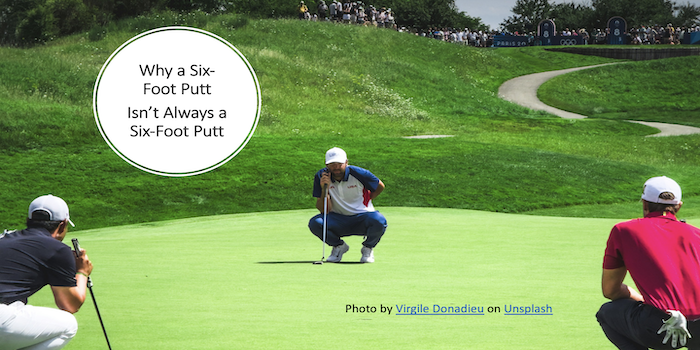
The findings of Pope and Schweitzer were illuminating and counterintuitive to the notion of pure skill. They discovered that professional golfers were, on average, 2 to 4 percentage points more likely to successfully make a putt for par than for birdie, even when the putts were of the exact same distance and under comparable conditions. This statistical anomaly, occurring among athletes who dedicate their lives to mastering every facet of the game, points to a significant psychological factor at play.
The Principle of Loss Aversion
The explanation for this phenomenon lies in the well-documented psychological principle of loss aversion. Behavioral scientists Daniel Kahneman and Amos Tversky, pioneers in prospect theory, famously demonstrated that the psychological impact of a loss is significantly greater than the psychological impact of an equivalent gain. In simpler terms, people tend to feel the pain of losing something more acutely than they feel the pleasure of gaining something of equal value.
In the context of golf, this principle manifests in the golfer’s perception of the putt. When standing over a birdie putt, the golfer is presented with an opportunity to gain a stroke relative to par. While a successful putt results in a better score, the immediate consequence of missing it, assuming the subsequent putt is made, is simply achieving par. The golfer still retains the score of par.
However, when standing over a par putt, the psychological landscape shifts. The objective is to maintain the current score relative to par. Missing this putt results in a loss – a stroke is added to the scorecard, moving the golfer further away from their target. Even though, on paper, every stroke carries the same weight on the scorecard, the immediate emotional and psychological experience of standing over a putt for birdie versus a putt for par is demonstrably different for these athletes. This subtle, yet profound, psychological difference appears to influence the performance of even the most skilled golfers in the world.
Shifting Pressures: From Par to Position
Interestingly, Pope and Schweitzer’s research also revealed a dynamic aspect to this loss aversion bias. They observed that the differential in putting success between par and birdie putts decreased as the tournament progressed. In the first round, the difference was approximately 3.8 percentage points, a figure that reduced to 2.1 percentage points in the final round. However, the phenomenon never entirely disappeared, even under the highest pressure.
The researchers attributed this decline in the bias to a shift in a golfer’s psychological focus. In the earlier rounds, golfers are primarily concerned with their score relative to par for the course. As the tournament progresses into the final round, and especially as the leaderboard tightens, their focus increasingly shifts to their position relative to the other competitors. The desire to avoid losing ground to rivals on the leaderboard becomes a more potent motivator than the immediate concern of securing a birdie versus par. This competitive drive, while still rooted in avoiding negative outcomes, recalibrates the golfer’s immediate psychological priorities.
Broader Implications: Scarcity Beyond the Sales Pitch
The implications of this research extend far beyond the golf course. It highlights a fundamental aspect of human decision-making that influences our choices in countless everyday situations. Scarcity, a principle often leveraged in sales and marketing, is not always about a salesperson proclaiming, "Only two left!" or a website flashing, "Sale ends at midnight!"
Sometimes, scarcity is far more subtle. It can be the mere possibility of losing something one already possesses or has the potential to attain. A golfer’s intense desire to avoid dropping a stroke on a par putt, or to secure a crucial birdie, is driven by the fear of that loss. This fear can often exert a stronger influence on behavior than the prospect of an equivalent gain.
This understanding has significant implications for ethical influence. The goal is not to manipulate individuals by exploiting their fear of loss. Instead, it is about recognizing how people naturally make decisions and then communicating relevant information truthfully and effectively. By understanding the power of loss aversion, individuals and organizations can frame messages and opportunities in a way that resonates more deeply, while still upholding principles of honesty and integrity.
The Everyday Decision: Gain or Loss?
The takeaway for individuals facing important decisions is to engage in self-reflection. The next time you find yourself making a significant choice, pause and consider the underlying motivation. Are you genuinely pursuing something you desire for its inherent value, or are you reacting more strongly due to an ingrained fear of losing something? This distinction can be critical.
For instance, consider a career move. Are you excited by the prospect of new challenges and growth, or are you primarily driven by the fear of remaining stagnant in your current role? In personal finance, are you investing for long-term growth and security, or are you making impulsive decisions driven by the fear of missing out on a fleeting opportunity?
Recognizing this psychological tendency can empower you to make more deliberate and rational choices, aligning your actions with your genuine long-term goals rather than being swayed by the immediate emotional weight of potential loss.
A Question for Golfers
For those who play the game, the question remains: does this psychological phenomenon resonate with your personal experience on the course? Do you feel a distinct difference in pressure or focus when standing over a six-foot putt intended for birdie versus a six-foot putt for par? The subtle nuances of the game, played out on meticulously manicured fairways and greens, often reveal profound truths about the human psyche. The next time you watch a golf tournament, or perhaps even when you step onto the course yourself, consider the invisible force of loss aversion at play, influencing the swings, the putts, and ultimately, the outcomes.
The research by Pope and Schweitzer, originating from a deep dive into the data of professional golf, offers a valuable lens through which to view decision-making in a much broader context. It underscores that even in environments demanding peak performance, rigorous training, and immense focus, fundamental human psychological principles continue to shape outcomes. The ability to recognize and understand these principles, whether on the PGA Tour or in everyday life, is a key component of making more effective and intentional decisions.
