

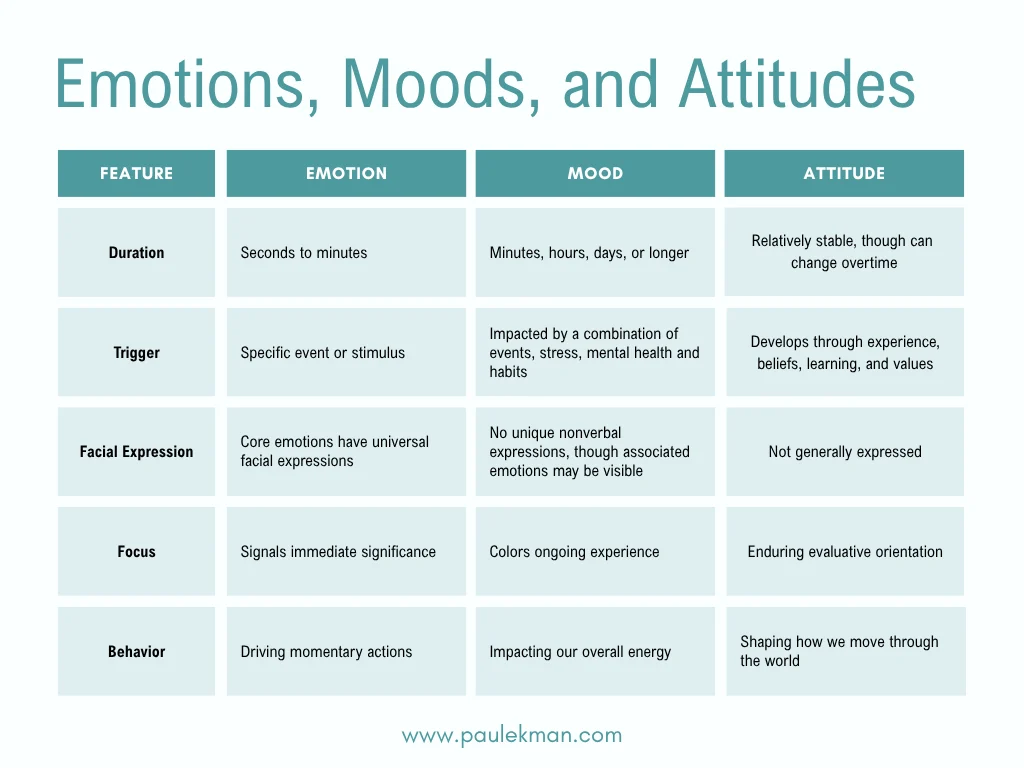
Building on previous explorations into the distinct yet interconnected nature of moods and emotions, this expanded discourse delves into the multifaceted concept of attitudes, illuminating how these three psychological constructs intricately shape our perception of ourselves and the world. While emotions, moods, and attitudes all profoundly influence our subjective experiences, they operate on differing temporal scales and fulfill unique psychological functions. A comprehensive understanding of their interplay is paramount for cultivating deeper emotional awareness, enhancing emotional regulation, and gaining a more profound insight into our ingrained patterns of thought and behavior. This article aims to provide a detailed examination of each concept, their interactions, and their implications for personal and interpersonal well-being, drawing on established psychological frameworks and research.
The Ephemeral Power of Emotions
Emotions, at their core, represent an automatic appraisal process, a sophisticated internal mechanism influenced by both our evolutionary heritage and the cumulative sum of our personal experiences. They are triggered when an event, internal or external, holds significant relevance to our goals, needs, or overall well-being. This relevance initiates a cascade of coordinated psychological and physiological changes designed to prepare us for action. By definition, emotions are relatively transient phenomena, typically lasting from fractions of a second to a few minutes. This brevity is crucial, as it allows for rapid adaptation to evolving circumstances.
Physiologically, emotions manifest through a complex interplay of bodily responses. This includes alterations in autonomic nervous system activity, such as changes in heart rate, respiration, and perspiration, which are demonstrably distinguishable among various emotional states. Furthermore, emotions are often accompanied by distinct facial expressions, a subject extensively researched by pioneers like Paul Ekman, who identified a set of universal facial expressions corresponding to fundamental human emotions such as joy, sadness, anger, fear, surprise, and disgust. These expressions are not merely outward displays but serve as critical communicative signals, both to ourselves and to others, conveying our internal state and readiness to respond to stimuli that demand our immediate attention. For instance, the widening of the eyes and parting of the lips in surprise signal an unexpected event requiring rapid assessment, while a furrowed brow and tightened jaw in anger prepare the body for confrontation or defense.
The Pervasive Influence of Moods
In stark contrast to the fleeting nature of emotions, moods are characterized by their sustained presence, representing more diffuse affective states that can endure for hours, days, or even longer. Unlike discrete emotions, moods often lack a clearly identifiable trigger or specific object of focus. It is not uncommon to awaken in a particular mood or to find oneself gradually descending into one without a discernible external cause. This inherent ambiguity distinguishes moods from emotions, making them more akin to an ambient emotional climate rather than a direct reaction to a singular event.
While moods may not elicit the pronounced facial expressions associated with many emotions, subtle physiological indicators such as increased muscle tension, altered posture, or noticeable shifts in energy levels can often be observed. These subtle cues can influence how others perceive us, even if the underlying cause remains unarticulated. Rather than serving as a direct response to a specific situation, moods act as an pervasive emotional backdrop that colors our entire experience. They exert a significant influence on the ease with which certain emotions are triggered, effectively lowering or raising our emotional threshold. Moreover, moods can profoundly shape our interpretation of everyday events, social interactions, and even our internal monologues, leading to a pervasive sense of optimism, pessimism, irritability, or contentment that colors our perception throughout the day. Research in affective neuroscience has shown that prolonged exposure to stressors can lead to persistent changes in neurotransmitter levels, contributing to the development and maintenance of negative mood states, a phenomenon that underscores the biological underpinnings of these enduring affective experiences.
The Enduring Framework of Attitudes
Attitudes, unlike emotions or moods, are not transient emotional states themselves. Instead, they are defined as relatively enduring evaluations of people, ideas, objects, behaviors, or experiences. Psychologists generally conceptualize attitudes as comprising a tripartite structure, often referred to as the ABC model of attitudes: Affect (emotional associations), Behavior (behavioral tendencies), and Cognition (beliefs). This framework posits that an attitude is a complex interplay of how we feel about something (affect), how we tend to act towards it (behavior), and what we believe about it (cognition).
For instance, an individual’s attitude towards public speaking might encompass a belief that it is an important skill for career advancement (cognition), a lingering feeling of embarrassment from a past presentation (affect), and a tendency to either actively seek out or vehemently avoid opportunities to speak in front of groups (behavior). Attitudes can be further categorized as explicit, meaning they are consciously held and readily accessible to our awareness, or implicit, operating at an unconscious level but still exerting a significant influence on our thoughts, feelings, and actions. Implicit biases, a well-documented form of implicit attitude, have been shown to significantly impact decision-making in areas ranging from hiring practices to judicial sentencing, highlighting their profound real-world consequences.
While attitudes are generally more stable and resistant to change than emotions or moods, they are not immutable. They are dynamic constructs that develop and evolve over time through a confluence of factors. Repeated emotional experiences, learning processes such as classical and operant conditioning, the pervasive influence of social and cultural norms, interpersonal relationships, and introspective reflection all contribute to the formation and modification of attitudes. New experiences can serve to reinforce existing attitudes, gradually weaken them, or even lead to their substantial reshaping. This plasticity is crucial, as it allows individuals to adapt their evaluations in light of new information and evolving life circumstances. Crucially, attitudes are always directed toward a specific target. We can hold attitudes towards individuals, inanimate objects, public policies, significant events, or even towards our own emotional responses. Because attitudes function as an evaluative lens, they significantly influence how we interpret new information and how we tend to respond to various stimuli, thereby shaping our overall experience of the world.
The Interwoven Tapestry of Influence
Despite their distinct conceptualizations, emotions, moods, and attitudes are in constant and dynamic interaction, forming an intricate tapestry that defines our psychological landscape.
When Mood Meets Emotion
Our prevailing mood significantly influences the likelihood and intensity of specific emotions that arise. An individual experiencing an upbeat mood may find themselves recovering more rapidly from minor frustrations, their positive affective state acting as a buffer against negative emotional spillover. Conversely, someone in an irritable mood may exhibit heightened reactivity to minor setbacks, minor annoyances potentially escalating into disproportionately strong emotional responses. This interaction is not always unidirectional; a series of intense, short-lived emotions, such as periods of worry or frustration, can coalesce and contribute to the development of a more prolonged post-condition, manifesting as an anxious or irritable mood. Research utilizing experience sampling methods, where individuals report their affective states at multiple points throughout the day, has consistently demonstrated this interplay, revealing how fluctuations in immediate emotional experiences can contribute to sustained shifts in overall mood.
Attitudes as the Evaluative Framework
Attitudes play a dual role, both shaping and being shaped by our emotional lives. Consider two individuals receiving the same constructive criticism. One, holding an attitude that views feedback as a valuable opportunity for growth and learning, might feel a sense of anticipation and even excitement. The other, harboring an attitude that perceives feedback as a personal threat or an indictment of their capabilities, may experience anxiety and annoyance. The objective situation remains identical, yet their pre-existing attitudes dictate their subjective evaluation and, consequently, the emotions they experience. This dynamic illustrates how attitudes act as cognitive filters, predisposing us to interpret events in a particular manner, thereby eliciting corresponding emotional responses. Furthermore, repeated emotional experiences related to a particular attitude object can reinforce or alter the attitude itself. For example, consistently positive emotional experiences associated with a particular brand might strengthen a favorable attitude towards that brand.
Attitudes Towards Emotions Themselves
A particularly significant and often overlooked aspect of attitudes is our attitudinal orientation towards emotions themselves. We may develop beliefs and evaluations that categorize certain emotions as "good" or "bad," "acceptable" or "unacceptable." For instance, one might believe that anger is inherently dangerous, sadness signifies weakness, fear should always be suppressed, or that joy is a state that should be universally shared. These attitudes are not innate but are typically cultivated over years through a complex interplay of family dynamics, cultural conditioning, educational experiences, and personal history. Our attitudes towards emotions profoundly influence our willingness and ability to recognize, accept, express, and learn from our internal states. This is closely linked to the concept of "display rules," the culturally learned norms that dictate when, where, and how it is appropriate to express emotions. While certain facial expressions of emotion are considered universal, reflecting shared biological underpinnings, display rules often vary significantly across cultures. These cultural variations in display rules can lead to observable differences in how emotions are expressed globally, even when the underlying emotional experience might be similar. For example, cultures that emphasize stoicism might discourage the open expression of sadness, leading individuals to internalize their distress, potentially impacting their mental well-being.
Cultivating Emotional Awareness: A Path Forward
At the Paul Ekman Group, we hold a foundational belief that the journey toward heightened emotional awareness commences with the cultivation of the ability to observe one’s internal experiences with a heightened degree of clarity and an inquisitive spirit. By diligently recognizing our emotions as they arise, understanding the pervasive influence of the moods that subtly shape our affective landscape, and becoming acutely aware of the attitudes that color our interpretations of the world, we empower ourselves to respond to both ourselves and others with greater wisdom, empathy, and compassion.
The development of these crucial psychological skills is not an instantaneous achievement but rather a process that requires consistent practice and dedication. Like any skill, they can be progressively strengthened and refined over time. For individuals seeking to deepen their understanding of the intricate science of emotion and enhance their emotional intelligence, the Paul Ekman Group offers a range of research-based resources, meticulously designed to foster these essential capabilities. These resources often delve into the empirical findings that underpin our understanding of emotions, moods, and attitudes, providing practical tools and frameworks for self-exploration and personal growth. Engaging with such resources can equip individuals with the knowledge and techniques necessary to navigate the complexities of their inner lives more effectively, leading to more fulfilling and resilient psychological well-being.
