

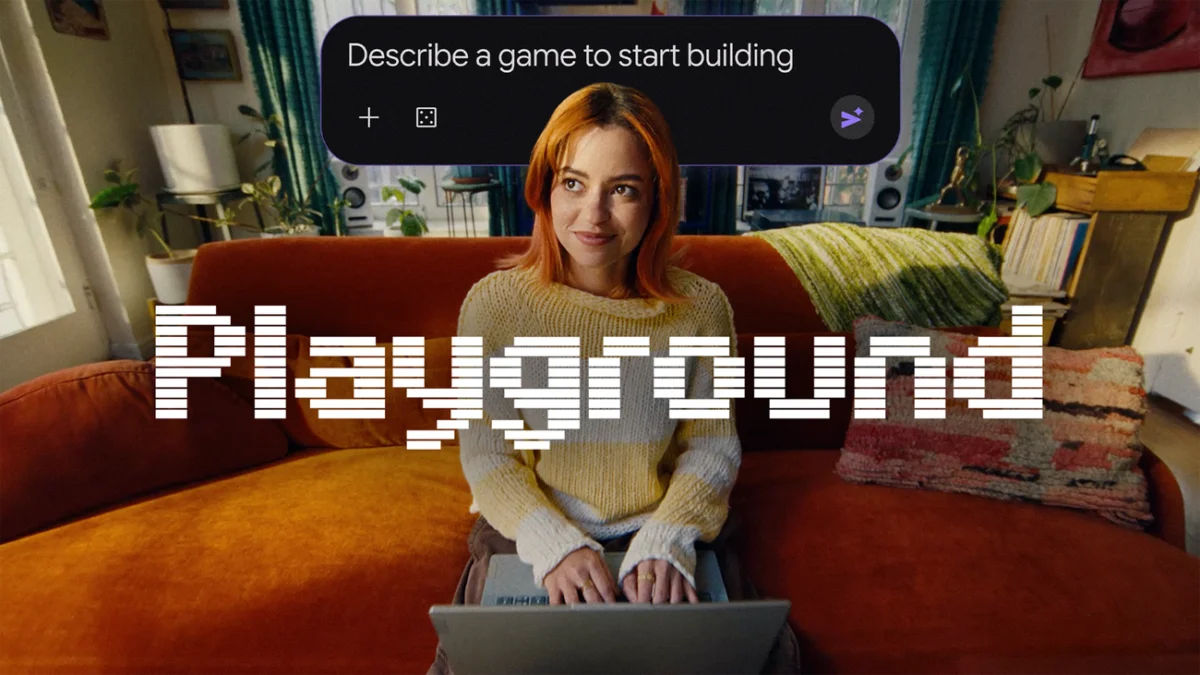
Google’s AI Innovation and Research division has officially unveiled Playground, an experimental gaming platform designed to democratize the process of game development through generative artificial intelligence. Announced by Maryam Karimzadehgan, a software engineer within the AI Innovation and Research team, the platform aims to eliminate the technical barriers that have historically restricted game creation to individuals with extensive coding knowledge and proficiency in complex engines like Unreal or Unity. By utilizing a conversational interface, Playground allows users to conceptualize, build, and iterate on interactive games using natural language prompts, signaling a significant shift in the landscape of user-generated content (UGC) within the multi-billion-dollar gaming industry.
The release of Playground arrives at a time when the global gaming population has surpassed 3.4 billion people, according to industry analysts at Newzoo. Despite this massive audience, the "creator" segment of the community has remained relatively small due to the steep learning curve associated with software development kits (SDKs) and programming languages such as C++ or C#. Google’s new initiative seeks to flip this dynamic, positioning game creation as a form of "creative expression" accessible to anyone with a web browser.
The Mechanics of AI-Driven Game Development
At the core of Playground is a sophisticated generative AI model capable of translating text-based instructions into functional game logic, physics, and assets. The platform’s interface operates as a "conversational engine," where users can start with a blank canvas or choose from a library of starter prompts. Unlike traditional development environments that require manual input of coordinates and logic gates, Playground users can simply type instructions such as "make the gravity lower," "add a scoring system based on time," or "change the character to a sloth."
This iterative process happens in real-time, allowing creators to test their games immediately after submitting a prompt. The platform handles the underlying complexities of physics engines and environmental rendering, which traditionally take months or years for novice developers to master. According to Karimzadehgan, the goal is to keep the user in "complete control of the creative direction," from the initial rough concept to the final, polished product. This "prompt-to-play" loop is designed to encourage experimentation, allowing users to overhaul environments or rewrite rules on the fly without the risk of "breaking" the codebase.
Social Integration and Browser-Based Accessibility
Recognizing that gaming is a fundamentally social activity, Google has integrated Playground with a robust set of community features. The platform is entirely browser-based, ensuring compatibility across desktop computers, laptops, and mobile devices without the need for high-end hardware or local installations. This accessibility is a strategic move to capture the mobile gaming market, which currently accounts for more than half of global gaming revenue.
Once a game is created, the user has several options for distribution. They can keep the project private for personal testing, generate a shareable link to challenge friends, or publish the game to the "Playground Explore" gallery. The gallery functions as a centralized hub where the broader community can discover, play, and rate games. To foster a competitive environment, Playground supports in-game leaderboards and multiplayer functionality in specific genres.
The integration with "Play Games" profiles allows users to claim custom handles, follow their favorite creators, and maintain a history of their liked games. This ecosystem mirrors successful platforms like Roblox or Fortnite Creative but focuses on the ease of AI generation rather than manual building blocks. To ensure the environment remains safe, Google has implemented a multi-layered screening process. Every published game undergoes safety checks aligned with the company’s community guidelines, and a user-reporting system is in place to flag inappropriate content.
The Strategic Partnership with Unity Spark
While Playground is currently positioned as an entry-level tool for casual creators, Google has announced a forthcoming integration with Unity Spark to bridge the gap between experimental AI projects and professional-grade development. Unity is currently the most widely used game engine in the world, powering millions of titles from indie hits to AAA mobile games.
The Unity Spark integration will allow Playground creators to export or expand their concepts using Unity’s professional-level mechanics and high-fidelity 3D capabilities. This partnership represents a significant evolution in the development pipeline. It suggests a future where a developer might "sketch" a game idea in Playground using AI prompts and then transition that project into Unity for fine-tuning, advanced rendering, and commercial deployment.
Unity Spark is currently in a testing phase, with a closed beta expected to launch soon. This collaboration highlights a growing trend in the tech industry: the marriage of generative AI with established professional software. By providing a path from a simple text prompt to the Unity runtime, Google and Unity are creating a pipeline that could significantly accelerate the "prototyping" phase of professional game development.
Timeline and Availability
Playground has officially launched today for users in the United States who are 18 years of age or older. Access to the platform is being rolled out in a tiered fashion, with priority and "creation access" levels determined by a user’s Google One membership. This strategy suggests that while playing games may be widely accessible, the computational resources required for AI-driven game generation will be managed through Google’s subscription ecosystem.
The launch follows several years of internal research within Google’s AI labs regarding the application of Large Language Models (LLMs) to creative media. It follows in the footsteps of previous experimental projects like Google’s "Game Builder" (2019), but with a much heavier emphasis on natural language processing rather than visual "block-based" coding.
Industry Implications and Market Analysis
The introduction of Playground is likely to have ripple effects across the gaming and AI industries. Market analysts suggest that the "democratization of creation" is the next frontier for tech giants. As AI becomes more proficient at generating code and assets, the value in the gaming market may shift from technical execution to "pure creativity" and "prompt engineering."
- The Creator Economy: By lowering the entry bar, Playground could exponentially increase the volume of games available online. This poses a challenge for discoverability but offers a massive opportunity for niche genres that are often ignored by major studios.
- Educational Applications: While presented as a gaming platform, the underlying technology has significant potential in STEM education. Playground can serve as a "gateway" tool, introducing students to the logic of game design and physics without the frustration of syntax errors.
- Competitive Landscape: Google is entering a space currently dominated by Roblox Corporation and Epic Games (Fortnite). However, by focusing on a browser-based, AI-first approach, Google is bypassing the need for a dedicated app store or high-performance console, potentially reaching a more casual, global audience.
- AI Safety and Ethics: The use of AI to generate interactive content raises questions about copyright and content moderation. Google’s reliance on safety screenings and community guidelines indicates a proactive approach, but the sheer volume of AI-generated content will test these systems’ scalability.
Official Reactions and Future Outlook
While external developers have yet to release formal statements, the internal sentiment at Google AI Research is one of cautious optimism. The platform is explicitly labeled as an "early experiment," acknowledging that the technology will continue to evolve based on user feedback. Maryam Karimzadehgan emphasized that Playground is designed to "ignite everyday creativity," suggesting that the platform’s success will be measured not just by the number of games created, but by the diversity of ideas brought to life.
As AI continues to permeate the creative arts—from text and images to music and video—interactive media like gaming represents the "final frontier" due to its requirement for real-time logic and user agency. Playground serves as a proof of concept that AI can handle the multi-dimensional requirements of game design.
For now, the platform remains a U.S.-only experiment, but the roadmap suggests a global ambition. With the upcoming Unity Spark integration and the continued refinement of Google’s generative models, Playground may very well mark the beginning of an era where "thinking it" is truly the only prerequisite for "playing it." Interested users can explore the current gallery of community-created titles, such as "Ube Rush" or "Sloth on the Clock," at playground.google, providing a glimpse into the early capabilities of this AI-driven creative revolution.
