


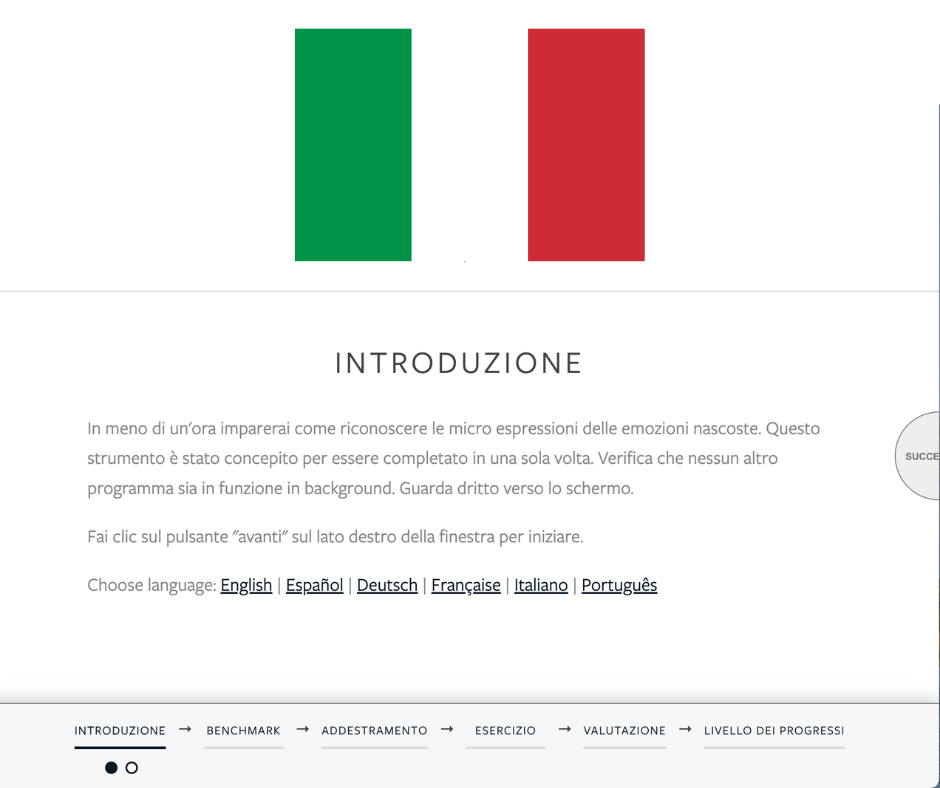
SAN FRANCISCO, CA – October 26, 2025 – The Paul Ekman Group, a leading authority in the science of emotions and microexpressions, announced today a significant expansion of its online training program, making its comprehensive suite of microexpression analysis tools fully accessible in Italian, French, and German. This strategic move aims to democratize access to crucial emotional intelligence skills for a broader international audience, reinforcing the organization’s commitment to fostering self-awareness and interpersonal understanding worldwide.
The newly translated modules encompass all seven core online training tools developed by the Paul Ekman Group. These tools, previously available primarily in English, Spanish, and Portuguese, are designed to equip individuals with the ability to recognize subtle, involuntary facial expressions that reveal a person’s true emotional state. The expansion directly addresses a growing global demand for accessible, science-based emotional intelligence education.
A Mission to Enhance Emotional Literacy
At its core, the Paul Ekman Group’s mission is to empower individuals with a deeper understanding of themselves and others through enhanced emotional awareness. Dr. Paul Ekman, a pioneer in the study of emotions and their expression, has dedicated decades to researching the universality of facial expressions across cultures. This latest initiative directly supports that foundational principle by removing language barriers that have historically limited access to his groundbreaking work.
"We are thrilled to announce the availability of our online microexpression training tools in Italian, French, and German," stated a representative for the Paul Ekman Group. "Our aim is to make the science of emotions, as pioneered by Dr. Ekman, more accessible than ever before. This expansion is a critical step in our ongoing effort to equip people across Europe and beyond with the vital skills of emotional recognition and understanding, regardless of their native language."
The translation effort involved meticulous attention to detail, ensuring that the nuances of emotional expression and the scientific terminology are accurately conveyed in each new language. Users will be prompted to select their preferred language at the beginning of each course, allowing for a seamless and immersive learning experience.
The Significance of Microexpression Training
Microexpressions are fleeting, involuntary facial movements that can betray genuine emotions, often before a person consciously processes or conceals them. These brief flashes, typically lasting between 1/25th and 1/2 second, are considered universal indicators of the seven basic emotions identified by Dr. Ekman: happiness, sadness, anger, fear, surprise, disgust, and contempt. Their significance lies in their ability to provide a window into a person’s authentic feelings, offering invaluable insights in a wide range of contexts.
For professionals in fields such as law enforcement, healthcare, education, and business leadership, the ability to accurately detect microexpressions can be transformative. It can lead to more effective communication, improved decision-making, enhanced empathy, and stronger interpersonal relationships. In personal life, understanding these subtle cues can foster deeper connections and more nuanced interactions.
The Paul Ekman Group’s training programs are built upon decades of rigorous scientific research, including extensive cross-cultural studies that have confirmed the universality of these facial expressions. The organization’s methodology emphasizes not only the identification of microexpressions but also their contextual interpretation, providing users with a holistic understanding of emotional communication.
A Chronology of Expansion and Accessibility
The journey towards making microexpression training globally accessible has been a gradual yet consistent one for the Paul Ekman Group. While the foundational research began in the mid-20th century, the development of digital training tools emerged more recently, aligning with the rise of online learning platforms.
- Mid-20th Century – Present: Dr. Paul Ekman conducts extensive research on emotions, facial expressions, and their universality across cultures. This forms the bedrock of the organization’s scientific approach.
- Early 2000s: The Paul Ekman Group begins developing and offering training programs, initially through in-person workshops and later transitioning to more scalable online formats.
- Mid-2010s: The organization establishes its comprehensive suite of online microexpression training tools, focusing on core modules covering the identification and understanding of these crucial facial cues.
- Late 2010s – Early 2020s: Recognizing the growing international demand, the Paul Ekman Group prioritizes the translation of its flagship training programs into key global languages. Spanish and Portuguese modules are developed and launched, significantly expanding the reach into Latin America and Portuguese-speaking communities.
- October 2025: The latest phase of expansion sees the full translation of all seven core online training tools into Italian, French, and German, marking a substantial enhancement of accessibility for European markets.
This phased approach reflects a strategic commitment to providing high-quality, scientifically validated training to a diverse global audience. The decision to add Italian, French, and German was likely driven by the significant number of speakers of these languages and their prominence in various professional and academic sectors.
Supporting Data and Global Impact
The Paul Ekman Group’s training tools have already found application in over 230 countries, underscoring the universal nature of emotions and the demand for skills in emotional intelligence. The addition of three major European languages is expected to further amplify this reach, potentially impacting millions of individuals in academic institutions, corporate environments, and public service sectors.
For instance, in Europe, the healthcare sector alone employs millions of professionals who could benefit from enhanced empathetic communication skills, particularly in patient care and mental health services. Similarly, educators in Italy, France, and Germany can leverage this training to better understand and support their students’ emotional well-being. Law enforcement agencies and security professionals in these countries will also gain a valuable tool for threat assessment and interpersonal communication.
The economic implications of improved emotional intelligence are also significant. Studies have consistently shown that companies with higher levels of emotional intelligence among their workforce experience increased productivity, better team cohesion, and reduced employee turnover. A 2023 report by the Global Emotional Intelligence Consortium estimated that the global market for emotional intelligence training was valued at over $1.5 billion, with significant growth projected in the coming years. The Paul Ekman Group’s expansion directly taps into this burgeoning market.
Official Responses and Future Outlook
While specific statements from government bodies or large organizations in Italy, France, or Germany were not immediately available, the proactive stance of the Paul Ekman Group suggests an anticipation of positive reception. Educational institutions and professional development organizations in these countries are likely to view these translated courses as valuable resources.
"We believe that understanding emotions is a fundamental human skill, and it should not be limited by language," the Paul Ekman Group representative added. "This initiative is more than just translation; it’s about empowering more individuals with the tools to navigate the complexities of human interaction with greater clarity and compassion."
The organization also indicated that this is not the end of their language expansion efforts. They are actively working on introducing more languages and encourage individuals to suggest languages they would like to see supported in the future by contacting their customer service department. This open feedback loop underscores their dedication to serving a truly global community.
Broader Impact and Implications
The availability of microexpression training in Italian, French, and German has several far-reaching implications:
- Enhanced Cross-Cultural Understanding: By providing training in native languages, the Paul Ekman Group facilitates deeper cross-cultural communication and understanding, crucial in an increasingly interconnected world.
- Democratization of Knowledge: This move makes advanced psychological and behavioral science accessible to a wider demographic, moving beyond those who are proficient in English.
- Professional Development: Professionals across various sectors in Italy, France, and Germany will have direct access to tools that can significantly enhance their effectiveness and interpersonal skills.
- Personal Growth: Individuals seeking to improve their self-awareness and relationships will find these resources more approachable and relevant to their daily lives.
The Paul Ekman Group’s commitment to scientific rigor, coupled with this strategic expansion of language accessibility, positions them as a key player in advancing global emotional literacy. As the world continues to navigate complex social and professional landscapes, the ability to understand and interpret human emotions accurately will remain an indispensable skill, and the Paul Ekman Group is ensuring that this vital knowledge is available to everyone, in their own language.
