

The concept of business storytelling has transcended buzzword status to become a foundational pillar of effective leadership and organizational success. Leaders adept at shaping information into compelling narratives are consistently observed to be those who successfully close deals, secure critical budgets, and guide their teams through complex periods of change. This proficiency in business storytelling does not necessitate opening every meeting with a personal anecdote, though such an approach can certainly be effective when applied thoughtfully. Instead, it involves framing business information as a coherent, engaging narrative rather than a mere recitation of facts, leveraging techniques proven to captivate audiences and inspire decisive action.
This article delves into seven illustrative presentation examples, offering a practical guide for seamlessly integrating storytelling principles into any business presentation, thereby elevating its impact and persuasive power.
The Rise of Narrative in Modern Business Communication
In an era characterized by information overload and shrinking attention spans, the ability to communicate with clarity, empathy, and memorability has become paramount. Business storytelling addresses this challenge by tapping into humanity’s innate predisposition for narratives. For millennia, stories have been the primary vehicle for transmitting knowledge, values, and experiences, fostering connection and understanding. Modern neuroscience supports this, indicating that stories activate multiple parts of the brain, including those associated with emotion and experience, making information more resonant and easier to recall than raw data or abstract concepts.
The strategic application of storytelling in a business context allows presenters to transcend transactional communication, forging deeper connections with their audience. It transforms presentations from passive data dumps into immersive experiences, where listeners become active participants in the journey of an idea, a problem, or a solution. This shift is crucial for fostering engagement, building trust, and ultimately, driving desired outcomes, whether that’s securing investment, motivating employees, or converting prospects into customers.
1. The Foundational Structure: The Universal Hero’s Journey
At the heart of compelling narrative lies a robust structure, and few are as universally recognized and psychologically potent as the Hero’s Journey. This archetypal narrative pattern, famously identified by mythologist Joseph Campbell, outlines a sequence of events: a hero is introduced in their ordinary world, called to adventure, faces trials and tribulations, receives aid from a mentor, overcomes a central challenge, and ultimately returns transformed.

Translating this ancient structure to a business presentation is profoundly effective. It mandates a clear beginning, middle, and end, creating a natural flow that guides the audience through the narrative arc. In a business context, the "hero" must encounter a discernible problem or challenge. This problem is the catalyst for the journey, establishing tension and creating a need for resolution. The "mentor" then emerges, providing the crucial tools, insights, or solutions necessary to navigate this challenge. The "happily ever after" is reimagined as a tangible vision of success, a "new bliss" that illustrates the positive future state once the solution is embraced.
Understanding who embodies the hero and who the mentor is critical for the successful deployment of this structure. Misidentification can lead to self-serving presentations that fail to resonate with the audience’s actual needs and aspirations.
2. Positioning Your Audience as the Hero
A common pitfall in business presentations is the presenter inadvertently casting themselves or their company as the hero. This often manifests in presentations that heavily emphasize the company’s illustrious history, impressive client roster, or numerous accolades. While intended to build credibility, this approach can inadvertently alienate the audience, who are primarily concerned with their own challenges and how those challenges can be overcome. Such presentations become a monologue about the presenter’s greatness rather than a dialogue about the audience’s needs.
The most impactful storytelling presentations, however, masterfully position the audience as the hero. This strategic pivot recognizes that the audience is the entity grappling with a problem, facing a dilemma, or seeking a better future. They are the ones who need guidance, tools, and a path forward. By centering the narrative on the audience’s struggles and aspirations, the presenter establishes an immediate sense of empathy and relevance. The audience feels seen and understood, making them more receptive to the proposed solutions. This audience-centric approach aligns with contemporary marketing and communication strategies that prioritize customer experience and problem-solving, moving away from purely product-centric narratives.
3. Embracing Your Role as the Guiding Mentor
Following logically from positioning the audience as the hero, the presenter’s most effective role becomes that of the mentor. Seasoned presentation storytellers consistently adopt this persona, eschewing personal glory in favor of empowering their audience. Their primary objective is not to impress but to equip, providing the necessary insights, strategies, or products that enable the audience to surmount their obstacles.
Consider the stark difference in approach when selling a meal kit delivery service. A "hero" presenter might boast: "We are the industry leader, boasting the freshest ingredients, the most innovative menus, and a track record of over a thousand five-star reviews." While factual, this message focuses entirely on the company’s achievements, neglecting the customer’s perspective. It fails to articulate how these attributes translate into a solution for a specific problem.

In contrast, a "mentor" presenter would frame the offering differently: "One of the profound challenges modern parents face is the constant tension between dedicating quality time to their children and preparing nourishing, homemade meals. Imagine if a partner could step in, halving your meal preparation time. Our meal kit delivery service does precisely that. By delivering fresh, pre-portioned ingredients directly to your home, we empower the average family to reclaim five precious hours each week. This means no more agonizing choice between kitchen duties and cherished moments with your children; you can now effortlessly achieve both."
This mentor-driven narrative shifts the focus from "what we are" to "what we solve." It acknowledges the audience’s pain points and positions the service as the vital aid in their personal journey toward a more balanced life. This approach fosters a deeper connection and trust, as the presenter is perceived as a helpful guide rather than a mere vendor.
4. Igniting Engagement with Contrast: The Presentation Sparkline® Framework
Engaging storytelling thrives on contrast, a dynamic interplay between opposing states that keeps an audience captivated. Linear narratives, which simply list events in sequence ("Sarah wakes up and goes to work and attends a meeting"), often fail to hold attention. The most compelling stories replace the monotonous "and" with the dramatic "but then," introducing unexpected turns and challenges. For instance: "Sarah wakes up and gets in her car to go to work. But then she has a flat tire. She catches a ride to the office for an important meeting, but then she realizes she’s in the wrong conference room." This contrast creates tension, curiosity, and a desire to know what happens next.
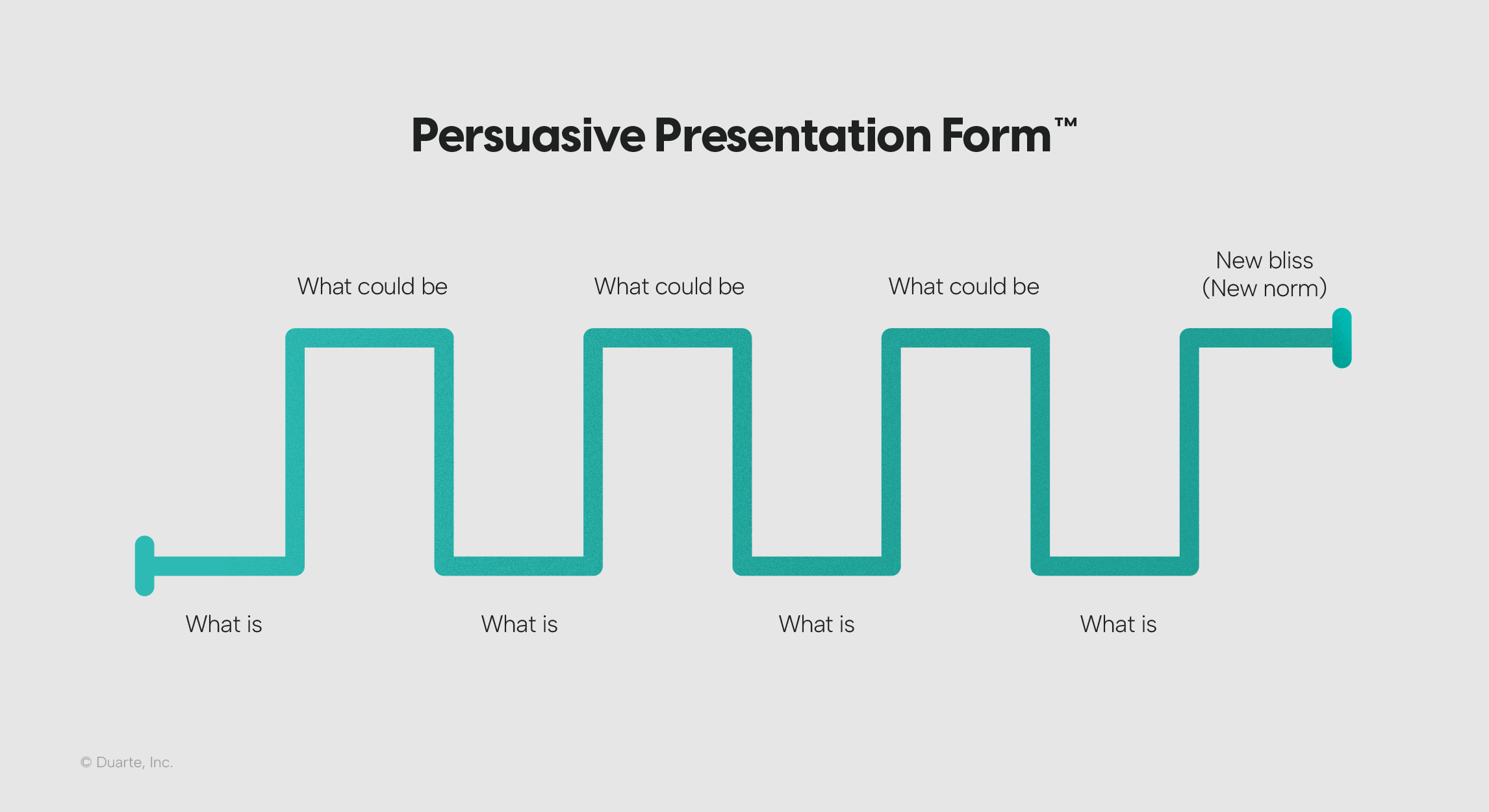
In business presentations, this principle is embodied by the Presentation Sparkline® framework, also known as the Persuasive Presentation Form®. Traditional business communication often falls into predictable patterns. A typical report might spend the majority of its time detailing "what is"—the current state of affairs, both positive and negative—before offering a single recommendation at the end for "what could be." This structure, while informative, can be tedious. Conversely, a standard pitch often opens with "what is" before dedicating most of its duration to an idealized vision of "what could be," often sounding too good to be true due to a lack of acknowledgment of current realities. Both approaches suffer from insufficient contrast, leading to disengaged audiences.
The Sparkline framework, popularized by communication expert Nancy Duarte, elegantly resolves this by continuously oscillating between "what is" and "what could be." It highlights the current reality, then contrasts it with the potential future, creating a rhythmic pattern that mirrors the ebb and flow of a compelling story. This constant shift maintains audience engagement by presenting problems and then immediately offering solutions, or by showcasing current limitations and then painting a picture of future possibilities. Duarte’s analysis of iconic speeches, such as Steve Jobs’ 2007 iPhone launch and Dr. Martin Luther King Jr.’s "I Have a Dream" speech, reveals their adherence to this very structure, demonstrating its power to move and persuade on a grand scale. This dynamic structure prevents monotony and keeps the audience actively invested in the journey towards the "new bliss."
5. Crafting Unforgettable Moments: S.T.A.R. Moments®
In a world saturated with information, true retention hinges on creating memorable experiences. A S.T.A.R. Moment® – "Something They’ll Always Remember" – is a technique designed to embed key messages deep within the audience’s memory, transcending the sheer volume of data. People struggle to recall lengthy lists of facts, but they vividly remember specific, impactful moments. These moments are often unexpected, visually striking, emotionally resonant, or physically engaging, making them stick in the mind long after the presentation concludes.

A powerful illustration of a S.T.A.R. Moment comes from Al Gore’s presentation of his climate change findings, which ultimately inspired the documentary An Inconvenient Truth. Faced with the challenge of communicating the alarming projected rise in CO2 concentration over the next half-century, Gore didn’t merely display a graph. Instead, he dramatically extended the data line off the chart, physically rising on a hydraulic lift alongside the projected numbers. This visceral, experiential moment transformed an abstract scientific projection into a tangible, alarming reality, imprinting the severity of the crisis onto the audience’s consciousness far more effectively than any spoken statistic could have. This technique leverages the power of sensory input and active participation to create a lasting impression, demonstrating that a well-crafted moment can convey more meaning than a multitude of words.
6. Infusing Meaning with Data Storytelling
One of the most significant challenges in business communication is transforming raw, often dry, data into a compelling narrative. Data, in isolation, lacks inherent meaning; it requires a presenter to provide context, interpretation, and emotional resonance. The art of data storytelling involves not just presenting numbers but weaving them into a narrative that explains their significance, highlights patterns, and evokes understanding. Presenters have several powerful options for achieving this: they can marvel at the magnitude of a data point, humanize the data by connecting it to individual experiences, or surprise the audience with unexpected insights.
An exemplary demonstration of surprising the audience with the unexpected comes from Steve Jobs’ 2008 reveal of the MacBook Air. Instead of simply stating the laptop’s incredibly thin dimension—the thickest part being a mere 0.76 inches—Jobs dramatically slid the device out of a standard manila office envelope. This simple, yet brilliant, visual immediately communicated the revolutionary slimness of the laptop in a way that words or abstract measurements never could. The manila envelope, a common object, served as an unexpected unit of measurement, shocking the audience with the device’s improbable thinness. This moment transformed a technical specification into an engaging, memorable revelation, perfectly illustrating the power of contextualizing data in a surprising and relatable manner.
7. Culminating in a Vision of "New Bliss"
Every effective story, including a business presentation, requires a compelling resolution. The ending is not merely a summary but a powerful vision of what the future could be – a concept we refer to as the "new bliss." This isn’t a fairytale ending but a concrete, attainable vision of a transformed reality, directly resulting from the solutions presented. It serves as the ultimate motivation for the audience, the hero, to embrace the path forward.
The "new bliss" ties together the entire narrative arc. Having identified the audience’s problem (the initial challenge), positioned the presenter as the mentor offering solutions (the tools), and navigated the complexities with contrast (the trials), the presentation must conclude with a clear, inspiring depiction of the positive outcome. This future state must be credible and directly linked to the proposed solutions. For example, if the presentation is about a new software solution, the "new bliss" might be a streamlined workflow that saves countless hours, reduces stress, and boosts productivity, allowing employees to focus on more strategic tasks. It’s the tangible benefit, the desired state that makes the journey worthwhile. By painting a vivid picture of this attainable "happily ever after," the presenter reinforces the value proposition and motivates the audience to take action, making the call to action feel like a natural progression of the narrative rather than an abrupt request.
The Broader Impact of Masterful Storytelling in Business
The mastery of storytelling presentation skills is not merely a desirable attribute; it is a strategic imperative for organizations striving to move work forward in today’s dynamic business landscape. From securing pivotal deals and aligning disparate teams to successfully implementing complex change initiatives, the underlying thread of success is often a well-crafted, well-delivered story. It is the judicious application of narrative that transforms abstract ideas into actionable insights, fostering buy-in and driving momentum.
Communication experts and industry leaders universally acknowledge that the ability to articulate a compelling corporate story profoundly impacts an organization’s bottom line, reputation, and internal culture. Companies that invest in developing these capabilities among their leadership and teams experience tangible benefits, including enhanced employee engagement, greater customer loyalty, and improved investor relations. The skills outlined—structuring narratives with the Hero’s Journey, empowering the audience as the hero, adopting the mentor’s role, leveraging the Sparkline for dynamic engagement, creating S.T.A.R. Moments, transforming data into narrative, and concluding with a vision of "new bliss"—collectively form a robust toolkit for any leader seeking to exert influence and inspire action.
Organizations recognize that this crucial skill set can be cultivated through various avenues. Some engage specialized agencies to collaboratively craft high-stakes presentations, ensuring every word and visual aligns with strategic objectives. Others opt for comprehensive team training programs, empowering their internal talent to independently develop and deliver impactful storytelling presentations. Many find that a blended approach, combining external expertise with internal skill development, yields the most sustainable and transformative results. Ultimately, fostering a culture where compelling narratives are valued and expertly wielded is key to unlocking an organization’s full potential, ensuring that every message resonates, every initiative gains traction, and every vision becomes a reality.
