

The verb haben serves as a cornerstone of the German language, functioning not only as a primary indicator of possession but also as the essential auxiliary verb for constructing the majority of past tense forms. In the hierarchy of German linguistics, haben is categorized alongside sein (to be) and werden (to become) as one of the three "helping" verbs that facilitate complex sentence structures. Its mastery is considered a prerequisite for achieving functional literacy in German, as it dictates the mechanics of the Perfekt (present perfect) tense, which is the standard mode of communication for describing past events in spoken discourse. Beyond its grammatical utility, haben is deeply embedded in the idiomatic fabric of the language, governing expressions of physical sensation and abstract states that differ significantly from English and Romance language counterparts.
The Historical and Morphological Evolution of Haben
Linguistic researchers trace the origins of haben back to the Proto-Germanic root *habjaną, which originally meant "to take" or "to grasp." This etymological heritage is shared with the English verb "to have." Over centuries of phonetic shifts, the German haben underwent a process of morphological erosion, particularly in its high-frequency present tense forms. This phenomenon explains why the verb is classified as irregular. In the second-person singular (du hast) and third-person singular (er/sie/es hat), the medial "b" found in the infinitive is omitted.
Philologists note that this contraction mirrors the development of the English "has," which evolved from the more cumbersome "haves." High-frequency verbs in most Indo-European languages tend toward simplification to facilitate rapid speech. In German, this specific irregularity serves as an initial hurdle for students, who frequently attempt to apply regular conjugation patterns (producing incorrect forms like "habst" or "habt") before internalizing the contracted standard.
Structural Breakdown: The Present Tense and Possession
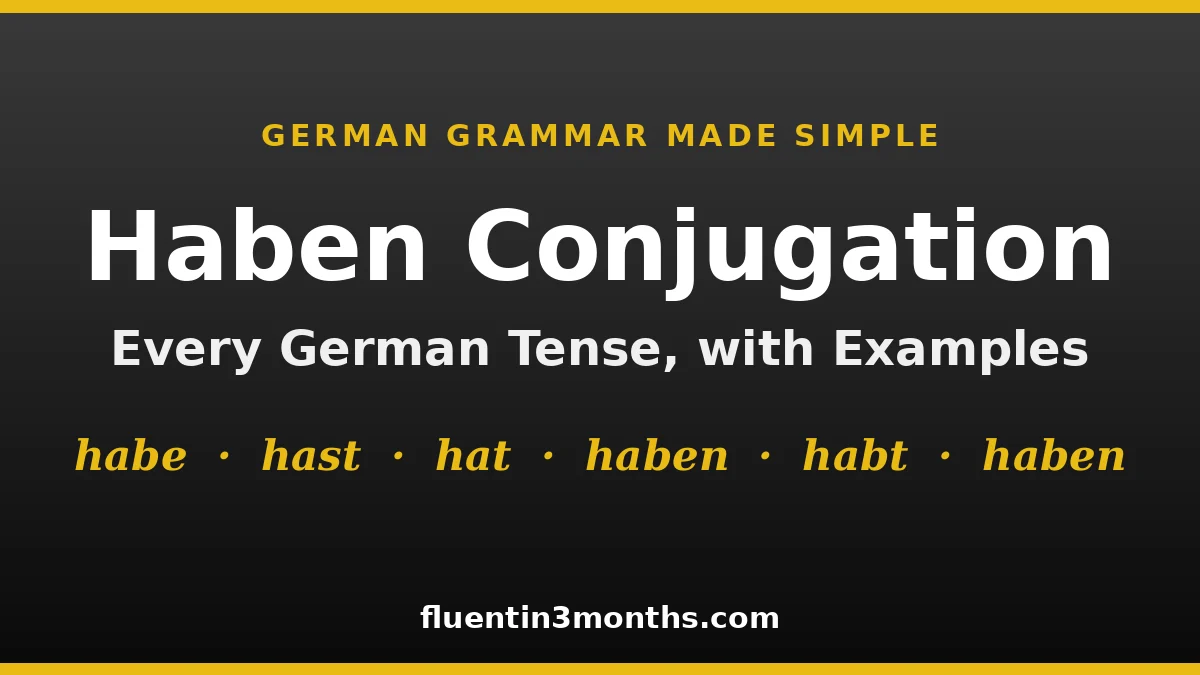
At its most fundamental level, haben indicates ownership or a relationship between a subject and an object. In the present tense (Präsens), the verb follows a specific pattern that must be memorized to ensure grammatical accuracy in basic syntax. The following data represents the standardized conjugation of haben in the present tense:
- First-person singular: ich habe (I have)
- Second-person singular (informal): du hast (you have)
- Third-person singular: er/sie/es hat (he/she/it has)
- First-person plural: wir haben (we have)
- Second-person plural (informal): ihr habt (you all have)
- Third-person/Formal plural: sie/Sie haben (they/you formal have)
In terms of syntax, haben requires the use of the accusative case (Akkusativ) for its direct object. This requirement has significant implications for German noun declension. For example, in the sentence "Ich habe einen Hund" (I have a dog), the masculine article "ein" must take the "-en" ending to reflect its role as the direct object. Failure to apply the accusative case in conjunction with haben is one of the most common errors identified by language evaluators in early-stage German acquisition.
The Role of Haben as a Temporal Auxiliary
The linguistic importance of haben expands exponentially when considering the Perfekt tense. In German, the Perfekt is formed by combining a conjugated auxiliary verb with a past participle (Partizip II). Statistical analysis of the German lexicon reveals that approximately 80% of all verbs utilize haben as their auxiliary. This includes all transitive verbs (verbs that take a direct object) and most intransitive verbs that do not involve a change of state or location.
The construction of the Perfekt with haben follows a rigid word order: the auxiliary verb occupies the second position in a standard declarative sentence, while the past participle is placed at the very end. For instance, in the sentence "Ich habe den Film gesehen" (I have seen the film), the verb haben provides the temporal framework, while "gesehen" provides the semantic content.
Linguists distinguish between the use of haben and sein in the past tense based on the nature of the action. While haben is the default, sein is reserved for verbs of motion (e.g., gehen, laufen) or verbs indicating a transition from one state to another (e.g., sterben, aufwachen). Understanding this binary system is crucial for achieving fluency, as using the wrong auxiliary can fundamentally alter the perceived competence of the speaker.
Narrative Past and the Präteritum
While the Perfekt is preferred in spoken German, the Präteritum (simple past) remains the standard for written narratives, journalism, and formal literature. Haben is one of the few verbs that is frequently used in the Präteritum even in spoken conversation, as the compound Perfekt form "habe gehabt" is often viewed as unnecessarily redundant.
The Präteritum forms of haben are:
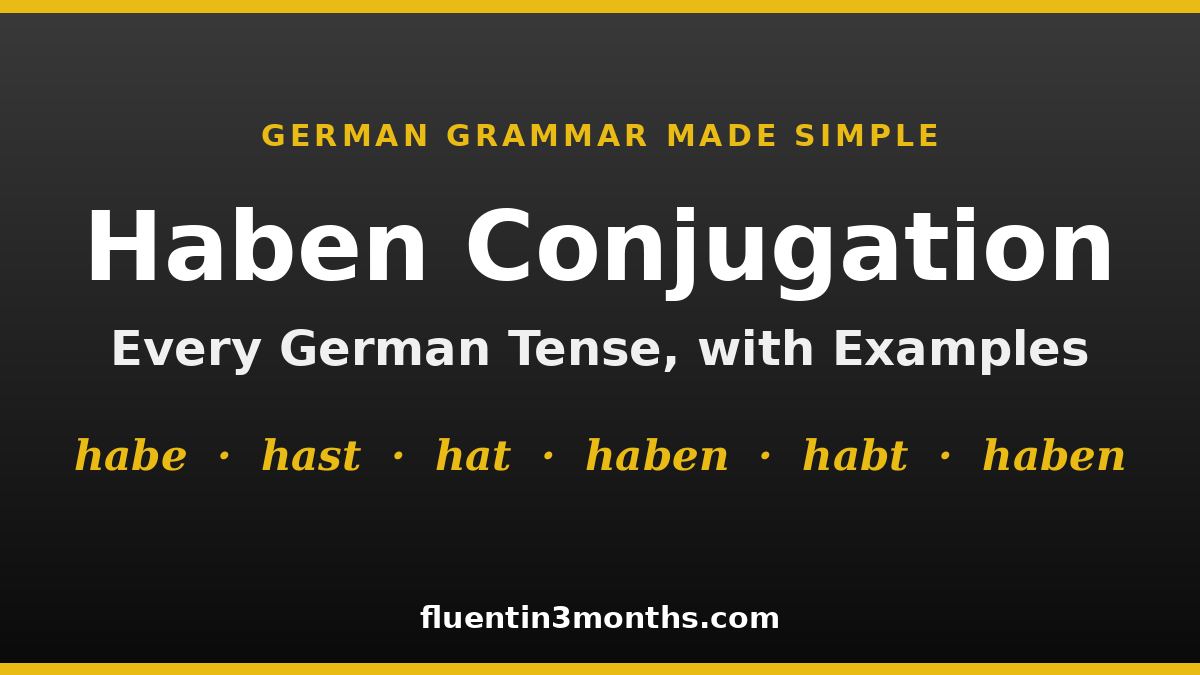
- ich hatte
- du hattest
- er/sie/es hatte
- wir hatten
- ihr hattet
- sie/Sie hatten
This tense is categorized as "mixed," meaning it combines elements of weak and strong verb patterns. It uses the dental suffix "-te" characteristic of regular verbs, but undergoes a stem change from "hab-" to "hat-". This distinction is a key focus in advanced German pedagogy, as it marks the transition from basic communication to stylistic sophistication.
Hypothetical States: The Konjunktiv II
In the realm of modal logic and hypothetical discourse, haben transforms into "hätte." The Konjunktiv II is the mood used to express wishes, polite requests, and conditions contrary to fact. In modern German society, the use of "ich hätte gern" (I would like) is the standard for polite interactions in service environments, such as restaurants or retail stores.
The conjugation of Konjunktiv II involves adding an umlaut to the Präteritum stem:
- ich hätte
- du hättest
- er/sie/es hätte
- wir hätten
- ihr hättet
- sie/Sie hätten
From a socio-linguistic perspective, the mastery of "hätte" allows speakers to navigate the nuances of German etiquette. It softens the directness of the language, transforming a demand into a request. Furthermore, it is the building block for the past subjunctive (Konjunktiv II der Vergangenheit), which allows speakers to discuss missed opportunities or alternative histories (e.g., "Ich hätte das getan," meaning "I would have done that").
Cross-Linguistic Interference and Idiomatic Usage
One of the most complex aspects of haben for non-native speakers is its role in idiomatic expressions where English would typically employ the verb "to be." Linguistic data suggests that English speakers often struggle with "conceptual transfer," mistakenly applying the English "I am" to German states of being.
In German, the following sensations are expressed using haben:
- Hunger: "Ich habe Hunger" (literally: I have hunger).
- Thirst: "Ich habe Durst."
- Fear: "Ich habe Angst."
- Luck/Success: "Ich habe Glück."
- Time: "Ich habe Zeit."
Conversely, German uses sein for age (e.g., "Ich bin zwanzig Jahre alt"), a point of contrast with Romance languages like French (avoir 20 ans) or Spanish (tener 20 años), which use their respective versions of "to have." This tripartite divergence—where English uses "be," Romance languages use "have," and German uses a mix depending on the context—is a primary subject of study in comparative linguistics.
Analysis of Common Errors and Pedagogical Implications
The Goethe-Institut and other language certification bodies identify several recurring errors regarding the use of haben among students. The most prevalent is the "auxiliary slip," where a learner uses haben for a verb of motion (e.g., ich habe gegangen instead of ich bin gegangen). While the error does not usually impede basic comprehension, it is a significant marker of non-native status.
Another frequent mistake involves the imperative mood. The command form of haben—"Hab keine Angst!" (Don’t be afraid!)—requires the speaker to drop the final "-e" in common speech, though "Habe" remains technically correct in formal writing. This distinction between "textbook German" and "living German" is a critical hurdle for learners aiming for near-native fluency.
Conclusion: The Strategic Importance of Haben
The verb haben is more than a simple vocabulary entry; it is a structural pillar that supports the entire grammatical architecture of the German language. From its irregular present tense forms to its critical role as an auxiliary in the Perfekt and its nuanced application in the Konjunktiv II, haben is involved in the majority of German sentences.
For the professional or academic learner, an exhaustive understanding of haben is non-negotiable. It provides the temporal tools necessary to discuss history, the modal tools necessary to discuss possibility, and the idiomatic tools necessary to express the human experience. As linguistic trends continue to favor the Perfekt over the Präteritum in spoken German, the reliance on haben as an auxiliary verb is likely to increase, further solidifying its status as the most versatile and indispensable verb in the German lexicon. Mastery of this single verb represents a significant milestone in the journey toward German proficiency, unlocking the ability to communicate across past, present, and hypothetical timelines with precision and cultural accuracy.
